
What happens when you hold past the close
Every trade you keep open past the daily close is rolled over to the next trading day. That rollover is where the extra costs and risks of overnight trading come from.
Here is what an overnight move looks like on a real chart before we name the parts.
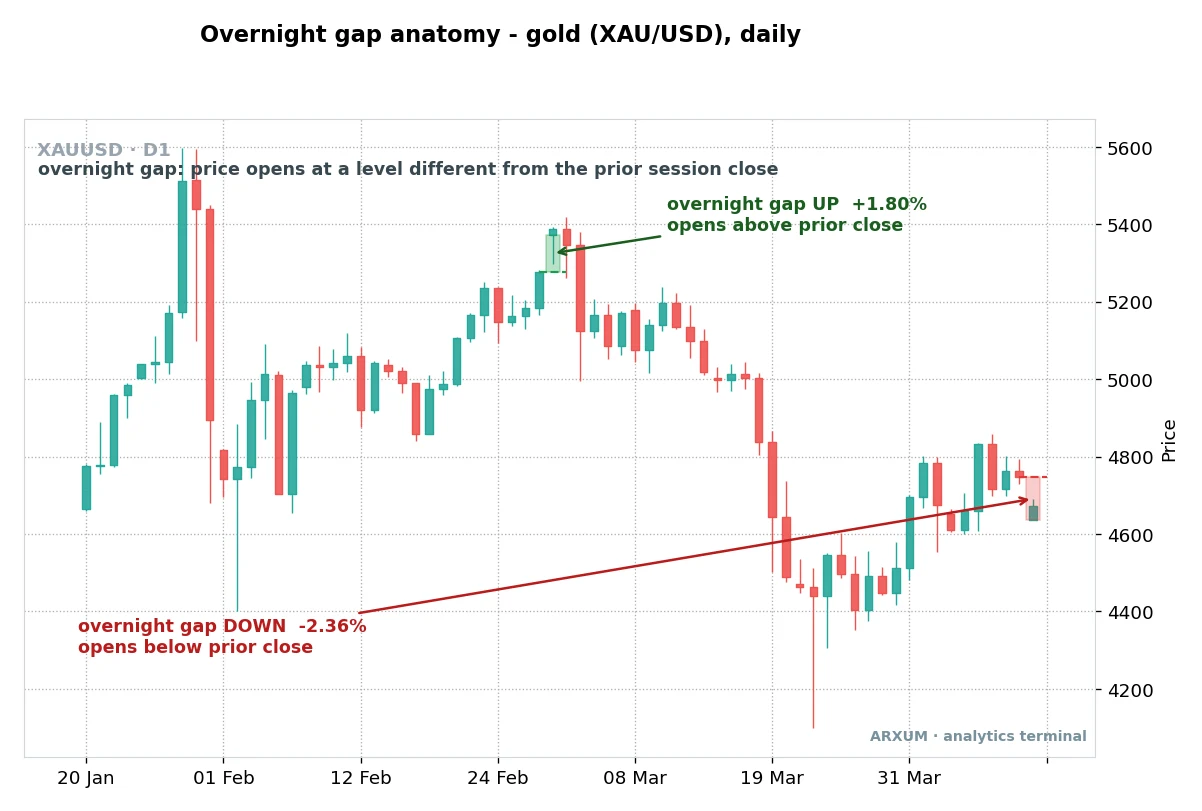
Each of those open-to-open jumps happened while the market was shut. That is the whole idea of overnight trading in one picture: the price you hold through the close is not guaranteed to be near the price you see at the next open.
Three separate things flip the moment your position crosses the daily close.
| What changes | Why it happens | What it means for you |
| Swap is charged | You are lent one currency to hold another past rollover | A small credit or debit hits the position each night |
| Gap risk appears | News can move price while the market is closed | The next open can be past your stop |
| Liquidity drops | The main desks in London and New York are offline | Spreads widen and hourly ranges shrink |
Take them one at a time. The rest of this guide is these three, in this order.
- The gap is a risk you size around, not one you can predict.
- The swap is a known, published number you can plan for.
- The thin session is a condition you trade differently, or skip.
The overnight gap: opening at a new price
An overnight gap is the empty space between one session’s close and the next session’s open. It is the most visible cost of holding overnight, and the anatomy chart above shows both directions on gold.
Gaps do not appear everywhere equally. They need a session break, so the market that closes longest gaps hardest.
| Market | When it gaps | Character |
| Forex majors | Weekend, at the Sunday or Monday open | Usually small, often fills |
| gold (XAU/USD) | Weekend or on a shock headline | Can run hard on a safe-haven bid |
| Stock indices | Nightly, and hardest on earnings | Frequent and news-driven |
| Bitcoin, crypto | Almost never; it trades nearly 24/7 | Watch CME futures gaps instead |
The single risk that makes overnight gaps different from any intraday move is worth stating plainly.
- A stop is not a guaranteed price over a gap. If price opens past your stop-loss, you exit at the next available price, which can be well beyond it.
- The damage is worst over the weekend. Two days of closed market means two days of news with nowhere to trade until Monday.
- Size is the defence. A gap against a small position is a dent; a gap against oversized leverage can wipe an account.
- Overnight gap trading is a setup in itself. Some traders hold specifically to catch a weekend gap or fade its fill, which the gap trading guide covers in full.
The takeaway is simple. A gap is not a bug in overnight trading, it is a feature of it, and the fix is smaller size, not avoiding the close.
The forex swap and rollover
The forex swap, also called rollover, is the interest cost or credit for holding a currency position past the daily rollover point. It is the mechanic behind holding forex positions overnight, and most beginners meet it as a mystery line on their statement.
The reason it exists is straightforward. Every forex trade is two currencies, one bought and one sold, and each currency carries its own central-bank interest rate.
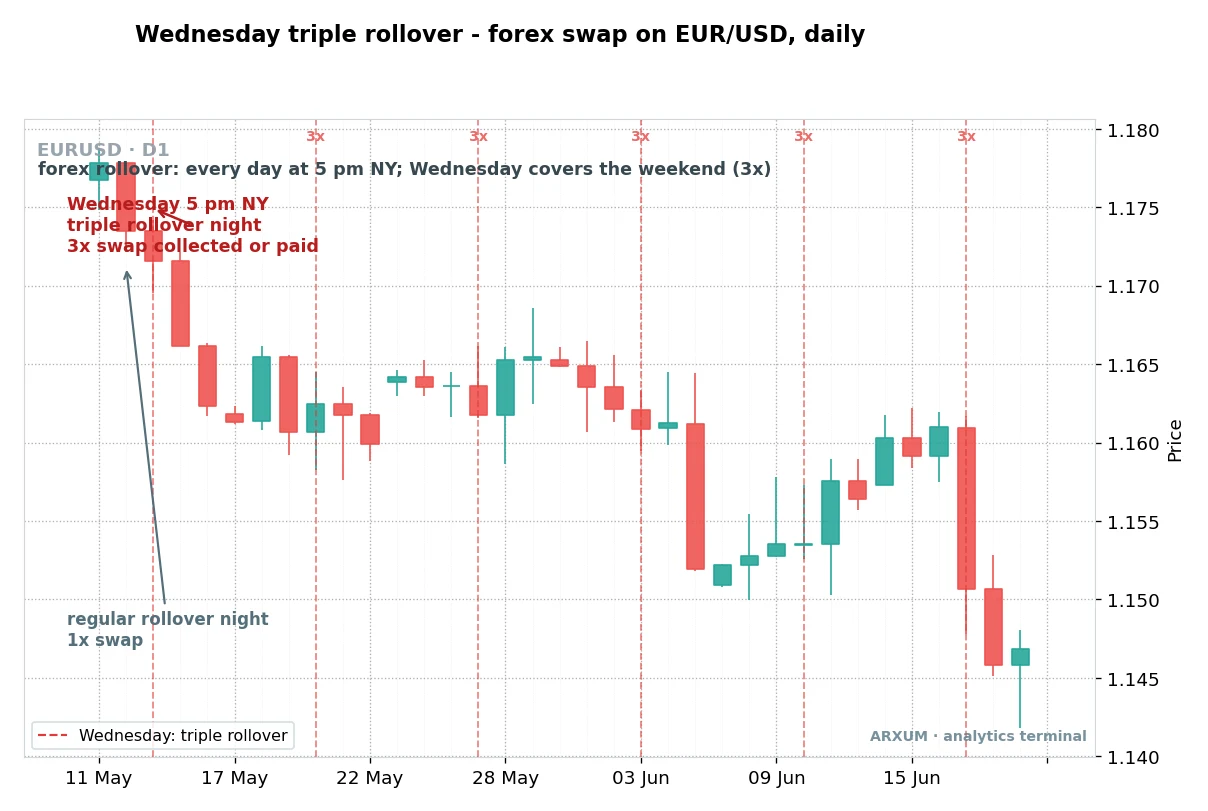
The dashed lines on that EUR/USD chart mark each Wednesday, the one night a week the charge triples. Every other rollover is a single charge, and we come back to why Wednesday is special below.
First, the direction of the swap. Whether you earn it or pay it depends on which currency you are holding and which you are effectively borrowing.
| Your position | Interest-rate read | Swap tends to be |
| Long the higher-yield currency | You hold the currency that pays more | Positive, a small credit |
| Long the lower-yield currency | You hold the currency that pays less | Negative, a small debit |
| Either direction, after markup | The broker adds its own spread | Often negative both ways in practice |
A few plain-language points make the table usable.
- The swap is set by the interest-rate differential, the gap between the two currencies’ central-bank rates. A wide gap means a bigger swap, in whichever direction you are holding.
- Earning a positive swap for holding the higher-yielding currency is the whole idea behind a carry trade, where the overnight credit, not the price move, is the point.
- In the real world the broker adds a markup, so the positive side is usually shaved thin and the negative side is padded. Assume you are paying to hold unless your own swap table says otherwise.
- The swap is charged per night, per lot. Bigger size and more nights both scale the cost up in a straight line.
The triple rollover on Wednesday
Rollover normally charges one night of interest. On Wednesday it charges three, and the marked candles on the chart above are those triple nights.
The reason is settlement, not a broker trick. Spot forex settles two business days after the trade, so a position open through Wednesday’s rollover has to account for the weekend that its settlement date lands on.
- Every day at 5 pm New York time, open positions roll to the next value date and the swap is applied. The exact clock is in the forex market hours guide.
- Wednesday is the triple night. Rolling past Wednesday’s close pushes the value date over the weekend, so three days of interest are charged at once, Friday, Saturday, and Sunday.
- Metals and indices can differ. Some brokers apply the triple charge to a different weekday for gold or index CFDs, so check your instrument, do not assume Wednesday for everything.
- A positive-swap position earns triple too. The Wednesday multiplier cuts both ways; if you are on the credit side, that night pays three times over.
Rollover forex without the swap
Traders who cannot or do not want to pay interest use a swap-free account, and this is where the “swap free forex” question comes from.
| Account type | Overnight charge | Who uses it |
| Standard | Swap credit or debit each night | Most retail traders |
| Swap-free (Islamic) | No interest; sometimes a flat admin fee | Traders observing Sharia, or long holders avoiding a wide negative swap |
- A swap-free account removes the interest line because charging interest conflicts with Islamic finance rules.
- Brokers often replace it with a flat administration fee once a position is held beyond a few days, so “swap-free” is not always “free”.
- For a short-term trader who rarely holds overnight, the account type barely matters. For a position trader holding for weeks, a wide negative swap can quietly outweigh the price move, so it is worth checking.
The overnight session: thin liquidity, wider spreads
Holding overnight also means your trade sits through the quiet hours, when the main London and New York desks are offline and only the Asian session is active. The market does not stop, it just thins out.
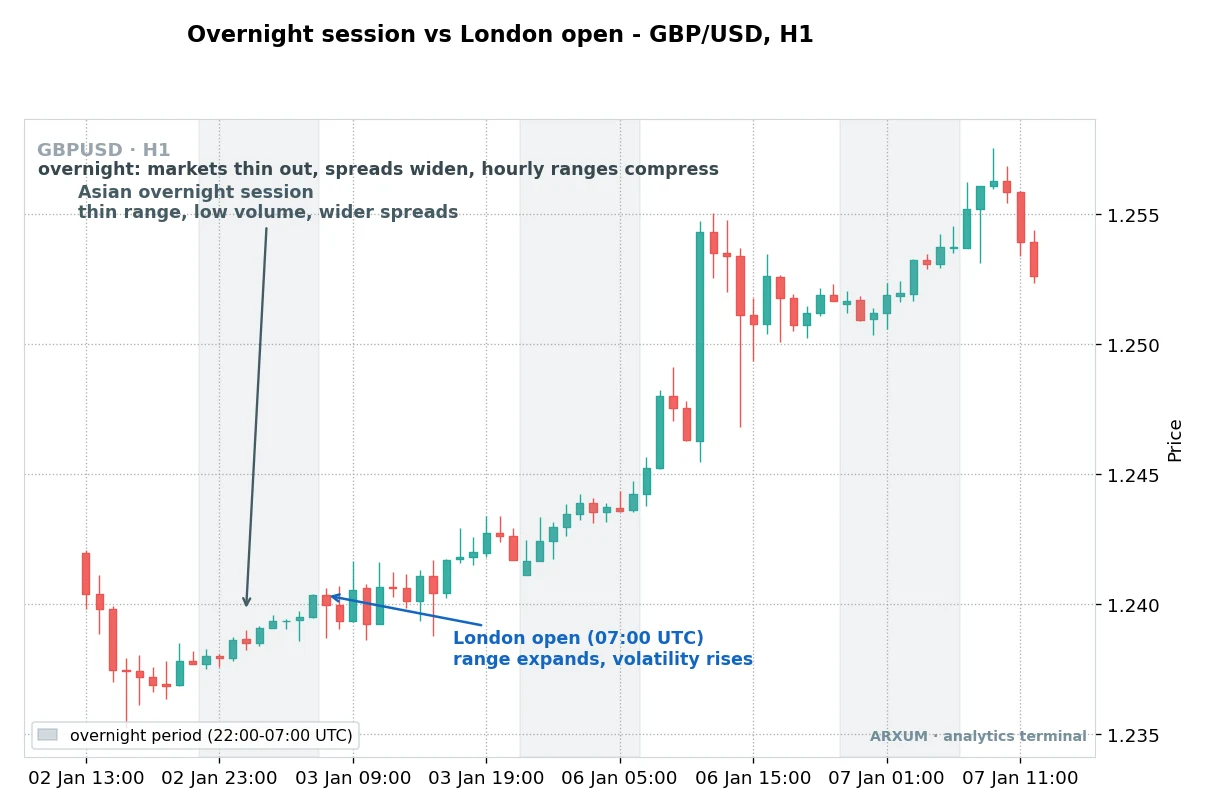
The shaded band on that GBP/USD chart is the overnight window. Notice the candles inside it are small and quiet, then the range opens up the moment London arrives.
What actually changes in those hours is easy to list.
- Volume drops. Fewer participants means fewer orders, so each trade moves price more than it would in a busy session.
- Spreads widen. With thin liquidity the gap between bid and ask stretches, which raises your cost to enter or exit. The forex spread guide explains that cost.
- Ranges compress. Hourly candles shrink, so an overnight breakout is more likely to be noise than a real move.
- Stops get hunted. Thin books make it cheaper for price to spike to an obvious stop level and snap back, so avoid parking stops right on round numbers.
Here is roughly how the clock behaves across the trading day, so you can see where the overnight window sits.
| Session (UTC) | Rough window | Liquidity and spreads |
| Asian / overnight | 22:00 to 07:00 | Thin, wider spreads, small ranges |
| London open | 07:00 to 08:00 | Liquidity floods in, ranges expand |
| London / New York overlap | 13:00 to 16:00 | Deepest liquidity, tightest spreads |
| New York close to Asia | 20:00 to 22:00 | Winding down into the quiet hours |
The practical read is that the overnight window is the worst time to open a fresh trade and a fine time to be holding one you already sized correctly. If you enter overnight, expect a wider spread and treat small moves with suspicion.
Stocks after-hours: the same idea, a longer break
Overnight trading in stocks has its own name, after-hours or extended-hours trading, and its own quirks because the equity market closes fully every night.
| Session (ET) | Rough window | Character |
| Pre-market | 04:00 to 09:30 | Thin, earnings and news reactions |
| Regular hours | 09:30 to 16:00 | Full liquidity, tightest spreads |
| After-hours | 16:00 to 20:00 | Thin, wide spreads, earnings gaps form here |
- Company results and guidance usually drop just after the close, so the after-hours session is where the earnings gap is born before most traders ever see it.
- Liquidity in extended hours is a fraction of the regular session, so spreads are wide and a small order can jolt the price.
- Index CFD traders meet the same gap the next morning, which is why an overnight equity position is a gap bet as much as a direction bet. The after-hours trading guide goes deeper on the mechanics.
When overnight trading makes sense, and when it does not
Overnight trading is not a yes-or-no choice, it is a fit question. Your style decides whether crossing the close helps you or just adds cost.
| Trader type | Holds overnight? | Why |
| Scalper | No | Trades last minutes; swap and gap add cost for no benefit |
| Day trader | Rarely | Flat by the close on purpose, to avoid gap risk |
| Swing trader | Yes | Holds days to weeks; the move needs time, so swap is a cost of doing business |
| Position / carry trader | Yes, deliberately | Wants the trend, or wants the positive swap itself |
The logic behind the table is short.
- If your edge plays out in minutes or hours, close before the session ends. You skip the swap, you dodge the gap, and thin liquidity never touches you. That is the whole point of an intraday plan, laid out in the day trading guide.
- If your edge needs days to weeks to work, you have to hold overnight, so you plan for the swap and size for the gap instead of fearing them. That is normal for a swing trading approach.
- If you are chasing the swap itself, the overnight credit is the trade, and price direction is secondary. That is the carry trade, and it lives or dies on the interest-rate gap staying in your favour.
Managing overnight risk
Holding past the close is fine as long as you treat the extra risks with the size dial, not hope. The rules are few and they are the same for everyone.
- Size down for the gap. Because price can leap your stop over a break, a sensible cap is to risk about 2% of the account on any one trade, so a bad gap is survivable.
- Know the swap before you hold. Open your platform’s symbol specification, read the swap for both directions, and decide if a multi-day hold is worth the running cost.
- Watch the economic calendar. Central-bank decisions, jobs data, and elections are the events that gap markets. Holding a big position straight into one is the classic avoidable mistake.
- Trim naked weekend size. If a Monday gap against a large position would hurt, cut it or hedge into Friday’s close. The stop-loss guide covers guaranteed stops, which some brokers offer for exactly this.
- Do not average into a losing overnight hold. Adding to a position that gapped against you is how a manageable loss becomes an account event.
A quick worked example keeps the swap cost concrete. It uses an illustrative number; your own broker’s table is the real one.
- The position: one standard lot of EUR/USD, held long, on a $1,000 account, which is already large for that account, so treat it as an illustration of the arithmetic, not a recommended size.
- The swap: suppose the specification shows about -$7 a night to hold that lot. That is the debit each rollover.
- A five-night hold: $7 a night over five nights is $7 x 5 = $35 in swap, before any price move.
- The Wednesday effect: if one of those five nights is a Wednesday, that single night is tripled, so it costs $7 x 3 = $21 on its own, pushing the five-night total nearer $49.
- The read: on a fast trade the swap is a rounding error; on a two-week hold it is a real line item you plan for.
The gap and the swap are separate costs, and they meet in one number that matters more than either, your reward against your risk.
Reward-to-risk written 1:X is the standard way to weigh a trade. The 1 is your risk, the entry-to-stop distance, and the X is how many times that risk the trade can pay.
The risk-reward ratio guide works it in full. It is the frame that keeps an overnight hold honest: if the swap and the gap risk eat the reward, the trade was never worth holding.
What works: the short version
Three ideas carry the whole topic.
- Overnight holding is a cost, not a flaw. You pay a swap and take a gap risk to give a slower trade the time it needs. Swing and position traders do it every day.
- Know your two overnight numbers. The swap on your platform’s table tells you the running cost; the size of a plausible gap tells you how small to trade. Check both before you hold.
- Match the hold to the style. If your edge finishes inside the session, close and skip all of this. If it needs days, plan for the swap and size for the gap instead of fearing them.
For the setups that specifically play the overnight break, the gap trading guide picks up where this one leaves off.
Glossary
- Overnight trading: holding a position past the daily market close, rolling it to the next trading day.
- Rollover: the daily process, at 5 pm New York time, of carrying open positions to the next value date.
- Forex swap: the interest credit or debit applied at rollover, based on the two currencies’ interest-rate gap.
- Interest-rate differential: the gap between the central-bank rates of the two currencies in a pair, which sets the swap.
- Triple swap: the tripled rollover charge on Wednesday, covering the weekend’s settlement.
- Swap-free account: an account that charges no interest at rollover, often replaced by a flat admin fee.
- Overnight gap: the jump between a session’s close and the next session’s open.
- Slippage: filling at a worse price than your stop when the market gaps through it.
- After-hours trading: trading stocks in the extended sessions before and after the regular market day.
- Carry trade: a position held mainly to earn the positive overnight swap rather than to catch a price move.
FAQ
What is overnight trading, in plain terms?
Overnight trading means keeping a position open past the daily market close instead of shutting it before the session ends. When the trade rolls to the next day, three things change. You are charged or credited a small interest amount called the swap, you take on gap risk because news can move price while the market is closed, and you sit through the quiet overnight hours when spreads are wider. Swing and position traders hold overnight all the time; day traders and scalpers usually close out to avoid it.
What is a forex swap?
A forex swap, also called rollover, is the interest you pay or earn for holding a currency position past the daily rollover point at 5 pm New York time. Every forex trade involves buying one currency and selling another, and each carries its own central-bank interest rate. If you hold the higher-yielding currency you tend to earn a small credit; if you hold the lower-yielding one you tend to pay a small debit. Brokers add a markup, so in practice the charge is often negative in both directions.
What is rollover in forex?
Rollover is the daily process of carrying your open positions from one trading day to the next. It happens at 5 pm New York time, and it is the moment the swap is applied. Because spot forex settles two business days after the trade, rolling a position over is really moving its settlement date forward one day, and the interest for that extra day is what shows up as the swap on your account.
Why is the swap charged three times on Wednesday?
Spot forex settles two business days after the trade date. A position rolled over on Wednesday has its settlement land on the weekend, so the broker charges three days of interest at once, for Friday, Saturday, and Sunday, in a single Wednesday rollover. That is why Wednesday is called the triple-swap night. If you are on the positive side of the swap, that night pays three times too. Some brokers apply the triple charge on a different weekday for metals or indices, so check your instrument.
What is a swap-free forex account?
A swap-free account, sometimes called an Islamic account, does not charge or pay interest at rollover, because charging interest conflicts with Islamic finance rules. Brokers usually replace the swap with a flat administration fee once a position is held beyond a few days. It is used by traders observing Sharia, and sometimes by long-term holders who want to avoid a wide negative swap, though the admin fee means swap-free is not always cost-free.
Is it safe to hold forex positions overnight?
It is safe if you size for the gap. The main added danger is that the market can reopen at a very different price and skip past your stop, which is worst over the weekend when the market is closed for two days. The way to handle it is to risk only a small fixed slice per trade, around 2% of the account, keep an eye on the economic calendar for events that gap markets, and avoid holding a large naked position into a central-bank decision or over the weekend.
What is an overnight gap?
An overnight gap is the empty space on a chart between one session's close and the next session's open, created when price moves while the market is shut. In forex the main one is the weekend gap at the Monday open. In stocks and index CFDs gaps appear most mornings, and hardest on earnings. Crypto barely gaps because it trades nearly around the clock. A gap matters because a stop-loss is not guaranteed at your price when the market opens straight through it.
How do you calculate the forex swap?
Your platform publishes the swap in the symbol specification, usually as a number of points per lot per night for long and for short. To estimate the cost, multiply that swap figure by your lot size, then by the number of nights you hold, remembering that Wednesday counts as three. Swaps change with interest rates and differ by broker, so the table in your own platform is the only accurate source; any figure in a guide is only an illustration.
Should day traders hold overnight?
Usually not. The point of day trading is to be flat by the close so you avoid the swap, the overnight gap, and the thin overnight session entirely. Holding overnight only makes sense when your strategy needs days or weeks to play out, which is swing or position trading, or when you are deliberately chasing the positive swap in a carry trade. If your edge finishes inside the session, close the trade and skip the overnight risks.
Do overnight spreads really get wider?
Yes. During the overnight window, roughly 22:00 to 07:00 UTC, the major London and New York desks are offline and only the quieter Asian session is trading. With fewer participants, liquidity drops, the gap between bid and ask widens, and hourly ranges compress. That makes the overnight hours a poor time to open a fresh trade and a reason to be suspicious of small overnight breakouts, which are more likely to be noise than a real move.
Real-time trade setups with entry, stop loss and take profit. Daily market analysis. No subscription, no complicated theory.
🌍 Our recommended brokers


Reader Reviews
Be the first to review this — tell other traders what actually helped, or where it fell short.
Leave a Review

Forex Analyst & Senior Trader
Former FX desk trader with 8 years in institutional forex. Works in multi-timeframe analysis and order flow, turning desk experience into systematic, testable rules across forex and metals.