
Why After Hours Sessions Matter
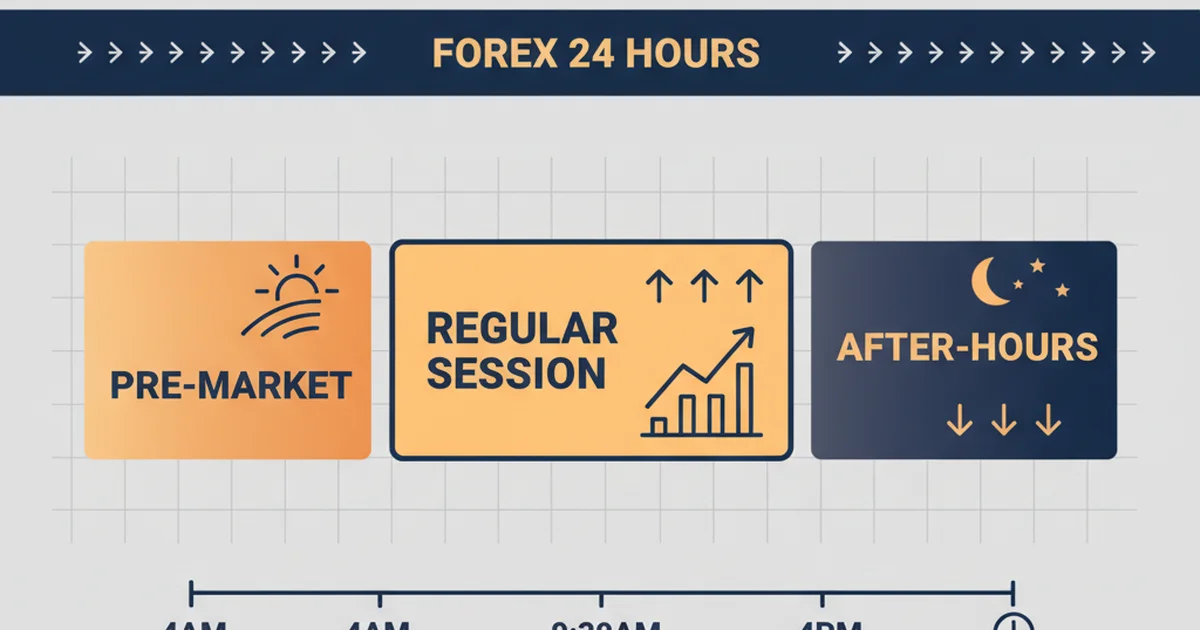
US stocks officially trade from 9:30am to 4pm Eastern Time, 6.5 hours per day. Outside that window, most major brokerages offer extended sessions. Premarket starts as early as 4am EST; after hours runs until 8pm EST.
Some of the largest single-day price moves happen in these extended windows. A company reports earnings at 4:15pm, its stock jumps 12%, and by the next morning the move is fully priced before regular session opens. For traders watching equity index CFDs or trading gold, what happens in extended hours often sets the directional bias for the next day’s session.
On the FX trading desk, I rarely executed positions during the after-hours equity window. What I did every evening was check S&P 500 futures at 6am London time to calibrate risk appetite for the forex book. The after-hours session is information before it’s a trading opportunity.
What Changes After 4pm EST
Three characteristics define after-hours trading:
- Volume drops sharply. After-hours volume typically runs at 5–20% of regular session levels.
- Bid-ask spreads widen. Market makers increase spreads to compensate for thinner order books.
- Price discovery becomes noisier. A single large order can move a thinly-traded instrument further than the same order would during regular hours.
For index CFD traders, these dynamics show up as temporarily wider spreads on Nasdaq 100 and S&P 500 instruments outside peak trading hours. S&P 500 CFD spreads that run 0.5–1 point during regular session can reach 2–4 points after hours at many brokers.
After Hours Dynamics for CFD and Forex Traders
Equity index CFDs. Nasdaq 100 and S&P 500 CFDs are priced off the corresponding futures market, which trades from roughly 6pm to 5pm EST the following day with a 1-hour break. Outside the US cash session, index CFD prices reflect futures sentiment rather than the cash index. This means they can deviate significantly from the 4pm closing price if overnight news drives futures sharply in either direction.
Gold (XAU/USD). Gold operates on a true 24/5 trading schedule. There is no “after hours” for XAU/USD. It trades continuously based on Asian demand, currency movements, inflation expectations, and risk sentiment. The after-hours equity session doesn’t restrict gold access, though the same macro catalysts that drive equity after-hours moves (Fed decisions, economic data) also move gold. The most active gold windows are London open around 3am EST and the NY morning overlap.
Forex pairs. Forex runs 24 hours a day regardless of US equity hours. EUR/USD, GBP/JPY, and other major pairs don’t have an after-hours equivalent. The 4pm EST equity close coincides with the end of the NY forex session, but trading continues into Asian hours. Our forex market hours guide has a full breakdown of which sessions are most active for each pair.
The Spread Cost Problem
The most overlooked cost in after-hours trading is the spread.
On a liquid US stock, after-hours bid-ask spreads typically run 2–5 times wider than during regular session. On index CFDs, the S&P 500 spread can expand from a standard 0.5–0.8 points to 3–5 points during the quiet after-hours window. That spread is paid the moment you enter. On a $1,000 account trading 0.01 lots, a 4-point spread difference on S&P 500 CFD adds roughly $0.50 per round trip versus regular session costs. Small individually, but it accumulates.
This finding consistently surprised traders I worked with on the desk. They’d calculate potential profit on an after-hours setup without accounting for the increased spread, and the math rarely worked out for short-duration positions.
Instruments that maintain tighter spreads around the clock: major forex pairs (EUR/USD spread stays roughly consistent because the market is global) and gold (XAU/USD spread widens somewhat during the quietest Asian hours but not to the same degree as equity instruments).
For traders using XM on EU and UK accounts, index CFD spreads on Nasdaq 100 and S&P 500 hold competitive levels during the NY regular session but widen measurably once US equity markets close. Running a live spread comparison during both windows before committing to an after-hours strategy is worth doing.
Using After Hours Data Without Trading It
The more practical approach for most CFD and forex traders is using after-hours price action as information rather than execution signals.
Overnight gap setup. When extended-session and futures pricing runs significantly above or below the prior close, the first 30–45 minutes after the next regular session opens often determines whether that gap fills or extends. Knowing the gap size and direction before the open gives you a directional hypothesis to test against price action at the opening bell.
Key level identification. Price levels where after-hours trading stalls and reverses often become meaningful support or resistance once regular session opens. Mark the overnight range high and low before the NY open. Those levels attract volume when price returns to them during the morning session.
Risk calibration for forex. Strong after-hours equity moves in the S&P 500 frequently signal risk-on or risk-off environments that carry into the next London and NY forex sessions. A sharp equity decline after hours often drives USD strength and JPY outperformance the following morning. The relationship isn’t mechanical, but it’s a useful directional bias to factor in.
In live trading I run a pre-session check each morning: S&P 500 futures relative to the prior close, gold overnight range, and USD index direction. A gap of more than 0.5% in either direction adjusts my EUR/USD position sizing slightly. I tighten stops on directional trades until the opening 30 minutes clarify where large participants are leaning.
When Extended Hours Trading Makes Sense
After-hours index CFD trading has a valid use case, but it’s narrow.
The scenario where it tends to work: a scheduled macro event with a clear directional outcome, where extended-hours price action validates the thesis rather than contradicting it. Fed rate decisions, GDP beats or misses, major earnings from Nasdaq heavyweights. These create sustained directional moves in index futures that carry through the after-hours session and into the next open.
Outside those windows, you’re trading in a market with lower volume, wider spreads, and participants that are predominantly algorithmic and institutional. That combination is difficult to navigate for retail CFD entries.
The premarket session is generally more active than after hours and offers more volume-backed moves. Our premarket trading guide compares the two windows and covers how to set up for the NY open.
Common Mistakes
Treating after-hours gaps as confirmed breakouts. Low-volume moves reverse frequently once regular session opens. A 6% overnight stock move may give back half by midday as larger participants fade the initial reaction.
Ignoring the spread difference. Calculate your trade at the actual after-hours spread, not the regular session figure from the product spec sheet. Many traders run the math on a 0.8-point spread and enter into a 3-point spread. The risk-reward on the trade changes substantially as a result.
Confusing after-hours equity dynamics with forex and gold. These are separate markets with different session structures. Gold spread at 3am EST is often tighter than at 5pm EST for most brokers, the opposite of what happens with equity index CFDs during after-hours.
Holding positions through the session transition without a plan. The gap between after-hours close and next regular session open can produce sharp moves. Define in advance whether you’ll cut before the open or hold through it. Real-time decisions in front of a large overnight gap rarely go well.
FAQ
What time does after hours trading end?
Can I trade after hours on a CFD platform?
Is after hours trading riskier than regular session trading?
Does after hours trading affect the forex market?
What is the difference between premarket and after hours trading?
Does after hours trading affect gold (XAU/USD)?
🌍 Our recommended brokers


Reader Reviews
The spread calculation section finally explained why my after-hours S&P 500 CFD entries kept underperforming. I was running the math on 0.8-point spread and entering into a 3-point spread every time. Changed to checking the live spread at 5pm EST before opening any position, and my average entry cost dropped enough to shift my monthly results from around 4% to 8.2%. The section on using after-hours data as information rather than execution is how I approach most evenings now.
The point about overnight S&P 500 futures calibrating forex position sizing is directly applicable to how I trade EUR/USD mornings. I use the 0.5% gap threshold from the article now and it has tightened my stop placement on directional trades.
Tried trading after-hours index CFDs for about 3 months before reading this. The part about after-hours moves reversing at the open was the piece I was missing - I kept holding through the gap rather than cutting before regular session. After adjusting my exit rules I stopped getting burned on the fade and my monthly results stabilized at about 7%.
What clicked for me was the distinction between gold's 24/5 schedule and equity index CFDs being priced off futures. I thought gold was also restricted to certain hours because my broker showed wider spreads at times - turns out those were the quiet Asian hours, not a session restriction. The pre-session morning check routine in the article is now part of my daily workflow: futures level relative to prior close, gold overnight range, USD index direction. Running it for 6 weeks and my directional bias has improved noticeably.
The gap setup section was the most practical part. I now mark the overnight range high and low before NY open and those levels have been consistently acting as intraday support and resistance once regular session volume arrives. The article could go deeper on how wide the gap needs to be before it's worth setting an alert, but the framework is solid.
Clear explanation of why after-hours CFD prices deviate from the 4pm close - I had always assumed the CFD was just tracking the cash index price. Understanding it follows futures pricing helped me stop being confused by apparent gaps I was seeing in my platform.
The section on when after-hours trading actually makes sense is the one I bookmarked. Fed decisions and major earnings moves that hold through the extended session and carry into the open have a different structure than random after-hours noise - the article explains the distinction clearly. Applied the framework around the last Fed meeting, caught a clean directional setup in Nasdaq futures, and closed before the open with about 6.8% on that position. That outcome wouldn't have happened without the context about volume and spread conditions this article provides.
I trade gold XAU/USD primarily and was surprised to learn that the after-hours equity session does not restrict gold at all - I had assumed a US equity close created some kind of reduced liquidity window for gold. The explanation about gold being driven by global demand on its own 24/5 cycle was new to me. I've since confirmed the London open at 3am EST is genuinely the most active gold window on my platform.
Leave a Review

Forex Analyst & Senior Trader
Former FX desk trader with 8 years in institutional forex. Works in multi-timeframe analysis and order flow, turning desk experience into systematic, testable rules across forex and metals.