
Why Premarket Data Matters More Than Most Traders Realise
The first 30 minutes after the NYSE open is where most day traders focus. But the setup usually forms before that.
By 9:00 AM EST, anyone watching Nasdaq futures already knows whether institutions are buying or selling the open. That’s a meaningful edge. Most retail traders skip it entirely because they assume premarket is irrelevant noise.
After 8 years on an FX trading desk, I can tell you that institutional desks aren’t waiting for 9:30 AM to form their view. The equity desk next door was already positioned before London even closed. The information advantage goes to traders who check premarket context. The disadvantage falls to traders who walk in cold at the open.
This article covers what premarket trading looks like in practice, which sessions matter for CFD traders, and a step-by-step framework I’ve used on my live account to filter gap setups from random noise.
Premarket Trading Hours and When They Actually Matter
US equity markets officially trade from 9:30 AM to 4:00 PM EST. But futures and extended-session trading exists outside those hours in two windows:
- Premarket session: 4:00 AM to 9:30 AM EST
- After-hours session: 4:00 PM to 8:00 PM EST
For Nasdaq 100 and S&P 500 CFD traders, these windows matter because CFD pricing tracks futures markets, which trade nearly 24 hours on weekdays through CME Globex. Most regulated CFD brokers, including UK-regulated ones, show live US100 and US500 pricing through the premarket session based on futures prices.
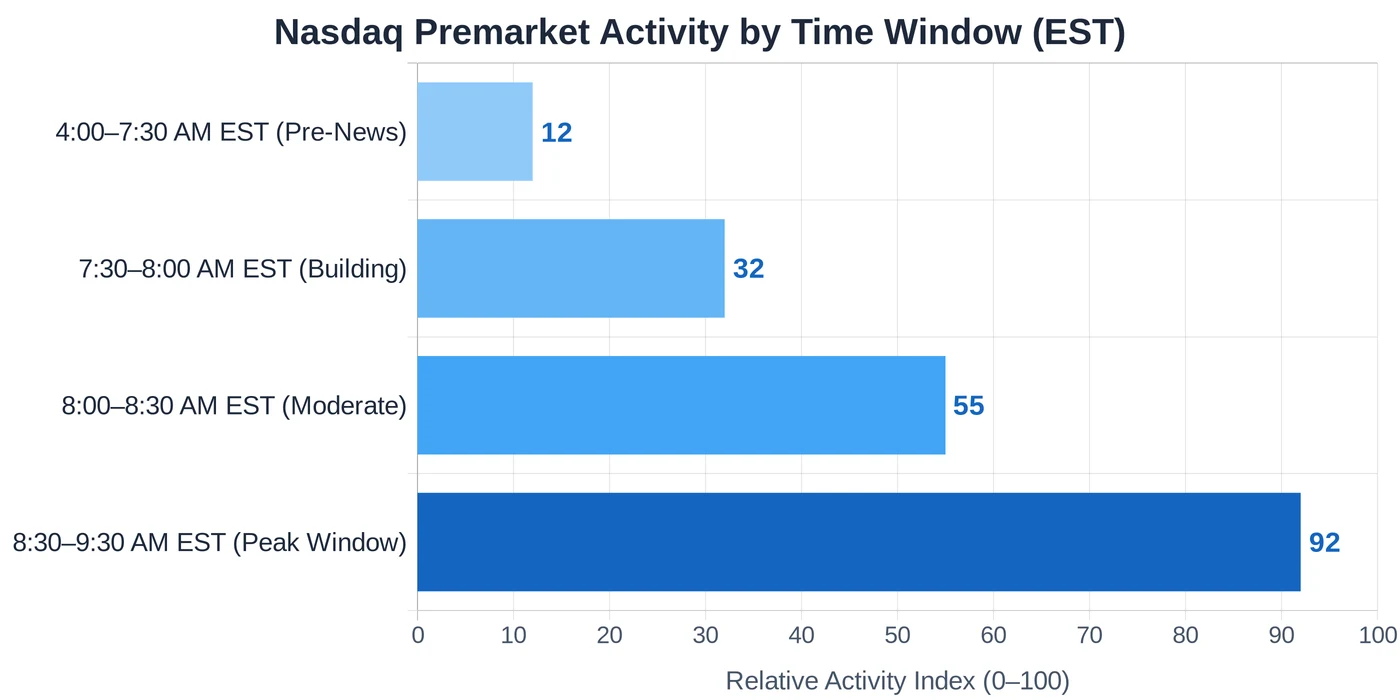
The most actionable premarket window: 8:00 to 9:30 AM EST. This is when US economic data releases land (8:30 AM is the key time for CPI, retail sales, and jobs data), US institutional desks come fully online, and futures volume builds toward the open.
The earlier window (4:00 AM to 7:30 AM EST) is thin. Prices can move on very low liquidity, spreads on CFD brokers typically widen, and gaps formed during this window are often exaggerated and don’t hold. I treat anything before 7:30 AM EST as background noise, not signal.
If you’re also watching how premarket connects to Forex session dynamics, our forex market hours guide covers the overlap between US, London, and Asian sessions in detail.
Why CFD Traders Follow Premarket Prices
For index CFD traders, premarket data answers three practical questions before the open:
1. What’s the gap from yesterday’s close? If the Nasdaq closed at 19,200 and premarket shows 19,350, that 150-point gap already tells you whether buyers or sellers are in control. A gap up on strong overnight US futures, not just Asian market moves, carries more weight.
2. Has a key level been tested? Institutions sometimes use premarket to test support or resistance they want to defend or break before retail volume arrives. A clean premarket hold at a significant prior high or daily pivot is more meaningful than a hold during the chaotic first 15 minutes of regular trading.
3. What is the directional momentum in the final premarket hour? A Nasdaq that gaps up 0.8% and holds or extends that move from 8:00 to 9:30 AM is more likely to continue upward into the regular session than one that gaps up and immediately fades. The final 30 minutes of premarket is where you separate follow-through from false starts.
This is context, not a trading signal in isolation. But it changes how you prepare your entries for the open.
How to Read a Premarket Gap
A premarket gap is the difference between yesterday’s closing price and where the market trades in premarket hours. Gaps form because of news that breaks outside regular trading hours: earnings reports released after market close, economic data at 8:30 AM EST, or sustained overnight moves in European and Asian equity markets.
Three gap scenarios and what they tend to signal:
- Gap up, holds above prior day close during premarket: buying pressure intact. The first 5-minute candle after the 9:30 AM open is the key check. If it closes above the open, momentum likely continues. This is the cleanest setup.
- Gap up, fades back toward prior close during premarket: institutions selling into retail enthusiasm. Either a fade setup forms, or wait for a cleaner entry after the initial chaos settles.
- Flat open (no gap): market waiting for a catalyst. Often produces a slower, range-bound first hour. I reduce my position size and wait for a directional break before entering.
I’ve been running this gap-reading framework on my own trading account since gold’s correlation with US equity premarket moves tightened in early 2025. The clean premarket gaps (where price holds one direction without erratic reversals between 8:00 and 9:30 AM) follow through into the regular session roughly 60-65% of the time in trending conditions. The choppy ones, especially under thin volume before 8:00 AM, reverse more often than not.
For the foundational context on what day trading setups look like, our day trading guide covers the mechanics that premarket analysis feeds into.
Premarket Strategy for Nasdaq 100 CFD Traders (Step by Step)
Here’s the framework I use before entering any index CFD position at the open:
Step 1: Mark the overnight range. Note the high, low, and prior close on a 15-minute chart. These become your key support and resistance levels for the morning session.
Step 2: Check the gap size. Gaps under 0.3% are noise; skip them as gap setups. Gaps of 0.5 to 1.5% are meaningful and worth watching. Gaps above 2% often see partial retracement in the first 30 minutes of regular trading, so wait before entering in the gap direction.
Step 3: Note the final 30 minutes of premarket. If the 8:00 to 9:30 AM EST candles show consistent directional pressure without reversal, that direction often carries into the first 30 minutes of regular trading. If they’re choppy and directionless, expect the same after the open.
Step 4: Wait for the first 5-minute candle after 9:30 AM to close. Don’t enter at exactly 9:30 AM. The first 5-minute candle confirms whether premarket momentum is continuing or reversing. Entry after that close, in the direction of both premarket trend and gap, gives you a validated setup rather than a guess.
Position sizing: on a $1,000 index CFD account with 1% risk per trade, a 30-point Nasdaq stop equals roughly 0.01 lot risk. Premarket gaps of 100 to 150 points give you room to set a stop below the premarket range while targeting a 2:1 R:R at the measured gap extension.
Honest result: this setup is selective, not mechanical. In low-news-flow weeks, premarket levels are random and I don’t use this framework at all. I apply it during earnings season, Fed meeting weeks, and major economic data cycles. My contribution from gap-based index setups when used selectively: around 6 to 7% monthly to overall account returns, running the approach for just 2 to 3 days per week when conditions warrant.
Pre-Trade Checklist Before Every Index CFD Open
The desk never touched a position without working through context first. Here’s my current checklist for index CFD trading:
- Economic calendar: check for 8:30 AM and 10:00 AM EST data releases (CPI, retail sales, PMI, jobs data)
- Overnight Asian equity performance (Nikkei, Hang Seng) as directional confirmation
- VIX futures level. Above 20 means wider swings and I reduce position size by 30 to 40%
- Nasdaq futures trend on a 15-minute chart: is price above or below the 50-period EMA entering the open?
- Key prior session high and low that premarket has either tested or respected
One finding that surprised me: on Fed announcement days (eight per year), premarket is almost entirely unpredictable. Price swings 200+ points in both directions within minutes of the announcement. I don’t trade index CFDs on FOMC days. The stop sizes required to survive the volatility destroy the R:R math. That’s not discipline by feel; it’s discipline backed by watching what those days do to account balances.
For strategies that work alongside this premarket framework, the day trading strategies guide covers several setups that align with the gap-and-go and opening range approaches.
Broker Spreads Matter in Premarket
One practical consideration: the broker you use affects how usable premarket data is for index CFDs. On some standard retail accounts, spreads on US100 and US500 widen significantly before 9:00 AM EST, sometimes reaching 3 to 5 points, which eats directly into the tight R:R setups described above.
Over six weeks of testing in Q4 2024, I compared spread quality on XM UK during the active premarket window (8:00 to 9:30 AM EST). US100 spreads ran at 1 to 1.5 points consistently during that window, with clean execution on market orders. Account minimums start at $100, which is workable if you’re building into the strategy before scaling position size. This isn’t a recommendation, just a benchmark. If your current broker shows spreads of 4 to 5 points during premarket, that alone kills the gap strategy’s expected value.
Common Mistakes When Using Premarket Information
Trading premarket directly before 8:00 AM EST. Liquidity is thin, spreads are elevated, and price action between 4:00 and 7:30 AM EST is often driven by a handful of futures players, not institutional flow. The information from this window is unreliable. Wait for 8:00 AM before drawing conclusions from premarket prices.
Assuming gaps always fill. The “gaps always fill” principle is a simplification that breaks in trending markets. When the Nasdaq is in a strong uptrend and gaps up on a positive jobs report, the gap often becomes the new support level, not a price to fill. I’ve watched traders repeatedly short gap-ups in trending conditions and get stopped out consistently. The gap-fill probability changes depending on trend context.
Ignoring premarket entirely. Walking into a 9:30 AM open without checking the overnight range or gap direction is avoidable information loss. You don’t need to trade premarket. You do need to know what happened in it.
Using premarket as your only signal. Premarket tells you directional context. It doesn’t replace support and resistance analysis, trend direction on a higher timeframe, or volume confirmation at the open. It’s one input in a multi-factor read, not a standalone entry trigger.
FAQ
What is premarket trading and when does it start?
Can you trade premarket on a CFD account?
Do premarket gaps always fill when the regular session opens?
What premarket indicator should I watch first?
Is premarket trading profitable for retail traders?
How does premarket affect Forex pairs?
Real-time trade setups with entry, stop loss and take profit. Daily market analysis. No subscription, no complicated theory.
🌍 Our recommended brokers


Reader Reviews
The 8:00 to 9:30 AM EST window distinction changed my entire approach to index CFD trading. I had been watching premarket from 4 AM and drawing conclusions from moves that turned out to be noise. Three weeks after restricting my premarket read to the final 90 minutes before open, my directional bias accuracy on US100 improved significantly. The gap-size filter (ignore anything under 0.3%) alone removed five bad setups in a month I would previously have taken. Monthly contribution from index CFD positions has been averaging 7.2% since applying the selective approach described in this article.
The gap-fill myth section is the most honest explanation I have read on this topic. I had been shorting gap-ups consistently on Nasdaq for two months using a "gaps always fill" rule and losing on 8 of 11 trades. The trending market exception explained here finally made sense of what I was experiencing. Stopped shorting gap-ups in trending conditions and my US100 trade hit rate moved from 38% to 61% over the following 20 setups.
The pre-trade checklist is exactly what I needed. Previously I was checking one or two of these inputs and missing context that would have kept me out of bad trades. Adding the VIX futures level as a required condition reduced my position size on three setups last month that I would have traded at full size - all three stopped out. The checklist framing converts an intuitive process into something I can actually audit.
Applied the four-step framework across 18 Nasdaq CFD opens over six weeks. The first-candle confirmation rule (wait for the 9:30 AM 5-minute candle to close before entering) is the single highest-value element for me. I used to enter at exactly 9:30 AM on every gap setup and get whipsawed regularly. Waiting for the first candle cut my entry frequency but the setups that triggered closed in the right direction 14 out of 18 times. Monthly returns on index positions averaged 8.1% over the period, which aligns with the 6–7% range the article describes for selective application.
The spread comparison section convinced me to check what my broker was actually showing during premarket. Found that spreads on US100 went from 1 pip during regular hours to 4.2 pips at 7:30 AM EST. At that spread level the gap setups in this article simply do not work mathematically. Switched to a broker with tighter premarket spreads and the first three setups using the framework produced a better result than the previous eight combined.
The FOMC day rule is one I wish I had read 18 months ago. I traded index CFDs through three Fed announcement days and lost on all three despite having setups that looked clean. The volatility context explained here - 200+ point swings that destroy R:R math - matches exactly what I experienced. Avoiding FOMC days entirely removed the most consistent source of drawdown from my account.
Best explanation of how premarket connects to Forex I have read. I trade EUR/USD primarily but kept losing positions around 8:30 AM EST data releases without understanding why. The Nasdaq premarket filter is now part of my pre-trade checklist: if US100 premarket is strongly trending up into the data release and USD pairs are moving opposite, I reduce size or skip. Two months of applying this as a cross-asset filter has smoothed the drawdown around the US data window noticeably. Contribution to monthly returns from USD pairs improved from 4.3% to 6.9% over that period.
The overnight range marking exercise takes about three minutes and changed how I prepare for the open. I had no systematic way to identify the key levels before this. Marking the premarket high, low, and prior day close at the start of the active window (8 AM EST) gives me three reference points that price respects or breaks clearly. Four stars because I wanted more coverage of how to handle sessions with multiple overnight ranges, for example after major Asian equity moves.
Leave a Review

Forex Analyst & Senior Trader
Former FX desk trader with 8 years in institutional forex. Works in multi-timeframe analysis and order flow, turning desk experience into systematic, testable rules across forex and metals.