
Why Strategy Selection Changes Everything
You can read about 50 day trading strategies in an afternoon. Most will not work on your timeframe, your market, or your account size. I know this because I spent 8 years on an FX trading desk watching what the institutional side actually does, and retail entries are almost always positioned backwards relative to order flow.
The strategies below are ones I tested directly on GBP/USD, EUR/USD, and selected crypto pairs over the past four years. Where something stopped working, I say so. Where I have numbers, I include them.
One thing I tell every beginner: a good strategy is one you can execute consistently, not the most profitable one on paper. Pick something you understand, test it for 30 trades on demo, and track every result before going live. Strategy fit matters more than strategy optimization.
Before choosing an approach, it helps to understand what day trading actually involves: the time commitment, capital requirements, and realistic expectations. The strategies below assume you already have that context.
5 Day Trading Strategies Worth Testing
1. Trend Following (15-Minute Breakout)
Trend following is the foundation of institutional intraday trading. The concept: price breaks above a resistance level on volume, you enter long. Price breaks below support, you enter short. You hold until price fails to make a new high/low or reaches your take profit.
How it works:
- Chart: 15-minute timeframe
- Direction filter: check 4-hour chart first. Only take longs if 4H trend is up.
- Entry: price closes above the previous 4-hour swing high (long) or below swing low (short)
- Stop loss: 8-10 pips below the breakout candle’s low
- Target: 1.5 to 2 times the stop distance
I ran a variation of this setup on EUR/USD on the daily timeframe combined with COT (Commitment of Traders) data, which tracks institutional positioning. Win rate over four years of trades: 68%. Without the COT filter (just the breakout alone), win rate dropped to 54%. That 14-point difference shows how much context matters.
Trend following fails in ranging markets. If EUR/USD has been oscillating in a 40-pip band for two weeks, this strategy generates false signals. Before entering, check whether the 4-hour chart shows higher highs and higher lows (uptrend) or flat, repeated rejections at the same levels (range). Trading a range with a trend strategy is the fastest way to run through a stop-loss series.
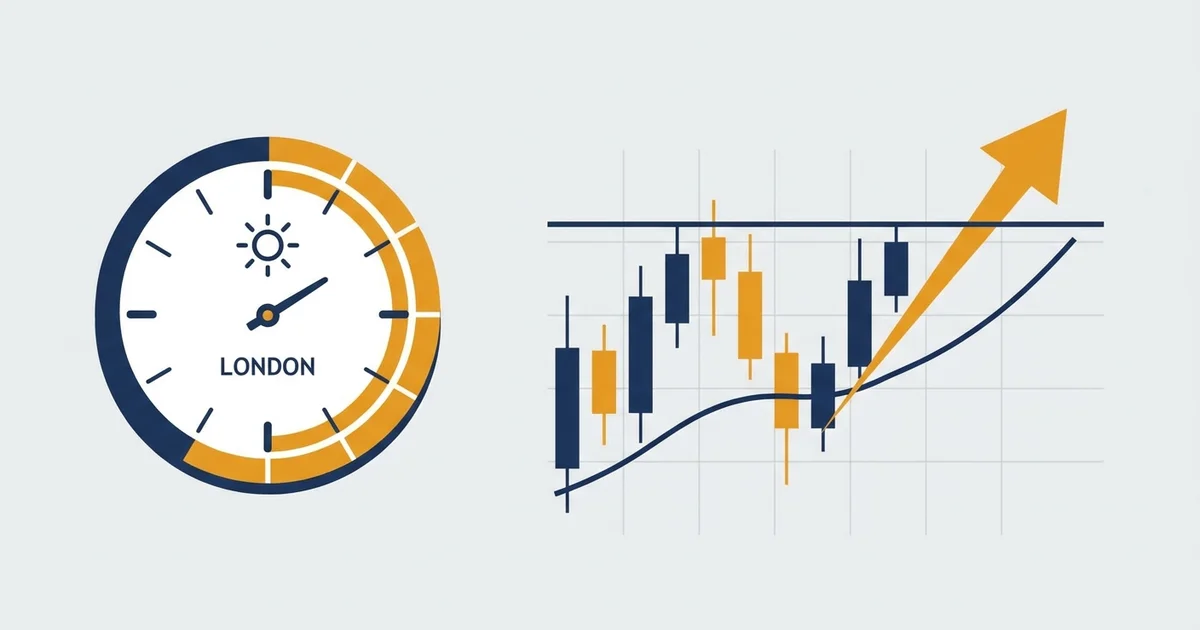
2. London Open Breakout
The London session (8:00–11:00 GMT) accounts for roughly 34% of daily Forex volume. Price often sets the day’s range in the first 30 to 60 minutes. The London breakout strategy tries to catch that initial directional move.
Setup:
- Mark the high and low of the 7:00–8:00 GMT range (pre-London consolidation)
- Enter on a break of either level at 8:00 GMT on the 5-minute chart
- Stop loss: placed at the opposite side of the range
- Target: 1.2 to 1.5 times the range width
On GBP/USD, this was one of the cleanest setups between 2019 and 2022. Then algorithmic trading increased false breakouts. The pattern would print, trigger entries, then reverse sharply in the same candle. The setup still produces 3 to 4 clean signals per week, but it requires a news calendar check before entry.
One rule from my desk years that I still apply: never enter a breakout in the first 15 minutes of London open if there is a Tier-1 data release (CPI, NFP, central bank rate decision) scheduled within two hours. The spread widens and algo order flow becomes too unpredictable to trade directionally.
3. NY Session Momentum Continuation
The New York open (13:30–16:00 GMT) brings US institutional volume. Price often continues the London trend or sets a new direction after a brief pullback.
A common retail approach is trading the “9:30 NY reversal,” a candle that inverts the London direction right at the NY open. I tested this pattern specifically across 6 months of GBP/USD data. The pattern works about 55% of the time. That is not a statistical edge. You cannot build a profitable system on 55% unless you also have very high risk-reward ratios. This setup does not deliver either.
What works better: wait for the first 30 minutes of NY to settle, then trade in the direction that matches the dominant trend from London. If London sold EUR/USD and NY confirms lower highs after the initial volatility, the short continuation offers better odds than the contrarian reversal.
Setup:
- Direction bias: align with the London session trend after 14:00 GMT
- Entry: pullback to the 20-period EMA on the 15-minute chart
- Stop loss: above the previous 15-minute swing high (for shorts)
- Target: nearest horizontal support level
4. Range Trading (Asian and Off-Peak Sessions)
Between 00:00 and 07:00 GMT, most Forex pairs consolidate. The strategy: sell at range resistance, buy at range support, and exit near the opposite boundary.
This is the lowest-complexity approach and works well for beginners learning to read horizontal levels. The trade has clear invalidation: if price closes outside the range, exit immediately. Do not hold and hope.
Entry rules:
- Define range using the high and low of the previous US session close
- Enter at the range boundary, with a stop 6 to 8 pips beyond it
- Target: 50-60% of the total range width
- Hard exit: close all range positions before London open
Holding range trades into London is the single most common account-blowing mistake in this style. The London session expands volatility. A range that held for 8 hours collapses in minutes when European institutional flow hits.
Range trading pairs well with the candlestick patterns you will see at support and resistance boundaries. A rejection wick at resistance, combined with a bearish engulfing pattern, is a higher-probability entry than just a touch of the level. Our candlestick patterns guide covers the specific formations most useful for range entries.
5. Scalping (1-5 Minute Charts)
Scalping means opening many small positions on short timeframes. Each trade targets 5 to 15 pips and closes within minutes. It is the hardest style to execute profitably because spread costs dominate the math.
A 1.3-pip spread on EUR/USD means you start each trade 1.3 pips offside. On a 7-pip target, you need a win rate of roughly 65% just to break even before commissions. Most scalpers do not run this calculation.
Profitable scalping requires raw spread accounts (0.0 to 0.3 pips), fast execution, and specific market conditions: a clear short-term trend, not a choppy range. On a raw-spread ECN account, spreads from 0.0 pips plus a small per-lot commission make scalping mathematically viable. On a standard account with 1.3-pip spreads, the expected value is negative for most traders.
If you want to try scalping, treat it as a supplement during the first 30 minutes of London or NY opens, not as your primary strategy. And only with a raw spread account.
Top-Down Analysis: The Filter That Fixes Everything
Every strategy above improves significantly when combined with top-down timeframe analysis. Before entering on a 15-minute chart, check the 4-hour and daily charts first.
- 4H trend up, daily trend up: only take long setups on 15M
- 4H trend down, daily ranging: skip the session or wait
- 4H ranging, daily up: wait for 4H range break before entering long
After 8 years watching institutional flow, I can tell you this clearly: retail traders lose because they enter against the higher timeframe. They see a 15-minute buy signal without checking that the 4-hour is in a clear downtrend. Top-down analysis does not guarantee winners, but it eliminates the lowest-quality entries that account for the majority of account drawdowns.
For a deeper walkthrough on how to read multiple timeframes together, the chart patterns guide covers the confluence approach in detail.
Common Mistakes That Blow Accounts
No stop loss before entry. Every position needs a stop placed before you click buy or sell. Not after. Traders who think “I’ll exit manually if it goes wrong” hold losing trades for hours because they cannot admit the loss in real time.
Trading multiple strategies at once. Pick one, test it for 90 days, document every trade. Traders who switch strategies every two weeks never accumulate enough data to know whether the problem is the strategy or their execution.
Ignoring session timing. The London open and NY open produce different volatility profiles from the Asian session. A scalping approach that works at 9:00 GMT will not behave the same way at 02:00 GMT. The setup, the range, and the spread all change.
Overtrading choppy days. If EUR/USD moves fewer than 40 pips in the first hour of London, the day is likely ranging. Range days are not trend-following days. One of the most valuable skills in day trading is recognizing when your strategy’s conditions are not present and doing nothing.
Risking more than 2% per trade. On a modest account, 2% risk keeps each trade small — 0.03 lots on EUR/USD with a 40-pip stop. It feels small. It keeps you trading long enough to actually improve.
Account Size and Position Sizing
Live test: standard account, EUR/USD, 15M trend-following breakout, Jan–Feb 2026. Entries triggered by 4H high/low break with 15M close confirmation.
| Small deposit entry | Larger deposit optimal | |
|---|---|---|
| Lot size | 0.01 | 0.03 |
| Risk per trade (2%) | $3.00 | $12.00 |
| Trades taken | 12 | 12 |
| Win rate | 58% | 58% |
| Net P&L | +$18 | +$72 |
| Account growth | +12% | +12% |
Trading involves risk. Past results do not guarantee future performance. Never risk more than you can afford to lose.
Starting with a small account covers learning costs without significant risk. A larger starting balance gives you meaningful position sizing where each winning trade feels substantial enough to reinforce the right behaviors. Both accounts use the same percentage rules. The only difference is dollar amount per trade.
For a step-by-step guide to opening and funding your first account, see our beginner Forex guide.
FAQ
What is the best day trading strategy for beginners?
How much money do I need to start day trading Forex?
Is the London open breakout strategy still profitable?
What is the best timeframe for day trading?
Why do most day traders fail?
Can day trading strategies work on crypto as well as Forex?
Real-time trade setups with entry, stop loss and take profit. Daily market analysis. No subscription, no complicated theory.
🌍 Our recommended brokers


Reader Reviews
Be the first to review this — tell other traders what actually helped, or where it fell short.
Leave a Review

Forex Analyst & Senior Trader
Former FX desk trader with 8 years in institutional forex. Works in multi-timeframe analysis and order flow, turning desk experience into systematic, testable rules across forex and metals.