

Day trading, in one session
Here is what a day trade looks like, start to finish, on a single session of spot gold (XAU/USD).
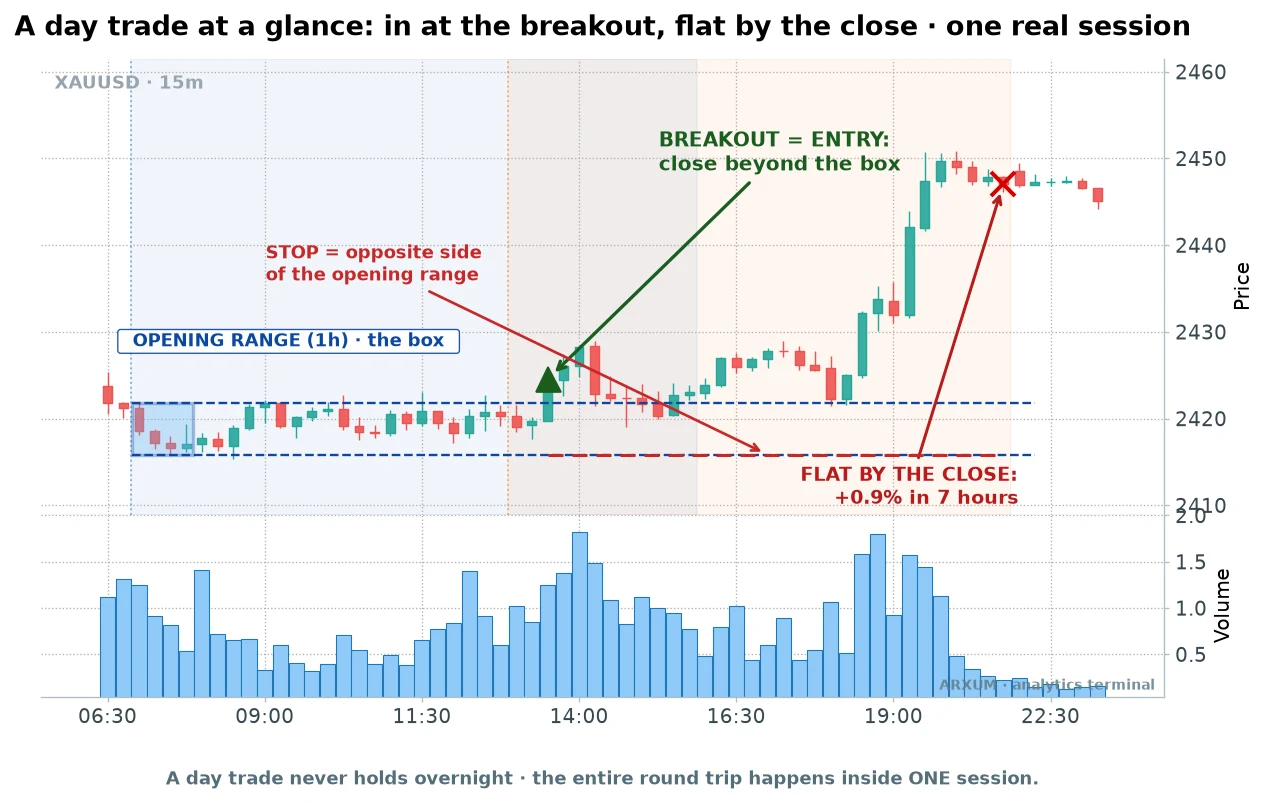
The market opens. Price spends the first stretch of the session carving out a range, a high and a low.
That early box is the opening range, and it is one of the most-watched levels on an intraday chart.
Then price breaks out of the box and runs. You enter on the break, ride the move, and close the position before the session ends.
Flat by the close, nothing carried overnight.
That is the whole shape of day trading. No gap risk while you sleep, no waking up to a position that moved against you for eight hours.
The trade lives and dies inside your screen time.
The trade-off is that everything happens fast, transaction costs bite harder against small moves, and it takes real attention. Day trading is a different job from swing trading, which holds for days and only needs a check-in.
Neither is better. They are different jobs.
Every setup in this guide is intraday. Each one is forced flat by the session close, and each holds for hours, not days.
What follows is not theory. It is what the two-year sweep actually rewarded.
The one thing that decides whether a setup pays
Most day trading guides hand you an entry rule and stop there. The entry is the easy part, and on its own it is usually not enough.
We ran four setups on each market with no filter at all, then added confirmations one at a time. The pattern was blunt.
Around eight of every ten raw setups lost money once fees came out. The same setups, with the right confirmation, paid.
So the useful question is not “which setup.” It is “which confirmation.”
Two terms first, because the numbers lean on them.
Profit factor is the whole strategy’s dollars won divided by dollars lost. Above 1.0 you made money.
A profit factor of 1.5 means about $1.50 came back for every dollar the losers cost. It is the right number for comparing setups.
Win rate is simpler: the share of trades that end in profit. Watch it alongside profit factor, never on its own, because a low win rate can still make good money when the winners are big enough.
You will see exactly that below.
A volume filter means we only took a signal when the entry bar traded heavily, at least one and a half times the recent average volume. Heavy volume says real money showed up, not a thin drift.
The finding was not the tired “just add volume” advice. The strongest confirmation was volume paired with a counter-trend move: a heavy bar arriving as price pushes against its own immediate short-term direction.
That is an intraday exhaustion, the moment a small push runs out of buyers or sellers and turns.
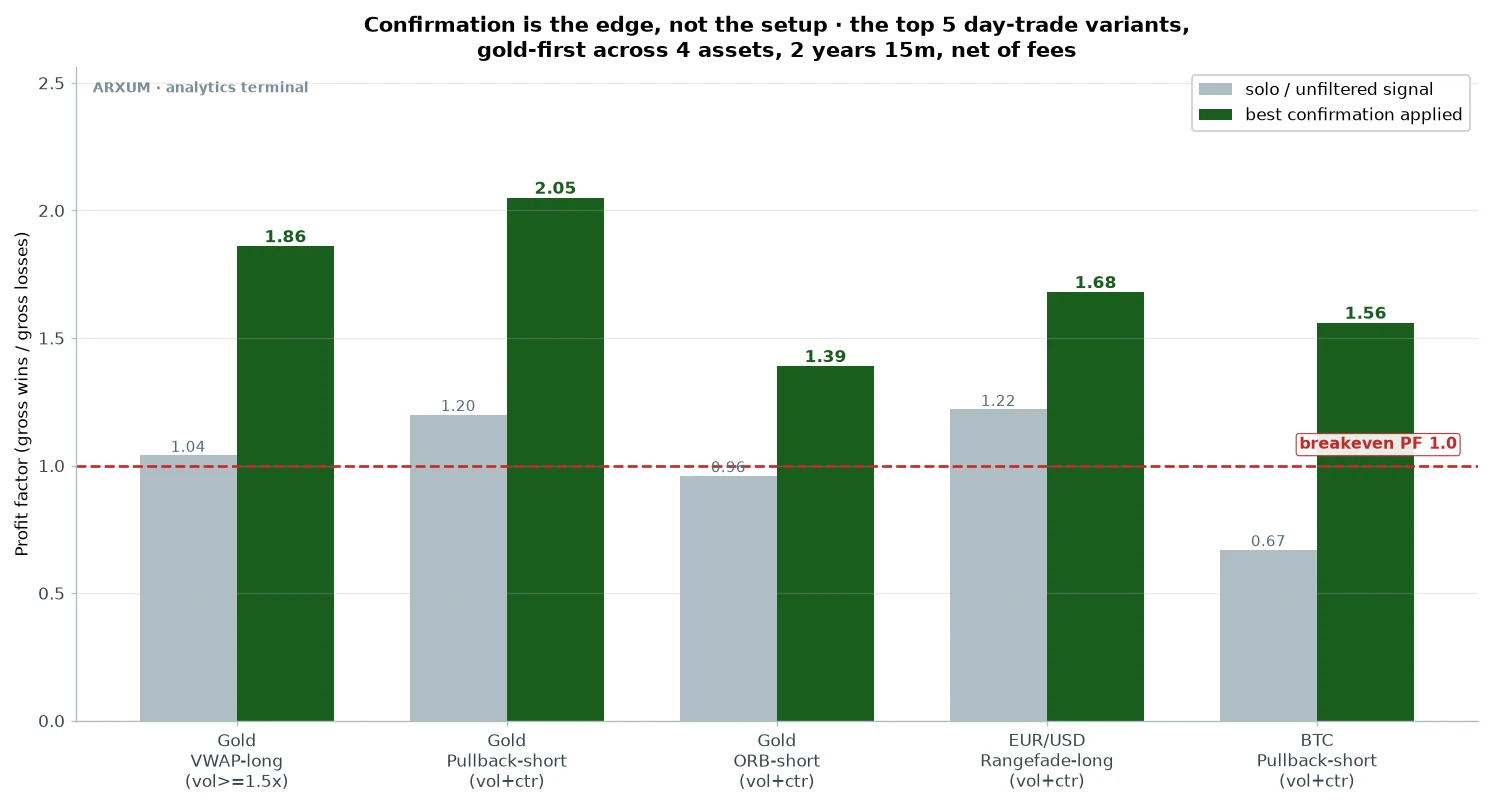
Read the chart, not a wall of numbers. Every setup starts near or below 1.0 on the left, the line between losing and making money.
Adding the confirmation pushes all five to the right, over that line. The gold opening-range short is the clearest case: an outright loser on its own, dragged into profit by the filter alone.
Four of those five leaned on volume-plus-counter-trend, not plain volume alone. That is the whole thesis of this guide.
How do you read it on a live chart, without a backtest running? Watch the volume bars under price.
When one spikes well above its neighbours while price is stalling or turning against the last few candles, that is the signal the filter wants. A heavy bar that simply confirms the current push is the weaker read.
One honest scope note before the setups. This sweep tested a volume-and-trend menu, not the wider indicator menu (ADX, RSI, ATR and the rest) that some of our other studies run.
The counter-trend finding is one confirmation proven across several setups, not five different filters. Widening that menu is the next iteration, and I am not going to pretend it is already done.
The ranking: five setups that cleared the bar
Out of thirty-two combinations of setup, side and market, these five cleared the bar on their best confirmation. Tap any name to jump to its rules and trades.
Two acronyms show up in the setup names below: VWAP and EMA. Both are defined in full where they first come up, so treat them as labels for now.
| # | Setup | Market · side | Profit factor | Win rate |
|---|---|---|---|---|
| 1 | Gold VWAP reclaim | gold · long | 1.86 | 52% |
| 2 | Gold EMA pullback | gold · short | 2.05 | 33% |
| 3 | Gold opening-range breakout | gold · short | 1.39 | 37% |
| 4 | EUR/USD range fade | euro · long | 1.68 | 47% |
| 5 | Bitcoin EMA pullback | Bitcoin · short | 1.56 | 36% |
Two things stand out. Gold takes three of the five, because gold has been trending hard and intraday tools love a trending market.
And the win rates are low on purpose.
A 33% win rate looks broken until you see the other half of the trade. These setups lose small and win big.
They run a low win rate against a high reward-to-risk, which I define properly at the first trade below. Each setup is explained in full underneath, with its rules and real trades.
Position small, let the winners run to the close, and do not judge a setup by win rate alone.
1. Gold VWAP Reclaim
The top setup, and the only one whose best confirmation was plain heavy volume rather than the counter-trend twist.
VWAP is the volume-weighted average price, the average price paid so far in the session, weighted by how much traded at each level. It resets every morning.
Traders treat it as the session’s fair-value line. Our VWAP indicator guide covers how to add it in one click.
The reclaim setup is simple. Price spends part of the session below VWAP, then pushes back up through it on heavy volume.
You buy that reclaim, betting the session’s balance has flipped bullish.
The rules:
- Trigger: price closes back above session VWAP.
- Confirmation: the reclaim bar trades at least 1.5 times the recent average volume.
- Stop: below the swing low that formed under VWAP.
- Exit: the session close forces you flat.
Here is one of those reclaims, from entry to exit.
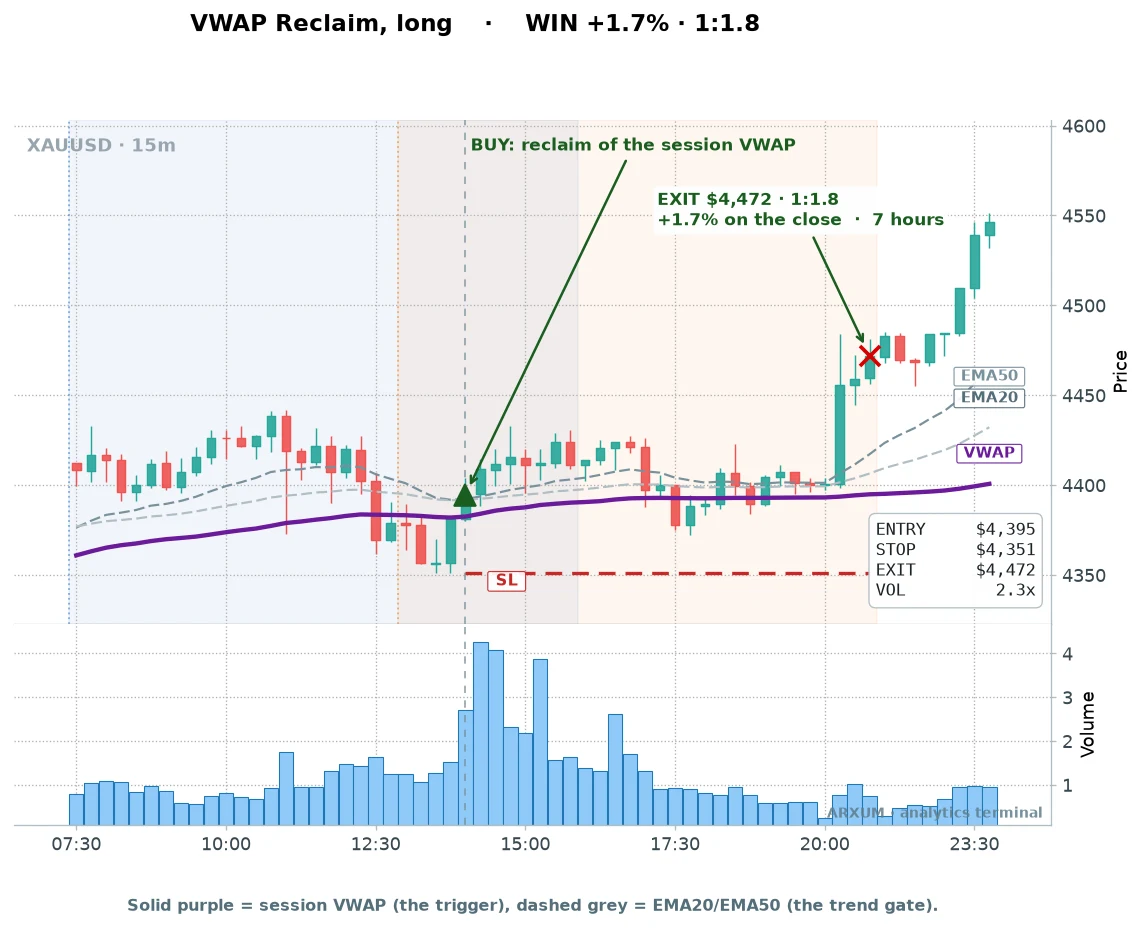
That phrase risk/reward 1:1.8 is worth a slow read. The 1 is your risk, the distance from entry to stop.
The X is the reward, how many times that risk the trade made back. So 1:1.8 means this winner returned about 1.8 times what it would have lost if stopped.
You will also see it called reward-to-risk, same idea, same number. Our risk/reward ratio explainer walks through it in full.
Price had been trading under VWAP, then reclaimed it on a volume bar well above its neighbours. That was the entry, the green marker.
The stop sat under the swing low, and the trade rode into the New York session before the close took it out for +1.72%.
Now the same setup losing, because honesty beats a clean story.
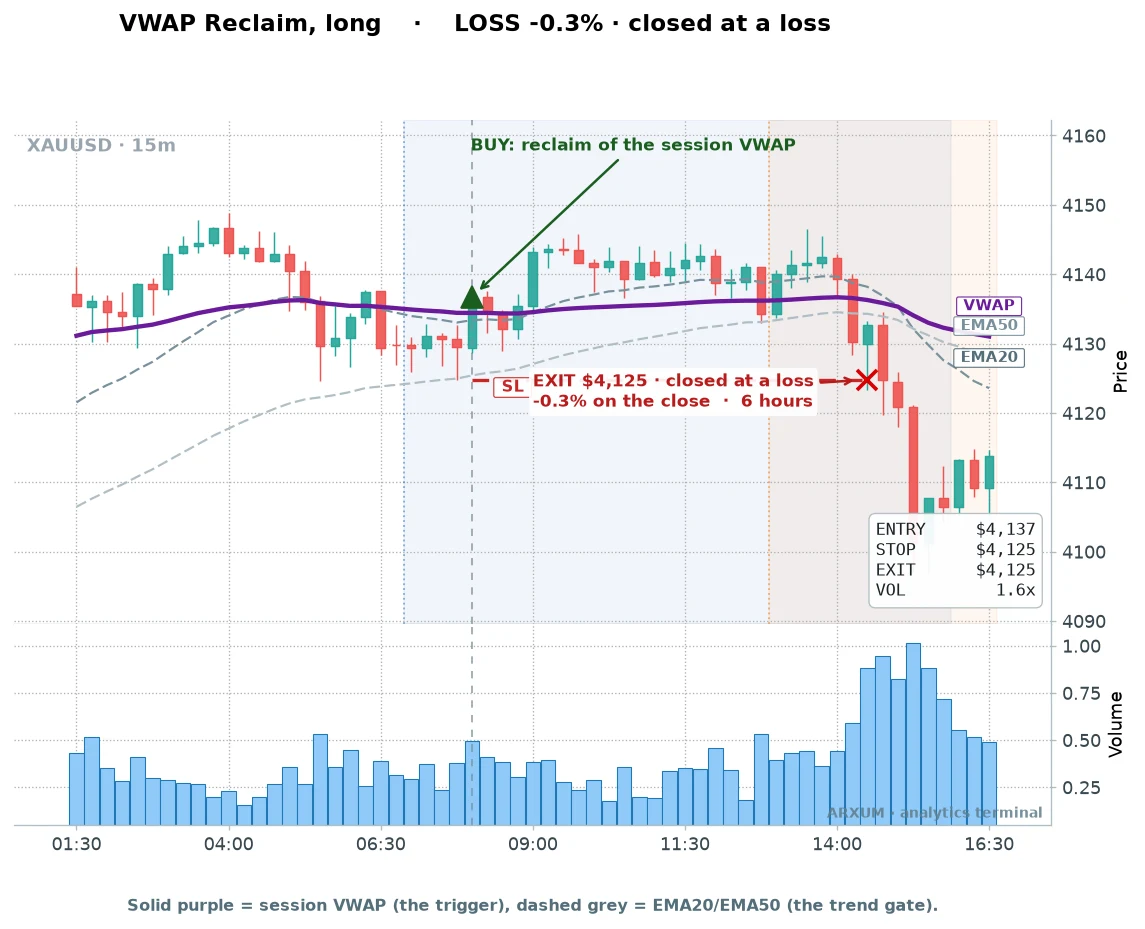
Everything looked right. Price reclaimed VWAP on volume, the entry fired, and then it simply rolled back over and hit the stop.
A small, clean loss. This is the shape of the losers in this style, and there are more of them than winners.
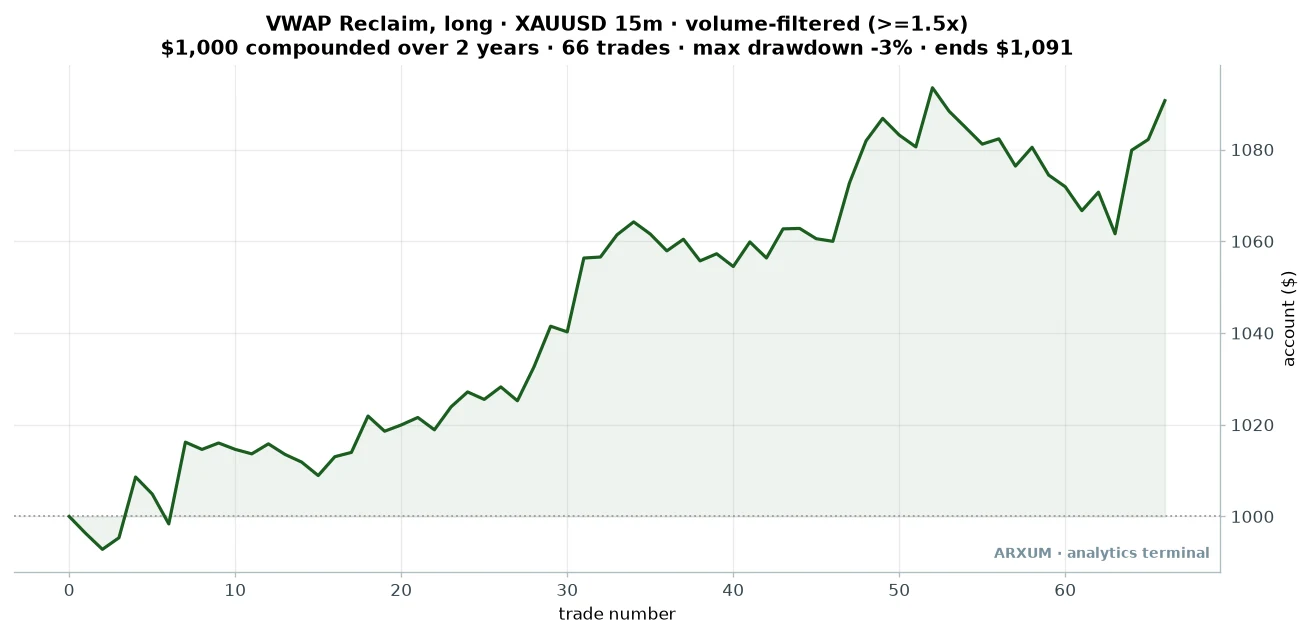
The full trade history on gold, using the heavy-volume filter:
| Trades | 66 |
| Win rate | 52% |
| Profit factor | 1.86 |
| Avg gain per trade | +0.13% |
| Typical hold | 5.5 hours |
| Net return on $1,000 | +9.1% |
Avg gain per trade is the expectancy, the average result of a single trade with wins and losses blended together. At +0.13% it is small, which is normal.
The edge is thin per trade and only shows up over many of them.
That $1,000 compounded to about $1,091 over the 66 trades, with the worst drawdown just 3%. A drawdown is the deepest drop from a peak your account sits through.
This one stayed shallow because the reclaim, filtered by volume, kept a steady win rate above half.
2. Gold EMA Pullback (Short)
The highest profit factor of all five, and a pure momentum setup on the short side.
An EMA is an exponential moving average, a line that tracks recent price and reacts faster to new moves than a plain average. We use two: a fast 20-bar and a slower 50-bar.
When the 20 sits below the 50, the short-term trend is down. That is your permission to look for shorts.
The pullback short catches a bounce inside a down move. Price is pulling lower, bounces briefly, and you sell as momentum resumes downward on heavy volume against that little bounce.
That “against the bounce” part is the counter-trend confirmation from earlier.
The rules:
- Regime: the 20-EMA is below the 50-EMA, short-term trend down.
- Trigger: a pullback stalls and price turns back down.
- Confirmation: the turn arrives on volume at least 1.5 times average, pushing against the small bounce.
- Stop: above the bounce high. Exit: the session close.
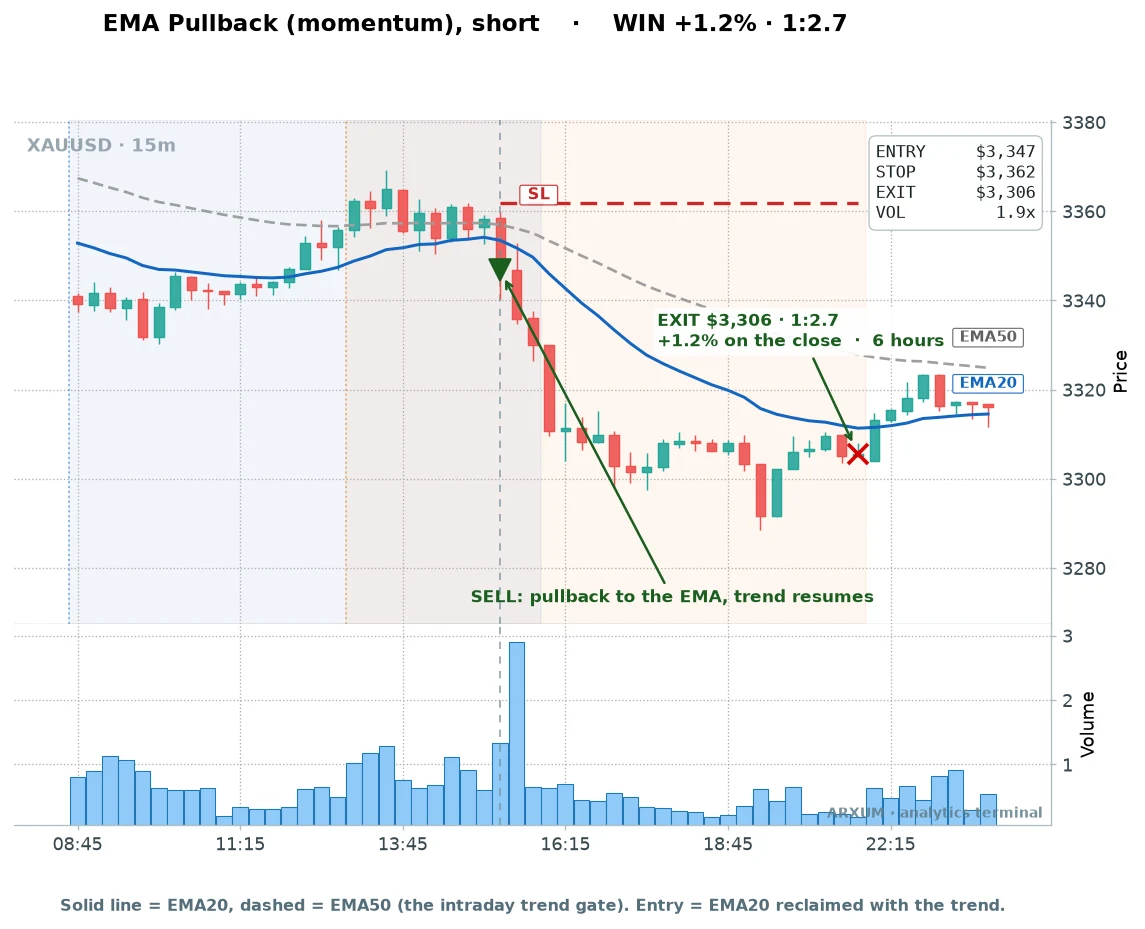
The bounce ran into a heavy down-bar, the entry fired, and the drop extended for the rest of the session. A 1:2.7 winner.
Those bigger winners are what carry a 33% win rate into profit.
And the loss:
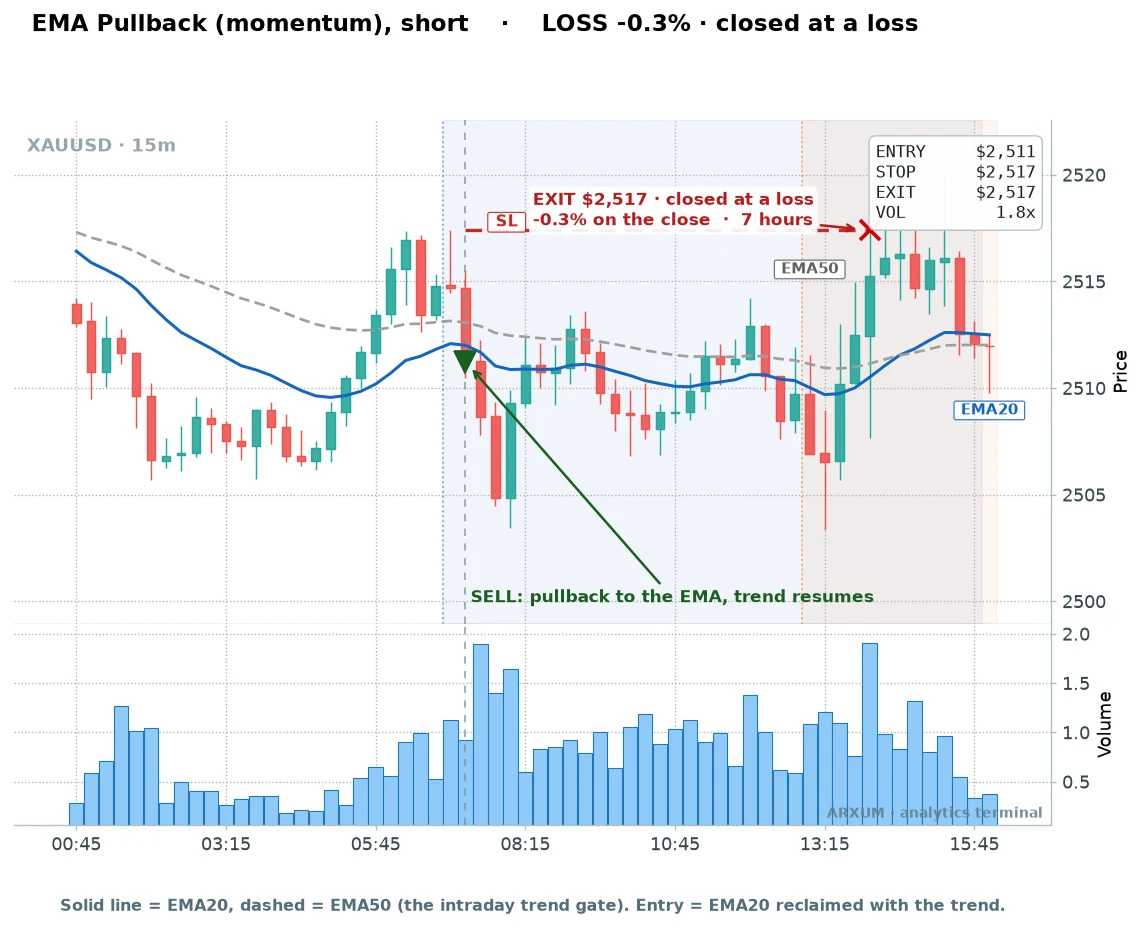
The setup was textbook and it still lost. Price ticked back up through the bounce high and took the stop.
Again, small. That is the deal with this setup: you eat a lot of small stops to be there for the runners.
| Trades | 33 |
| Win rate | 33% |
| Profit factor | 2.05 |
| Avg gain per trade | +0.20% |
| Typical hold | 4.7 hours |
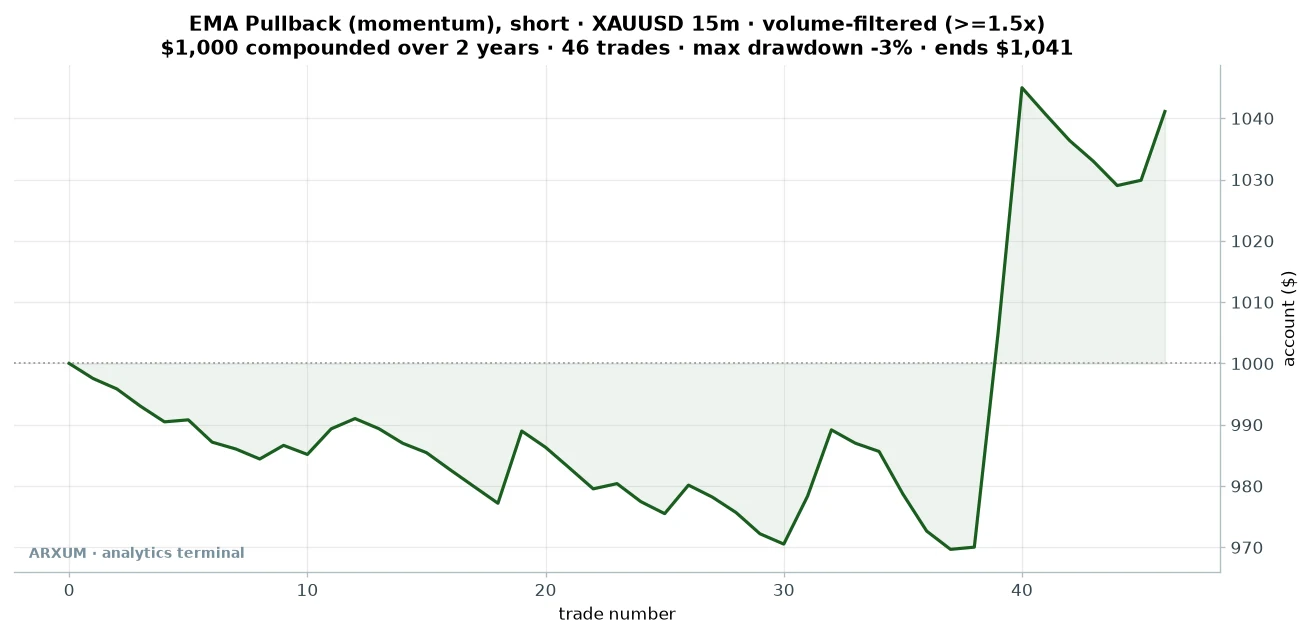
That 2.05 profit factor is the volume-plus-counter-trend version. On plain volume alone, this setup ran a $1,000 stake up to about $1,041 over 46 trades.
The counter-trend condition is what lifted it further, and it is why the filter matters more than the setup.
The edge here was actually stronger in the second half of the window than the first. That is the good direction for a setup to drift, and I checked it rather than assumed it.
3. Gold Opening-Range Breakout (Short)
This is the setup from the opener at the top, now on the short side and with a caveat attached.
The opening-range breakout is the classic intraday play. Mark the high and low of the session’s first stretch, the opening range, and trade the break of either edge.
Short the break below the low.
On its own, the gold ORB short lost money, a 0.96 profit factor, an outright loser. The volume-plus-counter-trend confirmation is the only reason it appears in this ranking at all.
The rules:
- Range: mark the opening range high and low.
- Trigger: price closes below the range low.
- Confirmation: the breakdown bar trades on heavy volume against the immediate micro-bounce.
- Stop: back inside the range. Exit: the session close.
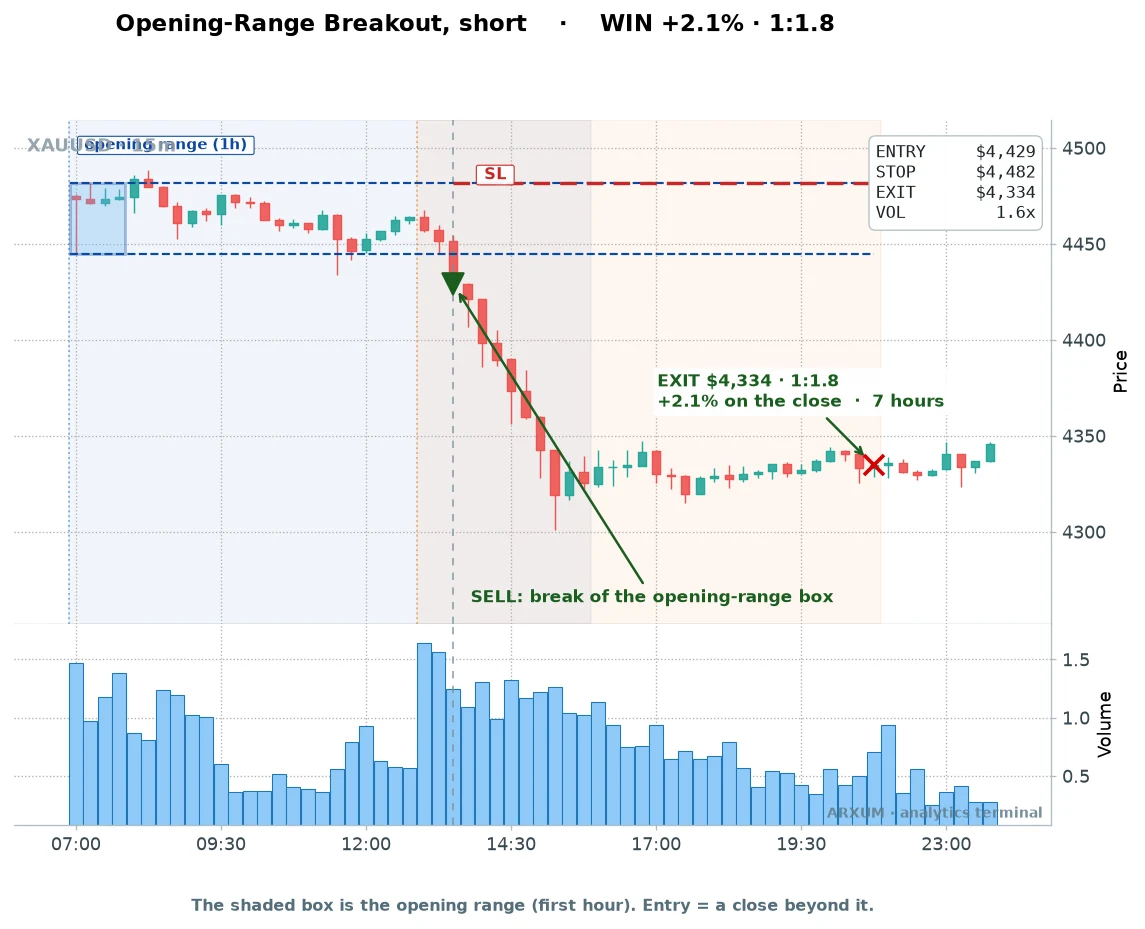
Price broke the range low on a heavy bar and kept going, the cleanest kind of ORB. The trade held into the afternoon session for +2.15%.
The loss shows the setup’s real weakness, the false break:
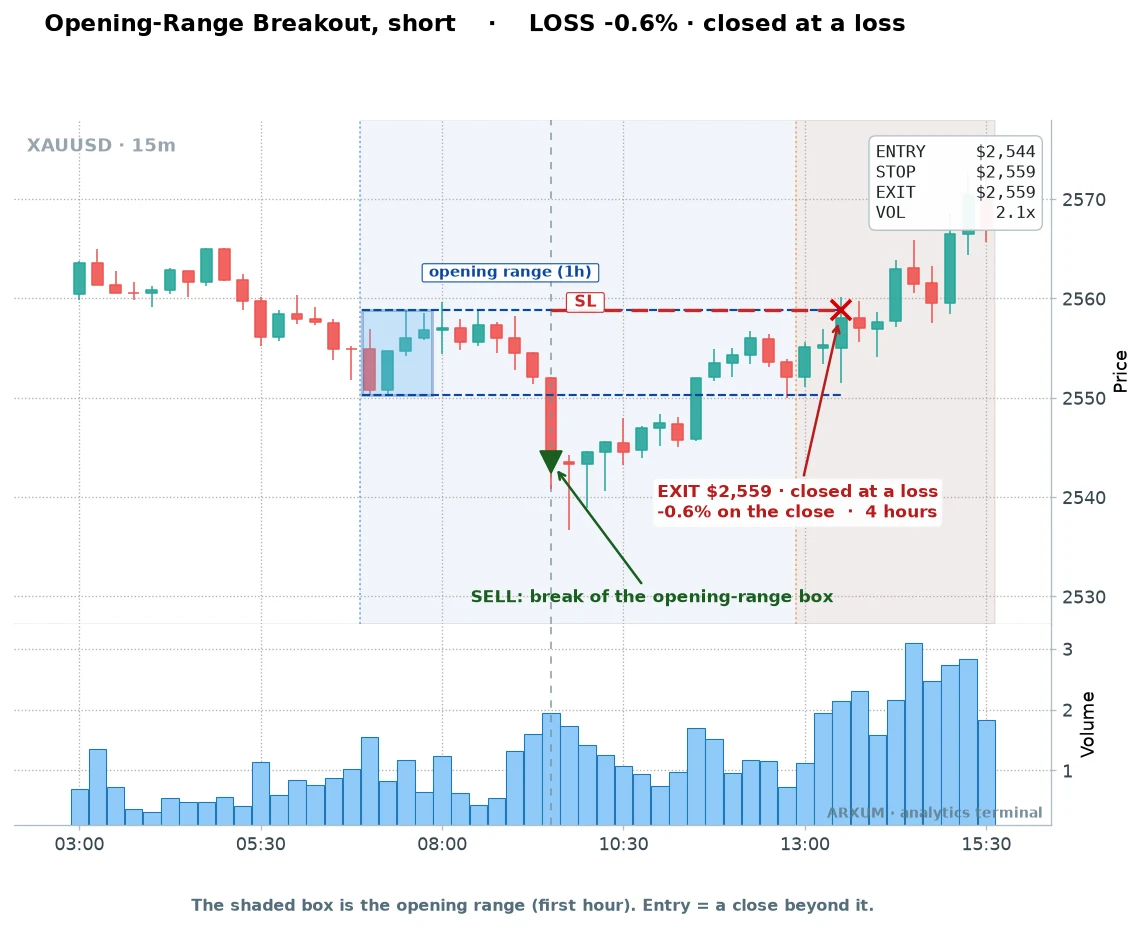
Price broke the low, triggered the short, then reversed straight back into the range and ran to the stop. False breaks are the tax you pay on breakout trading, and they are why the raw setup lost before the filter went on.
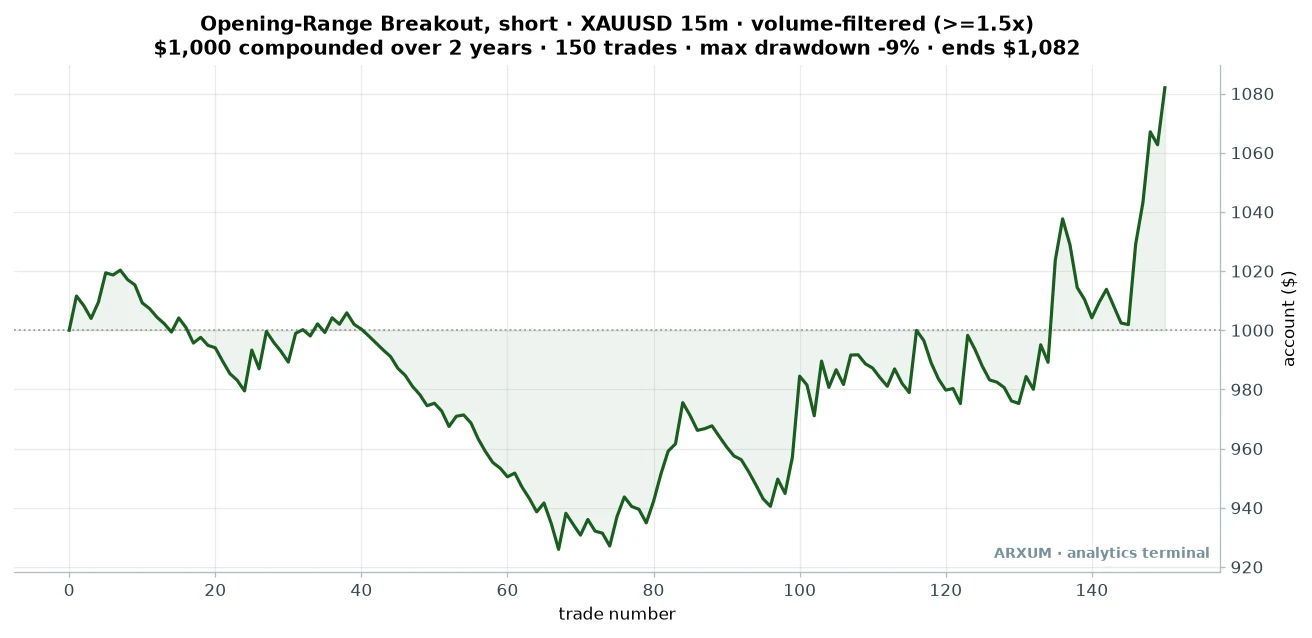
| Trades | 95 |
| Win rate | 37% |
| Profit factor | 1.39 |
| Avg gain per trade | +0.11% |
| Typical hold | 5.9 hours |
On plain volume, the $1,000 run reached about $1,082 over 150 trades. Here is the honest caveat, though.
This setup only cleared breakeven in the second half of the two years. In the first half it lost.
The confirmation rescued a losing setup, but the rescue is recent, so treat it as the least proven of the gold three.
4. The EUR/USD Range Fade
The euro is the honest stress test, because it spent most of the window chopping sideways while gold trended. A different market wants a different tool, and for the euro that tool is a fade, not a breakout.
Range fading means selling the top of a range and buying the bottom, betting price stays boxed in. This setup fades the prior day’s low back up into the range, during the quiet pre-London hours when the euro tends to drift rather than trend.
The rules:
- When: the quiet hours before the London session, roughly before 07:00 UTC.
- Trigger: price pokes below the prior day’s low, then a heavy bar pushes it back up.
- Confirmation: volume at least 1.5 times average, against the poke lower.
- Stop: beyond the prior-day low. Exit: into the range, or the session close.
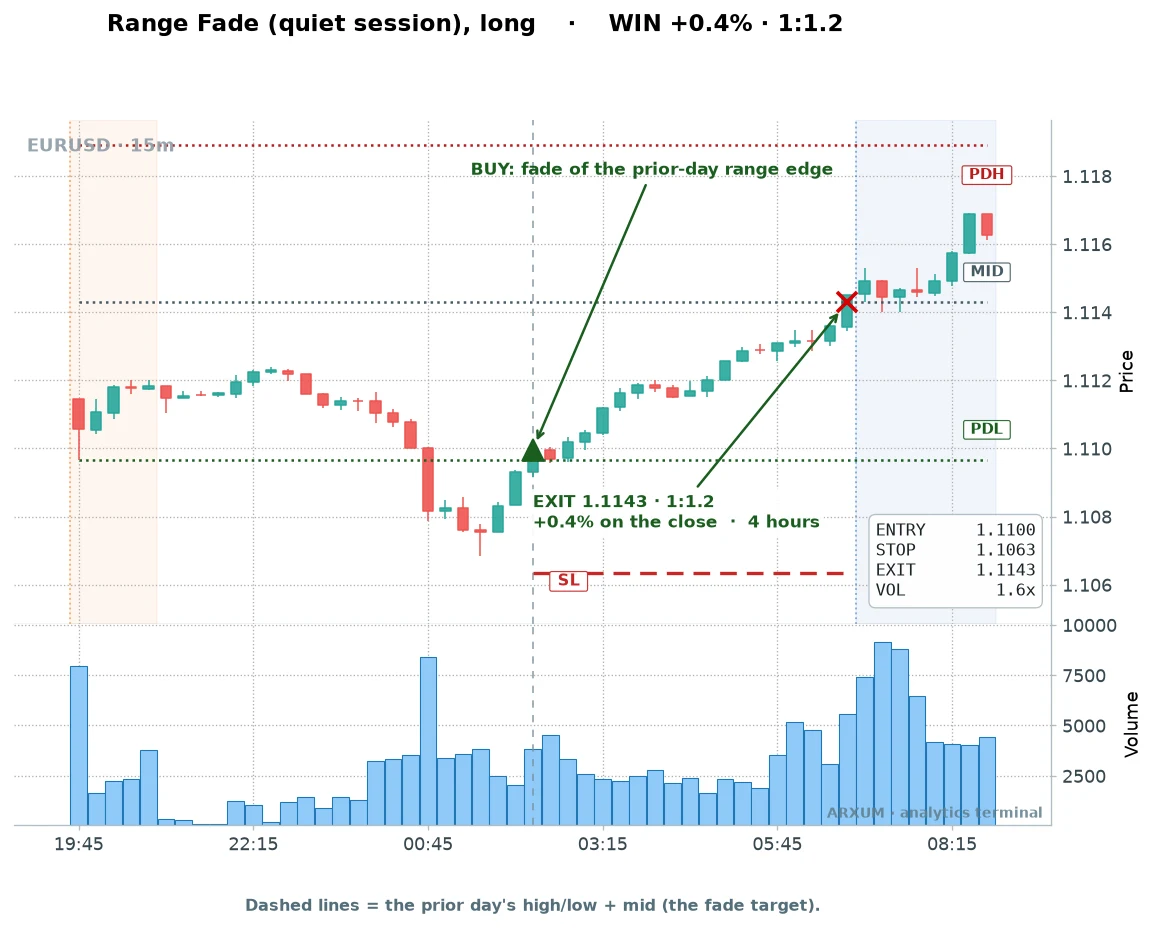
Price dipped below the prior low, a heavy bar snapped it back, and the fade drifted up into the range for a small win. The reward-to-risk is lower here, 1:1.2, which fits a range setup.
You are not catching a trend, you are catching a bounce back to the middle.
The loss is what happens when the range breaks for real:
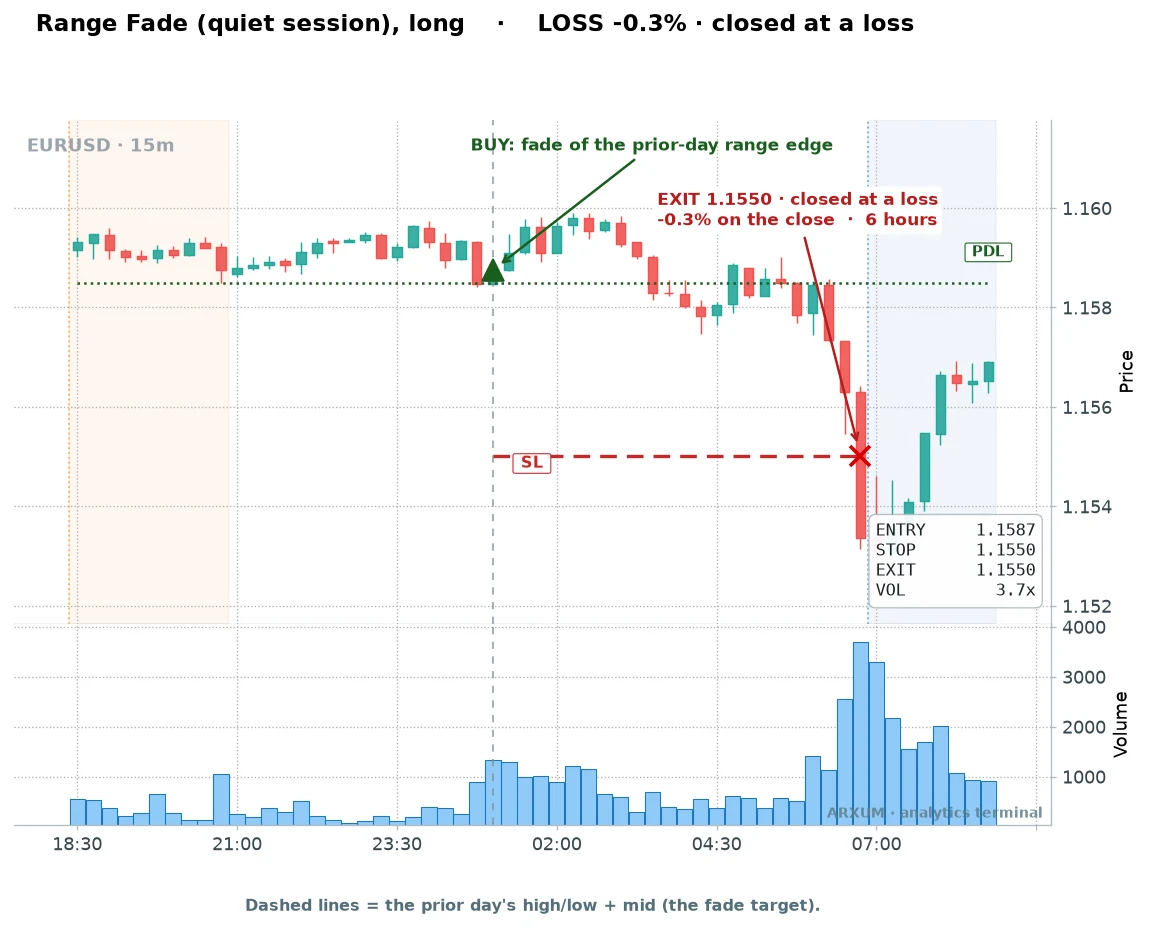
The fade assumes the level holds. When it does not, and the euro actually trends out of the range, the stop does its job.
This is the risk in every mean-reversion trade.
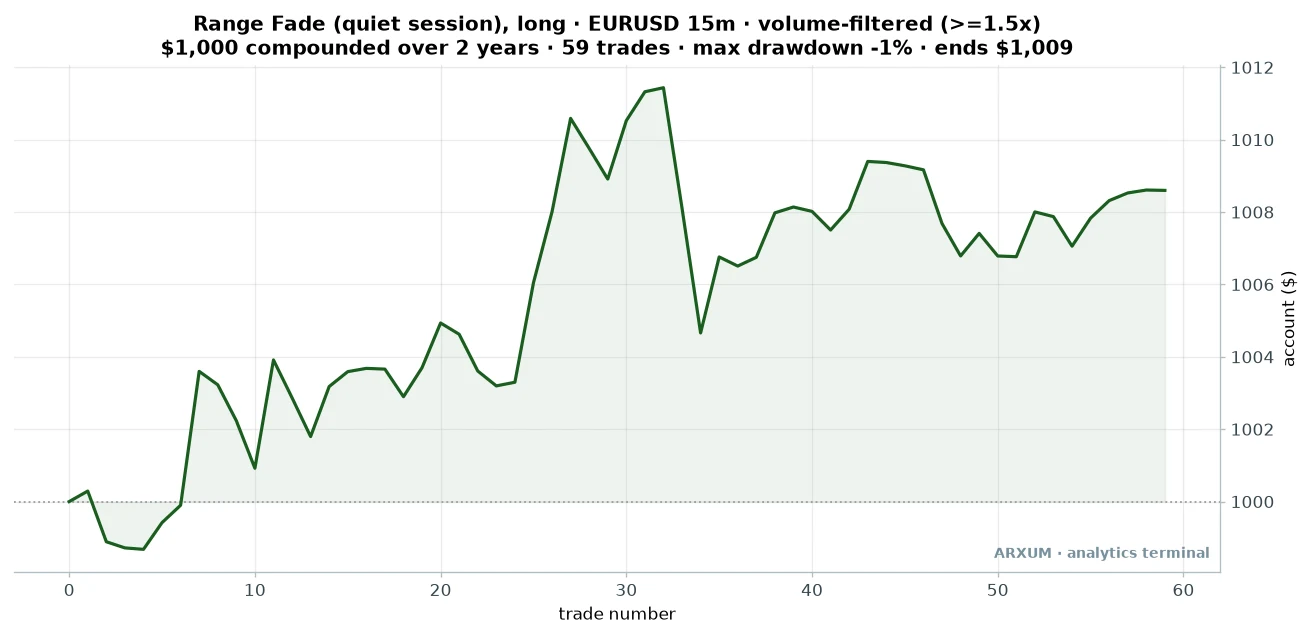
| Trades | 49 |
| Win rate | 47% |
| Profit factor | 1.68 |
| Avg gain per trade | +0.02% |
| Typical hold | 3.7 hours |
| Net return on $1,000 | +1.2% |
Now the red flag, stated plainly. We split the two years in half and checked the second half, data the rules were never fit to.
That is the out-of-sample test, the one that separates a real edge from a curve fit. The euro fade scored a healthy 1.69 profit factor in the first half and dropped to 0.86 in the second, below breakeven.
So this is a specialist, not an all-weather edge. It worked well in quiet, range-bound euro sessions and faded as conditions shifted.
Treat it as a tool for a specific market mood, and watch whether the euro is actually ranging before you use it. The range fade pairs naturally with reading rejection wicks at the level, which our candlestick patterns guide covers.
5. Bitcoin EMA Pullback
The cross-asset check, and never the lead. Gold and the euro are what most readers here trade.
Bitcoin is in this guide to answer one question: does the edge survive somewhere completely different?
Bitcoin has no trading session. It runs 24/7, so there is no opening range and no London quiet hour.
We used the calendar day as a stand-in for the session, which is honestly a weaker frame than a real one. It is also why the Bitcoin charts carry no session shading.
Every raw setup lost on Bitcoin. The two-year window included a 53% peak-to-trough drop in buy-and-hold, brutal conditions.
Only one setup survived, and only with confirmation: the same EMA pullback short from the gold section.
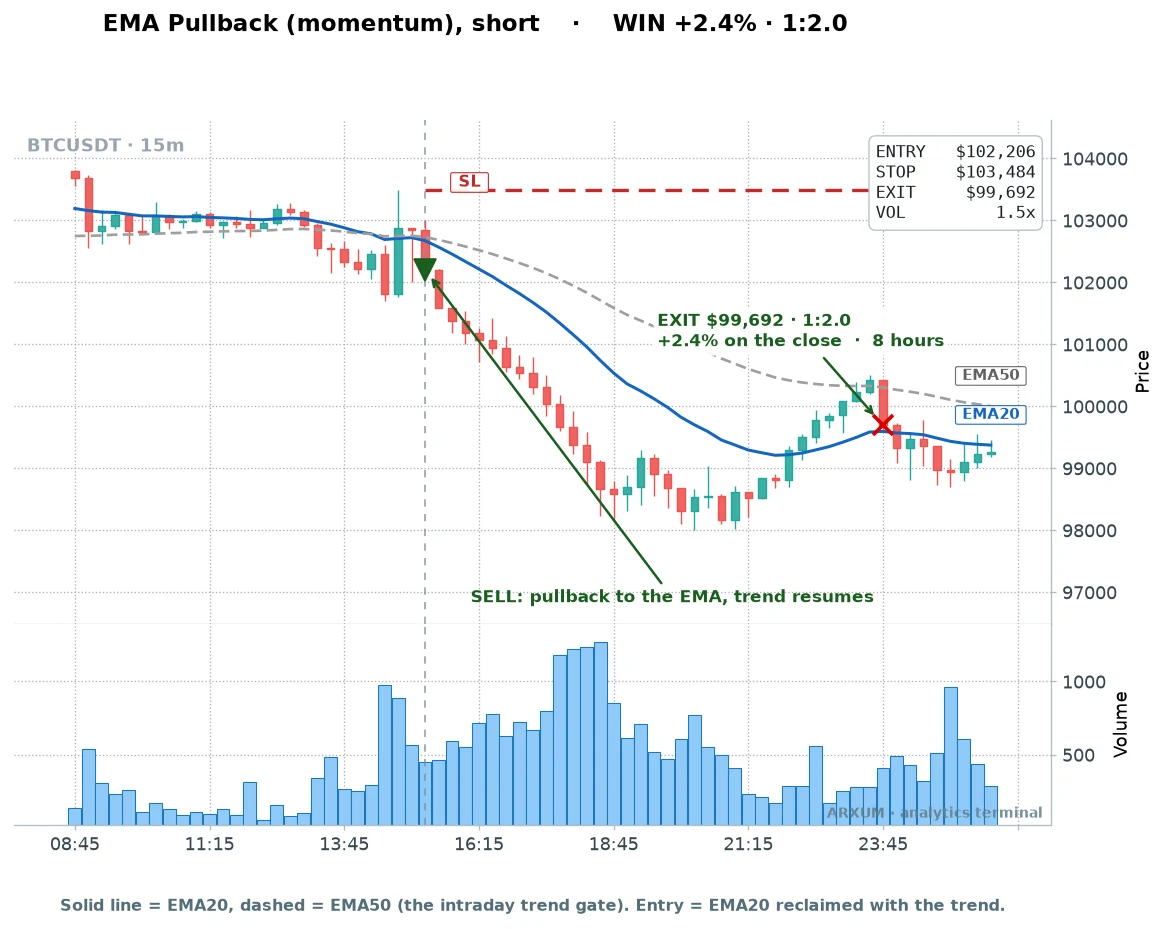
The same shape as the gold pullback: a bounce inside a down move, a heavy bar turning it back down, and a run into the stop or the day’s end. Here it ran to +2.42%.
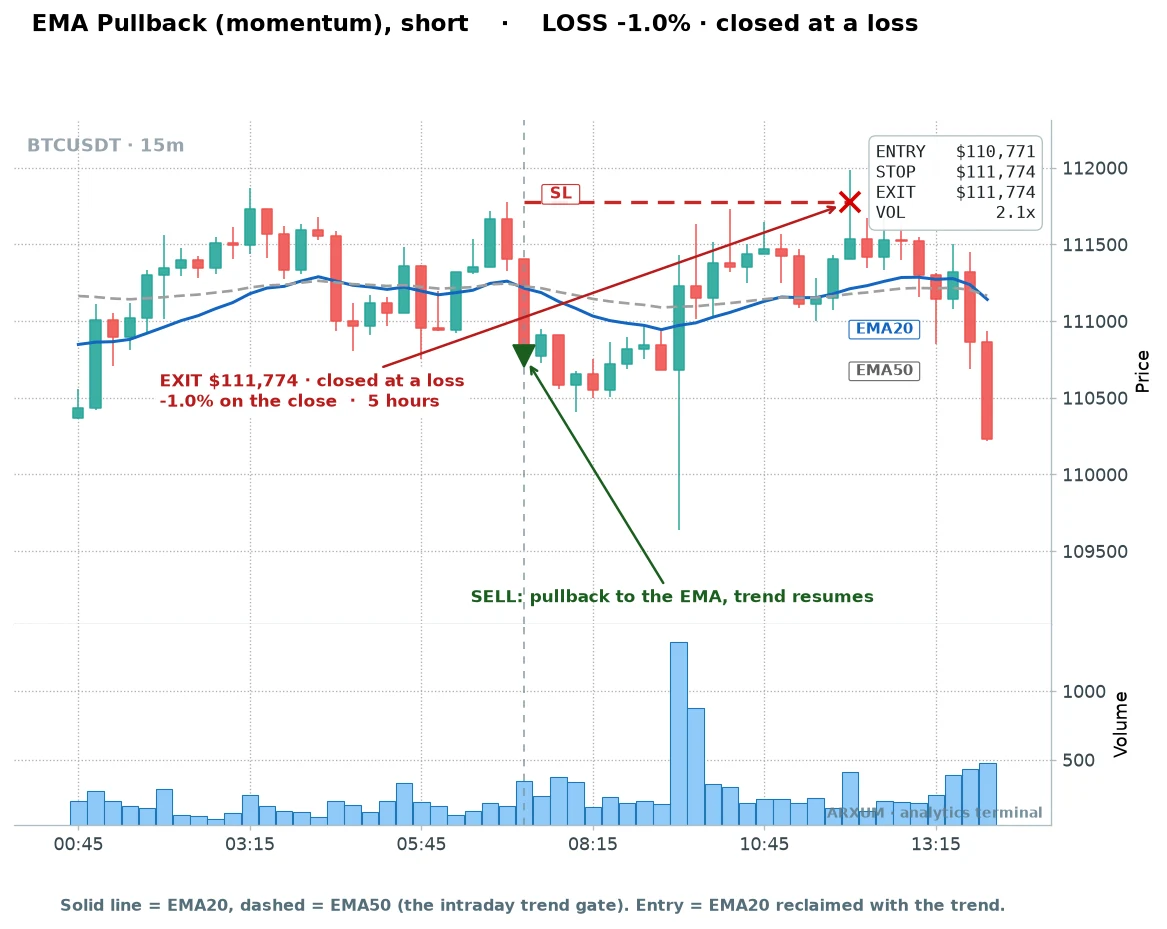
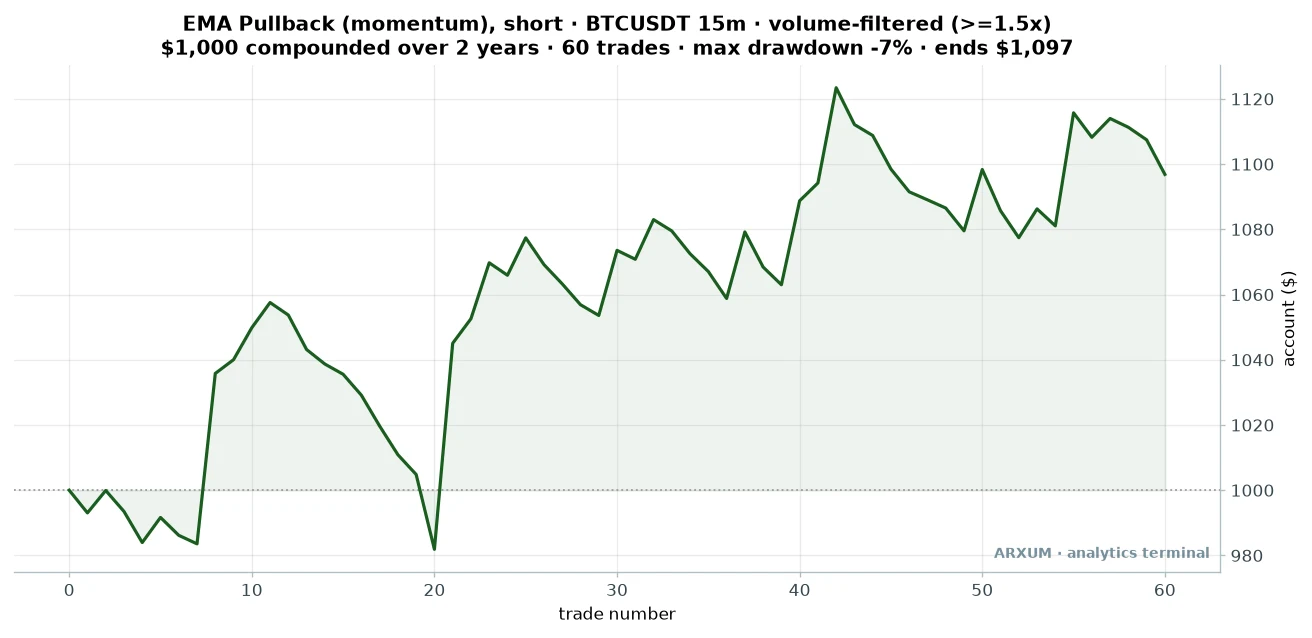
| Trades | 53 |
| Win rate | 36% |
| Profit factor | 1.56 |
| Avg gain per trade | +0.23% |
| Typical hold | 6.3 hours |
| Net return on $1,000 | +12.3% |
That a gold setup also worked on Bitcoin, on real exchange volume rather than the tick-volume estimate forex uses, is the closest thing to proof the whole study offers. The same confirmation carried the same setup across a metal and a crypto.
That is harder to fake than any single market’s numbers.
Sessions: when these setups actually fire
Forex and gold run around the clock on weekdays, but they are not equally active all day. The shaded bands on the gold and euro charts above mark the two sessions that matter.
- London open (around 07:00 to 08:00 UTC): volume arrives, ranges expand, breakouts get real fuel.
- London to New York overlap (around 13:00 to 17:00 UTC): the busiest window, the cleanest moves on gold and the euro.
- The quiet pre-London hours (before 07:00 UTC): thin and drifty. This is fade territory, which is exactly when the euro range fade fires.
Match the setup to the session. Breakout and momentum setups want the London open and the overlap, when volume can carry a move.
The range fade wants the quiet hours, when price tends to stay boxed. Running a breakout setup at 03:00 UTC on the euro is fighting the clock.
Our forex market hours guide maps the full session calendar.
Bitcoin is the exception, with no session at all. That is a genuine handicap, and it is why crypto was the hardest of the three markets here.
Timeframes: what to actually watch
Every setup above runs on the 15-minute chart. That is the primary intraday timeframe: enough detail to time an entry, not so much that every candle is noise.
But you do not read one chart in isolation. The professional habit is top-down.
Check the higher timeframe for direction, then drop to the 15-minute for the entry.
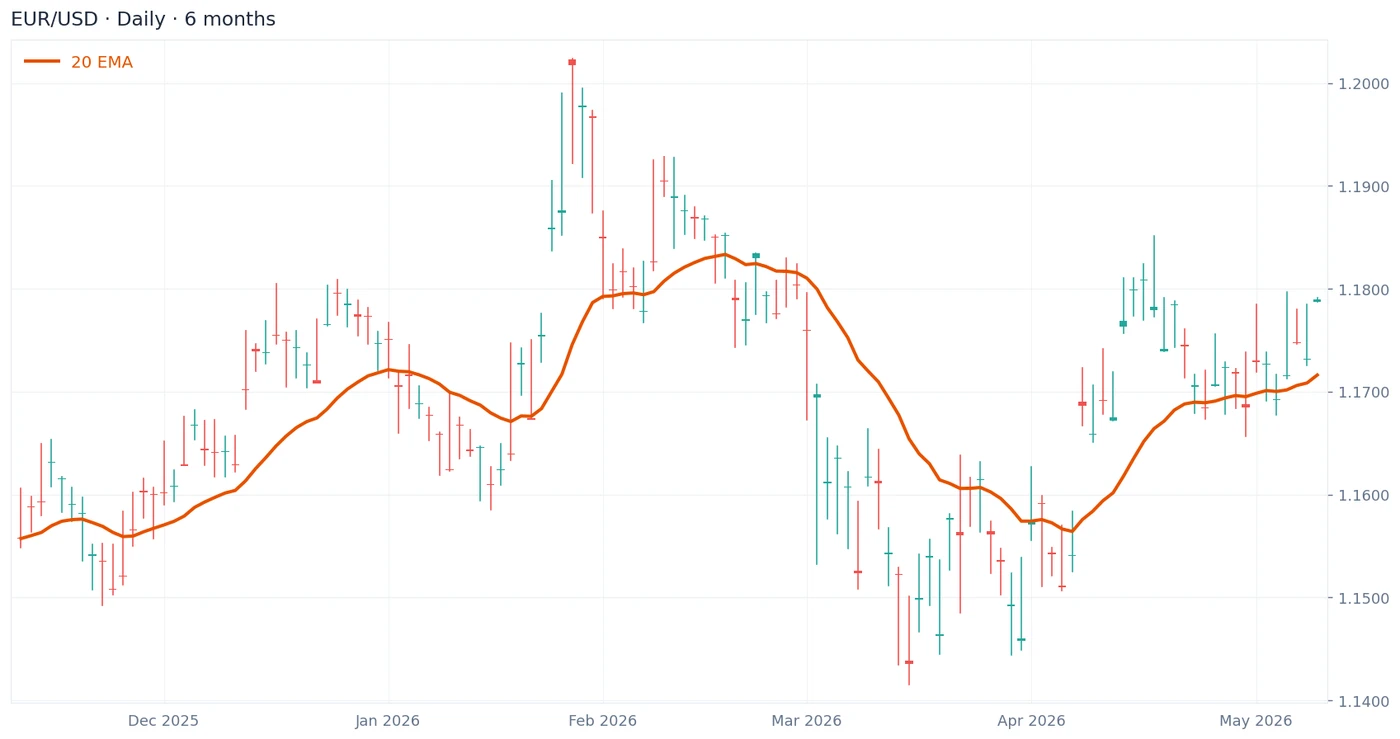
The idea in that chart carries down to any timeframe. When price sits above its moving average and keeps pulling back to it and bouncing, you have trend context and a series of entry points.
When price is chopping across the average with no direction, you have a range, and a trend setup will bleed you with false signals.
A rough map of the timeframes:
- 4-hour: direction only. Up, down, or range. This decides which side you take.
- 15-minute: the setup. Where the VWAP reclaim, the pullback, the breakout actually form.
- 5-minute: entry precision, once the 15-minute setup is in front of you.
The 1-minute chart has almost no value for direction. It is pure noise unless you are a professional scalper with a raw-spread account, and even then it is the hardest game in trading.
Position sizing: the part that keeps you in the game
Your entry matters less than your size. This is where the small-account math gets real, so let me work it, because it changes which market you should trade.
The rule everyone should keep is 2% risk per trade. On a $1,000 account, that is $20 at risk on any single position, no more.
Try to size the gold VWAP winner from earlier on that account. Entry was near $4,395, and the stop sat about $42 per ounce away. The position is one division:
- Risk budget: $20
- Risk per ounce: $42
- Position size: $20 ÷ $42 = 0.48 ounces
Here is the problem that division exposes. A lot is just a standard trade size, and what one lot buys depends on the instrument.
For gold, the smallest position most brokers offer is one micro lot, which is one ounce. Your math says 0.48 ounces.
On a $1,000 account at honest 2% risk, you simply cannot take this gold trade, because the correct size is smaller than the minimum.
That is not a flaw in the setup. It is the reality of trading a $4,000 instrument on a small account.
What you must never do is widen the stop or oversize to “make it fit.” That is how a 2% plan quietly becomes a 10% plan and blows up.
So here is the same math on a market a small account can actually trade, the EUR/USD range fade. Forex is sized in lots and measured in pips, the fourth decimal of the price.
On one micro lot, each pip is worth about $0.10.
Take the euro fade from earlier. The stop was about 36 pips away. Same $1,000 account, same 2% rule, so $20 of risk:
- Risk budget: $20
- Risk per micro lot on a 36-pip stop: 36 × $0.10 = $3.60
- Position size: $20 ÷ $3.60 = about 5 micro lots (0.05 lots)
That works. Five micro lots on the euro is a normal, affordable position on any standard account, and it risks close to the same 2%.
The lesson is not “avoid gold forever.” It is that a small account belongs on a cheaper instrument where the dollar stop is small enough to size honestly. For gold itself, you would want a broker offering fractional or cent-lot sizing.
How to place the trade, and three ready configurations
Once your size is set, placing an intraday order is three fields on the ticket:
- Entry: a market order on the bar that confirms the signal, or a stop order at the breakout level for the ORB.
- Stop-loss: in the stop field, at the level from the setup’s rules (the swing low, the bounce high, or the far side of the range).
- Exit: these are day trades, so the session close is your hard backstop. Close the position before the session ends even if neither stop nor target hit.
You can chart and practice all of this free on TradingView before risking a cent. Add VWAP or the moving averages from the Indicators menu by name, or on MT4 and MT5 through Insert then Indicators.
Start on a free demo account, not real money, until the trigger is obvious to you. The volume filter is easier to read than the number suggests. One practical note before you go live: day trading pays the spread on every single trade, so at twenty trades a week the difference between a 0.6-pip and a 1.4-pip average is most of your edge. Spreads measured on a live account are worth checking against your own.
Turn on the volume histogram under the chart, and look for a bar that is roughly half again taller than the handful around it. That is the 1.5-times-average read, by eye, no calculation needed.
Three tested configurations you can lift straight from the study:
- Gold, VWAP reclaim, long. 15-minute chart, London session onward. Buy the close back above session VWAP when the reclaim bar trades 1.5 times average volume. Stop under the swing low, flat by the close.
- Gold, EMA pullback, short. 15-minute, 20-EMA below the 50-EMA. Sell as a bounce turns back down on heavy volume against it. Stop above the bounce high, aim for roughly 1:2.
- EUR/USD, range fade, long. 15-minute, quiet pre-London hours only. Buy the heavy-volume snap-back after price pokes below the prior day’s low. Stop beyond that low, small target back into the range. Use it only when the euro is genuinely ranging.
The discipline this style demands
The risk talk here is not boilerplate, because these setups have a shape you have to make peace with.
You will lose most of your trades. Win rates of 33% to 37% mean roughly two losses for every win.
If you cannot sit through a string of five or six small stops without abandoning the plan, this style breaks you, not because it stopped working but because you stopped following it.
A few concrete habits keep you in the game:
- Risk the same 2% every time. Do not size up after a loss to win it back, and do not size up after a win out of euphoria. The math only holds if every trade is the same fraction of the account.
- Cap the day. If you lose 6% of the account in one day, close everything and stop. This kills the revenge-trading spiral before it kills the account.
- Use the circuit-breaker. If you take five or six losses in a row, the regime may have changed. Gold may have stopped trending, the euro may have started. Pause for a week and check conditions before the next trade.
- Run a calm live-versus-test check. If your live results drift far below the study over a real number of trades, do not panic-quit on one bad week, that is just variance. But a sustained, large gap is a real signal. Step back and look at whether the market still suits the tool.
No mechanical setup is permanent. These are tools for specific market moods: trend for the gold setups, quiet ranges for the euro fade.
When the market changes character, the tool changes with it, and noticing that is the actual job. Only risk money you can afford to lose.
What does not work
The ranking is the good news. The honest counterweight is everything that lost.
Most raw setups. Around twenty-four of the thirty-two combinations we swept lost money unfiltered. Day trading is not quietly profitable by default.
Without the right confirmation, the average setup bleeds fees.
GBP/USD, mostly. The pound was the weakest of the four markets. Every raw setup on it lost, and the best survivor, a VWAP short with a volume gate, was too thin to make the ranking.
It is in the study for completeness, not as a recommendation.
Bitcoin without confirmation. Every raw Bitcoin setup lost across a brutal window. Only the volume-plus-counter-trend pullback held up, and it is still the hardest of the three to trade because there is no session structure to lean on.
Scalping on the 1-minute chart. We did not even rank it, because the math is against you before you start. On a 0.7-pip spread, a 3-pip scalp pays away nearly a quarter of the target in cost before price moves.
Over twenty trades a day, the spread wins.
News trading without direct market access. Retail platforms show delayed prices during a major release. By the time the spike is on your screen, the professional side has already taken the other side of it.
This is not a setup, it is a liquidity donation.
Common mistakes
- No stop before entry. Every position gets a stop placed before you click. “I will exit manually” turns a small loss into a held disaster.
- Trading against the higher timeframe. A 15-minute buy signal inside a 4-hour downtrend is the lowest-quality entry there is. Check direction first.
- Skipping the confirmation. The whole study says the entry alone loses. Taking the setup without the volume-plus-counter-trend read is trading the version that does not work.
- Holding a range trade into London. A range that held all night can collapse in minutes when London volume arrives. Close range trades before the session opens.
- Judging a setup by win rate. A 33% win rate is fine when the winners run 1:2 and 1:3. Cutting winners early to raise your win rate quietly destroys the edge.
Where to go from here
If you are still deciding whether this style fits your schedule at all, the honest comparison is in swing trading versus day trading, which weighs screen time against overnight risk. And if the momentum tools here are new, the MACD indicator guide covers a close cousin of the pullback logic.
The bottom line is the one the data kept repeating. The entry gets you in the door.
The confirmation, a heavy volume bar pushing against the immediate move, is what turns an intraday setup from a coin flip into something worth trading. Trade the market that suits the tool, size for the account you actually have, and let the winners run to the close.
FAQ
What is day trading, in plain terms?
Is day trading profitable for beginners?
How much money do you need to start day trading?
What is the best time of day to day trade?
What is the best day trading strategy?
What indicators do day traders actually need?
What is the best timeframe for day trading?
Does day trading work on crypto like Bitcoin?
Why do most day traders lose money?
What are the key terms in this guide?
Real-time trade setups with entry, stop loss and take profit. Daily market analysis. No subscription, no complicated theory.
🌍 Our recommended brokers


Reader Reviews
The session breakdown changed how I was allocating my trading time. I was trying to trade EUR/USD during the Asian session and getting nothing but choppy noise. After reading this I switched entirely to the London-New York overlap and started seeing actual setups. The specific call-out that the overlap runs 1:00-5:00 PM GMT was the detail I needed; every other resource just says "trade the London open" without explaining that the real action is the 4-hour overlap window. Win rate went from 44% to 58% in my first month of doing this.
The risk management section with actual dollar amounts for a $600 account is exactly what I needed. Every guide tells you "risk 2%" but never does the math. 0.02 lots, $12 max loss, 60 pips of room: that's actionable.
Appreciated the honesty about the London breakout degrading since 2022. Most guides still present it as a reliable setup without mentioning algo front-running. The 30-pip minimum range filter for the Asian consolidation is a practical fix I can actually apply. Tested it over 3 weeks; filtering out narrow ranges reduced my false breakout losses by roughly half.
I came from a stock trading background and had no idea forex day trading worked differently. The piece about retail order timing: by the time your platform shows the news spike, institutions have already taken the other side. It was something I needed to hear. Stopped chasing news events immediately. The comparison table between day trading and swing trading is also the clearest breakdown I've seen of why screen time vs margin matters differently in each approach.
The section on transaction costs over a full year ($1,820 in spreads on 10 trades/week at 0.05 lots) was a wake-up call. I was trading way too frequently without accounting for this. Moved to higher-conviction, lower-frequency entries after reading this and my P&L stopped looking like a slow bleed.
No fluff, no "this strategy will make you rich" promises. Real numbers, specific timeframes, and an honest admission that 70-80% of retail traders lose. Best day trading intro I've read.
The 6% daily max rule sounds obvious until you've blown an account ignoring it. Having the hard number written out: stop at $36 loss on a $600 account, no exceptions. That's what turns a principle into a rule you actually follow. The explanation of why revenge trading happens (psychology, not discipline) makes it stick better than a simple warning would.
The indicator section is the most honest I've read, specifically the point about stacking RSI, MACD, Stochastic and CCI all measuring the same thing with different math. I had four momentum indicators on my chart for two months before reading this. Stripped back to RSI and 20 EMA only. Decision-making got noticeably faster when the contradictions disappeared. Would have liked more on volume indicators, but the core message here is right.
Leave a Review

Quant Researcher & Systems Builder
Quantitative researcher who builds the automated systems behind Arxum strategy testing. Works in Python and Pine Script, using AI alongside classic backtesting to validate strategies on years of real data.