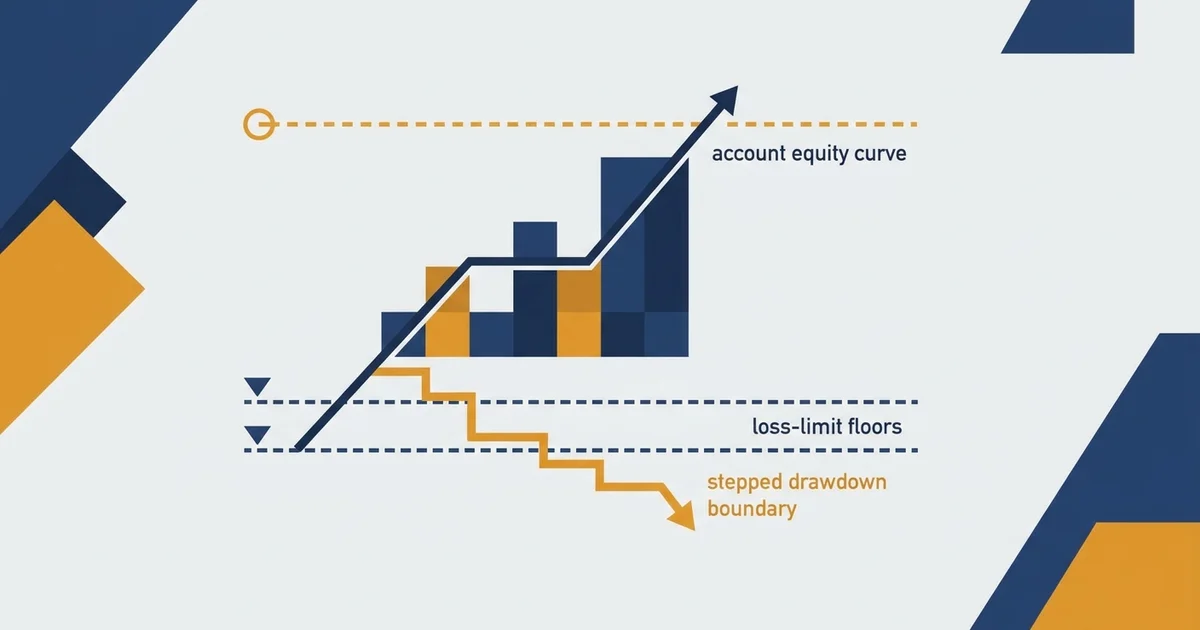

What the FTMO Challenge actually is
FTMO is a proprietary trading firm. It sells a paid evaluation, and traders who pass get to trade the firm’s money instead of their own.
The evaluation runs in two phases, and the FTMO Challenge is the first one. Here is the whole path at a glance.
| Stage | What it is | Profit target |
| Step 1: FTMO Challenge | The harder evaluation phase | 10% |
| Step 2: Verification | A second, gentler phase | 5% |
| FTMO Account | The funded account you trade for real | None, you just trade |
The loss limits are the same in both phases, so the second step is not easier on risk. It only asks for half the profit.
A few things are worth fixing in your head before the rules:
- You pay a one-time fee, scaled to the account size, and it is refunded with your first payout once you are funded.
- The account is simulated through both evaluation phases. Real money only enters once you pass.
- There is no bonus for speed. Hitting the target in three days or three weeks counts the same.
- Prop firms change their terms often. Treat the numbers here as the standard setup and confirm the current rules on the firm’s own site before you buy.
FTMO trading rules: the three numbers that decide it
Almost everything about passing comes down to three figures. Learn these before anything else, because they are the prop firm rules that end challenges, the FTMO trading rules included.
| Rule | Typical level | What it means |
| Profit target | 10% (Step 1) | What you must make to pass |
| Max daily loss | 5% | Most you can lose in one trading day |
| Max overall loss | 10% | Most you can lose across the whole account |
The target is the part beginners fixate on. The two loss limits are the part that actually fails them.
Notice the asymmetry. You are asked to make 10%, and you are allowed to lose 10% in total.
There is no room to make it back once you blow through the floor.
Account size sets your fee and your dollar limits, but the percentages stay the same across the range.
| Account | 5% daily loss | 10% max loss |
| $10,000 | $500 | $1,000 |
| $50,000 | $2,500 | $5,000 |
| $100,000 | $5,000 | $10,000 |
| $200,000 | $10,000 | $20,000 |
Bigger account, bigger fee, bigger dollar cushion. The skill it tests does not change with the size.
Daily loss versus max loss: the trap most people misread
These two limits sound similar and are not. Confusing them is the single most common way a good trader still fails.
| Limit | Resets? | What breaches it |
| Max daily loss (5%) | Yes, each new trading day | One bad session, or many small losses stacked in a day |
| Max overall loss (10%) | No, it is a hard floor | A slow bleed, or a daily loss that also drops the total below the line |
The daily limit is usually measured from your balance at the start of the day, so it forgives you overnight. The overall limit does not forgive anything.
Two rules follow directly from that:
- The daily limit means one bad day cannot end you if you respect it. Stop trading the moment a day gets close to the line, and tomorrow you start fresh.
- The overall limit means you can never fully recover from a deep hole. Lose 8% and you have 2% of room left to make 10%. That math almost never works.
If the word drawdown itself is fuzzy, our drawdown explainer walks through how firms measure it, including the trailing versions some prop firms use.
A trend method that fits the profit target
You do not need an exotic edge to make 10%. You need clean trends and the patience to sit in them, because forcing trades is what feeds the loss limits.
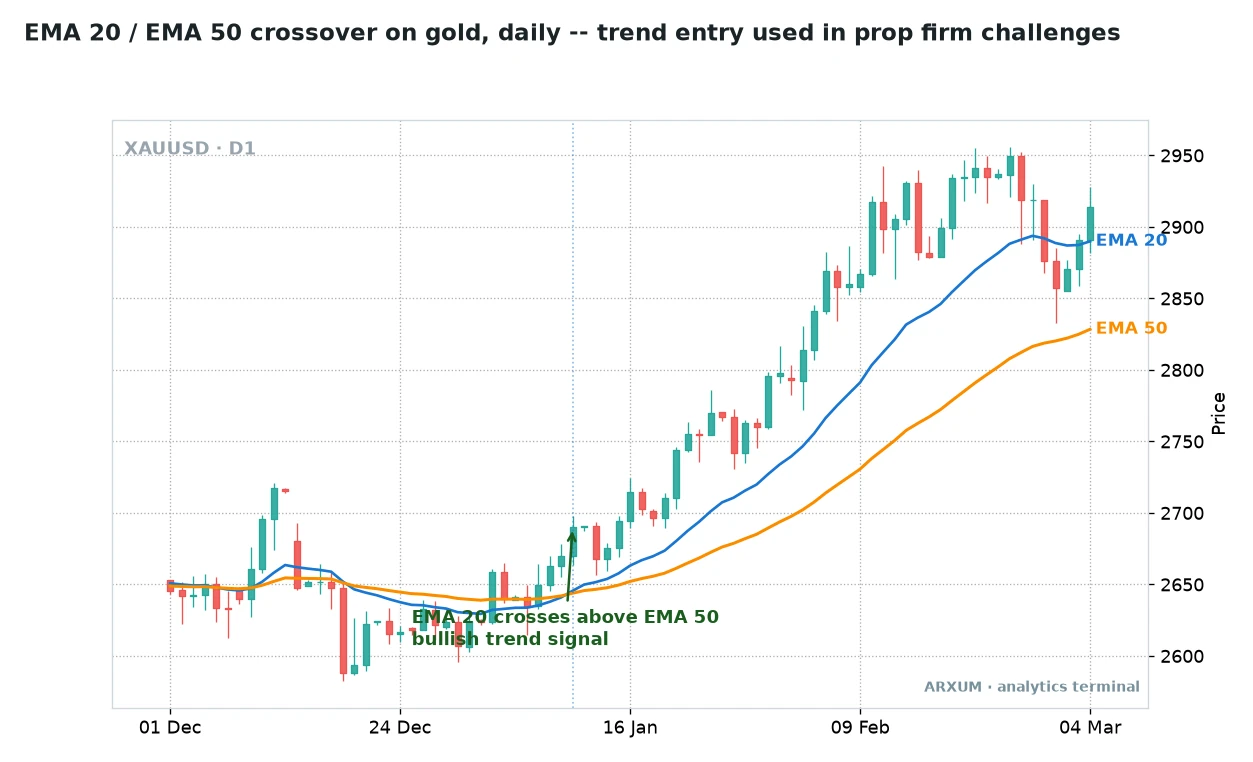
That gold chart shows the idea in one picture. The EMA 20 is a 20-day exponential moving average, a line that smooths the last 20 closes.
The EMA 50 does the same over 50 days and reacts slower.
When the faster line crosses above the slower one, the recent trend has turned up, and that is the entry the green arrow marks. Read it like this:
- The cross is the signal. Fast line over slow line means buyers have taken control of the recent range.
- The gap between the lines is the trend’s health. Widening apart is strong, curling together is a warning to tighten up.
- One good trend can be most of your target. Gold’s long climb is the sort of move that does the heavy lifting on its own.
| Element | How you use it | Best read |
| EMA 20 / EMA 50 cross | Times the entry with the trend | Daily or 4-hour, one clear direction |
| Distance between EMAs | Gauges how strong the trend is | Widening apart, not curling |
| The move itself | Carries you toward the target | Gold and index CFDs in a clean run |
The point is not that this exact cross is magic. It is that a trend-following approach keeps you out of the market most of the time, and time out of the market is time you cannot lose money.
Do not chase extended moves: protecting your drawdown
The fastest way into the daily loss limit is buying something that has already run. A stretched move is due a snapback, and that snapback is what hits your stop.
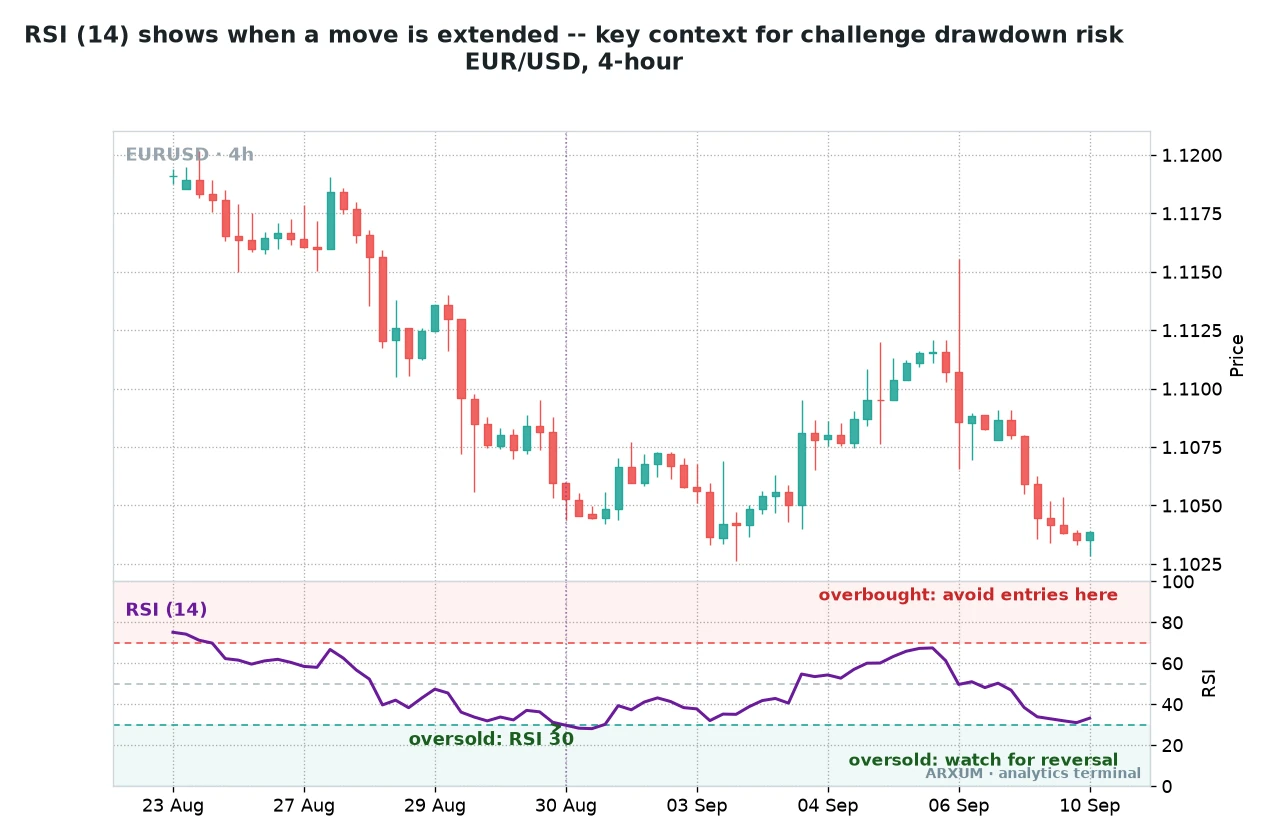
RSI, the relative strength index, is a gauge that runs from 0 to 100 and measures how one-sided recent moves have been. On this EUR/USD chart it sits in its own panel under the price.
Read the two bands and you have most of its value:
- Above 70, the overbought band: the move is stretched, and a fresh entry here is buying the top of a short-term push.
- Below 30, the oversold band: the move is stretched the other way, so a fresh short here is chasing the bottom.
- The middle, 30 to 70: ordinary conditions, where trend entries are cleaner.
| RSI reading | What it warns | What to do in a challenge |
| Over 70 | Long move is extended | Skip new longs, or wait for a pullback |
| Under 30 | Short move is extended | Skip new shorts, or wait for a bounce |
| Turning from a band | The snapback may be starting | Manage open trades, do not add |
You are not using RSI to predict tops here. You are using it to avoid the one entry that most often produces a fast, limit-threatening loss.
Position sizing: the real skill the challenge tests
This is where challenges are won and lost. Sizing every trade to the daily limit is the whole game, and it is why two traders with the same strategy get different results.
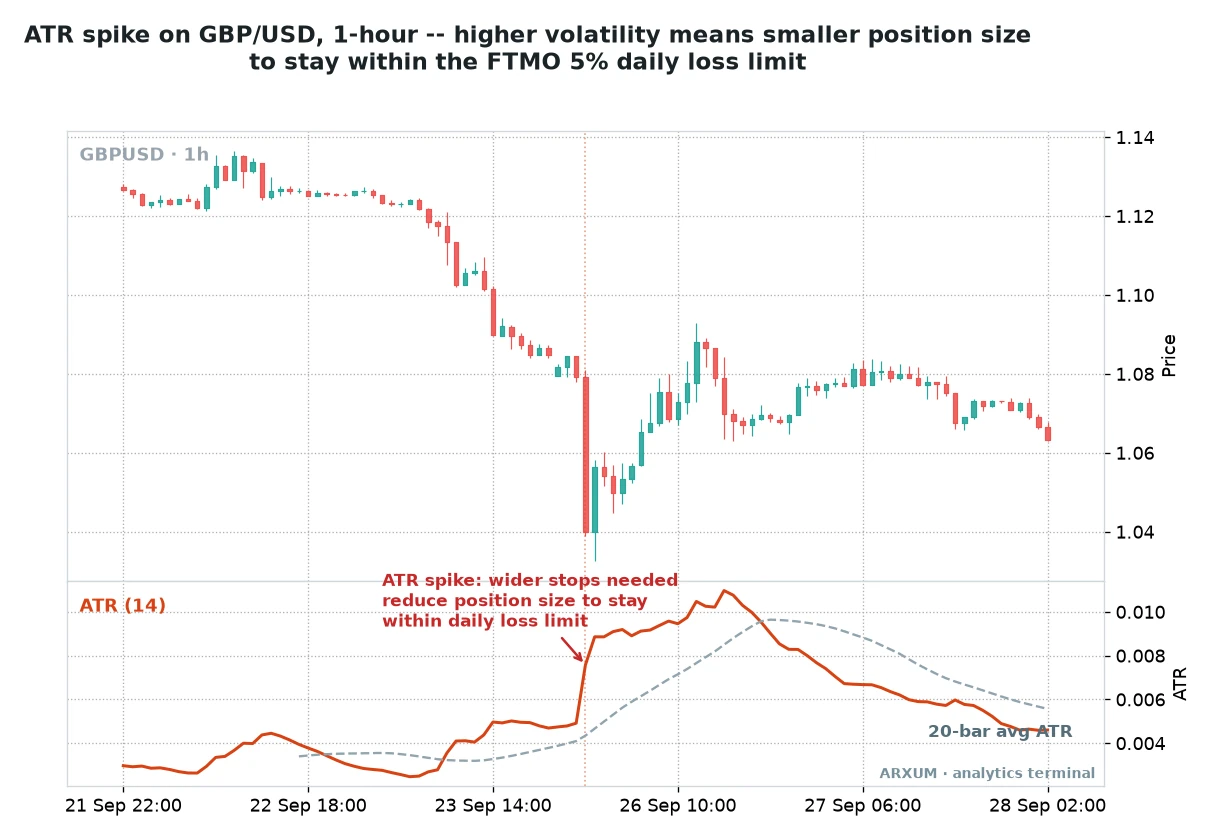
ATR, the average true range, is a simple volatility gauge. It measures how far price typically moves in a bar, and on this GBP/USD chart the spike marks a jump in volatility.
Higher volatility means you need a wider stop to avoid getting shaken out, and a wider stop with the same risk budget means a smaller position. The logic runs one way:
- Fix the dollar risk first, as a small slice of the account, then let the stop distance decide the size.
- When ATR is high, widen the stop and cut the lots, so the trade still risks the same dollars.
- Never widen the stop after entry to avoid a loss. That is how a 0.5% trade becomes a 5% day.
Here is the sizing worked out on a $100,000 challenge, so the numbers are concrete.
- Risk per trade: 0.5% of $100,000 = $500.
- Stop distance on EUR/USD: 50 pips.
- Value per pip you can afford: $500 ÷ 50 pips = $10 per pip.
- Position size: $10 per pip is 1.0 standard lot on EUR/USD.
So a full standard lot with a 50-pip stop risks $500, which is 0.5% of the account. Even four losers in a row cost 2%, well short of the 5% daily line.
| Risk per trade | Losers to hit the 5% daily limit | Verdict for a challenge |
| 2% | Two or three losing trades | Too aggressive, one bad session ends you |
| 1% | Five losing trades | Workable, but leaves little slack |
| 0.5% | Ten losing trades | Comfortable, keeps the daily limit far away |
The general advice you see everywhere is to risk 1 to 2% a trade. A prop challenge is the one place to go smaller, because the 5% daily cap punishes a normal losing streak far harder than your own account would.
Our position sizing guide covers the arithmetic in more depth, and the risk-reward ratio piece explains why a 0.5% risk aiming at a 1% or 1.5% reward is what actually builds the target.
How to pass the FTMO Challenge, step by step
Passing is less about a killer strategy and more about a boring, repeatable routine. Here is the whole thing as a checklist.
- Pick the smallest account you are comfortable funding. The rules are identical at every size, so learn the process cheaply before you scale up.
- Set your per-trade risk at 0.5%. Write down the dollar figure for your account and never let a single trade exceed it.
- Trade one or two setups only. A trend entry like the EMA cross, or a pullback in a clear trend, is enough. Fewer setups means fewer forced trades.
- Skip extended moves. If RSI is deep in a band, wait. The trade you skip is often the loss you avoid.
- Cap your day. Decide in advance that two or three losers ends the session, well before the 5% daily line. Walk away and start fresh tomorrow.
- Aim for a slow target, not a fast one. Averaging 1% a week clears the 10% target with room to spare and no heroics.
- Protect gains as you near the line. Once you are most of the way to the target, cut risk further. Giving back a passing account on a careless trade is the classic ending.
The routine matters more than the entries. Most people who fail do not lack a strategy.
They lack the discipline to size small and stop early.
Common reasons traders fail the FTMO Challenge
The failures cluster into a short list, and every one is avoidable. If you are going to lose, it is almost certainly one of these.
- Oversized positions. Risking 2% or more, so a normal losing streak trips the daily limit.
- Revenge trading. Taking a bigger trade right after a loss to win it back, which usually doubles the damage.
- Chasing news spikes. Entering into a fast, extended move that snaps back through the stop.
- Ignoring the daily limit. Trading on past a rough morning instead of closing the platform.
- Widening stops. Moving the stop to avoid a loss, turning a small planned loss into a limit breach.
- Rushing the target. Sizing up to pass in a week, which is the surest way to fail in a day.
| Mistake | The fix |
| Position too large | Risk 0.5% and size to the stop |
| Revenge trading | A hard daily loss cap you set in advance |
| Chasing extended moves | Skip entries when RSI is deep in a band |
| Widening the stop | Set it once, honour it, never move it wider |
| Rushing to pass | Target roughly 1% a week, not 10% at once |
Which markets and timeframes suit the challenge
You can trade the usual instruments, but some fit the format better than others. The goal is clean movement and stops you can size around, not the most action.
| Market | Best timeframe | Why it fits |
| Spot gold (XAU/USD) | Daily, 4-hour | Long trends carry a target with fewer trades |
| EUR/USD | Daily, 4-hour | Tight spreads, orderly trends, easy sizing |
| GBP/USD | 4-hour | Trends hard, but watch the ATR spikes on news |
| Index CFDs | Daily, 4-hour | Strong directional runs during trending regimes |
Two habits sit on top of the table:
- Trade the higher timeframes. The daily and 4-hour give fewer, cleaner signals, which suits a slow, steady target.
- Mind the calendar. Big news brings the ATR spikes that force smaller size, so trade lighter, or not at all, around scheduled releases.
Firm-to-firm the rules and instruments vary, so if you are still choosing where to take a challenge, compare the options in our prop trading firms guide before you pay a fee.
Decision guide: what to do, at a glance
| Situation | Do this |
| Starting a fresh challenge | Take the smallest account and risk 0.5% a trade |
| A clean trend on the daily | Enter with the trend, size to the stop |
| RSI deep in a band | Wait for a pullback, do not chase |
| Volatility spiking, wide ATR | Widen the stop and cut the position size |
| Two or three losses today | Stop for the day, well short of the 5% line |
| Most of the way to the target | Cut risk further and protect the pass |
| Down near the overall limit | Accept it is likely gone, do not gamble the last of it |
What works: the short version
If you keep three things from this guide, keep these.
- The loss limits beat you, not the target. Respect the 5% daily and 10% overall lines and the 10% target takes care of itself over time.
- Size small, around 0.5% a trade. A challenge is the one account where you go under the usual 1 to 2% rule, because the daily cap punishes streaks.
- Trade less, on higher timeframes. Clean trends, skipped extended moves, and a hard daily stop are what carry an account across the line.
FTMO reviews and firm rankings will tell you which challenge to buy. What passes it is the same on every firm: small risk, patient entries, and a hard stop for the day.
For the mechanics behind the model, see what prop trading is.
Glossary
- FTMO Challenge: the first, harder phase of FTMO’s two-step evaluation to fund a trader.
- Verification: the second phase, with a smaller profit target and the same loss limits.
- Profit target: the gain you must reach to pass a phase, usually 10% in Step 1.
- Max daily loss: the most you can lose in one trading day, typically 5%, reset each day.
- Max overall loss: the hard floor on total losses, typically 10%, which never resets.
- Drawdown: how far an account has fallen from its high point.
- EMA: exponential moving average, a line that smooths recent closing prices.
- RSI: relative strength index, a 0 to 100 gauge of how stretched a move is.
- ATR: average true range, a gauge of how far price typically moves in a bar.
- Profit split: the share of profits you keep on the funded account, often up to 80 to 90%.
FAQ
What is the FTMO Challenge?
The FTMO Challenge is the first phase of a two-step evaluation that a prop firm uses to decide whether to fund a trader with its own capital. You trade a simulated account and must reach a profit target, usually 10%, while never losing more than 5% in one day or 10% overall. Pass it, then pass a second Verification phase, and the firm gives you a funded account where you keep most of the profits.
What are the FTMO trading rules?
Three numbers matter most. A profit target of about 10% in the first phase, a maximum daily loss of 5%, and a maximum overall loss of 10%. The daily limit resets each trading day, while the overall limit is a hard floor that never resets. The percentages stay the same across account sizes, and firms update their terms, so confirm the current rules on the firm's own site.
How do you pass the FTMO Challenge?
Size small, around 0.5% risk per trade, so a normal losing streak stays far from the 5% daily limit. Trade one or two setups on the daily and 4-hour charts, skip extended moves, and set a hard daily stop of two or three losers. Aim for roughly 1% a week rather than the full 10% at once. The loss limits fail most traders, not the target, so protecting your drawdown is the whole job.
How to pass a prop firm challenge in general?
The approach is the same across firms. Trade smaller than you would on your own account, usually 0.5 to 1% risk per trade, because the daily loss limit punishes streaks. Take fewer, higher-quality trades on higher timeframes, respect a hard daily loss cap, and aim for a slow, steady target instead of a fast one. Most challenges are lost to oversizing and revenge trading, not to weak strategies.
What is the difference between the daily loss and the max loss?
The daily loss limit, around 5%, caps how much you can lose in a single trading day and resets when the next day begins. The maximum overall loss, around 10%, is a hard floor on total losses that never resets. One bad day cannot end your challenge if you respect the daily line, but a slow bleed or a deep hole against the overall limit can, because there is no room left to recover.
Is FTMO worth it? A short review.
For a disciplined trader who already manages risk well, the challenge model lets you trade far more capital than you could fund yourself, for a one-time fee that is refunded with your first payout. The catch is that most people fail, usually from oversizing rather than strategy. If you cannot yet trade a small account without big drawdowns, a challenge will expose that quickly. Compare firms on fee, profit split, and rules before you commit.
How much money do you need to start an FTMO Challenge?
You only pay the evaluation fee, which scales with the account size you choose, from small accounts up to $200,000 and beyond. You are not funding the trading account itself during the evaluation, since it is simulated until you pass. Start with the smallest account you are comfortable paying for, learn the process, then scale up once you can pass consistently.
How much should you risk per trade in a prop challenge?
Less than you would normally. About 0.5% of the account per trade is a comfortable level, because it takes ten losing trades in a row to reach the 5% daily limit. Risking the usual 2% leaves you two or three losers away from a breach, which a normal losing streak can trigger. Size to your stop distance, and cut the position further when volatility, measured by ATR, is high.
How long does the FTMO Challenge take?
There is no reward for speed, so the sensible pace is slow. Averaging around 1% a week reaches the 10% target in roughly two to three months with plenty of margin for error. Rushing to pass in a week is one of the most common reasons traders fail, because it forces oversized trades. Time limits and minimum trading days have changed over the years, so check the firm's current terms.
Real-time trade setups with entry, stop loss and take profit. Daily market analysis. No subscription, no complicated theory.
🌍 Our recommended brokers


Reader Reviews
Be the first to review this — tell other traders what actually helped, or where it fell short.
Leave a Review

Forex Analyst & Senior Trader
Former FX desk trader with 8 years in institutional forex. Works in multi-timeframe analysis and order flow, turning desk experience into systematic, testable rules across forex and metals.