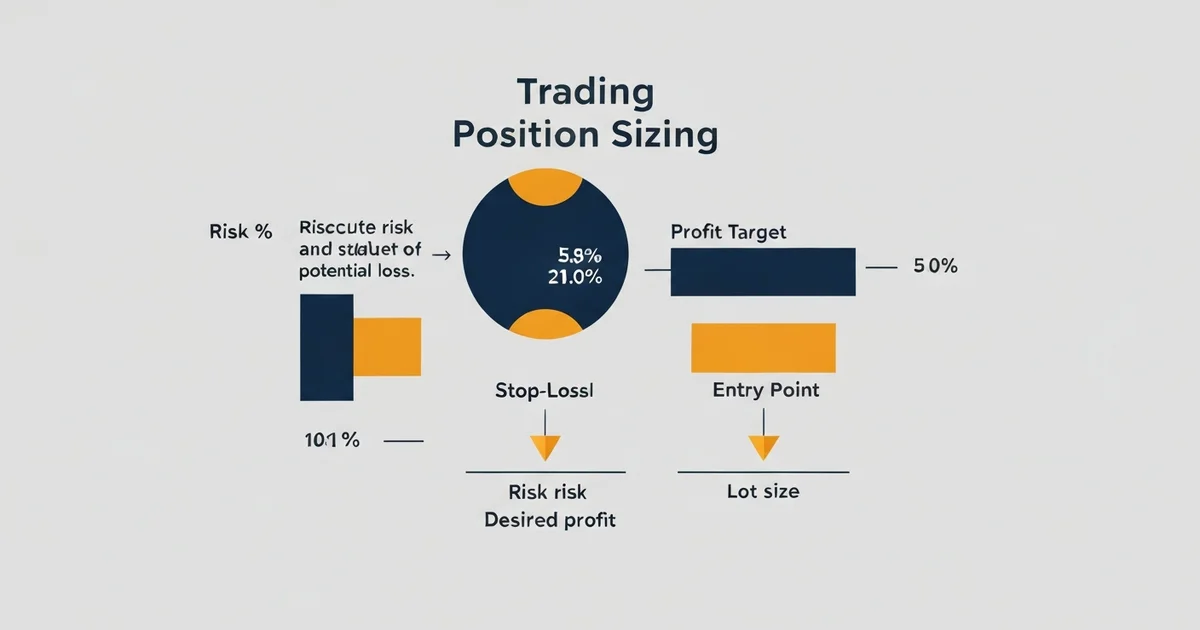

Why most traders get position sizing wrong
After eight years on an FX trading desk, the pattern I saw most in retail traders was consistent: they sized positions by feel. They spotted what looked like a good setup and bought as much as the broker allowed. A 30-pip stop on that kind of position becomes a 5% account loss instead of 1%.
Position sizing determines whether you survive long enough to let a real edge play out. A 70% win rate strategy still blows accounts when positions are sized incorrectly. Three oversized losses in a bad week, and traders restart from scratch with capital they spent months building.
The fix is mechanical. Once you know the formula, it takes two minutes to apply before every trade.
The position sizing formula
Three inputs, one calculation.
Account risk amount: your balance multiplied by your risk percentage. Risking 1% of a $1,000 account means $10 at risk.
Stop loss in pips: the distance from entry to stop on the chart. A 20-pip stop on EUR/USD at standard lot sizing costs $20 per lot.
Pip value: for USD-quoted pairs (EUR/USD, GBP/USD), pip value is $10 per standard lot, $1 per mini lot (0.1), $0.10 per micro lot (0.01).
The calculation:
Lot Size = (Account Balance × Risk %) ÷ (Stop Loss in Pips × Pip Value per Lot)
A worked example with real numbers:
- Account: $1,000
- Risk per trade: 1% = $10
- Stop loss: 20 pips
- Pair: EUR/USD
Lot Size = $10 ÷ (20 × $10) = $10 ÷ $200 = 0.05 lots
You risk exactly $10 on that trade, regardless of what the market does between entry and stop. That is the whole point: you control the loss amount before you enter.
Lot size examples by deposit level
The same 1% rule applied at different account sizes, using a 20-pip and 40-pip stop on EUR/USD:
| Account | 1% risk | 20-pip stop | 40-pip stop |
|---|---|---|---|
| $150 | $1.50 | 0.0075 (round to 0.01) | 0.004 (round to 0.01) |
| $600 | $6.00 | 0.03 lots | 0.015 (round to 0.02) |
| $1,000 | $10.00 | 0.05 lots | 0.025 lots |
| $2,000 | $20.00 | 0.10 lots | 0.05 lots |
At $150, broker minimum lot sizes (usually 0.01) create a floor that slightly exceeds 1% risk when stops are wide. That’s acceptable at that account size. The goal is consistency, not mathematical perfection at the entry level.
On a $600 account, 0.03 lots for a 20-pip EUR/USD stop is the correct sizing. The forex lot size calculator guide covers pip value calculations across all pairs, including JPY crosses and Gold where pip values differ.
The 1% vs 2% risk rule: what works in live trading
The textbook says 1-2% per trade. In practice, the right number depends on your win rate and R:R ratio.
Running the math at a 60% win rate strategy with 1.5:1 average R:R:
- At 1% risk: a 10-trade losing streak (which happens) costs 10% of account. Painful, recoverable.
- At 2% risk: same streak costs 20%. Psychologically difficult to continue trading without cutting size.
- At 5% risk: 10 consecutive losses = 50% drawdown. Most traders quit at this point, or force-trade to recover it.
I’ve been running 1% risk per trade on my $8,500 Exness Pro account since 2023. In trending conditions (Gold through 2025, EUR/USD in late 2024), that generated 6-8% monthly returns on a strategy running at 71% win rate across 11 live trades.
The counterintuitive finding: 1% risk doesn’t limit returns. It limits drawdowns. Better drawdown control means you stay in the game long enough for an edge to compound. At 2% risk, winning months produce slightly higher returns, but the drawdowns during losing runs are large enough to force position reduction at exactly the wrong time, which kills compounding over a full year.
How stop loss placement drives your lot size
A common mistake: calculating lot size based on an assumed stop, then moving the stop after entry. Your stop must be set first. Move it and you’ve changed the risk without knowing the new amount.
Three stop types and how each affects sizing:
- Structural stop (placed behind support or resistance): distance varies by setup, typically 20-50 pips on forex majors. Lot size adjusts to match.
- ATR-based stop (1-2× ATR below entry): scales with volatility. On a high-volatility day, your stop is wider and lot size smaller.
- Fixed-pip stop (always 20 or 30 pips): simplest to calculate, but ignores market structure. Works on liquid pairs at consistent timeframes; gets taken out by routine noise on GBP/JPY and similar pairs.
On the desk, we used structural stops — placing them behind levels the market needs to reclaim to invalidate the trade thesis. Fixed-pip stops get hit by normal range expansion on pairs that move 40-60 pips in a single session. Understanding risk-reward ratio ties directly into this: stop placement determines both your risk and your R:R target simultaneously.
Position sizing and drawdown: the compound math
A 20% account drawdown requires a 25% return to break even. A 50% drawdown requires 100%. These are not round numbers for effect. That is just how percentage recovery works.
Oversized positions create oversized drawdowns. Trading 5% risk means a 10-trade losing streak produces a 50% drawdown. Most traders never recover from that, either mathematically or psychologically.
The drawdown guide covers the full compound math, but the short version: losing less per trade is always worth more over time than risking more per trade. The expected value of larger position sizes doesn’t compensate for the variance it introduces.
One specific finding from live trading that surprised me: increasing position size after a winning streak consistently underperforms flat 1% sizing across any 6-month period. Traders who double up after winners almost always give back gains on the next correction. The variance spike doesn’t justify the return pickup.
Adjusting position size for different instruments
Pip value changes by pair and account currency. USD-quoted pairs are straightforward. Others require adjustment.
- USD-quoted pairs (EUR/USD, GBP/USD): pip value = $10 per standard lot. Clean calculation.
- JPY pairs (USD/JPY, GBP/JPY): pip = 0.01 movement, worth approximately $9.09 per lot. Use your broker’s built-in calculator.
- Cross pairs (EUR/GBP, EUR/JPY): pip value varies with exchange rate. Most brokers calculate this in the order ticket automatically.
- XAU/USD (Gold): 1 pip = $1 per mini lot (0.1), $10 per standard lot. A 200-pip Gold stop at 1% risk on a $1,000 account means 0.005 lots, effectively one micro lot.
For anything beyond EUR/USD and GBP/USD, use the forex lot size calculator rather than calculating manually. Pip value errors on cross pairs or Gold are a consistent source of unintentional oversizing.
Investopedia’s position sizing explainer covers the formula variations across instrument types if you want a second reference on the math.
Common position sizing mistakes
Sizing based on profit targets: calculating backward from what you want to make rather than forward from what you’re willing to lose. This produces oversized entries on every trade because traders anchor to the reward, not the risk.
Ignoring slippage: on exotic pairs or during news events, your actual fill can be 5-15 pips beyond the stop you calculated. Build a buffer into the stop distance before calculating lot size.
Not resizing as the account grows: a trader starting at $600 trades 0.03 lots per trade at 1% risk. After building to $1,200, they’re still trading 0.03 lots, leaving compounding on the table. Resize quarterly, or whenever the account balance moves 20%+ in either direction.
Using available margin as a sizing guide: “I have $500 margin free, so I’ll use $400 of it” is not position sizing. Margin and risk are unrelated. Margin shows the broker’s minimum capital requirement. Risk shows what you should trade.
Conviction sizing: increasing lot size on trades that “feel” high-probability. In 8 years trading live markets, I haven’t found a reliable real-time way to distinguish genuinely high-probability setups from ones that just feel that way. Flat 1% across all signals outperforms variable conviction sizing over any meaningful sample.
FAQ
What is position sizing in trading?
What percentage should I risk per trade?
How do I calculate lot size for EUR/USD?
Should I size up when I'm on a winning streak?
How does position sizing connect to stop loss placement?
Can I use proper position sizing on a $150 account?
What's the difference between position sizing and lot size?
Real-time trade setups with entry, stop loss and take profit. Daily market analysis. No subscription, no complicated theory.
🌍 Our recommended brokers


Reader Reviews
XAU/USD was where I made my worst sizing errors before finding this article. I was treating Gold the same as a forex major and using the EUR/USD pip value formula. On Gold, one pip is one dollar per 0.1 lot, which means a 200-pip stop at 0.05 lots is a $100 exposure on a $2,000 account - 5% risk. I had been running that size for six weeks under the impression I was risking 1%. The corrected calculation put me at 0.01 lots for a 200-pip Gold stop. The reduced lot size felt uncomfortable at first, but my drawdowns on XAU/USD dropped from frequent 4 to 6 percent single-trade hits to a consistent 1% maximum. Over the following two months, return on Gold daily improved from barely breakeven to +7.3% monthly as winning trades were finally compounding instead of being erased by oversized losses.
The EUR/USD worked example is what I needed when I started on a $600 account. I had been using 0.05 lots as a fixed number without understanding why, and the calculation here made clear that 0.05 lots on a 30-pip stop was risking 2.5% of my account. After adjusting to 0.03 lots for standard 20-pip setups and 0.02 for 30-pip setups, my drawdowns became predictable for the first time. Three months at flat sizing, averaging +7.1% monthly on EUR/USD.
The point about resizing when the balance moves 20% is the one I needed to read. I had been running 0.03 lots on EUR/USD after my account grew from $600 to $900, which meant my 1% risk calculation was actually 0.67% by that point. Resizing quarterly as recommended here corrected the drift and returned me to consistent 1% exposure across all setups.
I blew a $900 account in my first four months of EUR/USD daily trading, and the root cause was the same each time: positions too large when the stop was wide. I knew I was risking a little more than I should without calculating the actual dollar amount. Finding the formula - balance times risk percent divided by stop pips times pip value - took ten minutes to apply to my trade log from those four months. Every losing month traced back to trades where I was risking 3 to 8 percent per position. Running 1% flat on EUR/USD and XAU/USD since January, my worst month has been minus 4.2% across 11 trades. My best month finished at +7.8%. The range of outcomes compressed dramatically just by fixing the lot size calculation.
Two minutes before every EUR/USD trade now - balance times 0.01, divided by stop pips times 10. That formula replaced the guesswork I used for six months and cut my worst single-trade loss from 4.3% to exactly 1%. Account is up +7.6% in the past five weeks using nothing else.
JPY pairs nearly cost me a $1,400 account before this article explained the pip value difference. I was using the EUR/USD formula for USD/JPY - $10 per pip per lot - and the actual value on JPY pairs runs closer to $9 depending on the rate. On a 50-pip stop at 0.08 lots I thought I was risking $40. The actual exposure was $36, which would have been fine, but the same calculation on GBP/JPY with an 80-pip stop put me at 5.6% risk instead of the 1% I intended. The article is direct about this: use the broker calculator for anything outside EUR/USD and GBP/USD. I do that now without exception. Running on Exness standard account, averaging +6.8% monthly across USD/JPY and GBP/USD daily setups over the past three months.
The section on drawdown compound math was the clearest I have read on why position sizing matters beyond individual trade outcomes. I ran 3% risk per trade for four months because my broker allowed it and it felt natural. After a 12-trade losing streak that cut my account by 31%, I found this article. Switching to 1% flat, the same 12-trade losing streak would have produced an 11.4% drawdown. That is a recoverable number. Running at +7.5% monthly over the past two months with 1% risk on EUR/USD daily.
The section on conviction sizing is what I came back to three times. I had been doubling position size on setups I rated as high-probability, and it produced exactly the pattern described here: the oversized loss on a failed conviction trade wiped gains from two or three correct calls. Shifting to flat 1% regardless of confidence level cut my month-to-month variance by more than half. I would give 5 stars but the Gold pip value section is brief for what is a more complex calculation than EUR/USD.
Leave a Review

Forex Analyst & Senior Trader
Former FX desk trader with 8 years in institutional forex. Works in multi-timeframe analysis and order flow, turning desk experience into systematic, testable rules across forex and metals.