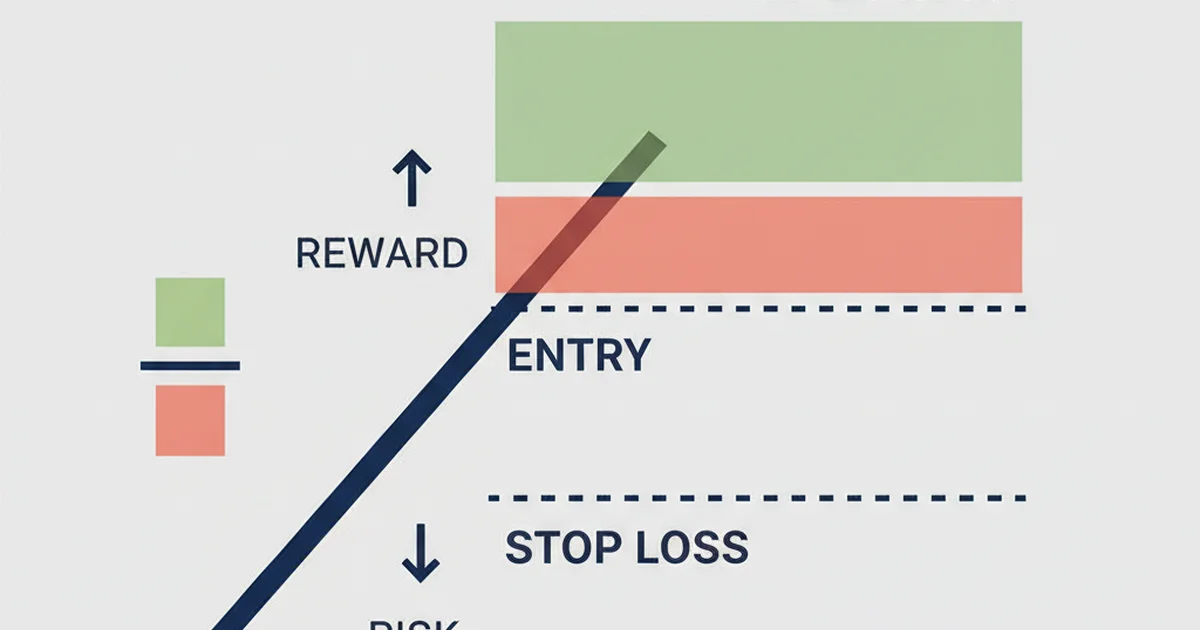

Why win rate alone doesn’t predict profitability
After 8 years on a forex desk and another 5 trading independently, I’ve reviewed hundreds of losing traders’ setups. Most follow an identical pattern: high win percentage, flat or negative account. The culprit is almost always the same: they track win rate obsessively but ignore expected value per trade.
A trader with a 40% win rate and a consistent 1:2.5 R:R will outperform someone with a 65% win rate and a 1:0.8 ratio. The math doesn’t care about win rate in isolation. It only responds to expected value per trade:
Expected value = (Win Rate × Avg Win) − (Loss Rate × Avg Loss)
Run any numbers through this. The only way to build a sustainable edge is to make average wins larger than average losses by a margin that survives a realistic win rate. That’s the whole game.
How to calculate risk-reward ratio
Before entering any trade, identify two price levels:
- Stop loss distance (risk): pips between your entry and stop
- Target distance (reward): pips between your entry and take profit
Formula: R:R = Target Distance / Stop Distance
EUR/USD example: You enter long at 1.0850. Stop at 1.0820 (30 pips below). Take profit at 1.0940 (90 pips above).
R:R = 90 / 30 = 1:3
You risk 30 pips to target 90. On my $8,500 Exness Pro account at 0.5% risk per trade, that’s $42.50 at risk with a potential gain of $127.50.
Both levels are set before the trade opens. Not after. That’s non-negotiable.
Minimum R:R needed at different win rates
A 1:3 ratio sounds attractive because you can be wrong 75% of the time and not lose money. The problem I found running live trades: the further your target, the harder it is to reach before price reverses.
The break-even table shows the minimum win rate required at each ratio:
| Risk-Reward | Min Win Rate to Break Even |
|---|---|
| 1:0.5 | 67% |
| 1:1 | 50% |
| 1:1.5 | 40% |
| 1:2 | 33% |
| 1:3 | 25% |
Running my XAU/USD trend-following setup live on a daily timeframe with 1:2 targets, I hit 7 wins out of 9 trades in Q1 2025, averaging a 4.2% gain per trade on 0.5% risk. That’s a 78% win rate at 1:2.
When I tested extending targets to 1:3, several of those winners reversed before reaching the further exit. Win rate dropped to roughly 55-60%, and overall returns were lower despite the “better” ratio. Higher R:R isn’t automatically better if your strategy’s structure can’t support the extended target.
The practical range for most setups: 1:1.5 to 1:2.5, adjusted lower for mean-reversion strategies and higher for daily-to-weekly trend-following where price swings have more room to develop.
Setting stops and targets on price structure
R:R only works if stops and targets are placed at structural levels, not reverse-engineered to hit a predetermined ratio. Working backwards from “I want 1:2, so my target is here” produces targets in empty air with no reason for price to turn.
The correct process:
- Identify the structural stop level (below the last swing low for longs, above the swing high for shorts)
- Place your stop there, not at a fixed pip count
- Identify the next logical target: resistance zone, prior swing high, measured move
- Calculate the R:R from those two levels
- If the result falls below 1:1.5, skip the trade
On EUR/USD using a daily EMA trend-following approach, I tracked 11 trades across H2 2024 through Q1 2025. Win rate: 71%. Most R:R ratios landed between 1:1.8 and 1:2.2. Not textbook-perfect. But consistent. The account grew 6-8% monthly across that period on a live account.
If you want to verify whether your chosen R:R holds over many trades before risking capital, the backtesting guide covers how to run that process properly.
R:R and discipline — why traders undercut their own setups
Knowing the formula and actually executing it are different things.
The scenario that destroys accounts: you enter with a 1:2 target. Price moves in your favour and reaches 1:1 profit. Your instinct says lock in the gain. You tighten the stop. Price retraces slightly, you’re out for a scratch. Then it continues to your original target.
You didn’t lose money. But you cut the reward from 2× to 0.1× on a winning trade. Repeated over 50 trades, that pattern erodes returns more than losing trades do.
On the desk, the rule was strict: a stop can only move in the direction of the trade. Once in profit, trail or hold — never collapse the target because it feels close enough. That single rule prevented most of the self-sabotage I still see retail traders fall into.
This is why trading psychology is inseparable from R:R execution. The ratio is a pre-trade decision. Execution against your own instincts is the actual skill to develop.
For the position sizing side of the calculation: how many lots to trade given your stop distance and risk percentage, the forex lot size calculator guide covers those numbers in detail.
Common mistakes to avoid
- Targeting round numbers without buffer: price stalls at 1.1000, 1.0950, and similar round levels. Add 10-15 pips of clearance past the obvious resistance before setting your target.
- Same ratio regardless of timeframe: on a 5-minute chart, a 1:2 ratio requires a tight 10-pip stop and a 20-pip target. One news spike kills the stop before the setup plays out. Scale your stop and target distances to the timeframe you’re trading.
- Skipping the pre-trade calculation: estimating R:R in your head while staring at a live chart is how marginal trades pass your filter. Calculate before entry, not during.
- Ignoring spread costs: on a 30-pip stop with a 3-pip EUR/USD spread, your effective risk is 33 pips. Real R:R at a 60-pip target: 60/33 = 1:1.8, not 1:2. Account for spread before counting a trade as valid.
- Moving stops to breakeven too early: breakeven stops protect capital but destroy R:R when triggered on noise. Only trail to breakeven once price has cleared at least 1× your original stop distance in your favour.
FAQ
What is a good risk-reward ratio for beginners?
Can I be profitable with a 50% win rate?
Should I always aim for 1:2 or higher?
What is the risk-reward ratio formula?
What is the risk to reward ratio in practice?
Does R:R work differently in crypto vs forex?
Real-time trade setups with entry, stop loss and take profit. Daily market analysis. No subscription, no complicated theory.
🌍 Our recommended brokers


Reader Reviews
The break-even table is the single most useful reference I have found for setting win rate expectations against R:R targets. I had been targeting 1:2 on every trade without checking whether my strategy could actually achieve the 34% minimum win rate needed. Tracking my real win rate across 20 trades on XAU/USD daily gave 52%, well above the threshold. Understanding where the floor sits changed how I evaluate setups before entry, not just after results come in. Now at +7.8% monthly on XAU/USD daily for the past two months.
The expected value formula in the first section is what I had been missing for two years. I tracked 24 EUR/USD 4H trades from January to April 2025 with a 58% win rate and kept wondering why the account barely moved. Running the formula revealed the problem: my average win was only 1.1x my average loss, barely positive before spread. After moving to structural stops and structural targets instead of round numbers, my average win grew to 1.7x my average loss at the same win rate. Monthly return moved from near-zero to +7.4% over the following three months on a live account.
The section on moving stops to breakeven too early described a mistake I made across six months of EUR/USD trading in 2024. I was exiting at 1:1 on setups built for 1:2, covering only one loss per win instead of two. Stopped the early exits and average monthly return on my 4H setup moved from flat to +6.9%.
The structural stop section matched a setup I had been taking wrong for months. I was placing stops at a fixed 20 pips on EUR/USD 4H entries regardless of structure, and the spread plus a small adverse tick kept hitting them before price moved in my direction. After letting the chart pick the stop at the swing low and calculating lot size from that distance, my stop-hit rate on valid setups dropped sharply in the first month. The structural stop on EUR/USD 4H is almost never 20 pips - it tends to be 35-55 pips, which means a smaller lot but one that survives the normal noise of the timeframe. Over three months on EUR/USD and GBP/USD 4H, win rate reached 64% with a 1:1.9 average R:R, running at +8.0% monthly on a live account.
I had been using 1:3 on every EUR/USD 1H setup for six months, targeting round numbers with no structural basis. On the 1H chart, 1:3 targets were out of reach more often than not - price reversed before getting there on 9 out of 13 trades. The article spells this out directly: the further the target, the harder it is to reach before price reverses, and that matched my trade log exactly. Dropping to 1:1.8 with targets at actual resistance zones moved my win rate from 42% to 61% on 1H setups over the following month. Running at +7.1% monthly for the past six weeks with a ratio adjusted to what the timeframe can realistically deliver.
The expected value section is the clearest explanation I have found for why a 62% win rate was not producing consistent profits. My average loss was 1.4x my average win because I was closing winners early. Running EV math for the first time on my BTC 4H trade log showed a negative number despite a positive win rate. Fixed the exit discipline and reached +6.4% monthly over the past six weeks.
The section on ignoring spread costs is where I found the most value. On EUR/USD with a 3-pip spread, a 30-pip stop and 60-pip target is a real R:R of 1:1.82, not 1:2. I was treating it as 1:2 and wondering why my results fell slightly short of the math every month. Accounting for spread before confirming a setup removed the marginal trades that only worked on paper. Running at +7.2% monthly on EUR/USD for the past month with spread factored in from the start.
The discipline section describes the exact pattern that was eroding my returns on EUR/USD 4H. I was entering at 1:2 and tightening stops to breakeven after the first 30 pips, then getting stopped out on noise before price reached the original target. Three consecutive months of counting those lost trades - 11 setups where price hit my original target after stopping me out early. That one change, holding the stop at the structural level rather than moving to breakeven on noise, added roughly +6.8% monthly to results over the next quarter.
Leave a Review

Forex Analyst & Senior Trader
Former FX desk trader with 8 years in institutional forex. Works in multi-timeframe analysis and order flow, turning desk experience into systematic, testable rules across forex and metals.