

What crypto arbitrage actually is
Every crypto arbitrage trade is the same bet: the same value is priced two ways, and you capture the difference before it closes. The clearest way to see that is a single coin quoted on two exchanges, with the gap between them scored underneath.
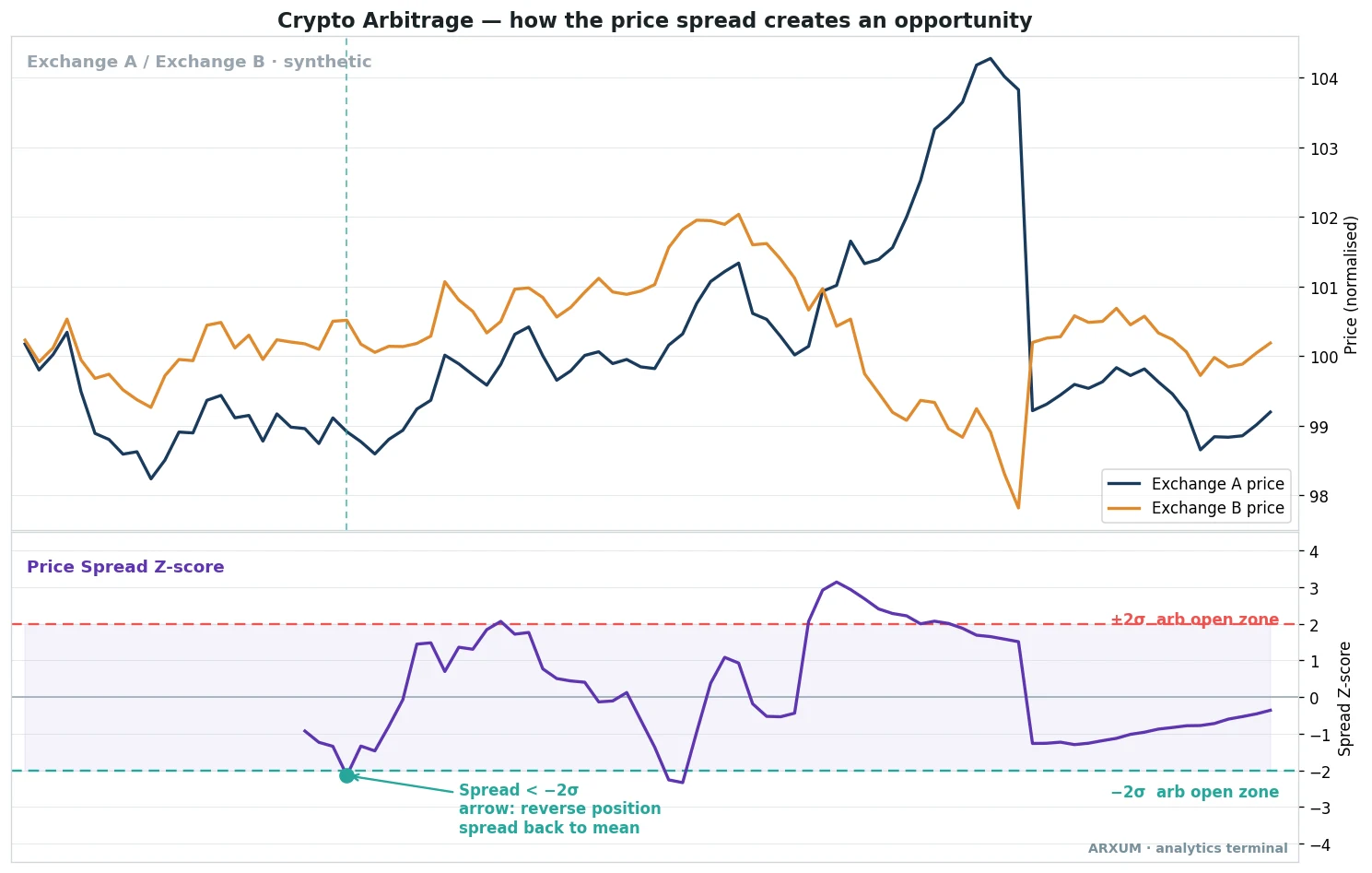
A few labels on that chart carry the whole idea, so read them before the types:
- The two price lines are one coin on Exchange A and Exchange B. Most of the time they sit almost on top of each other.
- The spread is the distance between them. That distance is the raw arbitrage opportunity.
- The z-score (bottom panel) rescales the spread into “how unusual is this gap right now”. A z-score of 0 means the gap is normal; a z-score of 2 means it is two standard deviations wide.
- Standard deviation is just a measure of normal wobble, written with the symbol σ (sigma) on the chart. Two of them is a genuinely stretched gap, not noise.
- The arb open zone is the shaded band past plus or minus two σ. Inside it the gap is wide enough to be worth trading, so you open there, and the arrow marks where it snaps back toward the average, which is where you close.
That open-when-stretched, close-at-the-average logic is exactly what the statistical types below trade. The fast types, spatial and triangular, skip the wait and just grab an instant gap.
All four hunt the same thing, they just look for it in different places.
| Type | Where the gap lives | Speed to capture |
| Spatial | Same coin, two exchanges | Milliseconds |
| Triangular | Three pairs, one exchange | Milliseconds |
| Statistical / pairs | Two correlated coins drifting | Hours to days |
| Funding rate | Perpetual futures vs spot | Hold for days |
Spatial (cross-exchange) arbitrage
Spatial arbitrage is the simplest case of that spread: one coin, two venues, buy the cheap side and sell the rich side at once. There is no waiting for a signal to revert, you just grab the gap the moment it opens, and it is the type retail lost first.
How it looks:
- The two exchange prices separate for a few seconds or minutes, usually around news, a big order, or a thin order book on one venue.
- The gap is small, often a fraction of a percent, and it closes fast as other traders pile in.
- The real move is buy on the cheap exchange, sell on the expensive one in the same instant, so you never actually hold direction.
- You need coins pre-funded on both venues, because waiting for a blockchain transfer to move funds across kills the trade.
Application at a glance:
| Role | How you use it | Best read |
| Spot the gap | Watch one liquid coin on two exchanges | BTC or ETH pairs |
| Enter | Buy cheap venue, sell dear venue at once | Both pre-funded |
| Exit | Close as the gap narrows | Within minutes |
| Filter | Skip if fees plus transfer beat the gap | Net gap only |
The catch is speed: automated systems sit on the same order books and take these gaps in milliseconds. That is why spatial arbitrage now belongs to high-frequency trading desks and bots, not to anyone refreshing two browser tabs to find the gap already gone.
Rule of thumb: if you can see the spatial gap on a normal chart, it is already too slow to trade by hand.
When a spatial gap actually lasts
A few cross-exchange gaps stay open for hours instead of milliseconds, and they are the exception worth understanding.
- Regional premiums open when local demand outruns supply on exchanges walled off from the rest of the market, the best known being the Korean “kimchi premium”.
- They persist because moving money in or out of that market is slow or restricted, so bots cannot arbitrage them flat the way they do a normal spread.
- That same wall is why most retail traders cannot capture them either. You need local banking, full identity checks, and a legal route to move the funds across the border.
- Read them as a signal about market structure and sentiment, not as a trade you can click from anywhere.
Rule of thumb: a gap that lasts is usually a gap you are not allowed to trade, which is exactly why it lasts.
Triangular arbitrage in crypto
Triangular arbitrage crypto traders never leave a single exchange. Instead of two venues, they exploit three trading pairs whose cross rates disagree for a moment.
How it looks:
- You trade a loop of three pairs, for example USDT to BTC, BTC to ETH, then ETH back to USDT.
- If the three quoted rates are perfectly consistent, the loop returns exactly what you started with, minus fees.
- When one pair lags the other two, the loop returns slightly more than you put in, and that surplus is the arbitrage.
- No coin ever leaves the exchange, so there is no transfer wait, but the mispricing lasts an eyeblink.
Here is the loop as a worked mechanic, with illustrative rates only:
| Step | Action | Illustrative rate |
| 1 | Start with 1,000 USDT | - |
| 2 | Buy BTC with USDT | BTC/USDT 63,000 |
| 3 | Buy ETH with that BTC | ETH/BTC 0.030 |
| 4 | Sell ETH back to USDT | ETH/USDT 1,900 |
Those three rates imply a fair ETH/USDT of 1,890 (63,000 x 0.030 = 1,890), so a real quote of 1,900 leaves a thin surplus on the round trip. That is the entire edge, and it is tiny.
Application at a glance:
| Role | How you use it | Best read |
| Find the loop | Compare three pairs on one venue | Deep, liquid books |
| Execute | Fire all three legs together | Bot only, not by hand |
| Size | Big enough to clear fees | Maker fees help |
| Filter | Skip if any leg is thin | Slippage eats it |
Rule of thumb: triangular gaps are real but measured in fractions of a percent, so fees and slippage decide everything, and only a fast bot on low taker fees can clear them.
Statistical and pairs arbitrage
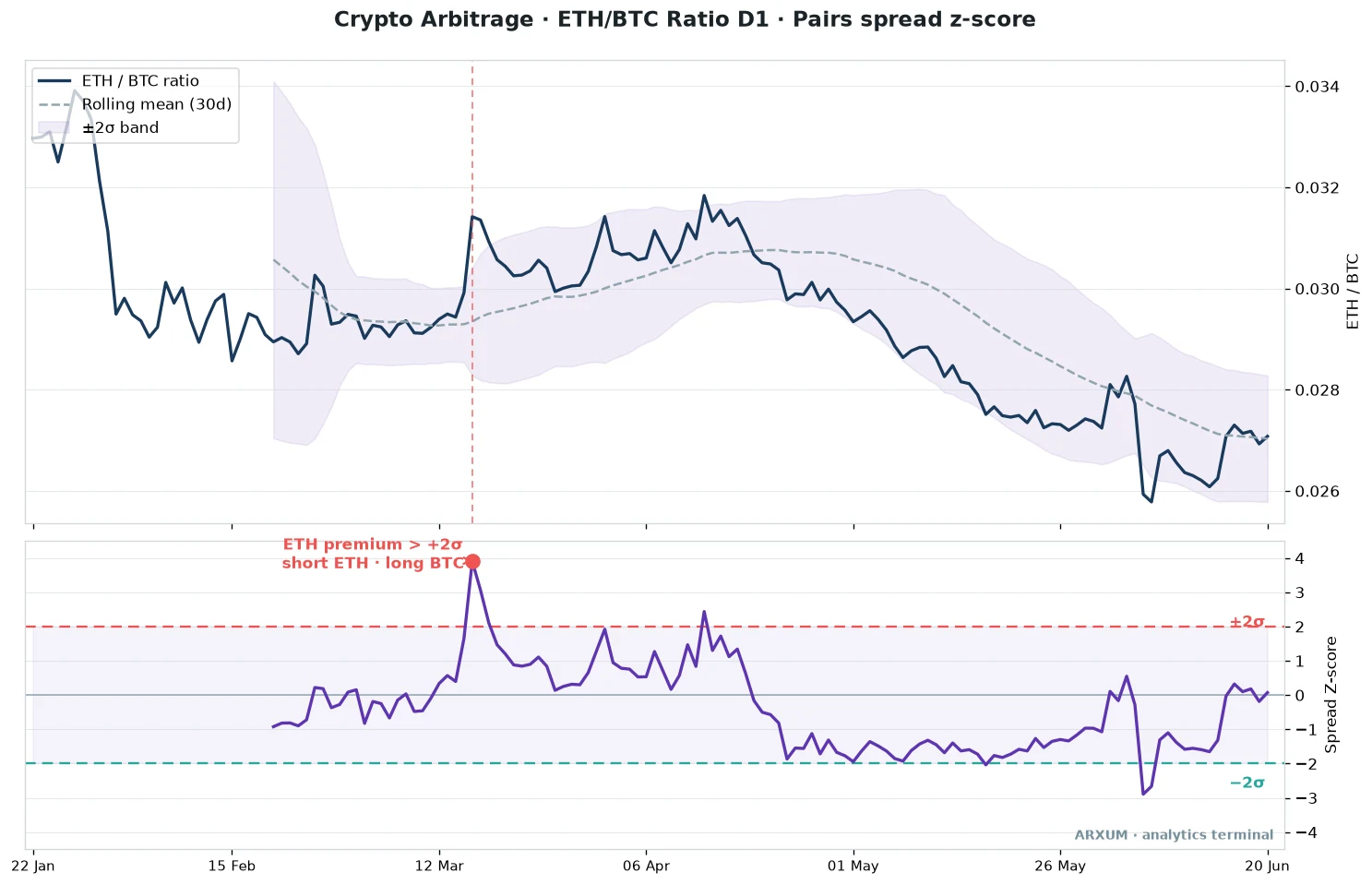
This is where retail actually has room, because the edge is slow enough to trade by hand. Statistical arbitrage stops chasing the exact same coin and instead trades two correlated coins reverting toward each other, and the cleanest crypto version is the ETH/BTC ratio.
How it looks:
- The ratio line is Ethereum priced in Bitcoin. It wanders, but it keeps returning to a rolling average.
- The rolling mean is the average ratio over the last 30 days, the “normal” the pair keeps snapping back to.
- The band is two standard deviations around that mean, the same stretched zone as the anatomy chart.
- When the ratio pushes above the top band, ETH is expensive versus Bitcoin, and the trade is short ETH plus long BTC.
- When it drops below the lower band, the trade flips: long ETH, short BTC. You close as the ratio returns to its mean.
A $500 version of this trade:
- Split the money into two equal legs, roughly $250 short ETH and $250 long BTC, so the two sides cancel each other out.
- You are betting only on the ratio narrowing, not on crypto going up or down, which is what “market neutral” means here.
- Close both legs when the ratio returns to its 30-day mean, and cut the trade if the two coins keep diverging instead of converging.
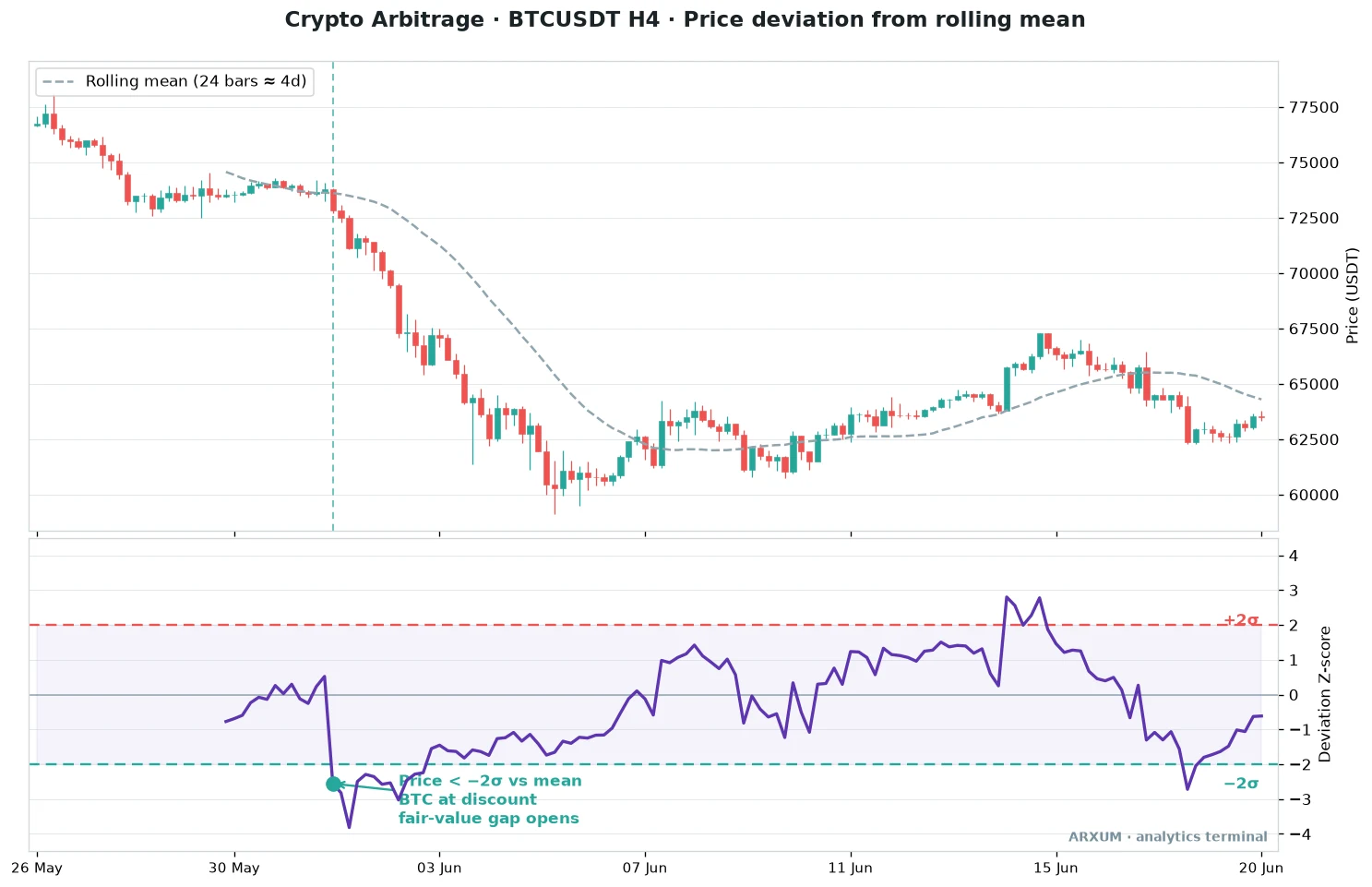
The same reversion logic works on a single asset against its own average, which reads even more simply.
How the single-asset version looks:
- The dashed line is the rolling mean, here 24 bars, roughly four days of price.
- The deviation z-score below scores how far price has stretched from that mean.
- A drop past minus two standard deviations flags a discount to the coin’s own average, which price often closes back into. The chart tags this a “fair-value gap”, meaning only that price sits below fair value here.
- It is not true arbitrage, since you carry real direction risk, but it borrows the same statistical trigger, so treat it as its cousin. The full method sits in the mean-reversion trading guide.
Application at a glance:
| Role | How you use it | Best read |
| Pick the pair | Two coins that track each other | ETH/BTC, large caps |
| Trigger | Spread past two standard deviations | Daily or 4-hour |
| Direction | Short the rich leg, long the cheap leg | Stay market neutral |
| Exit | Ratio returns to its mean | Days, not seconds |
Rule of thumb: statistical arbitrage trades a relationship, not a race, so a person can run it, but it carries real risk if the two coins stop tracking each other. The deeper build, cointegration (a stronger test that two coins genuinely track each other) and pair selection, is in the statistical arbitrage pillar.
Funding rate arbitrage
Funding rate arbitrage is the other type a patient retail trader can actually hold. It harvests the funding payment on perpetual futures while cancelling out the price risk.
How it looks:
- A perpetual future, or “perp”, is a crypto contract with no expiry date that tracks the spot price, where spot just means the plain market price of the coin right now.
- Perps pay a periodic funding rate between longs and shorts to keep the contract near that spot price.
- When funding is positive, longs pay shorts. So you buy the coin on spot and short the same size in the perpetual.
- The two legs cancel: if the coin drops, your spot loss is offset by the short’s gain, and vice versa. That balance is called delta-neutral.
- You are left collecting the funding payment for as long as it stays positive, with the coin’s direction taken out of play.
Application at a glance:
| Role | How you use it | Best read |
| Screen | Find a high positive funding rate | Liquid perps |
| Set up | Long spot, short the perp, equal size | Delta-neutral |
| Collect | Bank funding each interval | Hold days to weeks |
| Exit | Close both legs if funding flips | Watch the rate |
Rule of thumb: funding arbitrage is the closest thing to a slow, mechanical yield in crypto, but it eats capital on both legs and turns negative the moment funding flips, so it is a monitoring job, not a set and forget.
Which type to trade, and by whom
The four types split cleanly by how fast you have to be and how much capital you tie up. Speed favours the machines; capital and patience are where a person competes.
| Type | Capital | Speed | Retail-viable |
| Spatial | Medium-high | Extreme | Rarely |
| Triangular | Medium | Extreme | Bots only |
| Statistical | Medium | Low | Yes |
| Funding rate | High | Low | Yes |
- Spatial and triangular are speed games. Unless you are running co-located infrastructure, a bot beats you to the gap, so these read as education, not income.
- Statistical and pairs are the realistic manual play. The signal lives on the daily and 4-hour chart, and you have hours to act.
- Funding rate rewards capital and discipline over speed, which suits a trader who wants a mechanical, market-neutral position.
- If you are starting out, the statistical version is the one to learn first, because the trigger is visible and the timeframe is forgiving.
The tools you actually need
Crypto arbitrage trading is an execution problem before it is an idea problem. The setup matters more than the strategy.
- Accounts on several exchanges, pre-funded, so you never wait on a transfer to catch a gap.
- Low taker fees, because arbitrage margins are thin and fees are the first thing that erases them.
- A bot or script for the fast types. Spatial and triangular are not human-speed, so they need automation. Start with the trading bots overview and the wider algorithmic trading guide before you trust one with money.
- API access on each exchange, since manual clicking cannot fire three legs at once.
- A funding-rate and spread screener to find the setups. Public dashboards track cross-exchange spreads and perpetual funding without any coding.
On TradingView: you can chart the ETH/BTC ratio directly by typing ETHBTC, and add a Bollinger Bands overlay, length 30 and 2 standard deviations, to draw the same band you saw on the pairs chart yourself.
Rule of thumb: if the tool cannot execute faster than the gap closes, it cannot trade that type of arbitrage, no matter how good the signal looks.
Why the easy money is mostly gone
The reason “just buy low, sell high across exchanges” no longer prints money is not the idea, it is the competition and the frictions around it.
- Bots got there first. Automated arbitrage bots scan every major venue continuously and close spatial and triangular gaps in milliseconds.
- Fees stack. Taker fees on both legs, plus withdrawal fees, routinely exceed the raw gap.
- Transfers are slow. Moving coins between exchanges can take minutes and costs network fees, and the gap is gone long before the transfer lands.
- Slippage bites. The size you need to make the thin edge worthwhile is often the size that moves the price against you.
- Exchange risk is real. Withdrawals get frozen, accounts get limited, and a venue holding your capital can fail. That is a risk no spread pays you for.
- Funding can flip. A market-neutral funding trade turns into a cost the moment the rate crosses zero.
None of that makes arbitrage a scam. It makes it a business with real overheads, where the edge survives only for those who cut the frictions.
Using it without getting hurt
Arbitrage sounds risk-free, and market-neutral does remove direction risk. It does not remove the other risks, and those are the ones that empty accounts.
- Count the full cost before the trade. Both taker fees, the withdrawal fee, and expected slippage have to fit inside the gap, or the trade loses on paper before it starts.
- Never let one exchange hold everything. Spread capital across venues so a freeze or failure caps the damage.
- Size the statistical trades properly. The two coins can keep diverging longer than you expect, so plan the loss and keep the reward-to-risk honest before you commit.
- Only use money you can afford to lose. Crypto venues carry counterparty risk that traditional brokers do not.
The edge here is small and mechanical, which means one careless fee assumption or one stuck withdrawal can wipe out many good trades. Respect the frictions and the type survives; ignore them and it does not.
What works, in one glance
- Spatial and triangular belong to bots now. Learn them, do not expect to click them by hand.
- Statistical and pairs arbitrage on the ETH/BTC ratio is the realistic manual edge, slow enough for a person and market-neutral by design.
- Funding rate arbitrage is the mechanical, capital-heavy play for a patient, monitoring trader.
- Frictions decide profit. Fees, transfers, slippage and exchange risk, not the raw gap, are what make or break every type.
Glossary
- Spread: the price difference between two venues or two instruments.
- Standard deviation: a measure of how far a value normally wobbles from its average.
- Z-score: how many standard deviations the current spread sits from its mean.
- Rolling mean: the average price or ratio over a moving window, like the last 30 days.
- Delta-neutral: a position with offsetting long and short legs, so the coin’s direction cancels out.
- Spot: the plain market price to buy or sell the coin now, as opposed to a futures contract.
- Perpetual future (perp): a crypto futures contract with no expiry date that tracks the spot price.
- Funding rate: the periodic payment perpetual futures traders make to each other to keep the contract near spot.
- Slippage: the gap between the price you expect and the price you actually get.
- Taker fee: the exchange’s charge for an order that removes liquidity from the book.
FAQ
What is crypto arbitrage, in plain terms?
It is profiting from the same value being priced two different ways at once. You buy where a coin is cheaper and sell where it is dearer, or trade a relationship that has stretched too far, and capture the difference as it closes.
How do you do crypto arbitrage?
Pick a type. For spatial or triangular you need a bot and pre-funded accounts, because the gaps close in milliseconds. For statistical or funding rate arbitrage you can act by hand: watch the ETH/BTC ratio or a positive funding rate, take the market-neutral position, and close when the spread reverts or the rate flips.
Is crypto arbitrage still profitable?
The simple cross-exchange version is mostly not profitable for retail anymore, because bots take those gaps first and fees eat the rest. The slower, capital-based versions, statistical pairs trades and funding rate arbitrage, still have room for a careful trader who controls costs.
Is crypto arbitrage legal?
Yes, in most places it is a normal trading activity. You are buying and selling on exchanges you have an account with. The usual rules apply: follow each venue's terms, meet any tax obligations on your gains, and check your local regulations.
What is triangular arbitrage in crypto?
It is a loop of three pairs on one exchange, for example USDT to BTC, BTC to ETH, then ETH back to USDT. If the three rates disagree, the loop returns slightly more than you started with. The edge is tiny and needs a fast bot to clear fees.
How much money do you need to start?
The thin edges mean small accounts struggle to clear fees, so the fast types want meaningful capital spread across venues. Statistical pairs trades are the most size-friendly to learn on, since the edge comes from the move reverting rather than from raw volume.
Is crypto arbitrage risk-free?
No. Being market-neutral removes direction risk, but it leaves exchange risk, transfer delays, slippage and fees. A frozen withdrawal or a funding rate flipping can wipe out many good trades, so it is low-direction, not no-risk.
Do you need a bot for crypto arbitrage?
For spatial and triangular arbitrage, yes, because they are far too fast to trade by hand. For statistical pairs trades and funding rate arbitrage you do not, since those play out over hours and days and a person can manage them on a normal chart.
🌍 Our recommended brokers


Reader Reviews
Be the first to review this — tell other traders what actually helped, or where it fell short.
Leave a Review

Quant Researcher & Systems Builder
Quantitative researcher who builds the automated systems behind Arxum strategy testing. Works in Python and Pine Script, using AI alongside classic backtesting to validate strategies on years of real data.