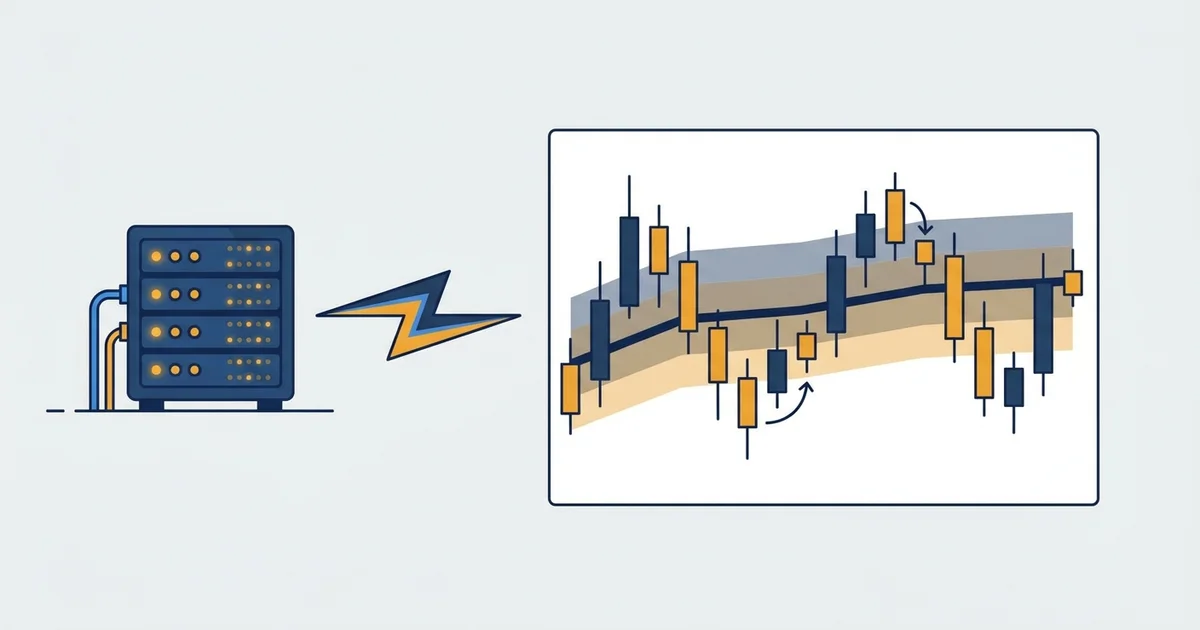

What high-frequency trading actually is
High-frequency trading is a narrow, extreme branch of automated trading. The whole edge is speed: seeing a price, deciding, and firing an order faster than anyone else in the queue.
Here is the clearest footprint the machines leave on a chart you already watch.
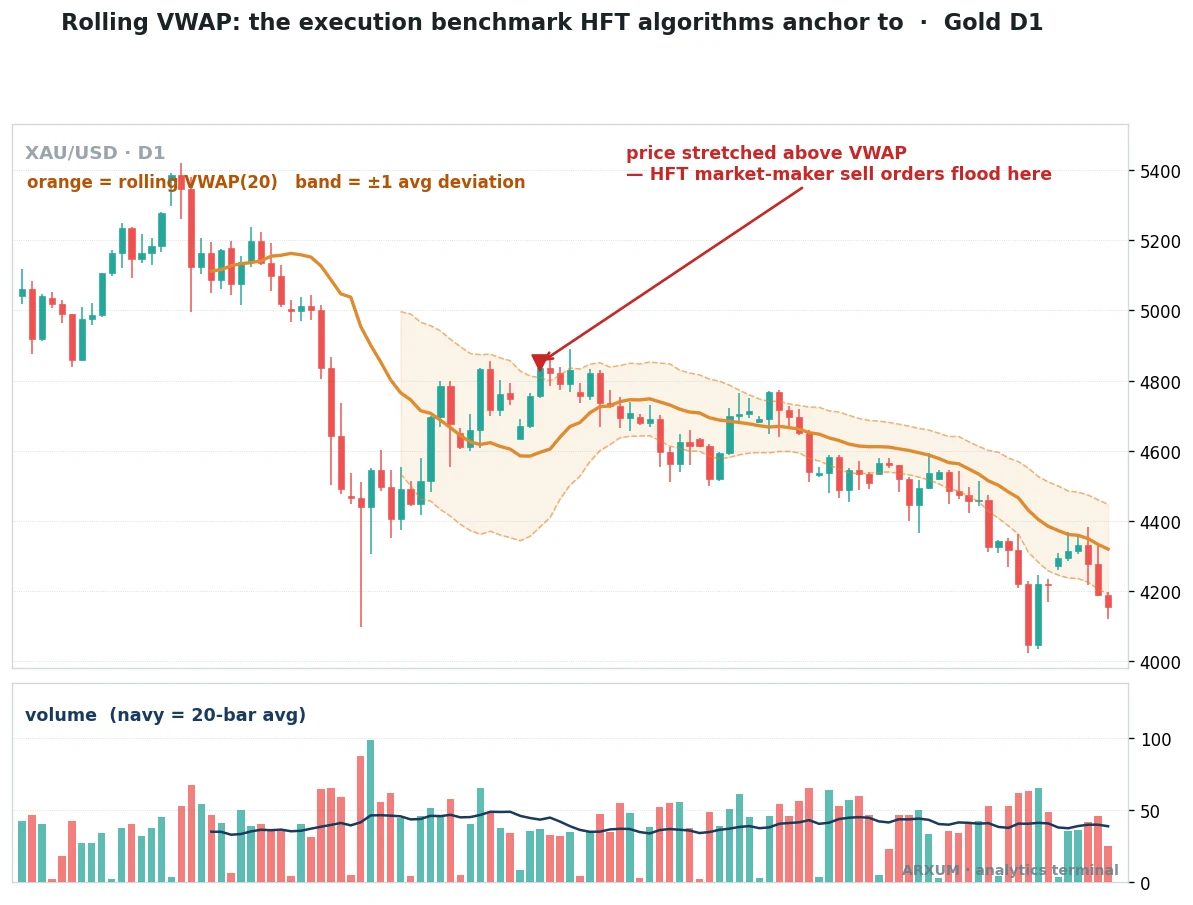
Read that picture, then the definition falls into place:
- Speed is the product. An HFT system measures its reaction in microseconds, millionths of a second. A fast human reacts in about 200,000 microseconds.
- Holding time is tiny. Positions last from a fraction of a second to a few minutes, then close. Overnight risk is rare.
- Volume is huge, edge per trade is minute. A firm may trade millions of times a day to earn a sliver on each one.
- It is a subset of algo trading, not a synonym. All HFT is algorithmic, but most algorithmic trading is slow. See our algorithmic trading guide for the broader family and quantitative trading for the math-research side.
The bottom line: HFT is not a strategy you pick, it is an infrastructure race. The firm with the shortest path to the exchange wins, and everyone else, retail included, trades in the wake.
The speed game: colocation and latency
Before the strategies, understand what the money buys. HFT firms spend fortunes shaving nanoseconds off the trip between their code and the exchange, and lower latency is the whole game.
| Edge | What it is | Why it matters |
|---|---|---|
| Colocation | Renting server space inside the exchange building | Cuts the signal trip to the shortest possible distance |
| Microwave / laser links | Line-of-sight data relays between cities | Beats fibre-optic cable, light bends less through air |
| FPGA and ASIC chips | Custom hardware that runs the trading logic | Reacts far faster than ordinary software |
| Direct market access | A raw pipe straight to the order book | Removes the broker middle layer and its delay |
| Tick-level data feeds | Every quote and trade, unfiltered | The machine sees the book change before charts update |
- Latency is measured in nanoseconds now, billionths of a second. A single mile of fibre adds roughly eight microseconds, which is why physical distance is worth millions.
- Colocation is the big one. If your server sits in the exchange and mine sits across town, you see and act on every price first, every time.
- None of this is available to a retail account, and no amount of a faster laptop or a wired connection closes the gap. That is worth saying plainly before anyone tries to compete on speed.
The three strategies HFT firms actually run
Strip away the jargon and almost every HFT desk is doing one of three things. Each leaves a different mark on the markets you trade, and each maps to one of the charts in this guide.
1. Market making: quote both sides, keep the spread
A market maker posts a buy price and a sell price at the same time and earns the gap between them, the bid-ask spread. Do that across millions of trades and the pennies add up.
The catch shows up when the market moves fast. Watch what the spread does in a volatility burst.
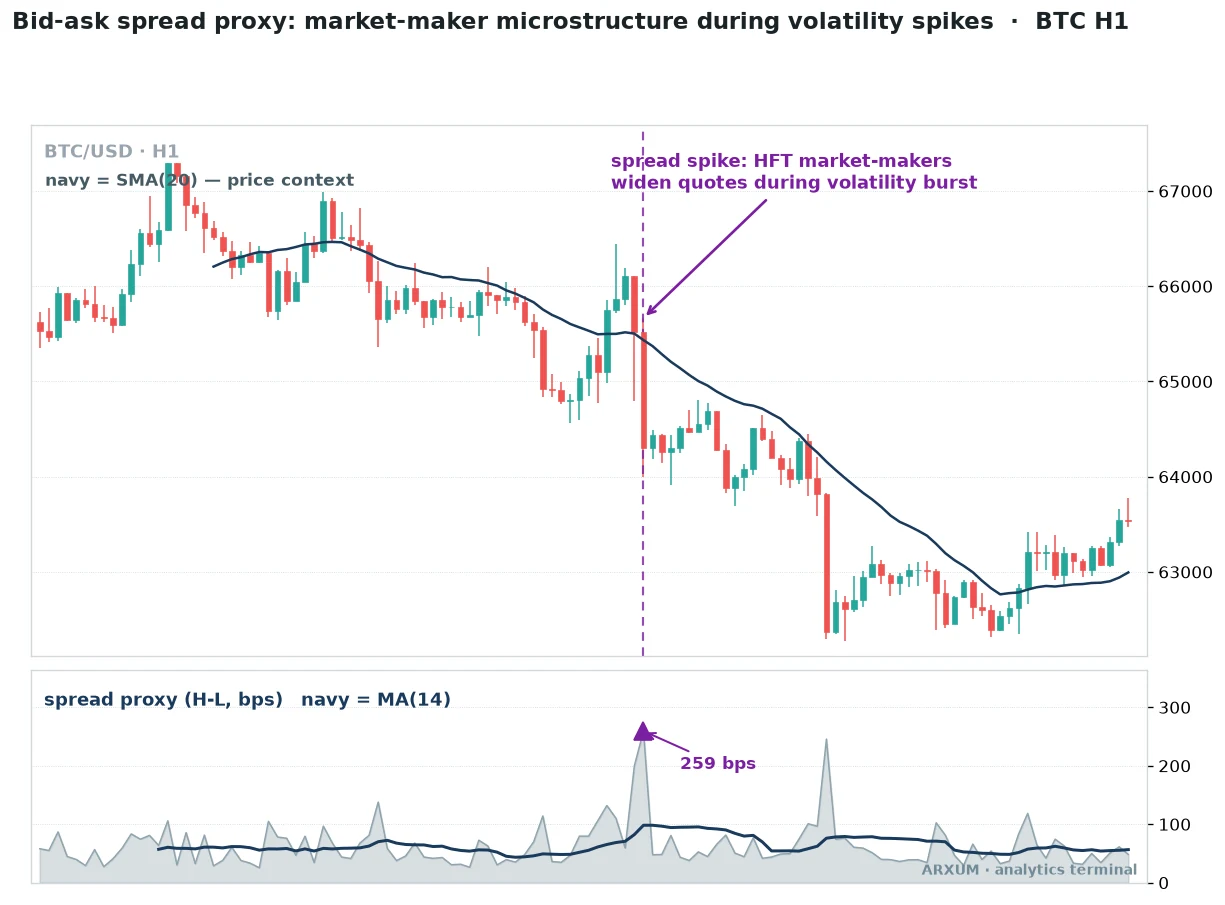
How it looks on your chart:
- In calm conditions the spread is razor thin, because dozens of machines compete to quote the tightest price.
- When volatility jumps, the same machines pull back and widen, so the spread balloons for a few seconds.
- That widening is why a stop can fill far worse than its level during news, the tight quotes vanished for a moment.
| Role for you | How to use it | Best read |
|---|---|---|
| Cost check | Trade when spreads are tight, avoid the widened-quote windows | Any instrument, around news |
| Volatility tell | A sudden spread jump flags that market-makers see risk | BTC H1, gold on data releases |
| Execution filter | Skip market orders during a spread spike, use limits | Fast markets, thin sessions |
| Session context | Spreads are thinnest in the busy London and New York overlap | Forex majors, see market hours |
Retail traders feel the spread every day as the cost of doing business. Know your instrument’s normal spread, treat a sudden jump as a warning, and lean on our Forex market hours guide for the deepest-liquidity windows.
2. Order-flow and statistical arbitrage: reading the imbalance
The second family predicts the next tiny move by reading the order book, whether buyers or sellers are leaning harder. HFT statistical-arbitrage models also hunt for prices that drift out of line across related markets and snap them back.
You cannot see the raw book, but you can see a proxy for the pressure it measures.
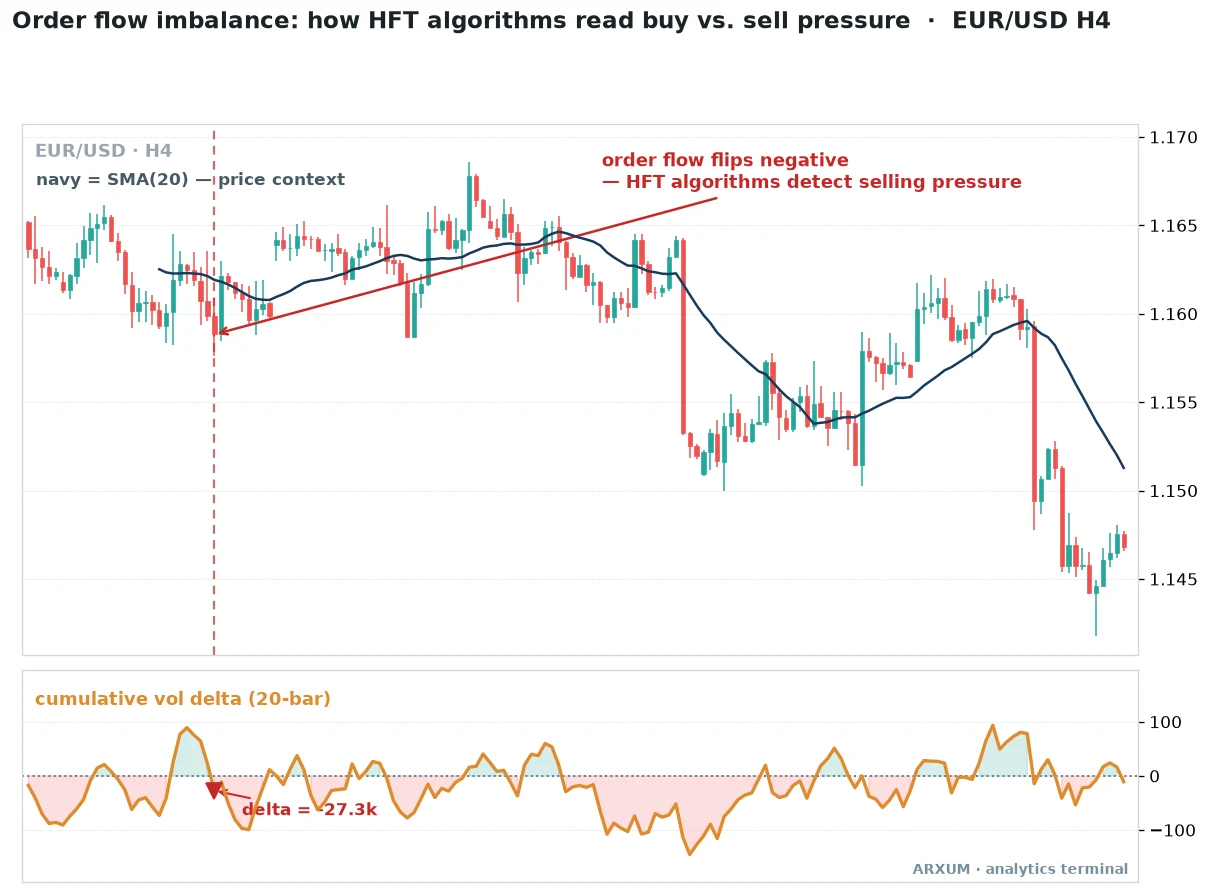
How it looks on your chart:
- Cumulative volume delta rising while price rises means buyers are backing the move, a healthy trend.
- Delta falling while price still grinds up is a warning, the buying is thinning under the surface.
- A sharp flip in delta often leads the price turn by a few bars, which is exactly the edge the machines monetise in milliseconds.
- On Forex the volume is tick volume, a count of price changes rather than real traded size, but it still tracks pressure well enough for the slow reads here.
| Role for you | How to use it | Best TF / instrument |
|---|---|---|
| Confirmation | Take a breakout only when delta pushes the same way | EUR/USD H4, gold H1 |
| Divergence warning | Price up but delta down means the move is hollow | Any liquid market |
| Context gauge | Persistent one-way delta shows who owns the session | BTC H1, FX majors |
| Exit cue | Trim when delta rolls hard against your position | Intraday trades |
This is the one HFT idea a retail trader can genuinely borrow, just slowed way down. Our market profile and on-balance volume guides go deeper on reading flow off a chart.
3. Execution algorithms: slicing orders around VWAP
The third family predicts nothing. When a bank must buy a billion dollars of something, its execution algo slices the order into thousands of small pieces to avoid moving the price.
The benchmark those algos measure against is VWAP, the session’s volume-weighted average price. That is the gold chart at the top of this page, where price is measured against VWAP all session long.
How it looks on your chart:
- Price tends to revert toward VWAP through the session, because so much institutional flow is anchored to it.
- A big stretch above or below the VWAP band is often faded, the same behaviour a mean-reversion trader trades.
- Round numbers and the session open draw the most algo activity, so reactions cluster there.
| Role for you | How to use it | Best TF / instrument |
|---|---|---|
| Mean-reversion anchor | Fade an over-stretched move back toward VWAP | Gold D1, indices intraday |
| Trend filter | Above VWAP favour longs, below it favour shorts | EUR/USD H1, BTC H1 |
| Value reference | Judge whether the current price is rich or cheap for the day | Any intraday market |
| Entry timing | Wait for a pullback to VWAP rather than chasing | Trending sessions |
VWAP is the single most useful HFT footprint for a manual trader, and it sits on every platform for free. Our VWAP indicator guide explains the tool, VWAP trading strategy shows the setups, and the fade itself is classic mean reversion.
How HFT moves the markets you trade
You do not need to trade against the machines to be affected by them. Their activity shapes the conditions of every order you place, for better and worse.
| What HFT does | Effect on you | Good or bad |
|---|---|---|
| Constant two-sided quoting | Tighter spreads in calm markets | Good, cheaper to trade |
| Deep, fast liquidity | Orders fill instantly most of the time | Good, in normal conditions |
| Pulling quotes in a spike | Spreads gap, stops fill worse | Bad, worst during news |
| Reacting to news first | Price has moved before you read the headline | Bad for news trading |
| Sweeping obvious stop clusters | Quick spikes through round numbers | Bad if your stop sat there |
On a quiet day the machines make your trading cheaper and your fills cleaner than any era before them. Around a data release or a thin session they step back, and that is when spreads blow out and stops slip.
- Do not trade the first seconds of a major news release. The machines have already repriced, and the spread is at its widest.
- Place stops with a buffer past obvious round numbers, not right on them, so a quick sweep does not clip you.
- Prefer limit orders in fast conditions. A market order pays whatever spread the machines are showing at that instant.
Can retail traders do high-frequency trading?
The short answer is no, not the real thing, and it is worth being blunt about why.
| HFT needs | A retail trader has | Verdict |
|---|---|---|
| Servers inside the exchange | A laptop and home internet | No contest on speed |
| Direct market access | Orders routed through a broker | Extra delay baked in |
| Custom FPGA hardware | Off-the-shelf software | Milliseconds behind at best |
| Rebates for providing liquidity | Pays the spread and commission | Cost side, not the earning side |
Chasing HFT with a fast bot on a retail account is a way to donate money. The machines you are racing measure their advantage in nanoseconds, and your order reaches the exchange after theirs no matter what you buy.
What retail traders can do instead:
- Read the footprints, do not race them. Use VWAP, spread behaviour and volume delta on slower charts, where a few seconds of latency does not matter.
- Trade the timeframes machines ignore. HFT lives inside the second. On the 4-hour and daily, a human’s judgement is competitive again.
- The closest retail cousin is scalping, manual short-term trading measured in minutes, not microseconds. Our scalping guide covers it, and it is a different sport from true HFT.
- Let the machines work for you on cost. Their liquidity is why your spreads are tight, so trade when they are most active and quotes are cheapest.
The takeaway: you will not beat HFT at speed, and you do not need to. Slow down to a timeframe where reading their tracks beats trying to outrun them.
Which HFT footprint to watch, and when
The three footprints are not rivals, they answer different questions. Match the tool to what you are trying to see:
| If you want to know | Watch this footprint | Where it reads best |
|---|---|---|
| Is now a cheap time to trade? | The bid-ask spread | Any instrument, around sessions and news |
| Who is winning, buyers or sellers? | Cumulative volume delta | EUR/USD H4, BTC H1 |
| Is price rich or cheap right now? | Distance from VWAP | Gold D1, indices intraday |
| Should I stand aside? | A spread spike plus a delta flip together | Fast, headline-driven markets |
Rule of thumb: the strongest signal is when two footprints agree, price stretched from VWAP while the volume delta flips against the stretch. That is the machines and the manual trader reading the same exhaustion at once.
The big high-frequency trading firms
Most HFT volume runs through a small set of specialist firms. They are private and secretive, but the names are well known in the industry:
| Firm | Known for |
|---|---|
| Citadel Securities | Handles a large share of US retail order flow |
| Virtu Financial | Market making across global venues, publicly listed |
| Jump Trading | Low-latency trading, active in crypto too |
| Jane Street | Quantitative market making, ETFs and options |
| Hudson River Trading | Research-driven automated market making |
| Tower Research (Latour) | One of the earliest low-latency specialists |
- These firms provide much of the liquidity you trade against, which is why they are the ones quoting both sides of your order.
- Several also make markets in crypto now, which is part of why Bitcoin spreads on major exchanges have tightened over the years.
- They compete with each other far more than with you. The retail order is a small, welcome customer, not the target.
What works, in three lines
- You read HFT, you do not race it. VWAP, spread and volume delta are the three footprints you can actually see and use.
- Slow down to win. On the 4-hour and daily the machines’ speed edge disappears and judgement matters again.
- Respect the spread spike. A sudden widening is the machines stepping back, the worst moment to fire a market order.
Key terms
- Latency: the time it takes an order to travel from your system to the exchange. HFT firms fight to shrink it to nanoseconds.
- Colocation: renting server space inside the exchange building to cut that travel time to the minimum.
- Bid-ask spread: the gap between the best buy price and the best sell price, and the market maker’s core source of profit.
- Market maker: a firm that continuously quotes both a buy and a sell price and earns the spread between them.
- VWAP: the volume-weighted average price, the session benchmark execution algorithms anchor their fills to.
- Volume delta: buying volume minus selling volume, a running read on which side is pressing harder.
- Basis point (bps): one hundredth of one percent, the unit used to measure small spread and price moves.
- Statistical arbitrage: trading tiny, temporary mispricings between related markets, one of the core HFT families.
FAQ
What is high-frequency trading, in plain terms?
Can retail traders do high-frequency trading?
What are the main high-frequency trading strategies?
Is high-frequency trading the same as algorithmic trading?
How does high-frequency trading affect ordinary traders?
What is colocation in high-frequency trading?
Who are the biggest high-frequency trading firms?
Is high-frequency trading profitable?
Is high-frequency trading legal?
Can I use VWAP the way HFT firms do?
Real-time trade setups with entry, stop loss and take profit. Daily market analysis. No subscription, no complicated theory.
🌍 Our recommended brokers


Reader Reviews
Be the first to review this — tell other traders what actually helped, or where it fell short.
Leave a Review

Forex Analyst & Senior Trader
Former FX desk trader with 8 years in institutional forex. Works in multi-timeframe analysis and order flow, turning desk experience into systematic, testable rules across forex and metals.