
What a crypto winter actually is
A crypto winter is not a bad week. It is a regime, a stretch where the whole market trends down together and stays frozen for months.
The cleanest first read is how far Bitcoin has fallen below its 200-day moving average, the slow line that marks the long-term trend.
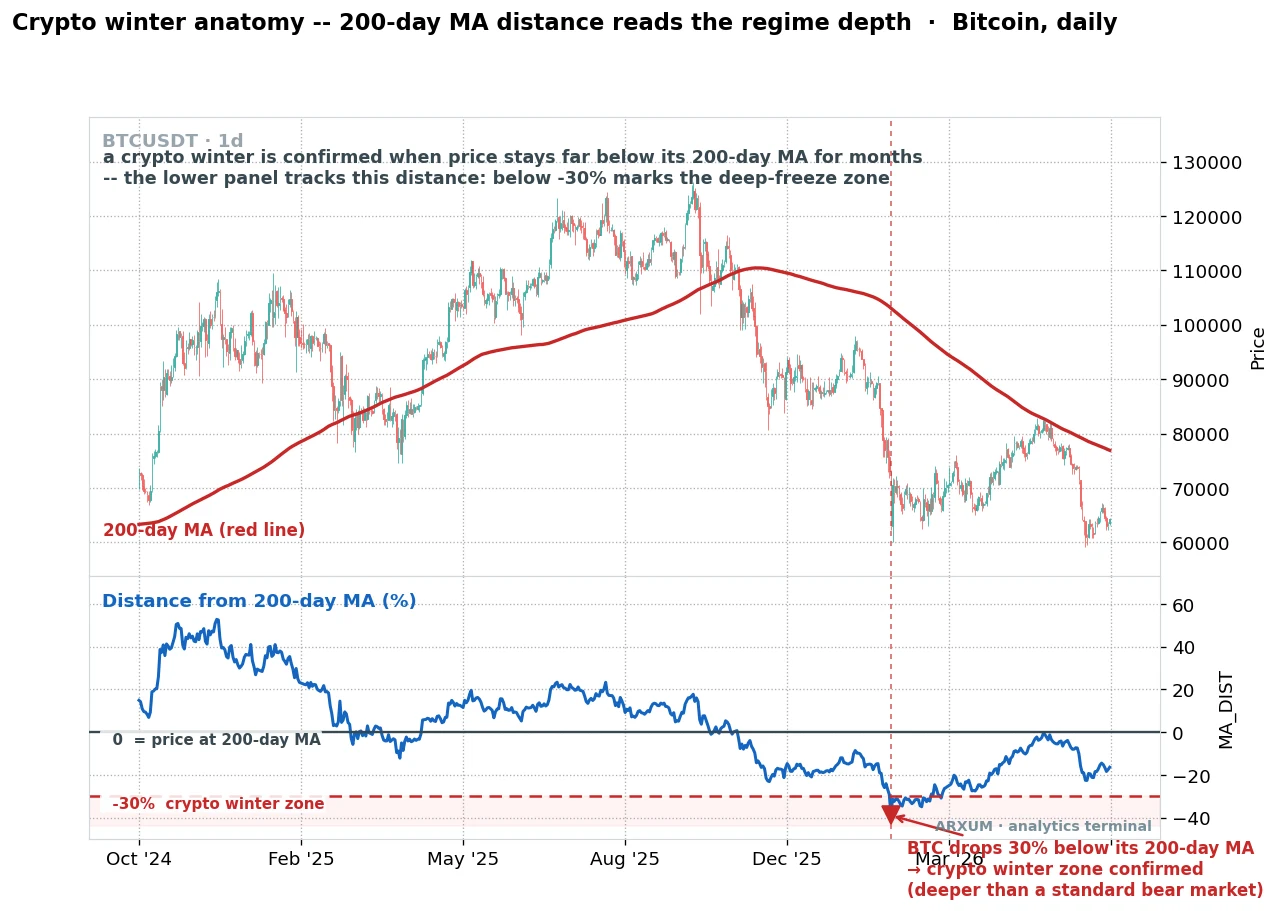
What the chart is showing:
- The red line is the 200-day moving average, the average closing price over the last 200 days. It smooths out the noise and shows the long-term trend.
- The lower panel is the distance from that line, in percent. Zero means price is sitting right on the 200-day average.
- The minus 30% band is the crypto winter zone. Price staying that far below the 200-day line for weeks, not days, is the tell.
- The read: a normal correction dips under the 200-day line and bounces back. A crypto winter parks price far below it and keeps it there.
The key word is duration. A crypto market downturn only earns the name winter when depth and time both show up together.
| Feature | Ordinary dip or bear | Crypto winter |
|---|---|---|
| Depth from peak | 20% to 40% | 70% or more |
| Duration | Weeks to a few months | A year or longer |
| 200-day MA | Brief dip below, recovers | Price stuck far below for months |
| Sentiment | Nervous, buys the dip | Bored, stops watching |
| Recovery | Quick snap back | Slow, months of basing |
Depth alone is not enough. A sharp 40% flush inside a bull run is a scare, not a winter, and the difference is what you use the next two reads to settle.
| Role | How you use it | Best read |
|---|---|---|
| Regime read | Price far below the 200-day line for months = winter, not a dip | Daily, Bitcoin |
| Depth gauge | The further below, the deeper the freeze | Daily, Bitcoin |
| Trend filter | Below the 200-day line, treat rallies as bounces, not the bottom | Daily, Bitcoin |
| Turn cue | Price reclaiming and holding above the 200-day line hints the thaw has begun | Daily, Bitcoin |
Rule of thumb: one read never calls a winter on its own. The 200-day distance tells you the trend is broken, not how deep the damage goes.
Bear market or full winter? The depth gauge
Every crypto winter is a bear market, but not every bear market is a winter. The separator is depth, and Bitcoin’s rolling 90-day return puts a number on it.
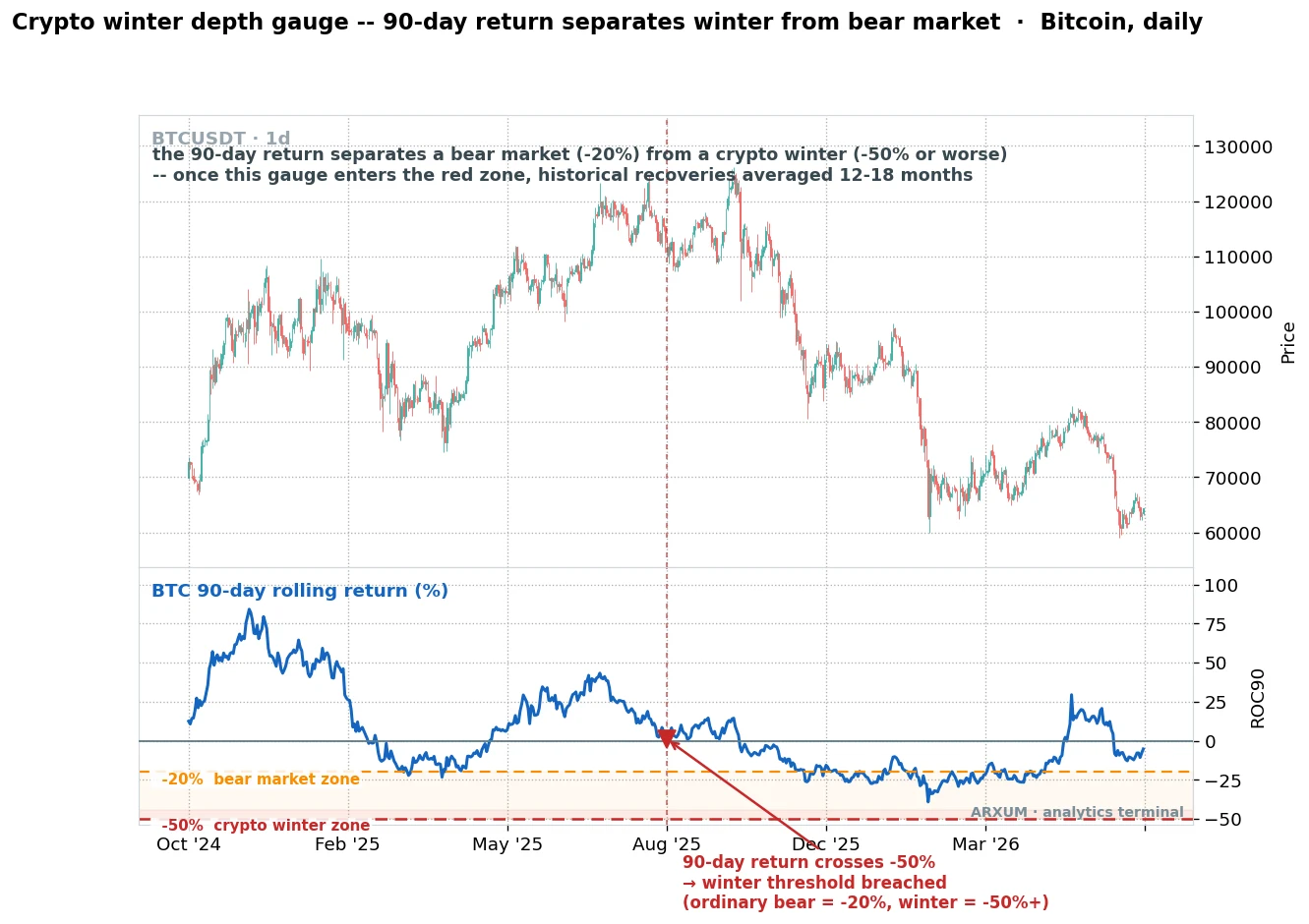
What the labels mean:
- The blue line in the lower panel is Bitcoin’s 90-day rolling return, its three-month change in percent.
- The minus 20% band is the ordinary bear-market zone. Uncomfortable, but crypto sees it often.
- The minus 50% band is the crypto winter zone. A three-month loss that deep is a different animal, and it rarely reverses fast.
- The read: the depth of the drop, not the fact of a drop, is what tells you which regime you are in.
Why the two thresholds matter for a plan:
- A minus 20% read means risk-off. Trim, hedge, wait, but the cycle may still be alive.
- A minus 50% read means the cycle has broken. History says the recovery is measured in many months, not weeks, so there is no rush to catch the exact low.
- The gauge cuts both ways. When the 90-day return climbs back above zero and holds, the freeze is thawing.
| Role | How you use it | Best read |
|---|---|---|
| Depth gauge | Under minus 20% = bear; under minus 50% = winter | Daily, Bitcoin |
| Patience filter | Deep in the red zone, stop trying to time the exact bottom | Daily, Bitcoin |
| Recovery cue | The line climbing back above zero = momentum returning | Daily, Bitcoin |
| Sizing input | The deeper the read, the smaller and slower you add | Daily, whole book |
Rule of thumb: a bear market scares you, a crypto winter bores you. The 90-day return is how you tell one from the other before the mood does.
Has the whole market given up? The breadth gauge
The first two reads live on Bitcoin. The last one checks whether the pain has spread to everything else, and for that you price Ethereum in Bitcoin.
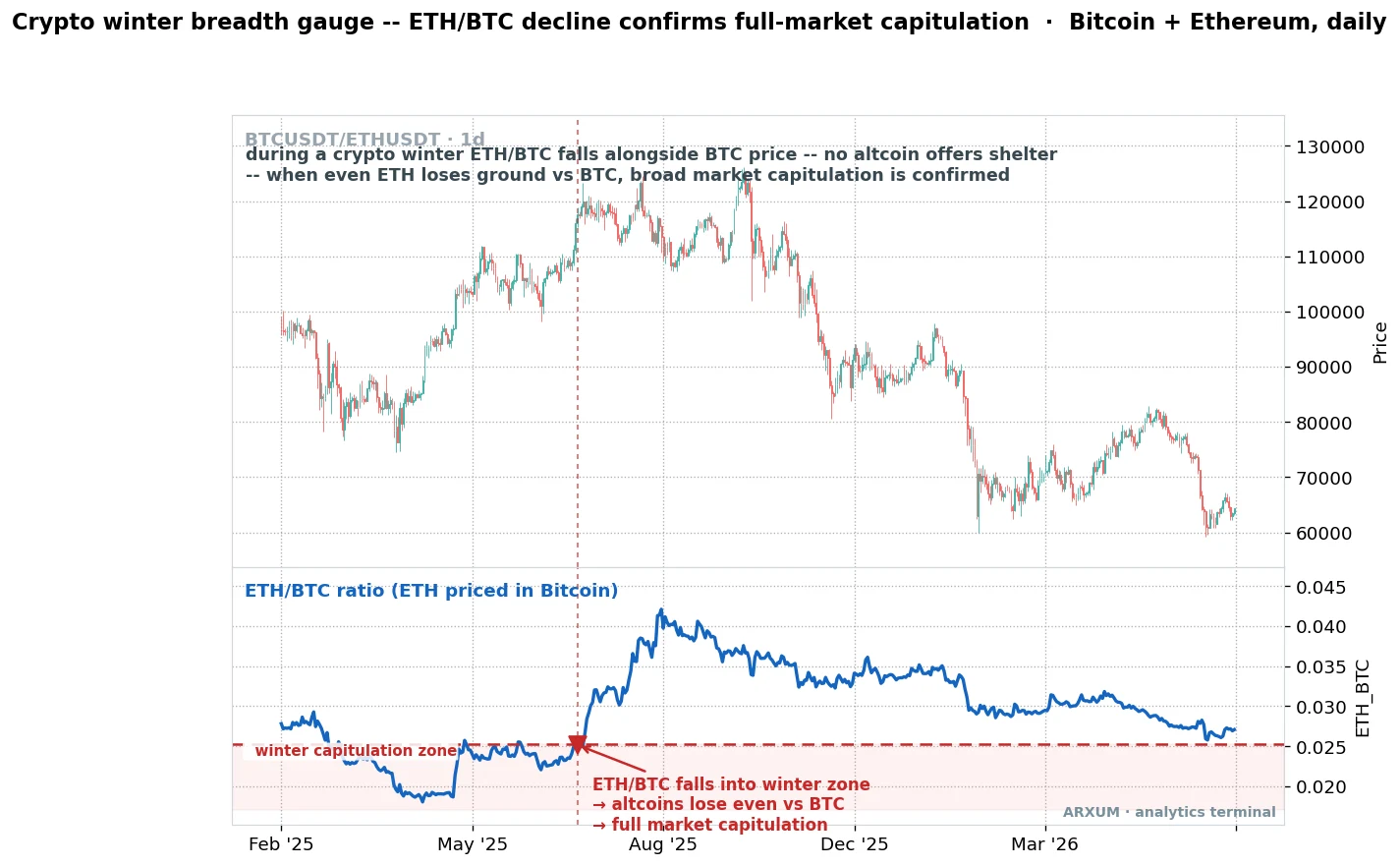
What the labels mean:
- The ETH/BTC ratio is Ethereum’s price measured in Bitcoin, not dollars. It shows which of the two is winning.
- A falling ratio means Bitcoin is holding up better than Ethereum, so money is fleeing risk even inside crypto.
- The capitulation zone is the shaded band near the bottom. The ratio sinking there means altcoins are being abandoned wholesale.
- The read: in a real crypto winter no coin offers shelter. When even Ethereum bleeds against Bitcoin, the whole market has capitulated.
How to use the breadth read:
- Bitcoin down, alts down harder. That is the normal shape of a winter. Altcoins are higher-risk, so they fall further and recover later.
- A rising ETH/BTC ratio is the early hint of a thaw. Large-cap alts turning up against Bitcoin often marks the first return of risk appetite.
- Do not go bargain hunting in small alts early. They lead the fall and lag the recovery, and many never come back at all.
| Role | How you use it | Best read |
|---|---|---|
| Breadth gauge | Falling ratio = pain spreading past Bitcoin to all of crypto | Daily, ETH/BTC |
| Capitulation check | Ratio in the low zone = full-market surrender confirmed | Daily, ETH/BTC |
| Shelter filter | In a winter, no altcoin is a hiding place; Bitcoin is the least-bad hold | Daily, whole book |
| Early-thaw cue | Ratio turning up = large caps leading risk back in | Daily, ETH/BTC |
Rule of thumb: Bitcoin tells you the trend, the 90-day return tells you the depth, and ETH/BTC tells you how far the damage has spread.
The three reads side by side
The reads are one picture at three angles. Stack them, and a real crypto winter is hard to miss.
| Question | Read | Winter looks like |
|---|---|---|
| Is the trend broken? | Distance from 200-day MA | Price stuck far below for months |
| How deep is it? | BTC 90-day return | Three-month loss past minus 50% |
| Has it spread? | ETH/BTC ratio | Ratio sunk into the capitulation zone |
How to weigh them:
- All three lined up: a confirmed crypto winter. The trend is broken, the drop is deep, and the whole market has surrendered. Plan for months, not days.
- Reads one and two, not three: a deep Bitcoin bear where alts have not fully capitulated yet. Often an earlier stage, with more downside to come.
- Read one only: a broken trend that has not turned deep. It could be an ordinary bear or the front edge of a winter. Watch, do not commit.
- None aligned: no winter. A scary dip inside a live cycle is not the same regime, and the survival playbook below does not apply.
What past crypto winters looked like
Every crypto winter rhymes. Naming them by their trigger, not their calendar, makes the pattern obvious, because the same script runs each time.
| Winter | What broke it | Roughly how deep |
|---|---|---|
| The Mt. Gox winter | The first big bull ended, a major exchange collapsed | Bitcoin fell around 80% and based for over a year |
| The ICO hangover | The token-mania blow-off unwound, from about $20k to $3k | Roughly 80% off the peak, over a year of freeze |
| The leverage unwind | A stablecoin failure, then cascading blow-ups and a big exchange fraud | From near $69k to around $16k, most of a year down |
The lessons that repeat across all of them:
- The trigger was always leverage or fraud, not price alone. A protocol failure or a wave of cascading liquidations turned a correction into a collapse each time.
- Bitcoin fell hard, and altcoins fell harder. Most small coins from the prior cycle never reclaimed their highs, and plenty went to zero.
- The bottom was boring, not dramatic. Each winter ended with quiet months of basing, not a v-shaped snap, which is why the exact low is impossible to catch and pointless to chase.
How long does a crypto winter last
There is no fixed clock, but the past winters cluster tightly enough to plan around.
- Roughly a year to eighteen months peak-to-recovery is the rough shape of the last two. Long enough that patience beats prediction.
- The depth sets the timeline. A deeper freeze, read off that 90-day return, tends to need a longer base before a real recovery.
- The thaw is gradual. Price reclaiming the 200-day line and the ETH/BTC ratio turning up come first, well before the headlines call the bottom.
- Halvings and macro matter. Bitcoin’s supply-halving cycle and the wider rate environment have shaped past recoveries, but neither is a countdown timer. Treat them as context, not a date.
Rule of thumb: assume a crypto winter lasts many months and size your plan for time, not for a quick rescue.
How to survive a crypto winter
Surviving a crypto winter is mostly about not blowing up before the thaw. The goal is to still be holding, and still solvent, when the cycle turns.
| Move | Why it works | Watch out for |
|---|---|---|
| Cut leverage to near zero | Deep drops liquidate leveraged longs first | Even small leverage stacks up in a freeze |
| Hold a stablecoin cushion | Dry powder to average in and to sleep at night | Platform and issuer risk, spread it out |
| Dollar-cost average majors | Buys the base without needing to time the low | Only capital you can leave for a year plus |
| Concentrate in survivors | Bitcoin and Ethereum recover, most small alts do not | Bag-holding dead coins hoping for a bounce |
| Set rules, then step back | A winter punishes emotional, screen-watching trades | Revenge trading the bounces |
Working the playbook, point by point:
- Reduce leverage first. Nothing ends an account in a crypto winter faster than borrowed size. Flat or lightly long is how you stay in the game.
- Build the stablecoin cushion before you need it. Cash on the sidelines is both your averaging fuel and your calm. Spread it across a couple of reputable issuers rather than one.
- Average in on a schedule, not a feeling. A fixed dollar-cost averaging plan into Bitcoin and Ethereum turns a scary chart into a routine. The point is to accumulate the base, not to nail the bottom.
- Favor the coins that come back. Winters are brutal filters. Concentrate in the assets with real usage and deep liquidity, and treat the long tail as lottery tickets, not a portfolio.
- Manage yourself, not just the book. The fear and greed index pinned at extreme fear is the emotional low, and that is exactly when discipline pays. Write your plan down while you are calm.
Rule of thumb: you cannot control the length of a crypto winter, only whether you survive it with capital and patience intact.
Which coins come back and which don’t
A winter does not lift all boats when it thaws. Most of the return goes to a short list, and knowing the filter matters more than picking the bottom.
| Factor | Recovers | Fades away |
|---|---|---|
| Liquidity | Deep, trades everywhere | Thin, one or two venues |
| Usage | Real users and volume through the winter | Only speculation, no activity |
| Team and funding | Funded, still building | Runway gone, devs left |
| Narrative | Core infrastructure or store of value | Last cycle's hype, now forgotten |
How to read the checklist:
- Liquidity is the first filter. A coin you cannot exit in size is a trap no matter how good the story sounds.
- On-chain activity is the honesty check. Projects that keep real usage through the freeze are the ones that tend to lead the next cycle.
- Follow the builders, not the promises. Teams still shipping in the depths of a crypto winter are voting with their time. That signal beats any roadmap.
When will the crypto winter end
Nobody rings a bell, but the same crypto-native reads that confirm a winter also mark its thaw. You watch for the reads turning, not for a headline.
- Price reclaims the 200-day line and holds it. The single clearest structural sign the long freeze is breaking.
- The 90-day return climbs back above zero. Bitcoin gaining over a rolling three months means real momentum, not a dead-cat bounce.
- The ETH/BTC ratio turns up. Large-cap alts leading again is the early tell that risk appetite is coming back into the market.
- Sentiment stops caring. Winters end in boredom, not panic. When crypto drops out of the headlines and the crowd has given up, the base is usually forming.
- A new narrative takes hold. Every recovery has been led by a fresh theme that pulls fresh money in. When one starts to stick, the next bull market is often already underway.
Rule of thumb: the reads turn before the mood does. By the time it feels safe, the easy part of the recovery is usually gone.
Common mistakes
- Calling a normal dip a winter. A 30% flush inside a live cycle is not a crypto winter. Check the depth and duration before you batten down.
- Averaging in with leverage. Buying the base is smart, doing it with borrowed money is how you get liquidated right before the low.
- Bottom-fishing dead alts. Small coins that led the last mania rarely lead the next recovery. Most are cheap for a reason.
- Trying to time the exact bottom. The low is only obvious in hindsight. A schedule beats a hero call every time.
- Selling at the point of maximum fear. The emotional low and the price low tend to arrive together. Panic selling locks in the worst price.
- Watching one gauge alone. A broken 200-day line without a deep 90-day return or ETH/BTC capitulation is not yet a confirmed winter.
Trading it without getting hurt
A crypto winter is the harshest regime crypto has. It rewards patience and punishes force, so the discipline matters more than the call.
- Size for survival, not for the rebound. Assume the freeze lasts longer than you expect and keep enough dry powder to still be buying at the end of it.
- Plan the exit and the add before you act. Know what a real thaw looks like and what would prove you wrong. The reward-to-risk has to make sense before you commit.
- Only risk money you can leave alone. This is the most speculative corner of markets, and a winter can test your timeline for a year or more.
The reads shift the odds in your favor by telling you which regime you are in. They do not remove the risk, and a crypto winter is unforgiving to anyone who forgets that.
Glossary
- Crypto winter: a prolonged, deep crypto bear market, typically a 70%-plus drop that lasts a year or more.
- 200-day moving average: the average closing price over the last 200 days, used to read the long-term trend.
- 90-day return: how much an asset has gained or lost over the past three months, a depth gauge for a downturn.
- ETH/BTC ratio: Ethereum priced in Bitcoin. Falling means altcoins are losing ground even against Bitcoin.
- Capitulation: the point where holders give up and sell in bulk, often near the bottom.
- Dollar-cost averaging: buying a fixed amount on a schedule rather than trying to time the low.
- Leverage: borrowed money used to size up a trade. The first thing wiped out in a deep drop.
FAQ
What is a crypto winter, in plain terms?
It is a long, deep crypto bear market. Prices fall most of the way back from their peak, often 70% or more, and stay frozen for a year or longer instead of bouncing in a few weeks.
How do I know it is a crypto winter and not a normal dip?
Check depth and duration together. Price stuck far below its 200-day moving average for months, a Bitcoin 90-day return past minus 50%, and a falling ETH/BTC ratio all pointing the same way is a winter. A quick 30% flush that recovers is just a dip.
How long does a crypto winter last?
There is no fixed length, but the last two ran roughly a year to eighteen months from peak to recovery. The deeper the freeze, the longer the base tends to take, so it pays to plan for time rather than a quick rescue.
How far do prices fall in a crypto winter?
Bitcoin has dropped around 80% from its peak in past winters, and most altcoins fell further. Many smaller coins from the prior cycle never reclaimed their highs at all.
How do you survive a crypto winter?
Cut leverage to near zero, hold a stablecoin cushion, and dollar-cost average into Bitcoin and Ethereum on a fixed schedule. Concentrate in coins with real usage and liquidity, set your rules while you are calm, and only commit money you can leave for a year or more.
When will the crypto winter end?
Nobody rings a bell, but the reads turn first. Price reclaiming the 200-day line and holding it, the 90-day return climbing back above zero, and the ETH/BTC ratio turning up are the early signs, usually well before the headlines call the bottom.
Is a crypto winter a good time to buy?
It can be, if you buy the way a winter demands. Averaging into Bitcoin and Ethereum on a schedule, with no leverage and money you can leave alone, has historically set up the next cycle. Trying to time the exact low or bottom-fishing dead alts is where people get hurt.
Is a crypto winter the same as a crypto bear market?
Every crypto winter is a bear market, but not every bear market is a winter. The difference is depth and time. A bear market can be a sharp, short drop, while a winter is a deep freeze that lasts many months.
Which coins survive a crypto winter?
The ones with deep liquidity, real usage through the downturn, and funded teams still building. Bitcoin and Ethereum have recovered from every past winter. Most small, hype-driven coins from the previous cycle do not.
🌍 Our recommended brokers


Reader Reviews
Be the first to review this — tell other traders what actually helped, or where it fell short.
Leave a Review

Forex Analyst & Senior Trader
Former FX desk trader with 8 years in institutional forex. Works in multi-timeframe analysis and order flow, turning desk experience into systematic, testable rules across forex and metals.