
What spot trading actually is
Every spot trade is a straight swap at today’s price. You pay, you receive the asset, and the deal settles right away.
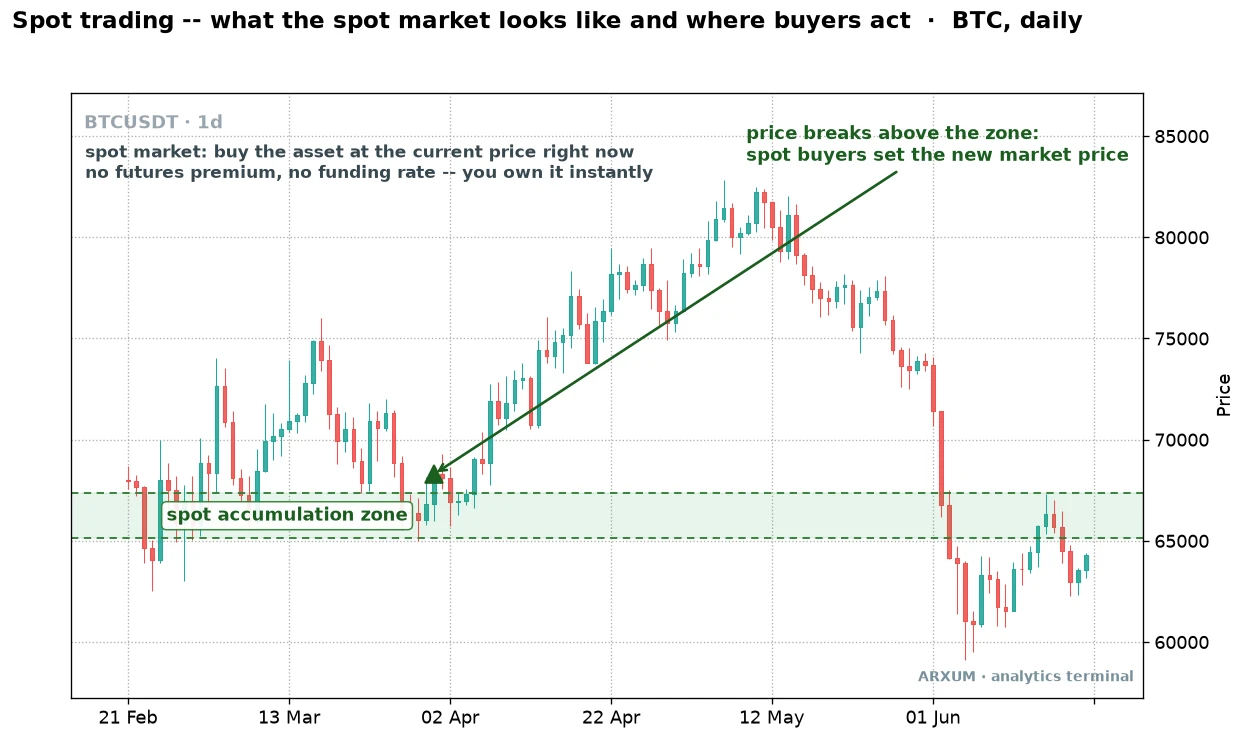
Read the chart from the shaded band out. That band is the spot accumulation zone, the price area where buyers were happy to own the asset.
The green arrow marks the break above it, where spot demand pushed price to a new level.
Four things define a spot trade:
- You own the asset. Buy spot Bitcoin and the coins are yours to hold, move, or sell whenever you like.
- Settlement is immediate. Crypto settles in minutes; spot forex and gold settle in a day or two, versus a dated contract that settles in the future.
- No leverage by default. You put up the full price, so there is no borrowed money and no liquidation.
- No expiry. A spot position never runs out of time. Hold it through a drawdown for as long as you want.
The trade-off is simple. Your risk is capped at what you paid, but you also give up the amplified size that leverage would hand you.
Spot vs futures vs margin, side by side
This is the comparison most beginners search for, so here it is in one table. All three let you take a position on the same asset, but the machinery underneath is very different.
| Feature | Spot | Futures | Margin |
|---|---|---|---|
| What you hold | The real asset | A dated contract | Asset bought partly on a loan |
| Leverage | None (1:1) | High (up to 125x) | Moderate (2x to 10x) |
| Funding or roll fees | None | Funding or expiry roll | Interest on the loan |
| Liquidation risk | None | Yes | Yes |
| Can you short easily? | Hard | Yes | Yes |
| Best suited to | Holders, beginners | Hedging, short-term | Sized-up conviction |
The one-line read: spot is ownership with no clock and no lender, futures is a leveraged bet on where price goes, and margin is spot with a loan bolted on. Spot is the only one of the three where you cannot be liquidated.
Why beginners start on spot: there is nothing to blow up. Price can fall hard and your position simply loses value on paper.
There is no margin call, no funding bill draining the account overnight, and no contract expiring against you. If you want to understand what the leverage adds, and what it costs, the margin trading guide and the crypto futures guide walk through both.
Spot trading crypto: CEX vs DEX
Spot trading crypto splits into two venues, and they behave differently. A centralized exchange holds your coins for you; a decentralized exchange lets you trade straight from your own wallet.
| Point | Centralized (CEX) | Decentralized (DEX) |
|---|---|---|
| Custody | Exchange holds your coins | You hold your own keys |
| Sign-up | Account plus ID check | Connect a wallet, no account |
| Liquidity | Deep on major coins | Thin on small tokens |
| Assets | Vetted listings | Any token, scams included |
| Main risk | Exchange hack or failure | Wrong token, gas spikes |
A quick read on each:
- CEX suits a beginner. Deep liquidity on the majors, a familiar buy and sell screen, and support if something breaks. The catch is that the exchange holds your coins, so an exchange failure is your risk.
- DEX suits self-custody. You keep your keys and can trade tokens that never reach a big exchange. The catch is that you carry every mistake yourself, from pasting the wrong contract address to a network gas spike on a busy day.
Rule of thumb: learn on a centralized exchange with the major coins, then move to self-custody as the amounts grow. Spot forex and spot gold sit outside crypto entirely and trade through a broker rather than an exchange.
What spot trading costs
Spot is usually the cheapest way to take a position, because there is no funding rate and no loan interest ticking against you. You mostly pay one thing: the cost to get in and out.
| Spot market | What you pay | Rough level |
|---|---|---|
| Crypto on a CEX | Maker or taker fee | Around 0.1% per side |
| Crypto on a DEX | Swap fee plus gas | 0.05% to 0.3% plus network gas |
| Spot forex (EUR/USD) | The spread | Roughly 0.1 to 1 pip on majors |
| Spot gold (XAU/USD) | The spread | Around 0.2 to 0.4 on tight accounts |
A few honest notes on the numbers:
- Volume cuts the rate. Most exchanges drop the fee as your monthly volume climbs, and some cut it more if you pay in their own token.
- Gas is separate. On a DEX the network fee is charged on top of the swap fee and swings with how busy the chain is.
- The spread is the fee on forex and gold. There is often no separate commission, so a wider spread is the real cost.
Spot forex and spot gold are the current cash-price market, as opposed to a dated future. Retail access to them is usually through a CFD on that spot price, so you track the spot move without taking delivery of physical metal or currency.
Spot beyond crypto: forex and gold
Spot is not a crypto-only idea. Forex and gold have a spot market too, and it works on the same principle: you deal at the current cash price for near-immediate settlement, rather than a dated contract.
| Market | How spot works | Settlement |
|---|---|---|
| Crypto (BTC) | Own the coin outright | Minutes |
| Forex (EUR/USD) | Deal at the cash rate | One to two days |
| Gold (XAU/USD) | Deal at the cash price | One to two days |
Two points worth knowing:
- Retail access is often a CFD. On a broker, spot forex and spot gold usually trade as a contract on the spot price, so you track the move without taking delivery of physical metal or currency.
- The market clocks differ. Crypto trades around the clock with no weekend gap, while forex and gold close for the weekend and can gap on the Monday open.
How spot traders time entries
Owning the asset does not tell you when to buy. Spot traders use the same tools as everyone else to time entries, and two show up constantly.
Neither is a guarantee. They tilt the odds, nothing more.
The oversold pullback
The first is buying weakness with the Relative Strength Index, or RSI. RSI is a momentum gauge that runs from 0 to 100 and measures how stretched recent moves are.
Below 30 the market is called oversold. Price is statistically cheap against its own recent range.
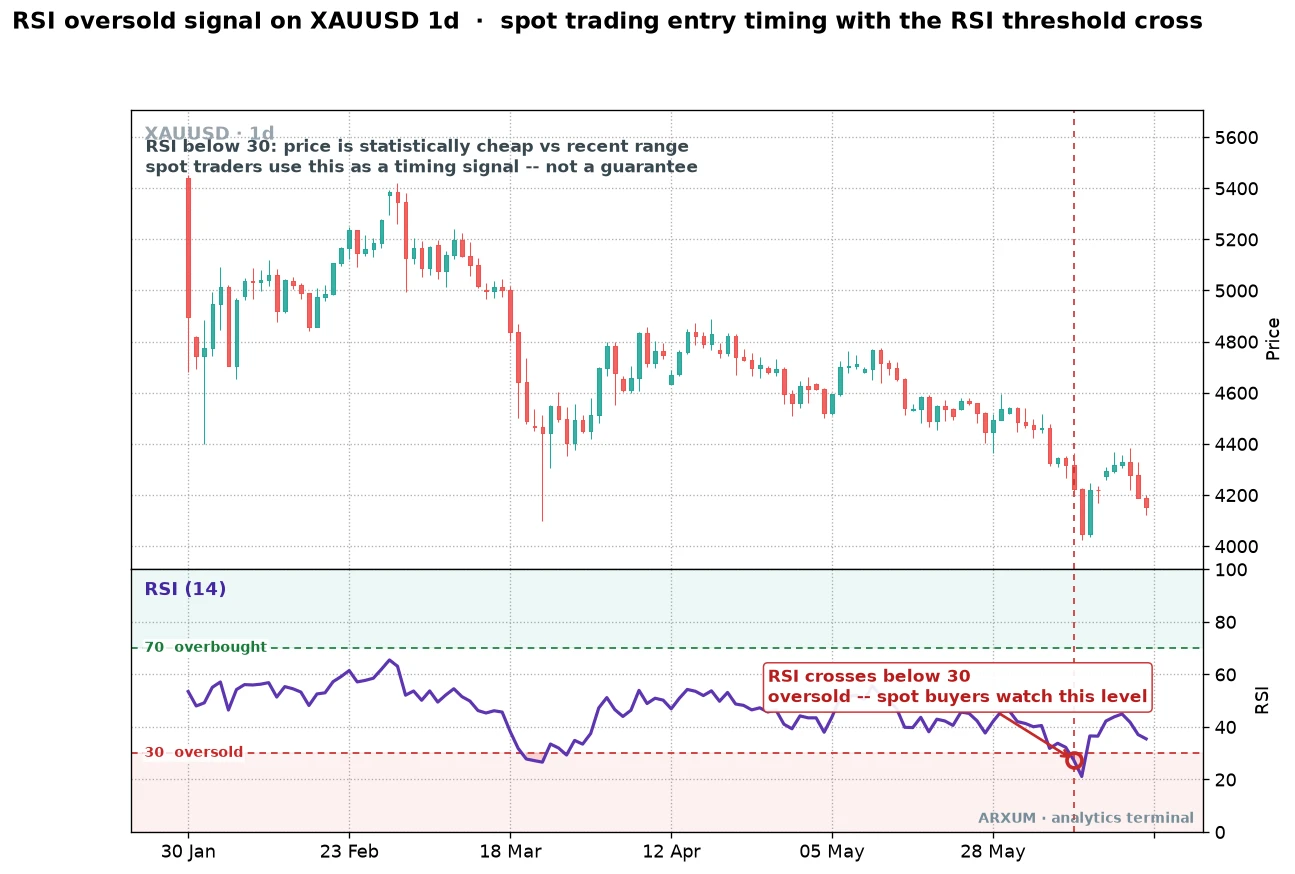
What the chart shows, in plain terms:
- The bottom panel is RSI (14), a 14-period momentum reading plotted under the price.
- The dashed line at 70 is the overbought level; the dashed line at 30 is the oversold level.
- The purple line crossing below 30 is the signal. Price is stretched to the downside.
- Spot traders treat that as a cue to look for a low, then wait for price to actually turn before buying.
| Role | How to use it | Best read |
|---|---|---|
| Timing cue | Watch for RSI under 30 | Price cheap vs recent range |
| Confirmation | Wait for price to turn up | Never buy on RSI alone |
| Exit caution | RSI back above 50 | Momentum has returned |
An oversold reading in a hard downtrend can stay oversold for weeks, so the signal works best paired with a level or a turn, not fired blindly. The RSI indicator guide covers the settings and the traps in full.
The trend follow
The second approach ignores dips and buys strength instead. It uses two Exponential Moving Averages, or EMAs, which are lines that smooth price to show its direction.
A short one reacts fast, a long one reacts slow.
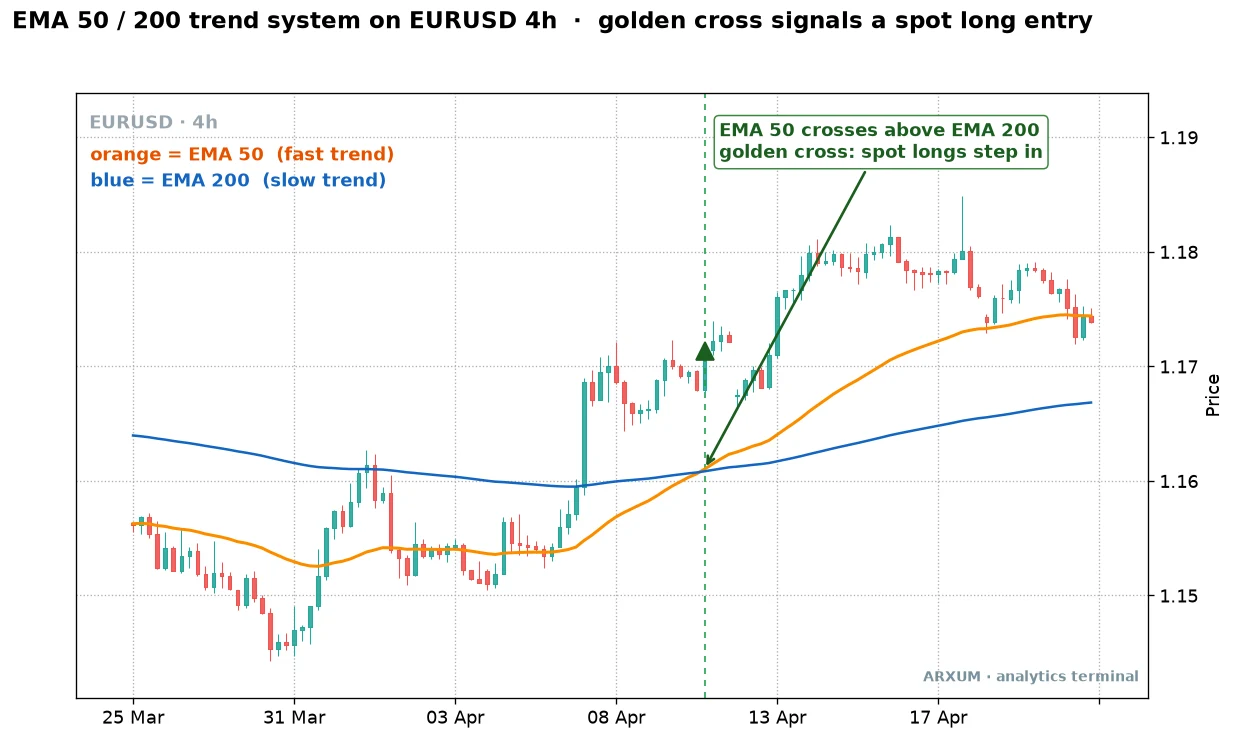
Reading the two lines:
- Orange, EMA 50: the fast average, tracking the recent trend.
- Blue, EMA 200: the slow average, tracking the bigger trend.
- The golden cross is orange rising above blue. It says the short trend has overtaken the long trend, so the market has turned up.
- Price sitting above both lines is a simple, readable uptrend, which is where spot buyers prefer to be long.
| Role | How to use it | Best read |
|---|---|---|
| Trend filter | EMA 50 vs EMA 200 | Fast above slow means up |
| Entry timing | Buy after the golden cross | Trend has just turned up |
| Regime read | Price above both EMAs | Longs favored, dips bought |
The cross is slow, so it enters late and whipsaws in a flat market. Its strength is staying with a real trend once one is running.
The golden cross guide shows where it earns its keep and where it fails.
One line that ties them together: the RSI pullback buys weakness expecting a bounce, the EMA cross buys strength expecting continuation. They fit opposite markets, so pick the one that matches the conditions in front of you.
Who spot trading suits
Spot is not the right tool for everyone. It rewards patience and ownership, and it frustrates anyone chasing fast leveraged gains.
| Trader type | Does spot fit? | Why |
|---|---|---|
| Beginner | Strong fit | No liquidation, simple to grasp |
| Long-term holder | Strong fit | Owns the asset, pays no funding |
| Dollar-cost averager | Strong fit | Buys fixed amounts over time |
| Active day trader | Partial fit | No leverage caps position size |
| Hedger or short-seller | Weak fit | Shorting needs futures or margin |
A steady way to trade spot without timing anything is to buy a fixed dollar amount on a schedule, which smooths your average entry price. That is the core idea behind dollar-cost averaging, and it pairs naturally with spot because you keep every coin you buy.
Which market to use when
Spot, futures, and margin each win in a different situation. This table is the quick decision guide.
| If you want to | Use | Avoid |
|---|---|---|
| Own crypto and hold it | Spot on a CEX or DEX | Dated futures |
| Buy fixed amounts over time | Spot plus DCA | Leverage |
| Trade bigger than your cash | Margin or futures | Spot |
| Short a falling market | Futures or margin | Spot |
| Never risk liquidation | Spot only | Any leveraged product |
Is spot safe for beginners? As a structure it is the safest of the three, because you cannot lose more than you put in and there is nothing to be liquidated.
The risk that remains is ordinary market risk. The asset can fall, sometimes a lot, so size each position to money you can afford to lose and never bet the account on one coin.
Understanding risk and reward before you buy matters more than any entry signal.
Common spot trading mistakes
Spot removes the leverage traps, but a few plain errors still cost beginners money.
- Buying the top of a hype move. A coin up several hundred percent in weeks is where most late buyers get trapped. Wait for the fear, not the euphoria.
- Putting everything in one asset. A single coin can fall a long way and never recover. Spread the money so one bad pick does not sink the account.
- Chasing an oversold reading blindly. RSI under 30 can stay under 30 for weeks in a downtrend. Wait for price to actually turn before you buy.
- Ignoring self-custody risk. On a centralized exchange the platform holds your coins, so an exchange failure is a real risk once amounts grow. Move to your own wallet.
- Confusing spot with margin on the same app. Many crypto apps put a leverage toggle right next to the spot buy button. Check which one you are on before you click.
What works: the points to remember
Keep these five and you have the whole picture.
- Spot means ownership. You buy the real asset at the current price, with no expiry and no funding.
- No leverage, no liquidation. Your worst case is the money you put in, which is why beginners start here.
- Crypto splits into CEX and DEX. Learn on a centralized exchange, move to self-custody as amounts grow.
- Cost is mostly the spread or a small fee. No funding or loan interest is the quiet advantage of spot.
- Time entries with a tool, not a hunch. The RSI pullback buys weakness, the EMA cross buys strength.
Key terms
- Spot trading: buying or selling an asset for immediate delivery at the current market price.
- Spot market: the market for immediate settlement, as opposed to a dated future.
- Settlement: the moment the asset actually changes hands, minutes for crypto, a day or two for forex.
- CEX: a centralized exchange that holds your coins and runs the order book.
- DEX: a decentralized exchange where you trade from your own wallet.
- Custody: who holds the asset, the exchange on a CEX or you on a DEX and in self-storage.
- Leverage: trading with borrowed money to take a bigger position; spot uses none.
- Liquidation: a forced close when a leveraged position runs out of margin; spot cannot be liquidated.
- Funding rate: a periodic fee paid between traders on perpetual futures; spot has none.
- RSI: the Relative Strength Index, a momentum gauge from 0 to 100; below 30 is oversold.
- EMA: an Exponential Moving Average, a line that smooths price to show trend direction.
- Golden cross: a faster moving average crossing above a slower one, read as an uptrend turning on.
- Spread: the gap between the bid and the ask, the cost you pay on a spot forex or gold trade.
FAQ
What is spot trading?
Spot trading is buying or selling an asset for immediate delivery at its current market price. When the trade fills you own the actual asset, whether that is Bitcoin, a currency, or gold. There is no expiry date, no funding rate, and no borrowed money, which makes it the simplest and oldest form of trading and the usual starting point for beginners.
How does spot trading work?
You place a buy or sell order at the going price and it fills against another trader on the exchange. You pay the full value of the position, so no leverage is involved. Crypto spot settles in minutes and the coins appear in your account, while spot forex and gold settle in a day or two. You then hold the asset for as long as you like, since a spot position never expires.
What is the difference between spot trading and futures trading?
In spot trading you own the real asset outright at the current price. In futures trading you hold a contract that tracks the price, usually with high leverage and a funding rate or an expiry date. Spot has no liquidation risk because you are not borrowing, while a leveraged futures position can be liquidated if price moves against you. Spot suits holders, futures suits short-term and hedging trades.
What is the difference between spot trading and margin trading in crypto?
Spot trading uses only your own money, so you buy the coin outright and cannot be liquidated. Margin trading adds a loan from the exchange, letting you take a larger position than your cash allows, typically two to ten times. That loan charges interest and can be liquidated if the trade moves against you far enough. Spot is safer and simpler, margin amplifies both gains and losses.
Is spot trading safe for beginners?
Structurally it is the safest of the three main ways to trade, because you can never lose more than you put in and there is nothing to be liquidated. The risk that remains is normal market risk, meaning the asset can fall in value, sometimes sharply. Size each position to money you can afford to lose, spread across more than one asset, and it is a reasonable place to learn.
How do you spot trade crypto?
You trade crypto on the spot market through either a centralized exchange or a decentralized exchange. On a centralized exchange you create an account, pass an ID check, deposit funds, and buy the coin, which the exchange then holds for you. On a decentralized exchange you connect your own wallet and swap tokens directly, keeping your keys. Beginners usually start on a centralized exchange with major coins for the deeper liquidity and support.
What are the fees for spot trading?
Spot is usually the cheapest way to trade because there is no funding rate or loan interest. On a crypto exchange you pay a maker or taker fee, often around 0.1% per side, lower as your volume rises. On a decentralized exchange you pay a swap fee plus network gas. On spot forex and gold the main cost is the spread, the gap between the buy and sell price, rather than a separate commission.
Can you make money with spot trading?
Yes, by buying an asset and selling it later at a higher price, or by holding it through a long uptrend. Without leverage the gains are unamplified, so returns track the asset's actual move rather than a multiple of it. Many spot traders combine a simple timing tool, such as buying oversold pullbacks or following a trend, with steady position sizing, and hold their winners rather than chasing quick trades.
Real-time trade setups with entry, stop loss and take profit. Daily market analysis. No subscription, no complicated theory.
🌍 Our recommended brokers


Reader Reviews
Be the first to review this — tell other traders what actually helped, or where it fell short.
Leave a Review

Forex Analyst & Senior Trader
Former FX desk trader with 8 years in institutional forex. Works in multi-timeframe analysis and order flow, turning desk experience into systematic, testable rules across forex and metals.