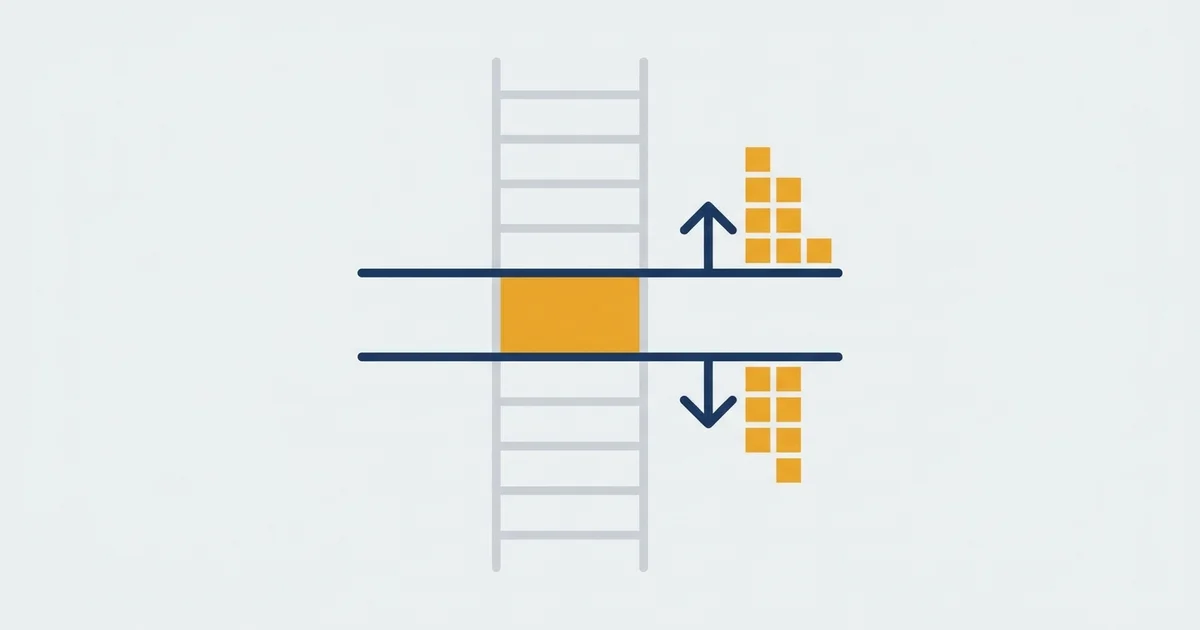

What spread betting actually is
Spread betting turns a market view into a simple bet: money per point of movement, up or down. You never own the shares, the gold or the currency.
You are betting on the price.
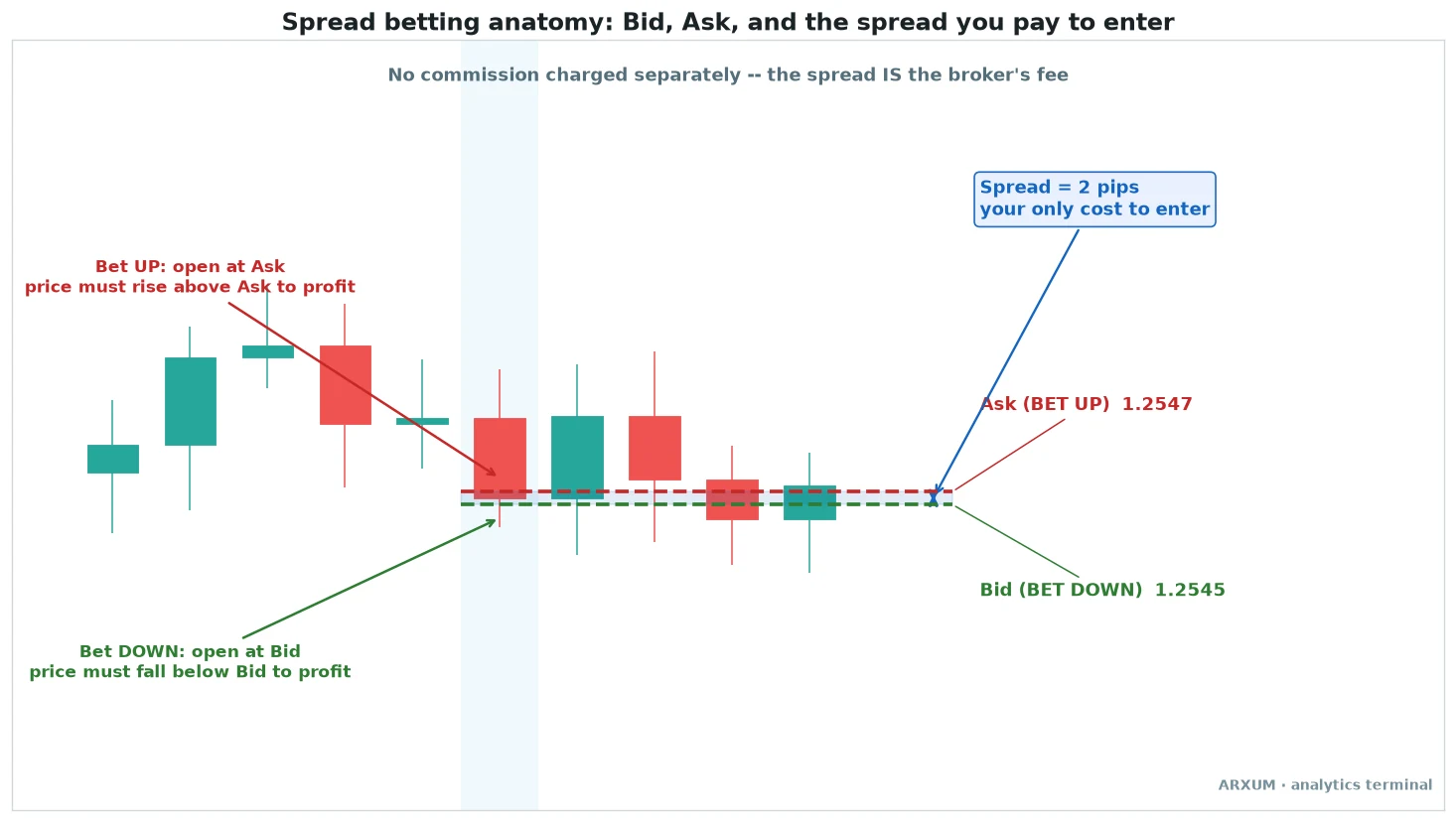
Read the diagram from the middle out. Everything in spread betting hangs off those two prices and the gap between them.
- The Bid and Ask are the sell and buy prices. You always open a bet on the worse side of the two.
- A bet UP (going long) opens at the Ask. Price has to climb above the Ask before you are in profit.
- A bet DOWN (going short) opens at the Bid. Price has to fall below the Bid before you are in profit.
- The spread is the distance between Bid and Ask. It is the broker’s fee, baked into the price rather than billed separately.
- A point is the smallest increment the platform quotes. On most forex pairs one point is one pip, the fourth decimal of the price, so a move from 1.2500 to 1.2501 is one point.
The jargon in one glance
| Term | What it is | Plain read |
|---|---|---|
| Stake per point | Money you risk for each point moved | Your bet size, e.g. £2 a point |
| Point | The smallest price step quoted | One pip on most forex pairs |
| Bet UP (long) | You profit if price rises | Opens at the Ask |
| Bet DOWN (short) | You profit if price falls | Opens at the Bid |
| Spread | Gap between Bid and Ask | Your cost to enter |
| Margin | Deposit the bet ties up | A fraction of the full exposure |
The whole product is that simple at heart. The complications come from leverage, cost and tax, which the rest of this guide walks through.
How does spread betting work: a worked example
The maths is the same every time: points moved times your stake per point. Nothing else.
Here is a long bet on EUR/USD, ignoring the spread for a second to keep it clean.
| Step | Detail | Running result |
|---|---|---|
| Your view | EUR/USD will rise | Bet UP (long) |
| Stake | £5 per point | Set the size |
| Open | Buy at 1.2500 | Position live |
| Price moves | Rises to 1.2550 | 50 points in your favour |
| Close | 50 points times £5 | +£250 profit |
Now the mirror image. The same long bet the wrong way round costs you exactly the same way it would have paid.
| Step | Detail | Running result |
|---|---|---|
| Open | Buy at 1.2500, £5 per point | Position live |
| Price moves | Falls to 1.2450 | 50 points against you |
| Close | 50 points times £5 | -£250 loss |
A few things fall straight out of that symmetry:
- Profit and loss scale with the stake. Double the stake to £10 a point and both the win and the loss double. The market does not change; your exposure does.
- There is no fixed odds. Unlike a sports bet, you do not win or lose a set amount. You win or lose per point, so a big move pays big and hurts big.
- You can close any time. You do not have to wait for an event to settle. Close the bet whenever you want to bank the profit or stop the loss.
- Short is as easy as long. Betting DOWN needs no borrowing and no special account. You just open on the Bid instead of the Ask.
The rule of thumb: decide your stake by what one point of movement costs you, not by how confident you feel. A £5 point on a market that swings 100 points a day is a £500 daily range on one bet.
What spread betting costs
The headline cost is the spread you already met, but it is not the only one. And the spread itself is not fixed.
Two charts make the point better than a paragraph can.
Gold is the clearest example of why the per-point value matters as much as the spread.
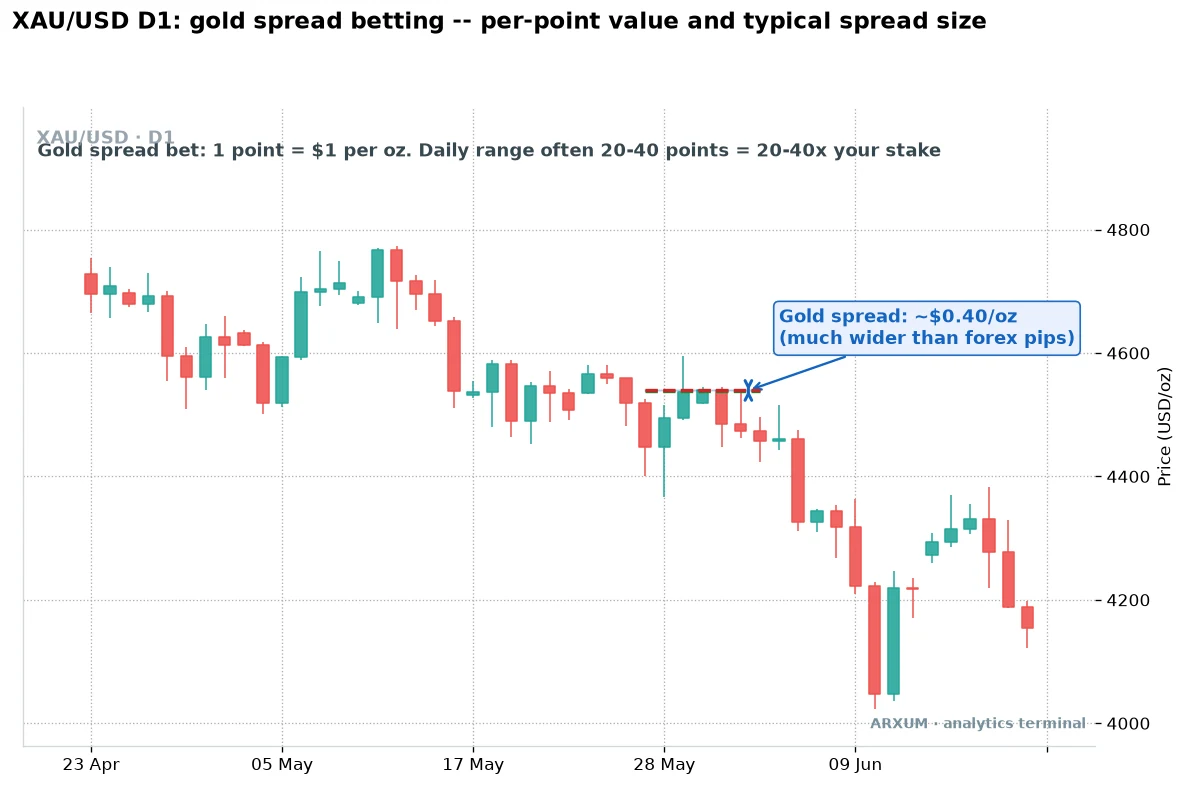
- A point is not a pound. On gold one point is worth $1 per ounce of exposure, so the per-point value is large. The same £1 stake behaves very differently on gold than on a currency pair.
- You still get paid in pounds. Gold’s price moves in dollars an ounce, but you stake in pounds per point and are paid in pounds per point, so your profit and loss stays in your account currency.
- Wide ranges cut both ways. Gold moving 20 to 40 points in a day means your daily swing is 20 to 40 times your stake. That is the leverage talking.
- The spread scales with the market. Gold’s entry spread of around $0.40 an ounce is much wider than a forex pip, so the cost to open is higher before price has moved at all.
The second hidden cost is timing. The spread widens exactly when the market moves fast, which is often when you most want to trade.
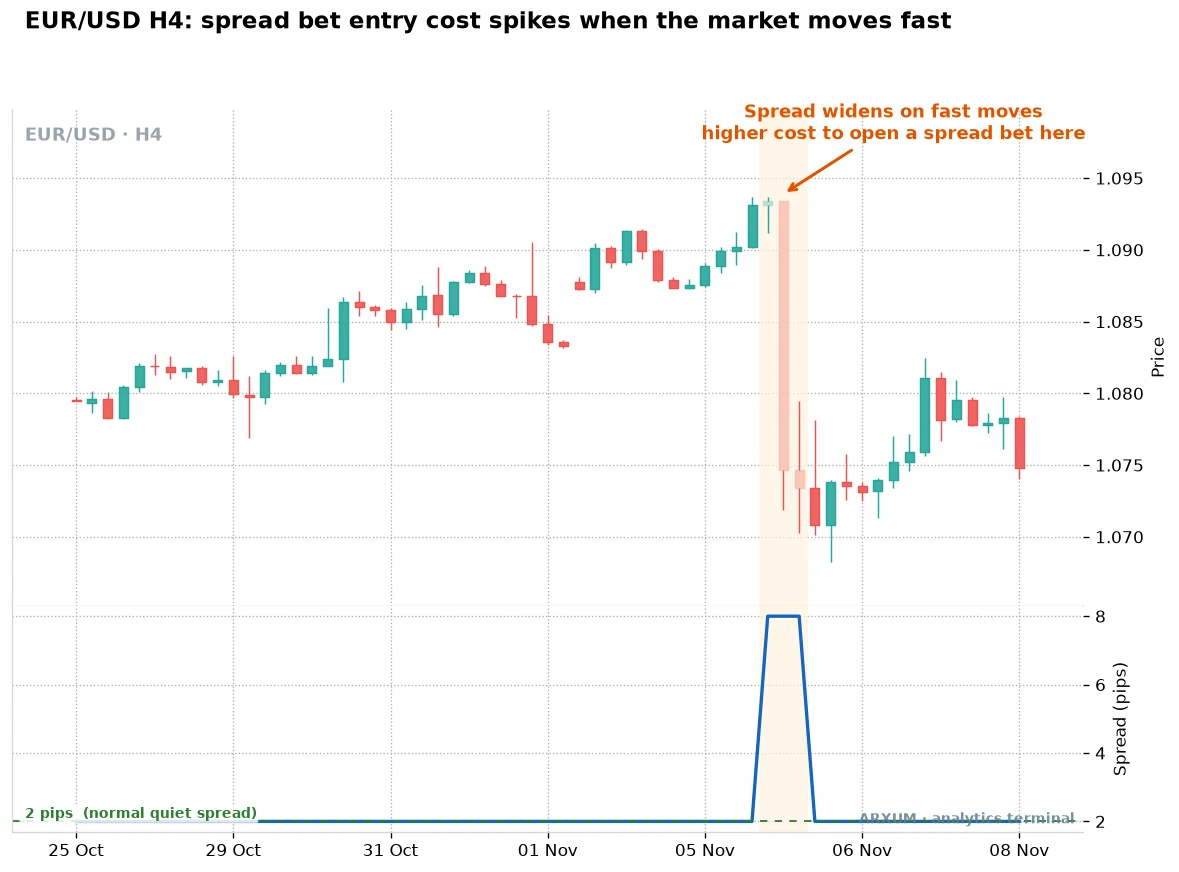
- Quiet spread, cheap entry. Through calm hours EUR/USD holds near a 2-pip spread, so the cost to open is small.
- Fast market, fat spread. On a news spike the same spread jumps toward 8 pips. You pay that gap the instant you open.
- The trap for beginners. Chasing a breakout means buying into the widest spread of the day, so the market has to move further just to cover your entry cost.
Beyond the spread, two more running costs apply to positions held over time.
| Cost | When it applies | Plain read |
|---|---|---|
| The spread | Every time you open | Wider on gold and fast markets |
| Overnight financing | Positions held past the daily cut-off | A small daily charge on leveraged size |
| Guaranteed stop premium | Only if you add one | A fee to lock your stop at an exact price |
| Commission | Never on spread betting | Built into the spread instead |
- Overnight financing is charged because leverage is effectively a loan. Hold a bet overnight and you pay a small daily fee on the full position size, which is why spread betting suits short holds more than long ones.
- A guaranteed stop removes slippage on your exit, but the broker charges a premium for it. Useful around news, wasteful on a quiet market.
The takeaway on cost: spread betting looks commission-free, and it is, but the spread plus overnight financing is the real price. On short intraday bets the spread dominates; hold for days and financing starts to bite.
Spread betting vs CFDs vs owning the asset
Spread betting is one of three ways to get exposure to a price. The other two are a CFD and simply buying the asset.
They are close cousins, and the differences are mostly tax and mechanics.
| Feature | Spread betting | CFD | Buy the asset |
|---|---|---|---|
| You own it | No | No | Yes |
| Leveraged | Yes | Yes | No |
| Bet size | Per point | Per contract | Per share or unit |
| UK tax | No CGT, no stamp duty | CGT applies | CGT plus stamp duty |
| Go short | Easy | Easy | Hard or not possible |
| Losses offset tax | No | Yes, against gains | Yes, against gains |
The practical read on when each fits:
- Spread betting suits a UK or Ireland based trader making short-term, speculative bets who wants the tax-free treatment and does not need to offset losses against tax.
- A CFD suits a trader who wants to offset trading losses against other gains for tax, or who trades from a country where spread betting is not offered. The mechanics of a CFD are otherwise almost identical.
- Buying the asset suits a long-term investor who wants to actually hold shares, collect dividends and is not using leverage.
The one-line difference: spread betting and CFDs are the same leveraged bet wearing different tax coats, while owning the asset is a different thing entirely.
Is spread betting tax-free?
This is the reason spread betting exists as a separate product in the UK and Ireland. Because it is legally a bet, the tax treatment is different from investing.
| Tax | Spread betting | Why |
|---|---|---|
| Capital Gains Tax | None on profits | Classed as gambling, not investment |
| Stamp duty | None | You never buy the underlying share |
| Income tax | None in normal cases | Winnings are not earned income |
| Loss relief | None | You cannot offset losses against tax |
The honest caveats, because tax is never quite that simple:
- Tax-free cuts both ways. You keep all the profit, but you also cannot write off losing bets against your tax bill. A CFD trader can; a spread bettor cannot.
- The rules can change. Tax law is set by government and can shift. Current UK treatment is favourable, but it is not a guarantee for all time.
- This is not tax advice. Your own position, especially if trading is your main income, can be more nuanced. Check with a qualified adviser rather than a trading blog.
The takeaway on tax: for a UK or Ireland retail trader, tax-free profits are the single biggest draw. Just remember the trade-off is no loss relief.
Which markets you can spread bet
One account covers most of what a retail trader wants. The per-point value changes market to market, which is the thing beginners forget.
| Market | Example | What one point tracks |
|---|---|---|
| Forex | EUR/USD, GBP/USD | One pip of the pair |
| Indices | FTSE 100, US 500 | One index point |
| Commodities | Gold, oil | A set price step, e.g. $1 an ounce on gold |
| Shares | Individual stocks | A penny or cent of the share price |
| Crypto | Bitcoin, Ethereum | A set dollar step of the coin |
- Forex is the most common starting point. Tight spreads, deep liquidity and a familiar pip make it the easiest market to learn stake sizing on.
- Indices give broad exposure in one bet. A single FTSE 100 bet is a bet on the whole basket, not one company.
- Commodities and crypto move hard. Gold, oil and Bitcoin have wide daily ranges, so the same stake carries far more risk than it would on a currency pair.
- Shares carry event risk. A single stock can gap on earnings, and a gap can jump your stop, so size shares smaller.
The rule of thumb: match the stake to the market’s range, not the other way round. A £2 point on gold is a very different bet from a £2 point on EUR/USD.
Leverage, margin and the real risk
Leverage is what makes spread betting powerful and what makes it dangerous. You put down a fraction of the position’s value as margin, and you get the full price exposure.
That cuts both ways, hard.
- Margin is a deposit, not the cost. You might tie up a few percent of the position size to open a much larger bet. The rest is leverage.
- Losses build at full size. Your profit and loss run on the whole exposure, not the margin. A small adverse move against a big position can erase the deposit fast.
- Margin calls come quickly. If losses eat into your margin, the broker asks for more or closes the bet. A margin call is not a warning shot; it is the position being cut. See what a margin call looks like before it happens to you.
UK and EU regulators cap how much leverage a retail account can use. Those caps exist because uncapped leverage wiped out too many beginners.
| Market | Max leverage | Margin required |
|---|---|---|
| Major forex pairs | 30 to 1 | About 3.3% |
| Gold, major indices | 20 to 1 | 5% |
| Other commodities | 10 to 1 | 10% |
| Individual shares | 5 to 1 | 20% |
| Crypto | 2 to 1 | 50% |
The margin in plain money, since the per-point stake hides it. Your bet controls a position far bigger than the deposit, and the order ticket shows that full exposure before you confirm.
- Margin is a slice of the exposure. Say the ticket shows £10,000 of EUR/USD exposure behind your bet. At the 30 to 1 major-forex cap you post about £330, or 3.3%, to open it.
- Financing is a small nightly slice. Hold that same bet overnight and you pay a yearly rate of a few percent on the exposure, charged daily, on the order of £0.50 to £1 a night on a position that size.
- The ticket does the sums. You never work the margin out by hand. The order screen shows the margin required and any overnight cost before you confirm, so check it there.
Two protections and one hard truth every beginner should know:
- Negative balance protection. For FCA and ESMA retail clients, you cannot lose more than the money in your account. The broker eats any gap beyond zero. Pro accounts do not get this.
- You can still lose the lot. Protection caps the loss at your balance, not at a comfortable number. A leveraged bet can drain a full deposit in a single fast move.
- A stop is not optional. Sizing the bet to a sensible risk-reward ratio and setting a stop is the difference between a controlled loss and a blown account. Work out the position size before you open, not after.
The takeaway on risk: leverage is the whole appeal and the whole danger. Treat the margin as the entry ticket, not the amount at risk, because the amount at risk is the full position.
Who spread betting suits, and who it does not
The product fits a specific kind of trader. Being honest about that is more useful than a sales pitch.
| You are | Spread betting fit | Why |
|---|---|---|
| UK or Ireland based, short-term trader | Strong fit | Tax-free profits, easy to short |
| Active trader wanting loss relief | Weak fit | A CFD lets you offset losses |
| Long-term investor | Poor fit | Financing costs eat long holds |
| Complete beginner, no risk plan | Dangerous | Leverage punishes mistakes fast |
| Outside the UK or Ireland | Often unavailable | Product is mostly UK and IE only |
- It rewards discipline. A trader with a stop, a stake sized to the market and a clear spread betting strategy can use the tax edge well.
- It punishes drift. Betting big on a hunch with no stop is how the leverage turns against you.
- It is not investing. Overnight financing makes spread betting a poor vehicle for a buy-and-hold view. Use it for days and weeks, not years.
How to place a spread bet
The mechanics are quick once the account is open. The thinking should take longer than the clicking.
- Open an account with a regulated spread betting platform and pass its checks. Most offer a demo to practise with first.
- Pick your market and check its current spread and per-point value. A point on gold is not a point on EUR/USD.
- Choose your stake per point based on the market’s daily range and what you can afford to lose, not on how sure you feel.
- Decide direction. Bet UP if you expect a rise, DOWN if you expect a fall.
- Set a stop-loss at the price where your idea is wrong. Attach a stop before you open, so the loss is capped by design.
- Place the bet and manage it. Watch the position, move the stop to protect profit, and close when your plan says so, not when your nerves do.
If you are weighing spread betting for beginners against other ways to start, the demo account is the safest first step, since it lets you rehearse the whole process with no money at risk.
A note on tooling, so you are not hunting menus:
- Charting. Free platforms like TradingView let you mark levels and plan the bet before you place it, with no paid plan needed.
- The platform. Your spread betting broker’s own app is where you actually stake and set stops. Practise the order ticket in demo until it is second nature.
Deciding which way to bet, up or down, is a separate skill from placing the bet, built on chart reading and market analysis rather than the order ticket. For that broader grounding before you stake real money, the beginner’s guide to forex trading covers the basics that spread betting sits on top of.
What to remember: three things
If you keep only three points from this guide, keep these.
- The maths is points times stake. Profit and loss is simply the points a market moves multiplied by your stake per point, in both directions. Size the stake to the market’s range.
- The spread is the cost, and it moves. You pay the spread to enter, it is wider on gold than forex, and it balloons on fast markets. There is no separate commission, but financing adds up on held bets.
- Tax-free, but leveraged. UK and Ireland profits dodge CGT and stamp duty, which is the real draw. The price of that is leverage that can drain a deposit fast, so a stop is not optional.
Spread betting is not a shortcut to easy money, and anyone selling it that way is selling. Used for what it is good at, short-term, tax-efficient, leveraged bets with a stop and a plan, it is a clean and flexible tool for a UK or Ireland trader.
Glossary: the key spread betting terms
- Spread betting: a leveraged bet on a market’s direction, staked per point of movement, with no ownership of the asset.
- Stake per point: the money you win or lose for each point the market moves.
- Point: the smallest price increment a platform quotes, usually one pip on forex.
- Bid and Ask: the sell and buy prices. You open a long at the Ask and a short at the Bid.
- Spread: the gap between Bid and Ask, which is your cost to enter.
- Leverage: control of a large position with a small deposit, which magnifies gains and losses alike.
- Margin: the deposit a leveraged bet ties up.
- Overnight financing: a small daily charge for holding a leveraged bet past the cut-off.
- Negative balance protection: an FCA and ESMA rule capping a retail client’s loss at their account balance.
- Guaranteed stop: a stop that fills at your exact price for a premium, even through a gap.
FAQ
What is spread betting, in plain terms?
Spread betting is a leveraged way to bet a fixed amount of money per point on whether a market will rise or fall, without owning the asset. You choose a market, set a stake per point, and go long if you expect a rise or short if you expect a fall. Your profit or loss is the number of points the market moves multiplied by your stake. The cost to enter is the bid/ask spread rather than a separate commission.
How does spread betting work?
You pick a market and a stake per point, then bet up or down. If you stake five pounds a point on EUR/USD going long and price rises fifty points, you make fifty times five, or two hundred and fifty pounds. If it falls fifty points instead, you lose the same way. You can close the bet at any time, and going short is as simple as going long because you never borrow the asset.
Is spread betting tax free?
In the UK and Ireland, spread betting profits are free from Capital Gains Tax and stamp duty because it is legally classed as gambling rather than investment. The trade-off is that you cannot offset losing bets against your tax bill, which a CFD trader can. Tax rules are set by government and can change, and your personal position may differ, so this is not tax advice.
What is the difference between spread betting and CFDs?
They are almost the same leveraged product with different tax treatment and sizing. Spread betting is staked per point and its UK profits are tax-free but losses cannot offset tax. A CFD is traded per contract, is subject to Capital Gains Tax on profits, but lets you offset losses against gains. CFDs are also available in more countries, while spread betting is mostly a UK and Ireland product.
Can you lose more than you deposit spread betting?
As an FCA or ESMA retail client you have negative balance protection, so you cannot lose more than the money in your account. The broker absorbs any gap beyond zero. That protection does not make it safe, though. A leveraged bet can still drain your entire deposit in a single fast move, so a stop-loss and sensible stake sizing matter regardless.
How much money do you need to start spread betting?
Many platforms let you open with a modest amount, sometimes a hundred pounds or less, and you can stake small amounts per point. The real question is not the minimum but the stake. On a small account you should bet a small amount per point, because leverage means even a low stake carries meaningful risk. Practise on a demo account first to learn the order ticket.
Is spread betting gambling?
Legally, yes, which is exactly why UK profits are tax-free. In practice, how you approach it decides whether it behaves like gambling. Staking on a hunch with no stop is gambling. Sizing a bet to a plan, using a stop and managing risk is closer to trading. The product is the same either way, but the discipline is what separates the two outcomes.
What markets can you spread bet on?
Most platforms cover forex pairs like EUR/USD and GBP/USD, stock indices like the FTSE 100 and US 500, commodities such as gold and oil, individual shares, and major cryptocurrencies. The per-point value changes market to market, so one point on gold is worth far more exposure than one point on a currency pair. Match your stake to each market's typical range.
Is spread betting good for beginners?
It can be a reasonable place to learn because you can stake small and the tax treatment is simple, but the leverage makes it unforgiving of mistakes. A beginner should start on a demo account, bet small amounts per point, always use a stop-loss, and treat the margin as the entry ticket rather than the amount at risk. Without a risk plan, the leverage works against you fast.
🌍 Our recommended brokers


Reader Reviews
Be the first to review this — tell other traders what actually helped, or where it fell short.
Leave a Review

Forex Analyst & Senior Trader
Former FX desk trader with 8 years in institutional forex. Works in multi-timeframe analysis and order flow, turning desk experience into systematic, testable rules across forex and metals.