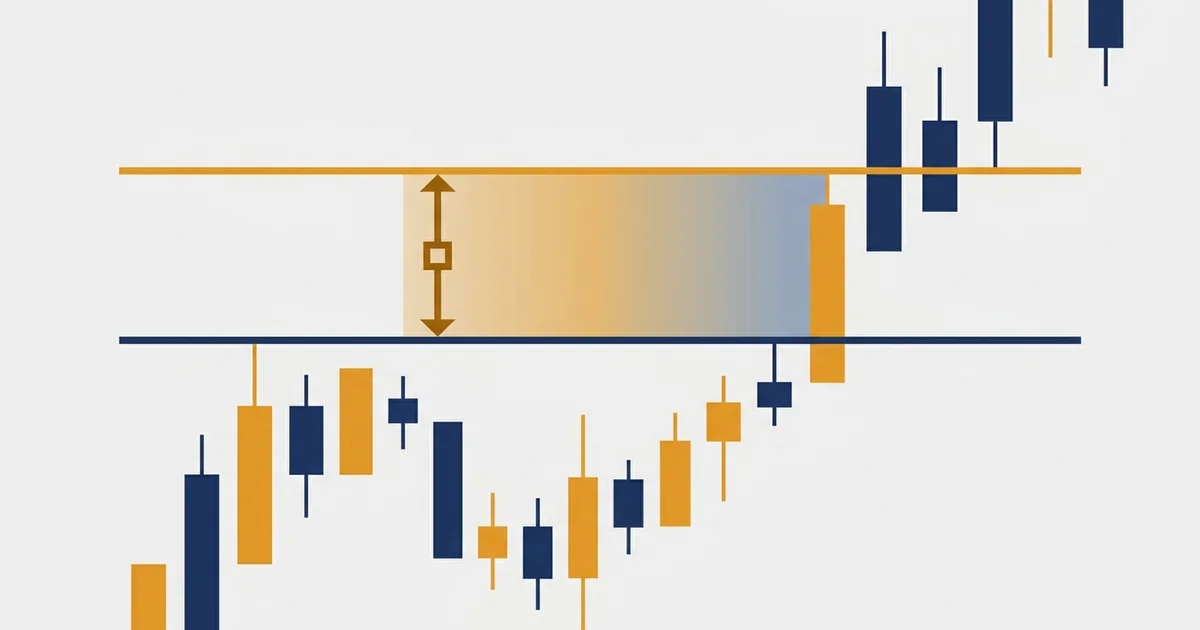

What a forex spread actually is
Every Forex quote has two prices, not one. The bid is what a buyer will pay you, the ask is what a seller will charge you, and the spread is the gap between them.
The clearest way to see it is to put both prices on one chart and mark the gap.
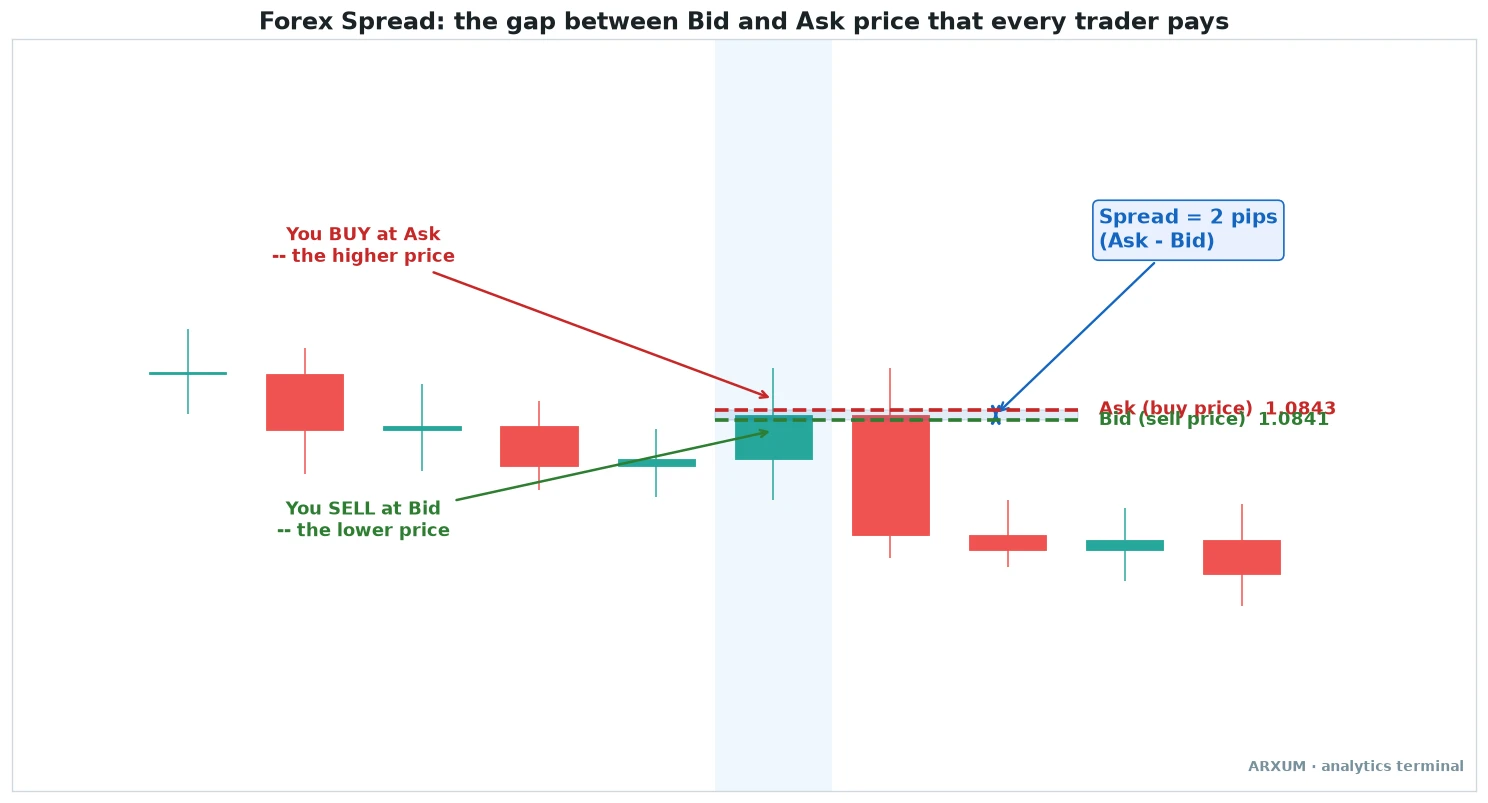
The whole idea sits in that one gap. Read the two dashed lines together.
- The ask (buy price) is always the higher of the two. When you click buy, you enter here, at 1.0843 in the picture.
- The bid (sell price) is always the lower one. When you sell, or close a long, you deal here, at 1.0841.
- The spread is ask minus bid, so 1.0843 minus 1.0841 is 2 pips. That gap is what the broker keeps.
- You start every trade slightly in the red. Buy at the ask, and price has to climb the spread just to reach break-even.
Here is the same point as a plain contrast.
| Term | What it is | You use it to |
|---|---|---|
| Ask | The higher price | Buy, or open a long |
| Bid | The lower price | Sell, or open a short |
| Spread | Ask minus bid | Pay, on every trade |
The one-line read: the spread is the toll you pay to get through the door, long or short, win or lose.
How the spread is measured, in pips
Spreads are quoted in pips, so you need the pip before you can price the spread. A pip is the standard small step a currency price moves in.
On most pairs a pip is the fourth decimal place, so 0.0001. On yen pairs like USD/JPY it is the second decimal, 0.01.
- A pip is the unit the spread is counted in. A 1 pip spread on EUR/USD is a move from 1.0841 to 1.0842.
- Many brokers quote a fifth decimal, called a pipette or a fractional pip. A spread shown as “0.8” means eight tenths of a pip.
- The pip is the same size whatever your position, but the money value of that pip scales with your lot.
- Pip value depends on the pair and your lot size. For the full breakdown, the lot size and pip value guide has the numbers.
Rule of thumb: a tighter spread in pips is always cheaper, but the dollar cost only becomes real once you fold in your lot size.
How to calculate spread cost in forex
The spread in pips is only half the story. The cost in money is the spread times your pip value times your lot size.
Work it from the lot down, one step at a time. Take EUR/USD with a spread of 1.2 pips.
- Step 1, find the pip value for your lot. A standard lot is 100,000 units, so a pip is worth about 10 dollars. A mini lot is 1 dollar a pip, a micro lot 10 cents.
- Step 2, multiply by the spread. On a standard lot: 1.2 pips times 10 dollars is 12 dollars. On a mini lot it is 1.20 dollars, on a micro lot 12 cents.
- Step 3, that is your entry cost. You pay it the instant you open, round-trip, since the spread already sits between your entry and your exit.
| Lot size | Units | Pip value | Spread cost |
|---|---|---|---|
| Standard | 100,000 | ~$10 | ~$12 |
| Mini | 10,000 | ~$1 | ~$1.20 |
| Micro | 1,000 | ~$0.10 | ~$0.12 |
That cost matters most against small targets. If you aim for 20 pips and pay a 1.2 pip spread, you have handed over 6% of the target before price moves your way.
Fixed spread vs variable spread
Not every spread behaves the same way through the day. Brokers offer two models, and the difference shows up exactly when the market gets busy.
A fixed spread stays the same whatever the conditions, a variable spread floats with supply and demand.
| Feature | Fixed spread | Variable spread |
|---|---|---|
| Set by | The broker | Live market |
| In calm hours | Same, often wider | Very tight |
| In news or thin hours | Same, but requotes possible | Widens, sometimes a lot |
| Best for | Planning a known cost | Trading liquid hours |
A few plain notes on the two.
- Fixed spreads buy certainty. You know the cost up front, which suits a beginner or anyone trading around news. The trade-off is a wider baseline in calm markets.
- Variable spreads reward good timing. They can drop to a fraction of a pip in deep liquidity, but they blow out when the book thins or a headline hits.
- Fixed spreads can still bite you sideways. In a fast move a fixed-spread broker may requote or reject your fill instead of widening the spread.
- Most brokers today run variable spreads, because they pass the real market cost straight through to you.
ECN vs market maker spreads
Behind the spread sits the broker’s business model, and it decides where your price comes from. The two main types are the market maker and the ECN or STP broker.
The gap between their spreads is real, but so is the fine print underneath.
| Feature | Market maker | ECN / STP |
|---|---|---|
| Counterparty | The broker | The wider market |
| Spread | Wider, sometimes fixed | Raw, near zero |
| Commission | Usually none | A separate fee per lot |
| Best for | Casual, low-volume trading | Scalpers, high volume |
The honest read on each.
- A market maker takes the other side of your trade. The spread is its main revenue, so it tends to be wider, and there is often no separate commission.
- An ECN broker passes you the raw interbank spread, which can sit near zero in liquid hours, then charges a commission on top, often a few dollars per lot per side.
- Compare them on the all-in cost, not the spread alone. A raw 0.1 pip spread plus commission can still beat a “zero commission” 1.5 pip spread.
- Very tight raw spreads suit anyone who trades often, since the saving repeats on every position.
When forex spreads widen
A variable spread is not one number, it breathes through the day. Two forces move it, the trading session and the speed of the market.
Both are worth watching before you click.
The session effect
The same pair can cost you very different amounts depending on the clock. Liquidity is deepest when the major centres are open, and the spread tightens with it.
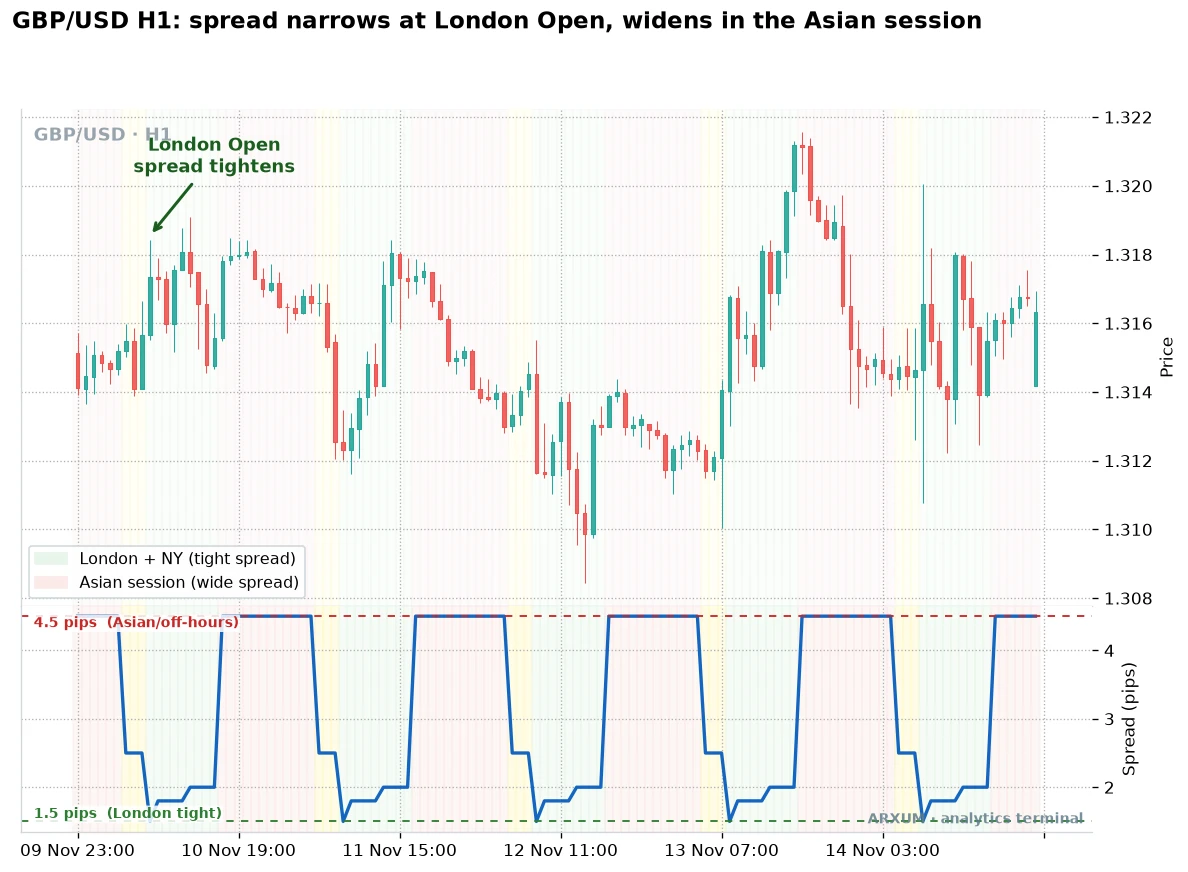
Read the bottom panel, which plots the spread itself, against the session shading on the price chart.
- The Asian and off-hours run wide. The book is thin, so the spread on GBP/USD sits up near 4.5 pips in the chart, the upper dashed line.
- The London open tightens it fast. As the big desks come in, the spread drops toward 1.5 pips, the lower dashed line and the green shading.
- The tightest window is the London and New York overlap, roughly 13:00 to 16:00 UTC, when both centres trade at once.
- The lesson: trade the busy hours for a cheaper spread, and treat the dead hours with care. Full times are in the Forex market hours guide.
| Window (UTC) | Session | Spread |
|---|---|---|
| 22:00 to 07:00 | Asia and off-hours | Widest |
| 07:00 to 08:00 | London open | Tightening fast |
| 13:00 to 16:00 | London and New York overlap | Tightest |
| 17:00 to 22:00 | New York afternoon | Widening again |
The volatility effect
Speed is the other trigger. When price moves fast, the spread widens to protect the broker, and the calm one-pip cost can jump for a few minutes.
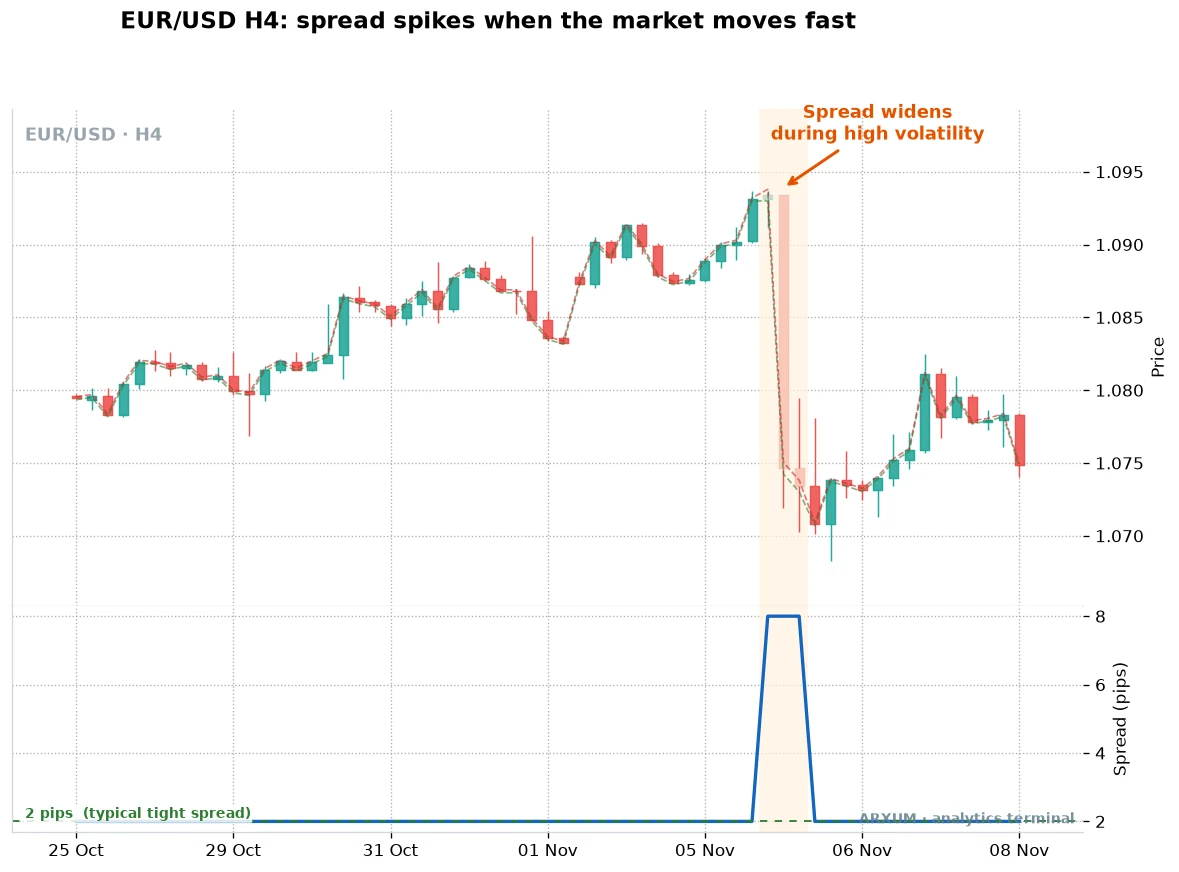
The lower panel tracks the spread while the top panel shows the price drop that caused it.
- In calm conditions the spread is flat and low, near 2 pips here, the green baseline. This is the normal cost you plan around.
- In the fast drop it spikes, up toward 8 pips in the shaded band, then settles back once the move calms.
- News releases do the same thing. A rate decision or jobs report can widen the spread for the minutes around the print.
- The read: do not open right into a news spike. You pay a wider spread and risk slippage on your fill at the same time.
Typical forex spreads by pair
What counts as a good spread depends entirely on the pair. The deep majors are cheap, the exotics are not, and the gap is large.
These are rough guides for a variable-spread broker in liquid hours, not fixed numbers.
| Pair | Type | Typical spread |
|---|---|---|
| EUR/USD | Major | 0.1 to 1.0 pip |
| GBP/USD, USD/JPY | Major | 0.5 to 1.5 pips |
| gold (XAU/USD) | Metal | ~20 to 40 cents |
| EUR/GBP, AUD/JPY | Minor | 1 to 3 pips |
| USD/TRY, USD/ZAR | Exotic | 20 to 100+ pips |
A few notes to read alongside the table.
- EUR/USD is the cheapest pair to trade. It is the deepest market in Forex, so its spread is the tightest you will find.
- Gold is measured in cents, not pips, but the idea is identical. Spot gold (XAU/USD) is deep and tight in the main sessions.
- Minors cost more than majors, exotics cost far more. That wide exotic spread is a real drag you pay on every trade. The Forex pairs guide sorts them by group.
- What is a good spread depends on the pair. Under a pip is excellent on EUR/USD, but a 3 pip spread is normal on a minor.
How the spread hits different traders
The spread is the same cost for everyone, but it does not hurt everyone equally. The faster you trade, the more it matters, because you pay it more often against smaller targets.
Match how much you care to how you trade.
| Style | Spread impact | What to do | Best window |
|---|---|---|---|
| Scalping | Critical | Tightest pairs, ECN, prime hours | Session overlap |
| Day trading | High | Liquid pairs, dodge news spikes | London and New York |
| Swing trading | Low | Any liquid pair | Any liquid session |
| Position trading | Minimal | Pick a deep asset | Any |
The same point in plain terms.
- Scalpers pay the spread the most. Aiming for a few pips, a one-pip wider spread can wipe out the edge, which is why the scalping guide leans on tight pairs and prime hours.
- Day traders should trade the overlap and skip the news spike. A tighter spread on ten trades a day adds up fast.
- Swing traders can relax. Holding for days, a 1 pip entry spread barely registers against a 200 pip move.
- Position traders care mostly about the asset. Pick a deep major or gold and the spread is a rounding error over months.
How to keep spread costs low
You cannot remove the spread, but you control most of how much you pay. Four levers do the heavy lifting.
- Trade deep pairs. EUR/USD and the other majors carry the tightest spreads. Drop to minors and exotics only with the wider cost in mind.
- Trade the liquid hours. The London and New York overlap gives the tightest variable spreads, the dead hours give the widest.
- Compare brokers on the all-in cost. Line up spread plus any commission on the pairs you actually trade, not the headline “from 0.0 pips” number. Our broker comparison lays out typical spreads side by side.
- Avoid trading into news. Spreads widen and slippage climbs at exactly the same moment, so wait for the spike to pass.
One honest note. The spread you see is your broker’s, and a decentralised Forex market means it can differ slightly from broker to broker.
Treat the tightest advertised number with mild suspicion, and check the live spread yourself in the quiet hours, when brokers cannot dress it up.
What works: the spread checklist
Keep these four points and you have covered most of what the spread will ever cost you.
- Know the two prices. You buy at the ask, sell at the bid, and the gap is the spread you pay on every trade.
- Price it in money. Spread in pips times pip value times lot size is your real entry cost, and it hurts most against small targets.
- Time it. The spread tightens in the session overlap and widens in the Asian hours, in fast moves, and around news.
- Shop the all-in cost. Compare spread plus commission on your pairs, and prefer a deep major in liquid hours.
The spread will not call a direction for you. But it is the one cost you pay on every single trade, and over a year of trading the difference between a tight spread and a sloppy one quietly decides whether a plan that works on paper still works in your account.
Key terms
- Forex spread: the gap between the bid and the ask price, the main cost of a trade.
- Bid: the price you can sell at, the lower of the two quotes.
- Ask: the price you can buy at, the higher of the two quotes.
- Pip: the standard small price step in Forex, usually the fourth decimal place on a pair.
- Fixed spread: a spread the broker holds steady whatever the market does.
- Variable spread: a floating spread that tightens and widens with market liquidity.
- ECN broker: a broker that passes you the raw market spread and charges a separate commission.
- Market maker: a broker that takes the other side of your trade and earns from a wider spread.
- Pip value: the money one pip is worth, which scales with your lot size.
FAQ
What is spread in forex, in plain terms?
How does forex spread work?
How do I calculate spread cost in forex?
What is the difference between fixed and variable spread?
What is a good spread in forex?
Why do forex spreads widen?
How does the spread affect trading profits?
What is the difference between an ECN and a market maker spread?
Which forex pair has the lowest spread?
Do I pay the spread on both entry and exit?
Real-time trade setups with entry, stop loss and take profit. Daily market analysis. No subscription, no complicated theory.
🌍 Our recommended brokers


Reader Reviews
Be the first to review this — tell other traders what actually helped, or where it fell short.
Leave a Review

Forex Analyst & Senior Trader
Former FX desk trader with 8 years in institutional forex. Works in multi-timeframe analysis and order flow, turning desk experience into systematic, testable rules across forex and metals.