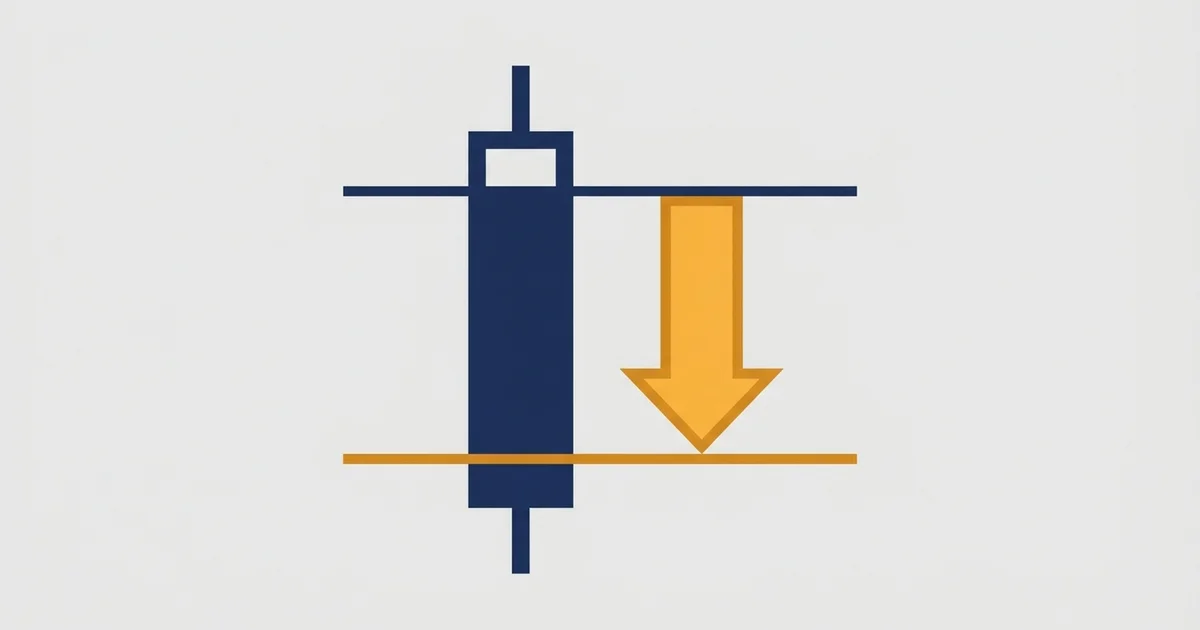

What slippage actually is
Every trade needs a buyer and a seller at a price. Slippage is what you get when the price you clicked is gone by the time your order arrives, and the next available price is different.
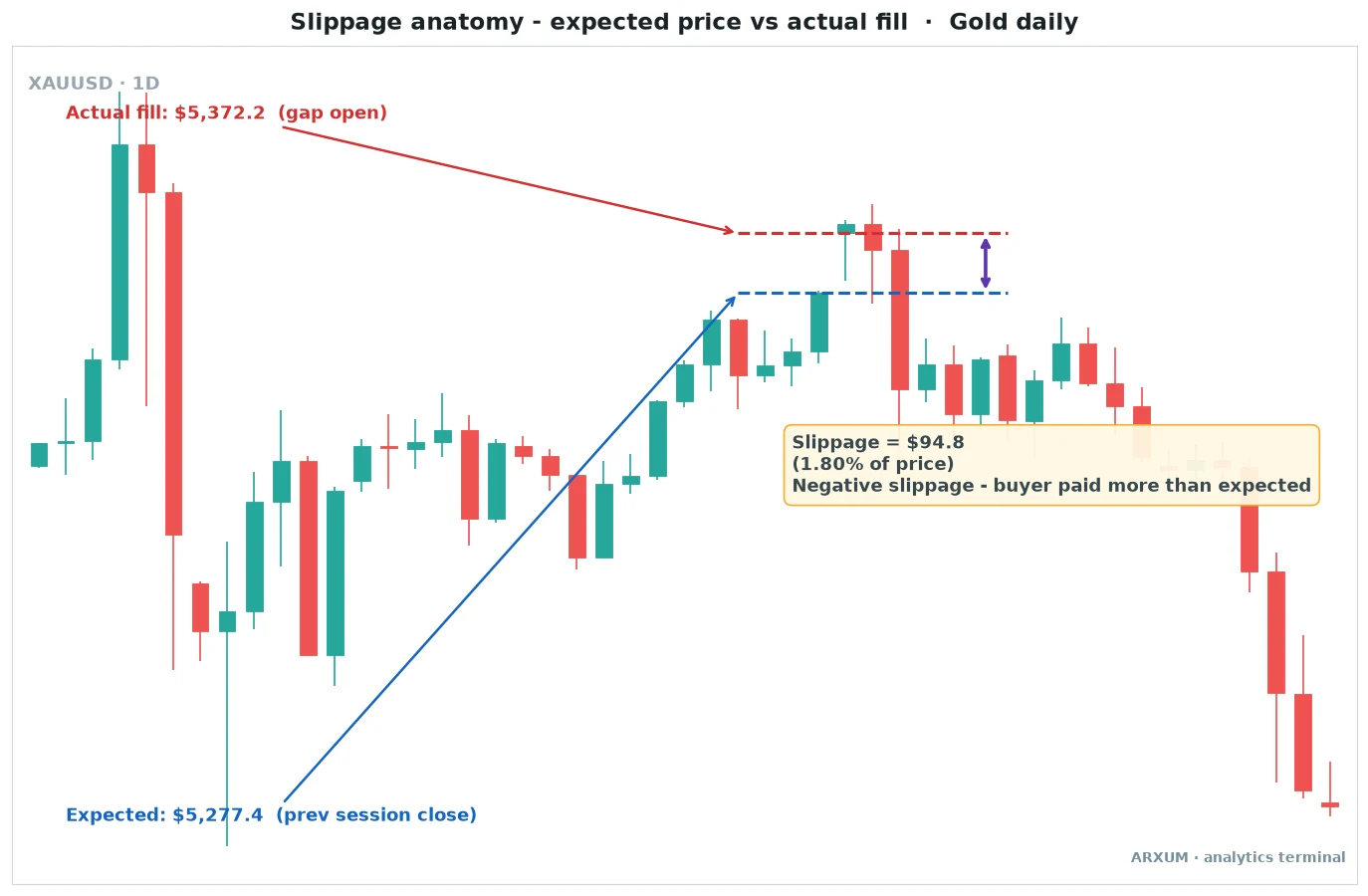
Read the chart top to bottom. The blue level is where you thought you would get in.
The red level is where you actually got in.
The distance between them is the whole idea:
- Expected price: the last price you saw, or the level your order was resting at.
- Actual fill: the price the market gave you when the order executed.
- The gap: that difference is slippage, measured in pips, points, ticks, or a percent of price.
- Direction matters: worse than expected is negative slippage, better than expected is positive slippage.
Slippage is not a broker fee and it is not the spread, though it lives next to both. It is purely the movement of price between your click and your fill.
Positive slippage vs negative slippage
Slippage cuts both ways. Most traders only notice it when it costs them, but a fast market fills plenty of orders at a better price too.
| Type | What happens | Effect on you |
|---|---|---|
| Negative slippage | Fill is worse than expected | Buy higher, sell lower |
| Positive slippage | Fill is better than expected | Buy lower, sell higher |
| No slippage | Fill matches the quote | Calm, liquid market |
Two things worth knowing about positive slippage:
- It is real, not a myth. In a fast move your favor, price can jump past your order and fill you cheaper than you asked.
- Honest brokers pass it on. A broker that only ever slips you the wrong way, and never the right way, is worth a hard look.
The rule of thumb: over many trades, slippage should roughly wash out on a fair execution setup. If it only ever hurts, the problem is the venue, not the market.
What causes slippage in trading
Slippage is not random. It comes from a small set of conditions, and once you know them you can see it coming.
| Cause | Why it slips | Where it bites hardest |
|---|---|---|
| Low liquidity | Few orders to fill against | Small caps, exotic pairs |
| Market orders | Take any available price | Every fast market |
| News and data | Price jumps in an instant | NFP, CPI, rate calls |
| Large order size | Eats through the order book | Thin books, whales |
| Gaps and opens | No trading between prices | Weekend gaps, session opens |
The single biggest driver is thin liquidity, which is just a shortage of resting orders near the current price. When there is little to fill against, your order reaches for the next price, and the next.
That is why the depth of the market matters as much as the headline price. The trading liquidity guide digs into order-book depth and why the bid-ask spread is a live read on how much slippage to expect.
A quick sense of scale, in plain terms:
- A major forex pair in quiet hours barely slips. The book is deep and orders fill where you expect.
- A thin altcoin at 3am can slip badly on a normal-sized order. There is simply nobody on the other side.
- Any market during a news release can slip hard for a few seconds, no matter how liquid it usually is.
Slippage when the market moves fast
Speed is the trigger most traders feel. When price starts traveling far on every bar, the spread widens and a market order gets caught reaching for a fill.
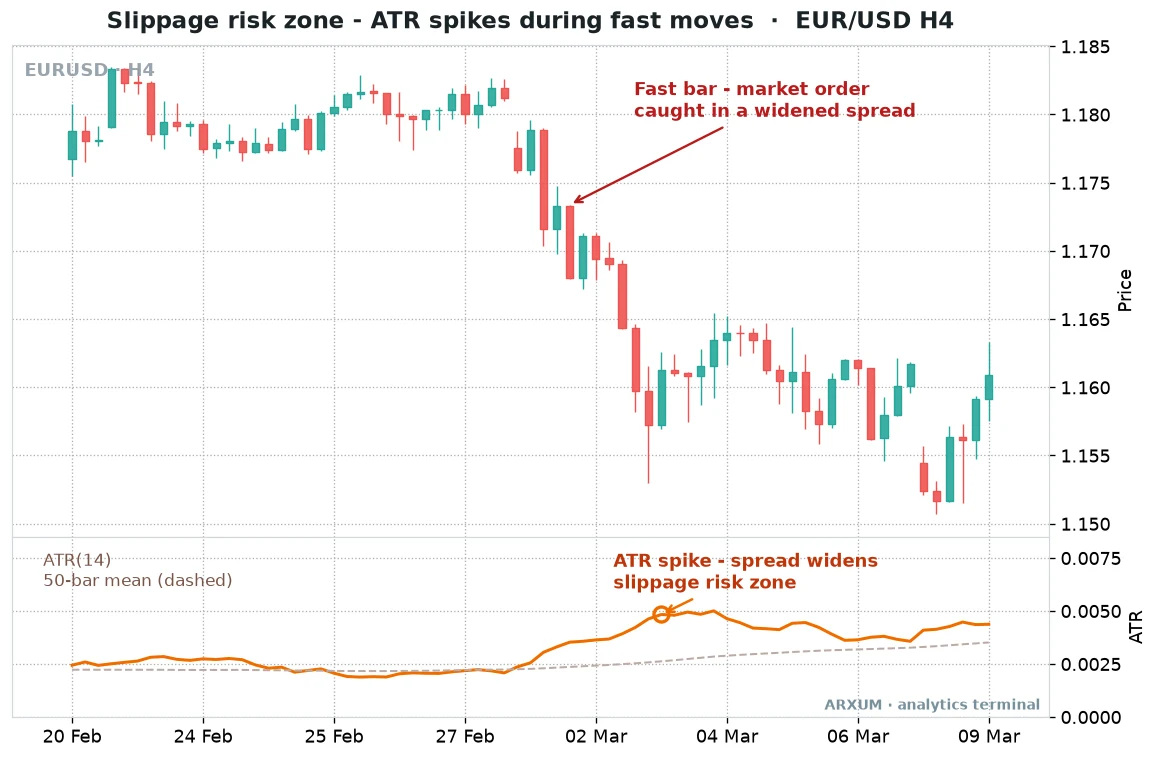
Here is how to read the two panels:
- Top panel, price: the arrow marks a fast bar, a candle where price moved a long way in one step.
- Bottom panel, ATR (14): the Average True Range measures the size of recent bars, so a rising line means price is speeding up.
- The dashed line: the 50-bar average of ATR, a baseline for normal speed.
- The spike: when ATR jumps above that baseline, the market is fast and the spread stretches, which is the slippage risk zone.
ATR is a simple volatility gauge, and it doubles as a slippage early-warning light. When it flares, market orders get expensive.
| ATR read | Market state | Slippage risk |
|---|---|---|
| Below its average | Calm, tight spread | Low |
| Rising toward average | Waking up | Building |
| Spiking above average | Fast, wide spread | High |
The practical move is to check volatility before you fire. The ATR indicator guide shows how to read it, and around scheduled news the safest ATR read is to simply wait for the spike to pass.
Slippage in thin and volatile crypto markets
Crypto shows slippage at its rawest. The market runs around the clock, liquidity swings wildly by hour and by coin, and a single volume spike can blow a market order well past its quote.
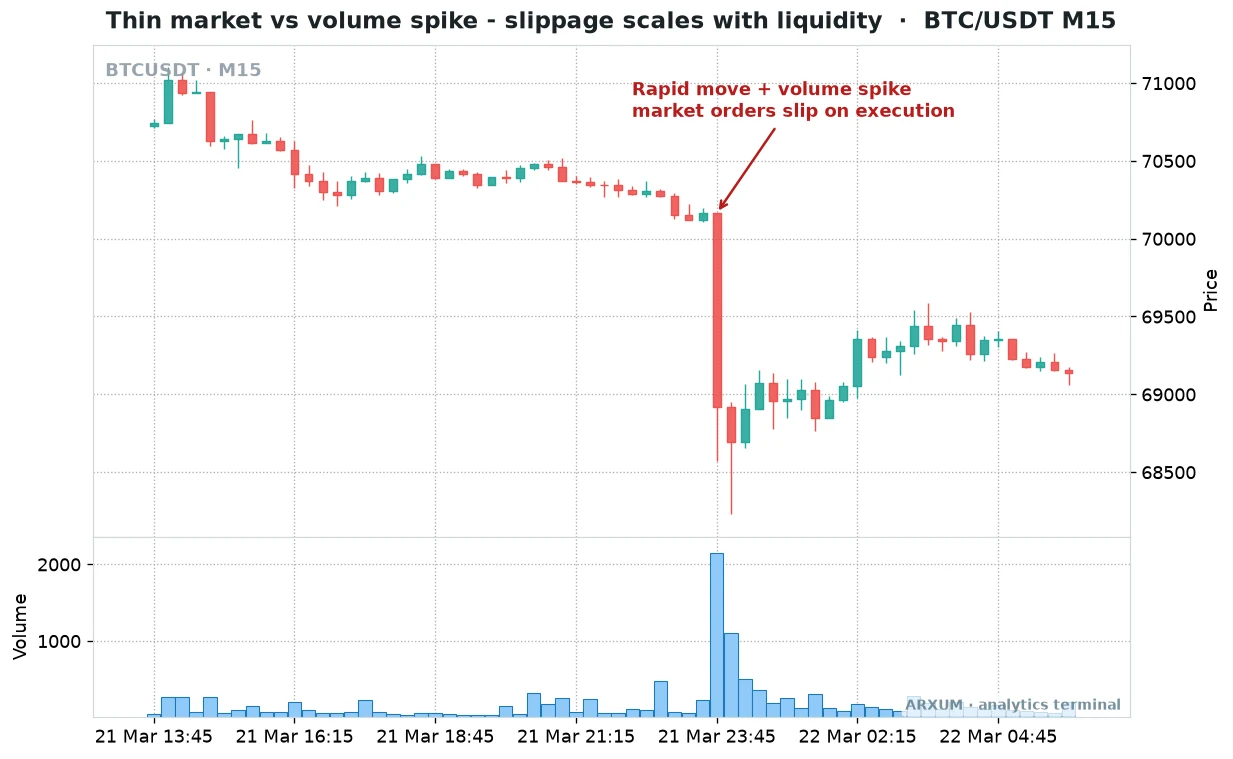
What the chart is telling you:
- The long red candle is a rapid move, price falling far in one 15-minute bar.
- The volume bar underneath spikes at the same moment, so a flood of orders hit at once.
- The mismatch is the point. Orders arrive faster than the book refills, so fills walk down the price.
- The result is that market sells in that candle fill lower than the screen price a second earlier.
Is slippage normal in crypto trading? Yes, and it is usually larger than in forex, for a few structural reasons:
- Fragmented liquidity. The same coin trades on dozens of venues, so no single order book is as deep as a major forex pair.
- 24/7 with no market makers on duty. In the quiet hours the book thins out and even a mid-size order can move price.
- Smaller tokens are worse. Away from the majors, liquidity drops fast and slippage climbs with it.
On a decentralized exchange the effect is priced in directly through a slippage tolerance setting, covered lower down. On a centralized venue, sticking to the deepest coins and the busy hours does most of the work.
Slippage across markets: forex, crypto, and stocks
The same idea, very different sizes. How much slippage you should expect depends heavily on which market you are in and how deep its book runs.
| Market | Typical slippage | Main driver |
|---|---|---|
| Major forex pair | Very low in calm hours | News, thin sessions |
| Minor or exotic pair | Moderate | Thinner liquidity |
| Spot gold (XAU/USD) | Low to moderate | Session opens, news |
| Large-cap crypto | Moderate | Volatility, split venues |
| Small-cap crypto | High | Thin order book |
| Liquid stocks | Low in market hours | Open, close, gaps |
A few notes that do not fit in a cell:
- Slippage in forex is mostly a news and session story. Trade EUR/USD during the London or New York session and it barely moves; trade it seconds after a rate decision and it can gap several pips.
- Gold behaves like a fast major. Spot gold slips most on session opens and around the same data releases that move currencies.
- Stocks gap at the open. A stock can close at one price and open far away the next morning, so an overnight order fills at the gap, not last night’s screen.
The thread through all of them is the same. Deep book plus calm market equals a clean fill, while thin book plus fast market equals slippage.
How to avoid slippage when trading
You cannot remove slippage, but most of it is avoidable with a handful of habits. This is the part that actually saves you money.
| Tactic | How it helps | Trade-off |
|---|---|---|
| Use limit orders | Fills at your price or better | May not fill at all |
| Trade liquid assets | Deep book absorbs your order | Fewer exotic plays |
| Trade the busy hours | More orders to fill against | Miss off-hours moves |
| Avoid the news window | Skips the widest spreads | Miss the volatility |
| Size orders sensibly | Does not exhaust the book | Slower to scale in |
| Set slippage tolerance | Caps the worst fill | Order can be rejected |
The single most effective switch is the order type. A market order says fill me now at any price; a limit order says fill me at this price or better, and never worse.
- Limit orders are the direct fix. You name the worst price you will accept, so negative slippage is capped by design.
- The catch is fill risk. If price runs away from your limit, the order sits unfilled and you miss the move.
- The balance most traders strike: limit orders for entries you can be patient on, market orders only when getting in right now matters more than a perfect price.
The full menu of order types, and when each one fits, sits in the order types guide. For cutting slippage, the limit order is the tool that does most of the lifting.
Three more habits that quietly shrink it:
- Mind the clock. Spreads are tightest during the main sessions and around the London and New York overlap. The dead hours are where thin-book slippage lives.
- Respect scheduled news. A calendar of releases tells you exactly when to stand aside. Fire your order before or well after, not into the spike.
- Keep size in proportion. An order that is large relative to the book will slip no matter what. Scale in rather than dumping the whole position at once.
How to minimize slippage in forex specifically
Forex has its own rhythm, so a few of the fixes above sharpen into concrete rules for currency traders.
- Trade the majors in session. EUR/USD, GBP/USD, and USD/JPY during London or New York have the deepest books and the least slippage.
- Stand aside for red-folder news. Non-farm payrolls, inflation prints, and central bank decisions widen spreads for seconds. Wait them out.
- Watch the rollover hour. Liquidity thins around the daily rollover, so avoid firing market orders into that quiet window.
- Use a broker with tight, honest execution. Slippage that only ever runs against you is an execution problem, not a market one.
New to the mechanics of currency execution? The forex trading guide for beginners covers spreads, sessions, and order handling from the ground up.
Slippage tolerance on a DEX
Decentralized crypto exchanges make slippage a setting you control directly. Before you swap, you set the maximum slippage you will accept, as a percent.
| Tolerance | What it does | Best for |
|---|---|---|
| Low (0.1% to 0.5%) | Rejects a bad fill | Deep, liquid pairs |
| Medium (0.5% to 1%) | Balances fill and price | Most everyday swaps |
| High (above 2%) | Forces the fill through | Thin tokens, urgent swaps |
Two warnings that matter here:
- Too low and the swap fails. On a volatile or thin token, a tight tolerance means the price moves past your limit and the transaction reverts, sometimes still costing gas.
- Too high invites a sandwich. A wide tolerance on a thin pool lets bots front-run your trade, buying ahead of you and selling into your order. Keep it as tight as the pool allows.
Rule of thumb: start low on liquid pairs and only widen it if the swap keeps failing, never as a default.
Which order type to use when
Slippage is mostly an order-type decision. This is the quick guide to which one fits the situation in front of you.
| If you want to | Use | Accept |
|---|---|---|
| Cap your fill price | Limit order | Might not fill |
| Get in right now | Market order | Some slippage |
| Enter on a breakout | Stop-limit order | Skips if it gaps past |
| Exit fast in a crash | Market order | Slippage is the cost of out |
| Trade a thin token | Limit or tight tolerance | Patience or a failed swap |
The honest trade-off runs through the whole table. A limit order protects your price but risks no fill; a market order guarantees a fill but not a price.
Slippage also quietly eats your reward-to-risk. A stop-loss that slips fills worse than planned, so a trade you sized for a clean 1:2 can come back closer to 1:1.5.
Sizing that in is part of the reward-to-risk math, and it is why traders on fast markets pad their stops a little.
What works: the points to remember
Keep these five and slippage stops being a mystery cost.
- Slippage is the fill gap. It is the difference between the price you expected and the price you got, up or down.
- It comes from thin books and fast markets. Low liquidity, news, gaps, and oversized orders are the causes.
- Limit orders are the main fix. They cap your price by design; the only risk is not filling.
- Time and size matter. Trade the liquid hours, skip the news spike, and keep orders in proportion to the book.
- Crypto slips most, majors least. Match your caution to the market you are actually in.
Key terms
- Slippage: the difference between the expected price of a trade and the price it actually fills at.
- Negative slippage: a fill worse than expected, so you buy higher or sell lower.
- Positive slippage: a fill better than expected, so you buy lower or sell higher.
- Market order: an order to fill immediately at the best available price, whatever it is.
- Limit order: an order to fill only at a set price or better, never worse.
- Liquidity: how many orders rest near the current price, ready to fill against yours.
- Order book: the live list of buy and sell orders at each price on an exchange.
- Spread: the gap between the bid and the ask, a live read on how tight the market is.
- ATR: the Average True Range, a gauge of how far price is traveling per bar.
- Slippage tolerance: on a DEX, the maximum slippage you will accept before a swap is rejected.
- Gap: a jump between two prices with no trading in between, common at opens and over weekends.
FAQ
What is slippage in trading?
Slippage is the difference between the price you expected on a trade and the price it actually filled at. Price is always moving, so by the time a market order reaches the exchange the best available price can shift. If the fill is worse than expected it is negative slippage; if it is better it is positive slippage. It is not a broker fee and not the spread, just the movement of price between your click and your fill.
What causes slippage in trading?
Slippage comes from a small set of conditions. Low liquidity means there are few resting orders to fill against, so your order reaches for the next price. Fast markets and news releases move price in an instant. Large orders eat through the order book, and gaps at session opens or over weekends leave no trading between two prices. The biggest single driver is thin liquidity, which is why deep, liquid markets slip the least.
What is the difference between positive and negative slippage?
Negative slippage is a fill worse than you expected, so you buy higher or sell lower and it costs you. Positive slippage is a fill better than expected, so you buy lower or sell higher and it works in your favor. Both happen in fast markets. On a fair execution setup they should roughly balance out over many trades. If slippage only ever runs against you, the venue is the likely problem, not the market.
Is slippage normal in crypto trading?
Yes, and it is usually larger than in forex. Crypto liquidity is split across dozens of venues, so no single order book is as deep as a major currency pair. The market runs around the clock with no dedicated market makers in the quiet hours, and smaller tokens have thin books that slip hard on normal-sized orders. Sticking to the largest coins during busy hours keeps it manageable, and on a decentralized exchange you control it with a slippage tolerance setting.
How do you avoid slippage when trading?
The most effective fix is to use limit orders, which fill only at your set price or better, so negative slippage is capped by design. Beyond that, trade liquid assets during the busy sessions, stand aside during scheduled news when spreads widen, and keep your order size in proportion to the order book. You cannot remove slippage entirely, but these habits shrink most of it.
How do you minimize slippage in forex?
Trade the major pairs like EUR/USD and GBP/USD during the London or New York sessions, when the order book is deepest. Stand aside for red-folder news such as non-farm payrolls, inflation data, and central bank decisions, which widen spreads for seconds. Avoid firing market orders during the thin rollover hour, and use a broker with tight, honest execution that does not only ever slip you the wrong way.
Does slippage happen with limit orders?
A limit order cannot fill worse than the price you set, so it protects you from negative slippage. The trade-off is fill risk. If price runs away from your limit before it triggers, the order simply does not fill and you miss the move. A limit order can fill better than your set price in a fast market, which is positive slippage in your favor. The only thing you give up is the certainty of getting in.
Is slippage always bad?
No. Slippage can help you as often as it hurts on a fair execution setup, since a fast move in your favor can fill you at a better price than you asked for. It only becomes a real cost when it runs consistently against you, which points to a thin market, an oversized order, or a poor execution venue. Managed with limit orders and sensible timing, slippage is a normal, controllable part of trading rather than a constant drain.
Real-time trade setups with entry, stop loss and take profit. Daily market analysis. No subscription, no complicated theory.
🌍 Our recommended brokers


Reader Reviews
Be the first to review this — tell other traders what actually helped, or where it fell short.
Leave a Review

Momentum Trader & Technical Analyst
Trades momentum across crypto and forex since 2019, built around RSI, MACD, and volume. Turns discretionary setups into rule-based, systematic entries and validates them on data before they go live.