
Why Pair Selection Matters More Than Strategy
Eight years on an FX desk taught me something retail traders rarely hear: your pair choice is a risk management decision, not just a preference. Before you run a backtest or pick an entry method, you need to know what you’re actually trading.
The spread on EUR/USD sits around 0.7-1.3 pips during the London session. The spread on USD/TRY can hit 80+ pips on a bad day. If you’re scalping or swing trading with a 20-pip stop, that difference isn’t cosmetic. On a $600 account with 0.03 lots, an 80-pip spread costs you $24 before the trade even moves.
This guide covers what forex pairs are, how the major/minor/exotic classification actually affects your trading, and which pairs are worth your time at different account sizes.
How to Read a Forex Pair
Every forex pair shows two currencies. The first is the base currency, the second is the quote currency. The price tells you how much of the quote currency you need to buy one unit of the base.
EUR/USD at 1.0850 means: 1 Euro buys 1.0850 US Dollars.
When you go long EUR/USD, you’re buying Euros and selling Dollars. When you go short, the reverse. Every price move is the relationship between these two economies shifting.
The pair is always written the same way. EUR/USD doesn’t flip to USD/EUR. If you want the inverse position, you take the opposite trade on the same pair.
Pip value depends on the pair and your lot size:
- Standard lot (100,000 units): ~$10 per pip on EUR/USD
- Mini lot (10,000 units): ~$1 per pip
- Micro lot (1,000 units): ~$0.10 per pip
On a $600 account, micro or mini lots are your practical range. 0.01-0.03 lots keeps your risk at 1-2% per trade with normal stops.
Major Forex Pairs
Major pairs all include the US dollar. They account for roughly 75% of daily forex volume, which is why their spreads stay tight and execution stays clean.
The seven majors:
- EUR/USD: Euro / US Dollar. Highest volume globally. Tight spread (0.7-1.3 pips). Moves cleanly with trend. Best pair for learning multi-timeframe analysis.
- USD/JPY: US Dollar / Japanese Yen. Japan’s low interest rates historically made this a carry-trade vehicle. Reacts strongly to Bank of Japan policy statements.
- GBP/USD: British Pound / US Dollar (“Cable”). Higher daily range than EUR/USD. Volatile around UK economic releases and historically during political events.
- USD/CHF: US Dollar / Swiss Franc. The “safe haven” pair. Often moves inversely to EUR/USD. Quieter during normal conditions, sharp during risk-off events.
- AUD/USD: Australian Dollar / US Dollar. Commodity-linked. Tracks copper and iron ore prices more than most retail traders realize. Volatile during Chinese economic data.
- NZD/USD: New Zealand Dollar / US Dollar. Similar to AUD/USD but lower liquidity and wider spreads.
- USD/CAD: US Dollar / Canadian Dollar (“Loonie”). Oil-linked. Strong inverse correlation with crude oil prices.
I spent 4 years running EUR/USD trend-following on the Daily timeframe. Combined with COT (Commitment of Traders) data, the win rate reached 68% across that period. That’s not magic: it’s the liquidity of that pair allowing the trend to play out without random noise interrupting the setup.
Minor Pairs (Cross Pairs)
Minor pairs don’t include the US dollar. They’re created by crossing two major currencies against each other. Common examples:
- EUR/GBP: Euro / British Pound. Low volatility. Range-bound for extended periods.
- EUR/JPY: Euro / Japanese Yen. Higher volatility than EUR/USD. Reacts to both European and Japanese central bank decisions.
- GBP/JPY: British Pound / Japanese Yen. Nicknamed “The Dragon” by old FX traders. High daily range. Spreads are acceptable (2-4 pips) but price swings fast.
- EUR/AUD: Euro / Australian Dollar. Wider spread than EUR/USD, but useful for traders who follow commodity trends.
- AUD/JPY: Australian Dollar / Japanese Yen. A popular carry-trade pair. Collapses fast in risk-off environments.
GBP/JPY was my preferred pair for breakout setups from 2015-2019. The London breakout on GBP/USD and GBP/JPY was profitable during that window. Post-2022, the algo dominance on these pairs has increased, and the breakout fades more often before running. I’ve scaled back on cable pairs since 2023 and shifted more weight to EUR/USD where institutional flow is more predictable.
Cross pairs give you directional exposure to two economies without the USD as a variable. That can be useful when you have a view on, say, UK vs Eurozone divergence, without wanting dollar risk attached.
Exotic Forex Pairs
Exotic pairs combine a major currency with the currency of a smaller or emerging-market economy.
Examples: USD/TRY (Turkish Lira), USD/ZAR (South African Rand), USD/MXN (Mexican Peso), USD/SGD (Singapore Dollar), EUR/PLN (Polish Zloty).
The honest case against exotics for retail traders:
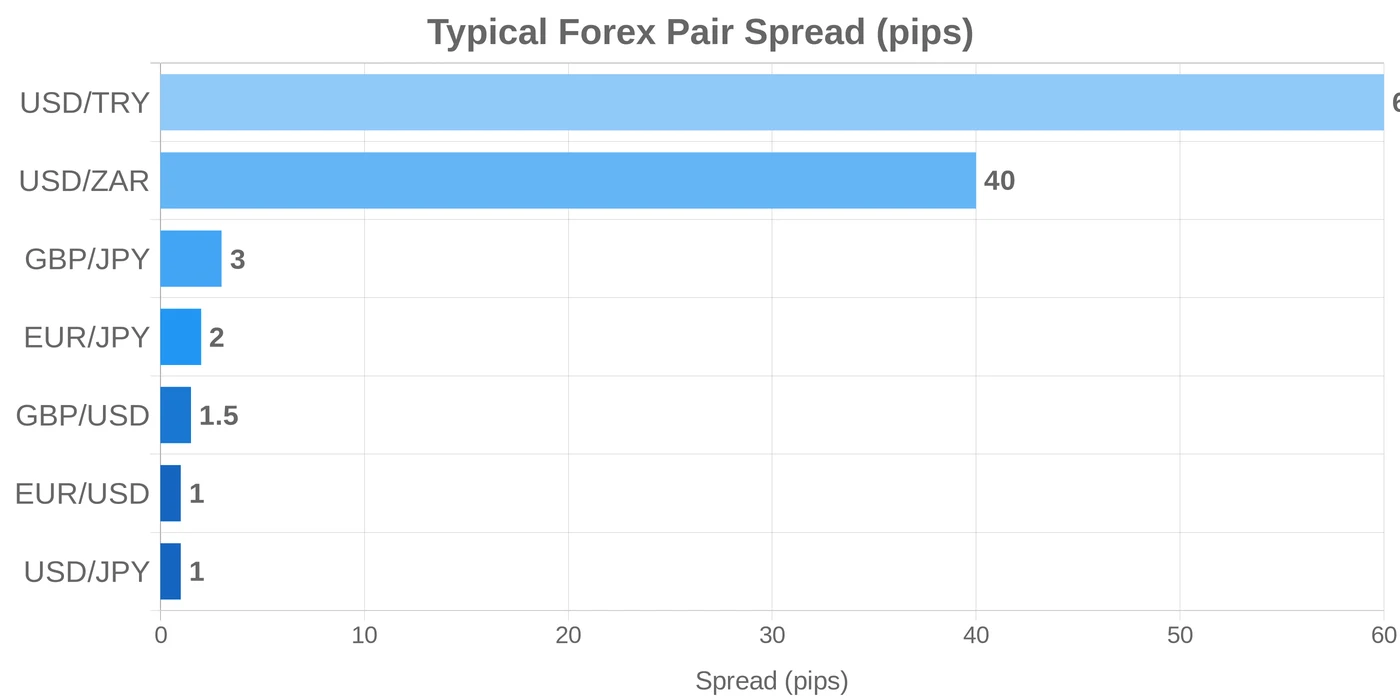
Spreads are the immediate problem. USD/TRY spreads routinely hit 50-200 pips. USD/ZAR can be 30-100 pips. For context, a decent swing trade on EUR/USD targets 60-150 pips. On an exotic, your spread cost alone can eat 30-50% of your target profit before you’ve moved a pip in your favor.
Liquidity gaps are the second issue. Exotics can jump 100+ pips in seconds during political events in those countries: Turkish elections, South African rate decisions, Mexican fuel prices. These moves don’t respect your stop placement. Slippage on tight stops is common.
Counterintuitive finding from my years on the desk: the traders who blew up on exotic pairs weren’t gamblers. They were disciplined traders who backtested exotic setups and found “better” risk-reward than majors. The backtest data was real. The forward performance failed because exotics have structural liquidity gaps that backtests don’t model well.
When exotics make sense: currency exposure hedging, macro speculation on specific EM economies, or very large accounts where the spread cost is a smaller percentage of target profit. Not for $150-600 accounts.
Spread, Liquidity, and What They Cost You
Spread is the difference between the bid (sell) price and ask (buy) price. You pay it on every trade entry. It’s how retail brokers make their money on most trades.
Here’s the practical impact at different account sizes:
| Pair | Typical spread | Cost on 0.01 lot | Cost on 0.03 lot |
|---|---|---|---|
| EUR/USD | 1.0 pip | $0.10 | $0.30 |
| GBP/USD | 1.5 pips | $0.15 | $0.45 |
| GBP/JPY | 3.0 pips | $0.30 | $0.90 |
| USD/TRY | 60+ pips | $6.00+ | $18.00+ |
| USD/ZAR | 40+ pips | ~$2.20+ | ~$6.60+ |
On a $600 account trading 5 times per week at 0.03 lots EUR/USD, your spread cost is about $0.75/week. Same trading frequency on USD/ZAR: $33/week in spread before a single pip moves in your direction.
Timing matters too. On a Standard account, EUR/USD spreads run 0.9-1.3 pips during London session. They widen to 2.5-4 pips during Asian session and spike around major news: NFP, CPI, FOMC decisions. Factoring that into your strategy matters. I learned this the hard way on EUR/USD pre-ECB: the spread widening in the 30 minutes before the decision killed what looked like a perfectly valid entry. Now I either enter before the window or skip that session entirely.
Which Pairs to Trade at Your Account Size
Not all pairs suit all account sizes. Here’s a practical framework:
$150-600 account: stick to 2-3 pairs. EUR/USD is the baseline. Tightest spread, cleanest trends, most educational material available. Add GBP/USD if you want more volatility. USD/JPY as a third if you want Asian-session exposure.
$600-2,000 account: you can add crosses. EUR/JPY or AUD/USD work well at this size. Some minor crosses like GBP/JPY can work if you understand the volatility and size down accordingly.
$2,000+ account: selective exotics become viable. If you have a specific macro view and can absorb the spread cost against a larger profit target, exotic exposure makes more sense. Still not a default choice.
The traders I saw struggle most were those who split attention across 8-12 pairs simultaneously. Price action looks similar across pairs, and you’ll find entries everywhere. But managing that many positions, tracking correlations (EUR/USD and EUR/JPY often move together, doubling exposure), and staying aware of news across multiple economies is genuinely hard.
My personal rule: master one pair completely before adding a second. “Completely” means you know its typical spread, its volatility at different sessions, how it reacts to its central bank, and what its daily range looks like. For EUR/USD, that took about a year of active trading.
Pair Correlations Worth Knowing
Forex pairs don’t move independently. Correlations matter for position sizing:
- EUR/USD and USD/CHF: strongly negative correlation (~-0.85). Long EUR/USD + long USD/CHF = almost neutral USD exposure.
- EUR/USD and GBP/USD: positive correlation (~0.75). Two longs = effectively doubled EUR/USD exposure.
- AUD/USD and NZD/USD: high positive correlation (~0.80+). Trading both simultaneously adds little diversification.
- USD/JPY and AUD/JPY: both JPY pairs; they often move together in risk-on/risk-off environments.
If you’re running two positions in correlated pairs, your real risk is larger than your per-trade calculation suggests. The Bank for International Settlements publishes forex volume data by currency pair; EUR/USD accounts for over 22% of all global daily forex turnover, which explains why it has the lowest spreads and most predictable behavior.
For a deeper look at when these pairs are most active and what that means for your entries, see forex market hours: the session overlap periods are where most of the daily range forms.
Common Mistakes to Avoid
Trading too many pairs at once. Spreads and volatility patterns are different for every pair. Beginners who jump between 6-8 pairs never develop pattern recognition on any of them.
Ignoring spread on smaller timeframes. A 1-pip spread on a 5-pip stop is 20% of your risk before entry. Scalping with wide spreads is statistically broken.
Assuming correlation is permanent. USD/CAD and oil have a strong historical correlation. It breaks down during periods of Canadian political risk or broad USD macro moves. Correlations are tendencies, not laws.
Trading exotics because the chart looks cleaner. Less data = fewer candles = charts that look simpler. That’s not a signal. It’s low liquidity, and it creates false patterns.
Not checking spread before news events. Economic calendars show when data releases hit. Spreads on major pairs can triple in the 5 minutes around a high-impact release. Either stay out, or factor the wider spread into your target.
If you’re building your first approach to forex, forex trading for beginners covers the account setup, broker selection, and first-trade checklist in one place. For understanding how CFDs work with forex pairs (since most retail accounts are CFD-based, not spot), CFD trading guide explains the mechanics.
FAQ
What is the most traded forex pair?
What is the difference between major and minor forex pairs?
Are exotic forex pairs worth trading for beginners?
How many forex pairs should a beginner trade?
What does the bid-ask spread actually cost me?
Do forex pairs correlate with each other?
When is the best time to trade major forex pairs?
Real-time trade setups with entry, stop loss and take profit. Daily market analysis. No subscription, no complicated theory.
🌍 Our recommended brokers


Reader Reviews
The correlation section was what I needed after two months of running EUR/USD and GBP/USD simultaneously and wondering why my drawdowns were deeper than my per-trade calculations predicted. Running both long at 0.03 lots each was effectively 0.06 lots EUR/USD exposure; the article explains a 0.75 positive correlation means the two positions amplify rather than diversify. I reduced combined sizing to match what I run on EUR/USD alone and drawdown on losing weeks fell immediately. The EUR/USD and USD/CHF inverse correlation note fixed a second blind spot: I had been treating them as separate uncorrelated positions when they run at -0.85 correlation. Adjusting position tracking to reflect correlated cluster risk rather than individual trade risk changed how I enter weeks with multiple open positions.
The recommendation to master one pair completely before adding a second is advice I should have followed from month one. Six months of jumping between EUR/USD, GBP/JPY, and AUD/USD produced a pattern of finding setups everywhere and executing on none of them well. Three months of EUR/USD only was my first stretch with consistent results.
The exotic pairs section stated something I had not seen written directly before: disciplined traders blow up on exotics precisely because their backtests appear to validate the setups. USD/ZAR spreads of 40-100 pips consume a third to half of a typical swing target before price moves at all. I had been watching USD/MXN and thinking the chart structure looked cleaner without accounting for what thin-liquidity clean charts actually mean during political events. The framing of liquidity gaps as unmodeled risk in backtests , not random bad luck, was what moved me back to majors.
The London-New York overlap timing confirmed something I had been doing correctly without knowing why. The two-hour window from 14:00 to 17:00 GMT is when I can trade, which the article identifies as the highest-volume period of the day. EUR/USD spreads on my broker consistently run 0.9-1.1 pips during that window versus 2.5-4 pips during the Asian session when I briefly tried early-morning entries. Returning to the overlap dropped my average entry cost from roughly 1.8 pips to 1.0 pip. At 0.03 lots and 40 trades per month, that difference comes to about $30 monthly that was previously going to the broker before a single pip moved in my direction.
The pip value table made explicit what I had been estimating loosely on every trade. At 0.02 lots on EUR/USD with a 25-pip stop, I now run the dollar-risk calculation before every entry instead of approximating; it takes under 30 seconds and stopped me from accidentally risking 4% of account on what looked like a normal-sized position.
The spread cost table stopped me from opening a USD/MXN position I had been planning for two weeks. At 0.03 lots, a 40-pip USD/ZAR spread costs $6.60 in entry cost before price moves at all; I had been targeting 35-pip profits, meaning nearly 19% of my target was already paid at entry. Switched to EUR/USD where the same lot size costs $0.30. The same setup played out over three sessions without the structural cost drag.
The correlation section finally explained a consistent pattern in my results: when EUR/USD lost, my GBP/USD position almost always lost the same week even when the entries were based on different signals. A 0.75 positive correlation means both longs are functionally one directional bet. I sized down my combined position to what I run on EUR/USD alone and the consecutive losing-week impact dropped noticeably. The AUD/USD and NZD/USD note resolved a second version of the same problem; I had been treating both as separate commodity-linked positions when they correlate at 0.80+. Running cluster risk rather than individual trade sizing has kept three consecutive months positive: up 8.1%, 6.4%, and 7.2% respectively.
The base and quote currency explanation resolved something I had been reading past for months. Going short EUR/USD means simultaneously selling Euros and buying Dollars; it is not just a directional label but a bilateral exchange. The worked example connecting pair direction, lot size, and pip value in dollar terms made the mechanics concrete enough to apply before my next session rather than after two more months of approximating.
Leave a Review

Forex Analyst & Senior Trader
Former FX desk trader with 8 years in institutional forex. Works in multi-timeframe analysis and order flow, turning desk experience into systematic, testable rules across forex and metals.