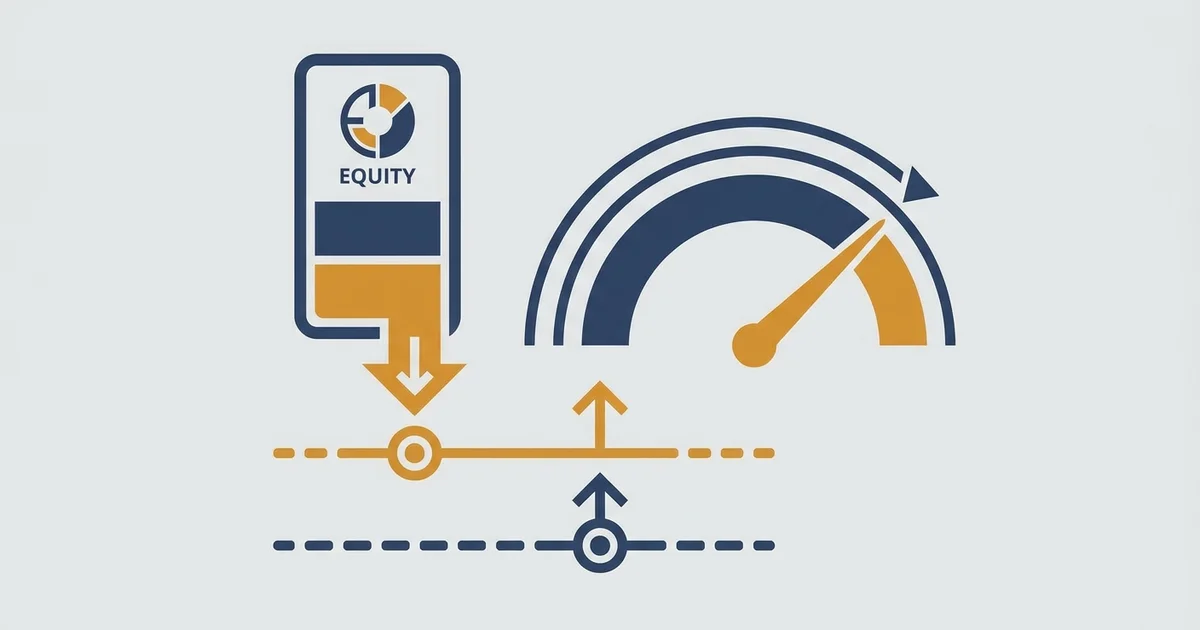

What a margin call actually is
Think of margin as a good-faith deposit, not the full cost of the trade. Your broker lends you the rest, and the margin call is the moment that loan needs more backing than your account can give.
The chart below is the whole story in one picture. Read the lower panel.
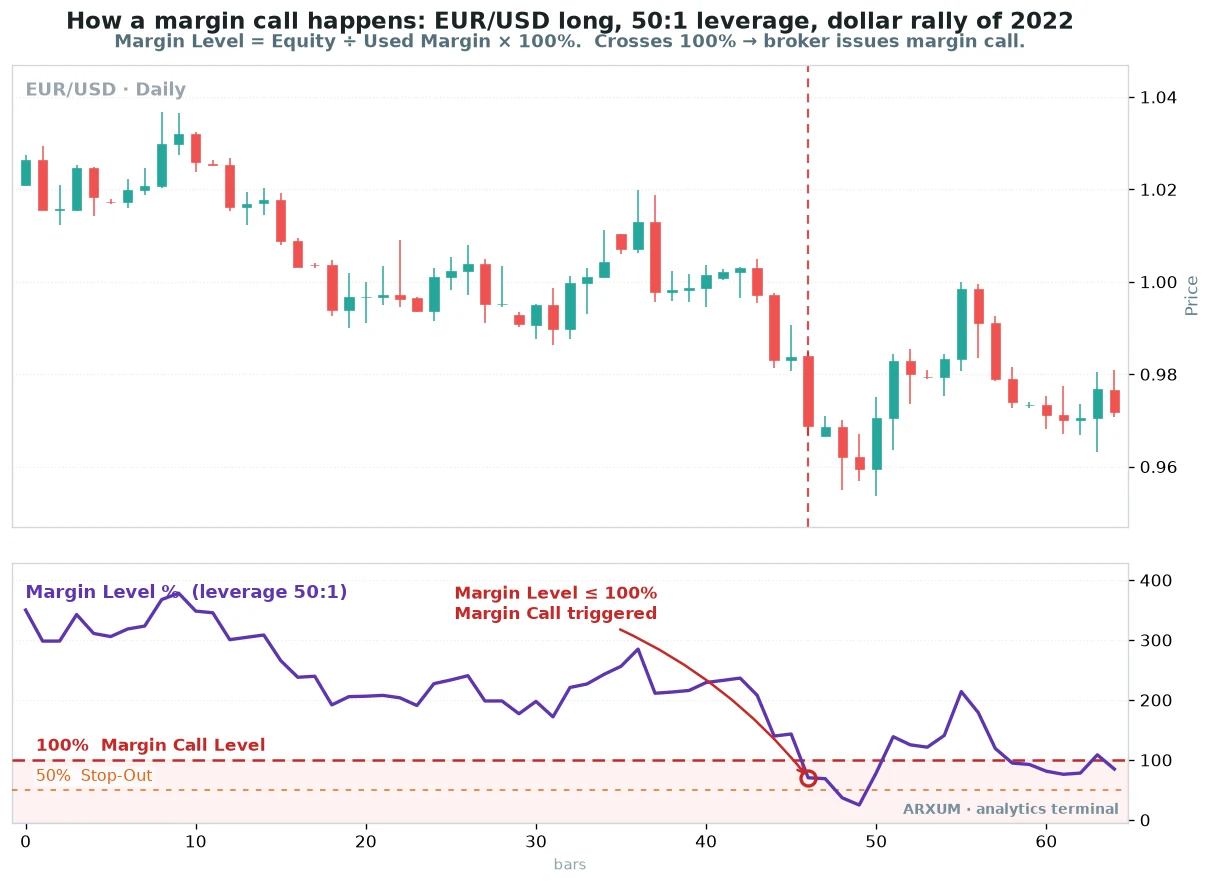
The account is built from a few moving parts. Once you can name them, the whole thing stops being mysterious.
- Equity: your balance plus or minus the profit or loss on open trades. This is the number that actually moves in real time.
- Used margin: the collateral locked up to hold your open positions. It stays roughly fixed while the trade is open.
- Free margin: equity minus used margin. The cushion you have left to absorb losses.
- Margin level: equity divided by used margin, times 100. The single percentage the broker watches.
- Margin call level: the margin level where the warning fires, usually 100%.
- Stop-out level: the lower line, often 50%, where the broker starts closing trades for you.
The one-line version: the margin call is not about your balance, it is about the ratio of what you hold to what your open trades demand.
The margin level formula
Everything runs off one calculation, and it is simple arithmetic.
| Term | What it is | Plain read |
|---|---|---|
| Margin level | Equity ÷ used margin × 100 | The health gauge, in percent |
| Equity | Balance plus open profit or loss | What you have right now |
| Used margin | Collateral locked by open trades | What the broker holds hostage |
| Above 100% | Equity still exceeds used margin | You can open trades, all clear |
| At 100% | Equity equals used margin | Margin call, no new trades |
| At 50% | Equity is half the used margin | Stop-out, trades force-closed |
A quick worked read. If your equity is $2,000 and your open trades use $500 of margin, your margin level is 2,000 ÷ 500 × 100, which is 400% and perfectly healthy.
If losses drop your equity to $500, the level is 500 ÷ 500 × 100, which is 100%, and the call fires.
The exact percentages vary by broker, so check yours. The shape never changes: high is safe, 100% is the warning, the stop-out is the eviction.
Margin call versus stop-out
These two get blurred together, and they are not the same event.
| Margin call | Stop-out | |
|---|---|---|
| Trigger level | Around 100% | Around 50% |
| What happens | A warning, new trades blocked | Broker force-closes positions |
| Who acts | You still can | The broker acts for you |
| Your move | Add funds or cut size | Too late, it is automatic |
The margin call is the yellow light, the stop-out is the wall.
The gap between them is your last window to act, and in a fast market it can close in minutes.
What triggers a margin call
A margin call is always the same math, but a few different habits push you into it.
- An adverse price move. The direct cause. Price runs against an open position and open losses drain equity.
- Too much leverage. The amplifier. A larger leveraged position loses equity faster per pip, so the level falls quicker.
- Oversizing the position. Committing most of your account as margin leaves almost no free margin to absorb a normal wobble.
- Holding several correlated trades. Three long Forex majors against the dollar are close to one big bet. They fall together.
- Adding to a loser. Averaging down raises used margin and lowers equity at the same time, squeezing the ratio from both sides.
- Fees and swap eroding equity. Overnight swap and costs quietly trim equity on positions held for days, nudging a borderline account toward the line.
The takeaway: price provides the loss, but leverage and position size decide how little of a move it takes to matter.
Leverage sets the distance to the call
Here is the part most beginners get backwards. Leverage does not move the call closer on its own.
It moves it closer because a higher cap tempts you into a bigger position, and a bigger position hits the stop-out after a far smaller move.
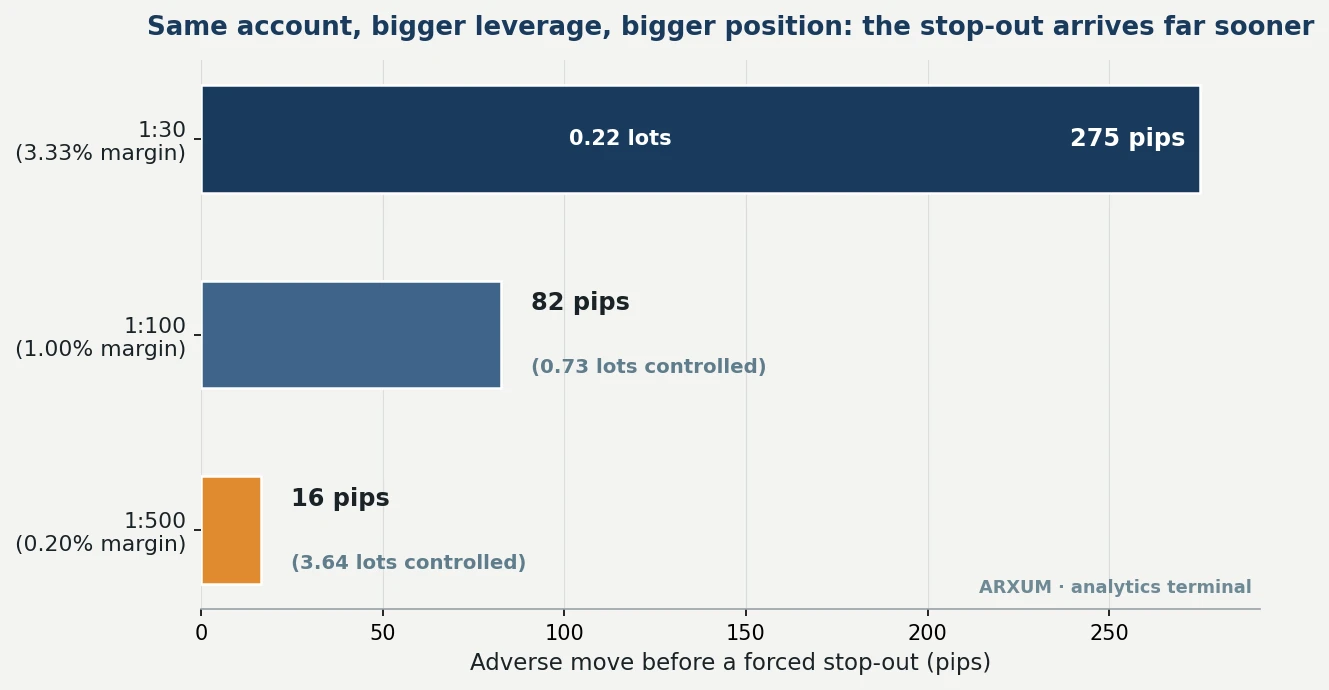
The bars read left to right as the danger climbing. One sample account, three different leverage caps, and in every case the trader sizes up to use most of the available margin.
| Leverage | Margin needed | Position it tempts | Move to stop-out |
|---|---|---|---|
| 1:30 | 3.33% of the trade | Around 0.22 lots | About 275 pips |
| 1:100 | 1.00% of the trade | Around 0.73 lots | About 82 pips |
| 1:500 | 0.20% of the trade | Around 3.64 lots | About 16 pips |
Note these figures assume a maxed-out position at each cap, which is why they run tighter than the modest 0.50-lot trade in the worked example below. Hold a smaller position and the buffer widens.
At 1:500 a routine 16-pip flutter, the kind Forex prints in an hour, is enough to end the trade. That is the trap.
The leverage number is not the enemy by itself, the oversized position it invites is.
Rule of thumb: pick your position from the stop you can afford, then check the leverage covers it. Never size up just because the broker lets you.
How fast it happens in a real market
A margin call is not a slow leak in a live market. It is often a single sharp leg that never comes back in time.
Three markets, three speeds.
Forex: a steady grind that adds up
Currency majors rarely gap, but a sustained one-way trend still walks a leveraged position into the ground.
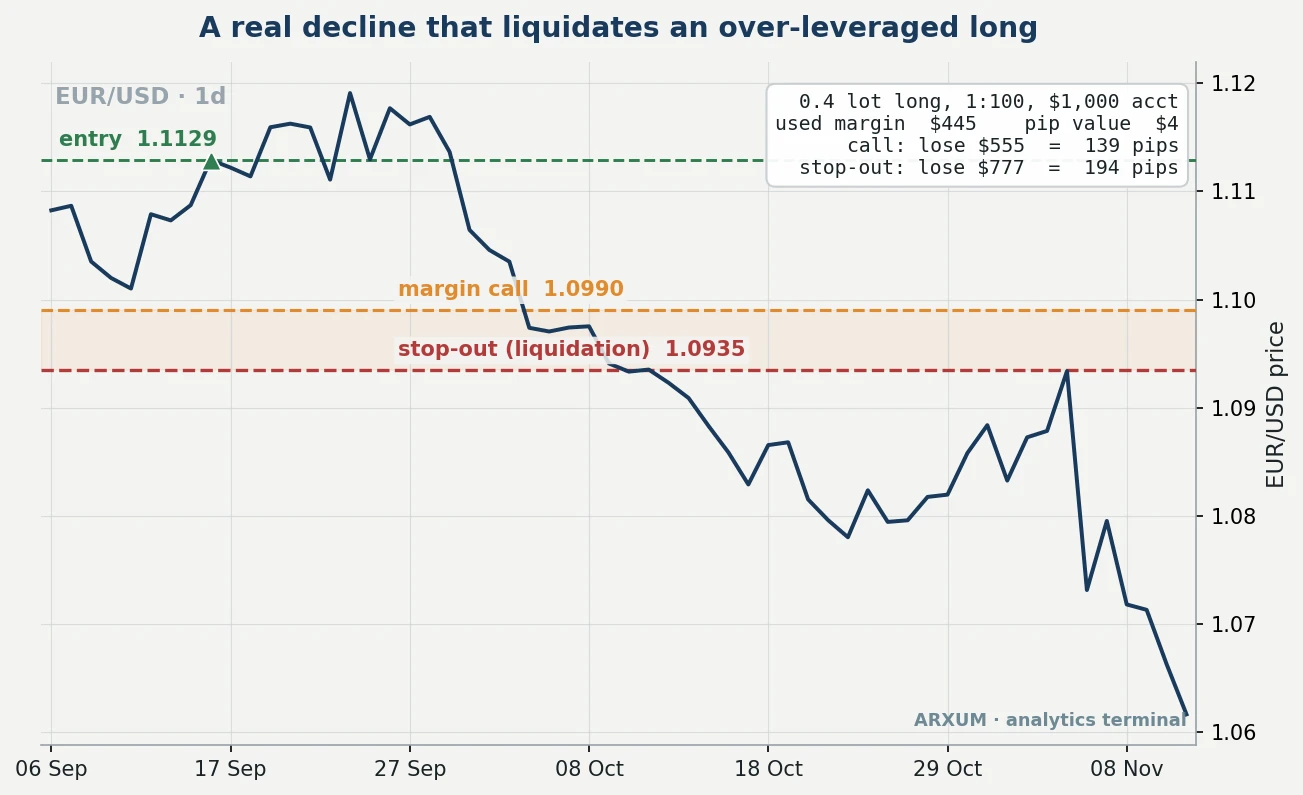
- EUR/USD moves in a fairly contained daily range, so the grind is slower.
- A leveraged long into a trend like this bleeds equity steadily, day after day.
- The lesson is patience cuts both ways. A slow trend feels survivable right up until the stop-out.
Gold: fast metal, thin buffer
Spot gold (XAU/USD) moves in far bigger dollar swings than a currency pair, so the same leverage burns through the buffer much faster.
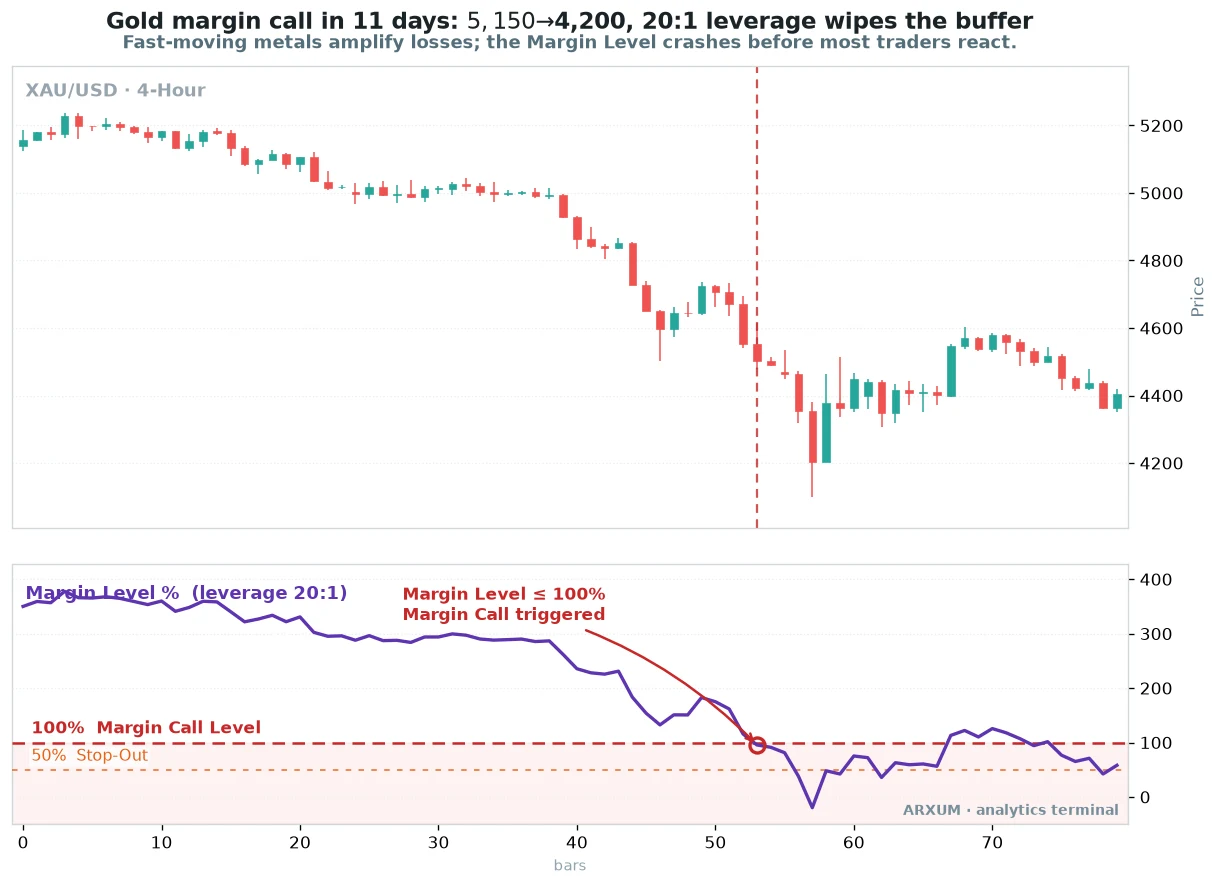
- Gold’s daily swings dwarf a Forex pair, so 20:1 on gold behaves like far higher leverage on EUR/USD.
- The margin level in the lower panel does not drift, it drops in steps as each big candle prints.
- When a move is this violent, the margin level can briefly punch below the stop-out line before the broker finishes closing you. That overshoot is exactly why fast markets are dangerous.
- If you trade metals, treat the leverage cap as a ceiling to stay well under, not a target. See how to trade gold for the volatility context.
Crypto: the eight-day wipeout
Bitcoin is the extreme case. Even leverage that sounds conservative in Forex terms leaves almost no room in a crypto drawdown.
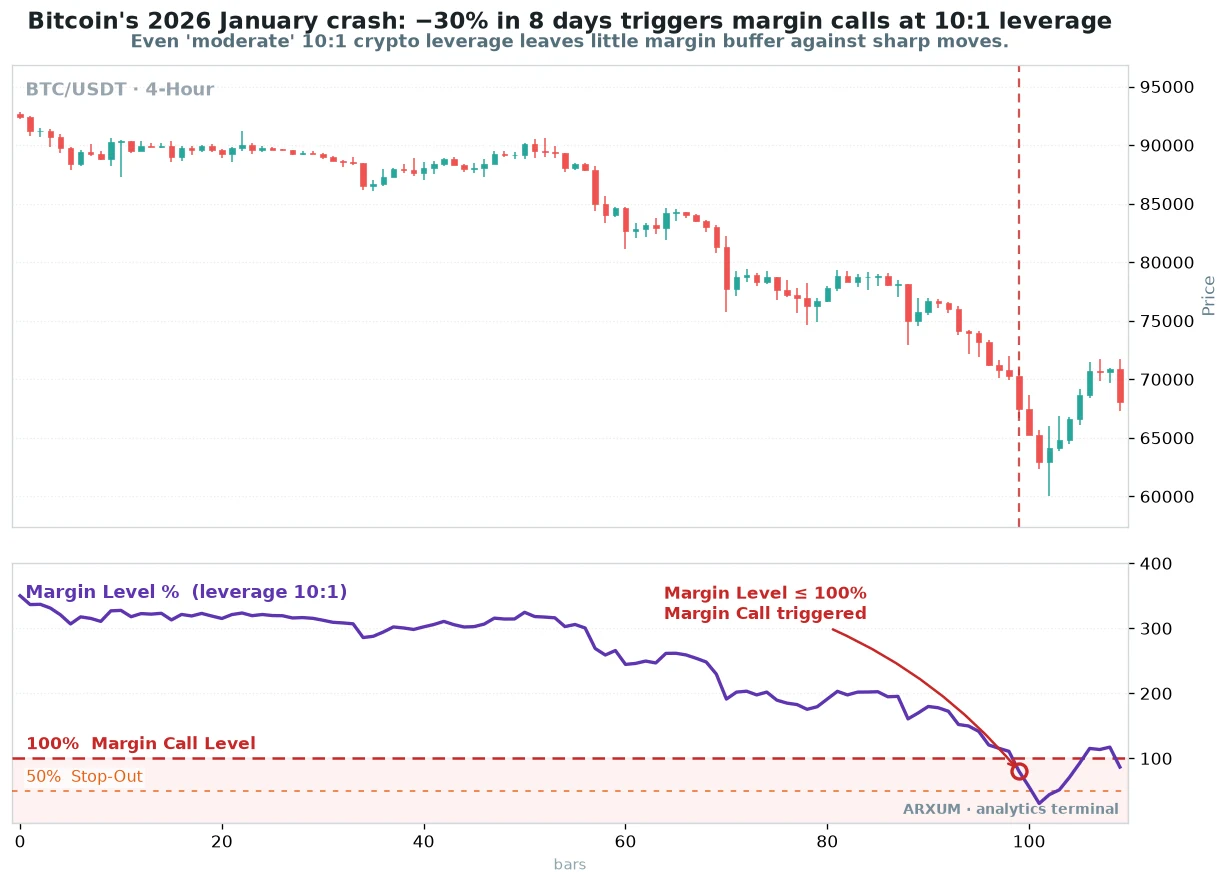
- A 30% move that takes gold months can happen in Bitcoin in a week.
- At 10:1, a move that size is many times the buffer, so the call and the stop-out arrive almost together.
- Crypto has no daily close to pause the bleed. It runs 24/7, and margin calls fire at 3am just as happily as at noon.
| Market | Typical speed | Why |
|---|---|---|
| EUR/USD | Days to weeks | Contained daily range, rare gaps |
| Spot gold | Days | Large dollar swings, fast trends |
| Bitcoin | Hours to a few days | Big percentage moves, 24/7, no close |
The pattern is clear. The more a market can move in a short window, the less leverage it takes to reach the call.
A worked example on a $1,000 account
Numbers make it concrete. Here is the full arithmetic on a small account, step by step, so you can run it on your own trade.
The setup: a $1,000 account, buying 0.50 lots of EUR/USD at 1.1000, at 1:100 leverage.
- Position notional: 0.50 lots × 100,000 × 1.1000 = $55,000, the full value you control.
- Used margin: $55,000 ÷ 100 = $550 locked as collateral.
- Free margin: $1,000 − $550 = $450 of cushion.
- Pip value: one standard lot is about $10 per pip, so 0.50 lots is about $5 per pip.
Now find the call. The margin call at 100% means equity has fallen to equal the used margin, $550.
- Loss that triggers the call: $1,000 − $550 = $450.
- Pips to the call: $450 ÷ $5 = 90 pips against you.
- Extra drop to the 50% stop-out: equity falls to $275, another $275 ÷ $5 = 55 pips.
- Total move to force-close: 90 + 55 = 145 pips from your entry.
So on this account, a 90-pip move against you brings the warning, and 145 pips ends the trade. That is a normal week in EUR/USD.
Now compare that to using a stop-loss. A 40-pip stop on this position caps the loss at $200, closing you out well before the 90-pip margin call.
Better still, 0.50 lots is oversized for a $1,000 account. Sized to risk just 2%, the position shrinks to a fraction and the margin line never comes into view.
The rule is simple: a stop-loss should always fire before the margin call does.
A quick sizing note. Lower leverage would not let you open this trade at all on $1,000.
At 1:30 the same 0.50 lots needs about $1,833 of margin, more than the account holds, so it forces a smaller, safer position. A lot size calculator does this math for you before you click.
How to avoid a margin call
A margin call is almost entirely preventable. It comes from sizing and discipline, not bad luck.
The habits below are the whole defence.
| Habit | Why it works |
|---|---|
| Risk a fixed small amount per trade | Cap the loss at about 2% of equity, sized to your stop, and the margin line stays far away |
| Use a stop-loss on every trade | The stop closes you out for a planned loss before margin becomes the issue |
| Size the position, not the margin | Choose lots from the stop you can afford, not from the maximum the broker allows |
| Keep free margin in reserve | A wide cushion absorbs normal noise so a routine wobble never reaches 100% |
| Use less leverage than offered | A lower effective leverage widens the distance to the stop-out |
| Avoid adding to losers | Averaging down raises used margin while equity falls, squeezing the ratio both ways |
| Mind correlated positions | Several trades on the same theme move together and drain equity together |
The single most important line here is the first one. If you risk a set slice of the account per trade and set your stop before you enter, the margin call becomes a line you simply never approach.
Position sizing in three steps, the same method that keeps the margin call out of reach:
- Decide the risk. On a $1,000 account, 2% is $20 per trade.
- Measure the stop in pips. Say your stop sits 40 pips from entry.
- Divide to get the size. $20 ÷ 40 pips = $0.50 per pip, which is 0.05 lots. That is the position, and it is a fraction of what leverage would allow.
Size that way and your loss on a stop-out is $20, not a margin call. The full method is in the position sizing guide, and the risk framing behind it is in the risk-reward ratio explainer.
One honest caveat: no amount of sizing removes gap risk entirely. A weekend gap or a news spike can jump straight past your stop, and in that rare case the margin call can still land.
Trading only money you can afford to lose is not a slogan, it is the last line of defence.
Quick reference: reading your margin level
Keep this in your head while a trade is live.
| Margin level | State | What to do |
|---|---|---|
| Above 300% | Comfortable | Trade normally, plenty of buffer |
| 150% to 300% | Getting tight | No new trades, review your stops |
| 100% to 150% | Danger zone | Cut size or add funds now |
| At or below 100% | Margin call | Act immediately, the stop-out is next |
| At or below 50% | Stop-out | Positions close automatically |
What to remember, in three lines:
- The margin level is the number that matters, not your balance. Watch equity divided by used margin.
- Leverage does not call the margin, oversizing does. Pick the position from the stop, never from the maximum on offer.
- A stop-loss should always fire first. If your planned stop is well inside the margin call distance, you control the exit instead of the broker.
Trade small enough that a losing streak is an annoyance, not an account-ending event, and the margin call stays a thing that happens to other people. For the bigger picture on how borrowed size works, the margin trading guide ties it all together.
Glossary
- Equity: your balance adjusted for the running profit or loss on open trades. The number that moves live.
- Used margin: the collateral your broker locks to keep open positions running.
- Free margin: equity minus used margin, the cushion left to absorb losses.
- Margin level: equity divided by used margin, times 100, shown as a percentage.
- Margin call level: the margin level, usually 100%, where the broker warns you and blocks new trades.
- Stop-out level: the lower margin level, often 50%, where the broker force-closes positions.
- Leverage: the multiple of your margin you are allowed to control, such as 1:100.
- Pip: the standard small unit of price movement in Forex, 0.0001 on most pairs.
- Lot: the position size unit. One standard lot is 100,000 units of the base currency.
- Notional: the full value of the position you control, far larger than the margin you post.
FAQ
What is a margin call, in plain terms?
What is the difference between a margin call and a stop-out?
How is the margin level calculated?
How do I avoid a margin call?
Does higher leverage cause margin calls?
Can I lose more than my deposit in a margin call?
What happens to my open trades in a margin call?
How fast can a margin call happen?
Should I add money to meet a margin call?
What do the key margin terms mean?
Real-time trade setups with entry, stop loss and take profit. Daily market analysis. No subscription, no complicated theory.
🌍 Our recommended brokers


Reader Reviews
Be the first to review this — tell other traders what actually helped, or where it fell short.
Leave a Review

Momentum Trader & Technical Analyst
Trades momentum across crypto and forex since 2019, built around RSI, MACD, and volume. Turns discretionary setups into rule-based, systematic entries and validates them on data before they go live.