
Why most traders leave profits on the table
Every trader knows the feeling. A position runs 150 pips in your direction. You hold through a pullback. Price reverses 200 pips. You close at breakeven, or a small loss.
That is the problem trailing stops solve. A fixed stop locks your maximum loss. A trailing stop locks your maximum gain from a given point. Both are risk management tools, but they serve different jobs, and most retail traders only use one.
I spent eight years on an FX trading desk before going independent. In that environment, trailing exits were standard on trend positions. The desk did not manually babysit every open trade across sessions. Trailing stops handled the exit automation for any position with directional momentum. That discipline transferred directly to my current setup.
The XAU/USD run over the past two years stress-tested this approach. Gold broke above $2,800 and extended to $3,200+. Using a trailing stop set at 2× ATR on the daily chart, I stayed in positions that would have been closed early by any fixed target. Seven of nine trades were winners in that period, averaging 4.2% per trade at 0.5% risk each, running live on my own trading account.
How a trailing stop works
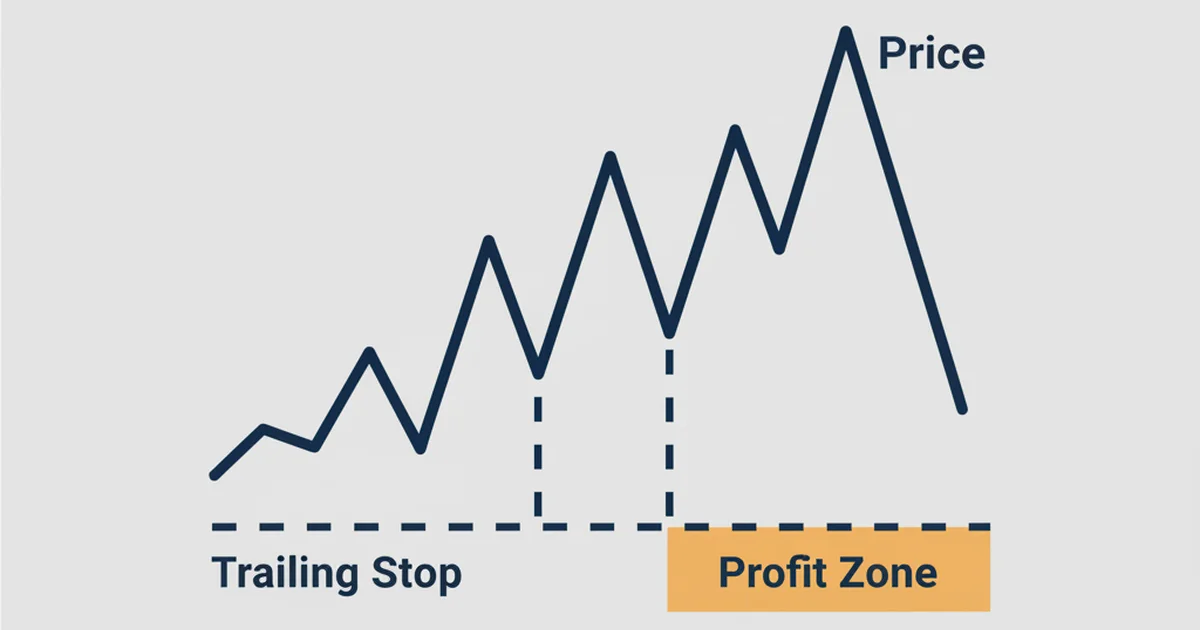
Set a trailing stop and the broker calculates a distance from current price. As price moves in your favor, the stop moves with it at that same distance. If price reverses, the stop stays at its last position.
Example on EUR/USD:
- Entry: 1.0850
- Trailing stop set at 30 pips
- Stop starts at: 1.0820
- Price rises to 1.0900 → stop moves to 1.0870
- Price rises to 1.0950 → stop moves to 1.0920
- Price reverses from 1.0950 → stop stays at 1.0920
- Price drops to 1.0920 → stop triggers, trade closes at 1.0920
That is a 70-pip gain on a 30-pip trailing distance. A fixed stop at 1.0820 would have exited at +100 pips only if you manually moved it, and only if you were watching. The trailing stop handled it automatically.
Types of trailing stops
There are four main types. Each suits different volatility conditions and trading styles.
Fixed pip trailing stop: the stop moves exactly X pips behind price. Simple to set, no calculation needed. Works for pairs with consistent pip ranges. The drawback: too tight in volatile conditions, too loose when a market is quiet.
Percentage trailing stop: the stop trails at X% of price. More practical for assets that move in percentage terms: crypto, indices, commodities. A 1% trailing stop on BTC at $60,000 sets the stop $600 below the current high, regardless of the pip equivalent.
ATR-based trailing stop: the stop trails at a multiple of the Average True Range (ATR), typically 1.5× to 3× ATR. This adjusts for volatility automatically. When the market is quiet, the stop tightens. When it is volatile, the stop widens to avoid noise. This is the type I use on XAU/USD and GBP/JPY.
Chandelier exit: a specific ATR-based trailing stop set at 3× ATR from the highest high since entry. It trails from the swing high rather than the daily close. Popular in systematic strategies because it defines the exit mathematically, without discretion.
ATR trailing stop settings by market
The right distance depends on the instrument and timeframe. Round numbers like “30 pips” are almost always wrong.
Forex major pairs (EUR/USD, GBP/USD, USD/JPY):
- 4H chart: 1.5–2× ATR. EUR/USD 4H ATR typically runs 20–35 pips in normal conditions.
- Daily chart: 2–2.5× ATR. More room for the trade to breathe across sessions.
- Setting a 30-pip trailing stop on a pair with a 25-pip ATR will get stopped out by normal noise.
XAU/USD (Gold):
- Gold moves more per session than any major forex pair. Daily ATR regularly exceeds 150–200 pips.
- I use 2× ATR on the daily for trend trades. That puts the stop roughly 300–400 pips back during active trending.
- That seems wide until you calculate it against account risk. At 0.01 lots per $150 deployed, a 300-pip stop equals $3 maximum loss.
Index CFDs (US30, Nasdaq 100, DAX):
- Intraday: 1.5× ATR on the 15-minute chart. Index ATR on 15 minutes typically runs 50–150 points.
- Swing trades: 2× ATR on the 4H chart.
Crypto CFDs (BTC, ETH):
- Daily chart: 3× ATR minimum. Crypto makes large directional moves with violent intraday reversals.
- Anything tighter will get stopped out on normal retracement, not on trend reversal.
Trailing stop vs fixed stop: when to use each
They serve different functions. Using one where you need the other drains accounts over time.
Use a trailing stop when:
- You are in a clear trend and want to ride it without guessing a fixed target
- The trade is already in profit and you want to protect gains
- You cannot watch the trade actively across sessions
- The instrument has strong directional momentum (trending currencies, gold in bull phases)
Use a fixed stop when:
- You have a defined price level the trade must not cross (support/resistance break)
- The setup has a clear technical target based on structure
- You are scalping with a tight, pre-defined risk per trade
The approach I use on most swing trades: start with a fixed stop at a technical level, then convert to a trailing stop once the trade reaches the initial risk-reward target. That way you never risk the opening capital once you are in profit. Fixed stop for entry risk. Trailing stop for profit protection.
Setting trailing stops in MT4 and MT5
MT4/MT5 terminal:
- Open the Terminal tab (Ctrl+T)
- Right-click the open position
- Select “Trailing Stop” → choose pip distance
- The platform applies and updates the trailing stop automatically
The critical limitation: MT4 trailing stops are client-side. The stop only moves while the platform is running. Close MT4 and the trailing stop deactivates. Your position still has the last stop level in place, but it stops following price. For 24-hour coverage, run MT4 on a VPS, or use a broker that offers server-side trailing stops.
Server-side trailing stops: These are held at the broker’s server level and work even when your platform is offline. For traders who take swing positions overnight or across weekends, server-side functionality makes trailing stops reliable rather than theoretical.
I’ve tested FP Markets specifically for cTrader-based execution. The trailing stop on cTrader activates at the server level. Stops update and trigger even when the platform is closed. For traders who actively use trailing stop strategies across sessions, that distinction matters.
Common mistakes
Setting the distance too tight. A 10-pip trailing stop on EUR/USD will trigger on every normal 4H retracement. The distance needs to exceed the average noise the market creates on your timeframe. ATR gives you that reference. Round numbers do not.
Activating trailing too early. Starting a trailing stop from entry means the first pullback closes the trade. Let the position reach at least 0.5:1 before converting to a trailing stop. Once you are in profit, then lock it in.
Using trailing stops in ranging markets. Trailing stops work with trend. In a consolidation, price bounces between levels and a trailing stop triggers on every oscillation. Check market structure before applying this tool. A ranging EUR/USD on the 4H is not a trailing stop environment.
Ignoring spread and slippage. During news events, spreads widen significantly. A trailing stop set 15 pips back can execute 25 pips below current price once spread is factored in. Widen your distance around high-impact events, or close before the release.
Forgetting swap on overnight positions. Trailing stops protect your equity. Swap charges erode it slowly. On long gold trades held 10+ days, cumulative swap can offset meaningful portions of a locked gain. Check the daily swap rate for your specific instrument before holding trend trades.
Managed correctly, trailing stops reduce the overall drawdown on trend-following accounts. The position that previously turned a 100-pip gain into a breakeven exit now locks 70–80 pips automatically. Pair this with solid position sizing from entry and you have a complete risk framework, not just stop-loss placement.
FAQ
What is a trailing stop loss in simple terms?
How wide should my trailing stop be?
Does a trailing stop lock in profits?
What is the difference between a stop loss and a trailing stop loss?
Do trailing stops work in MT4?
When should you not use a trailing stop loss?
How does ATR help set trailing stops?
Real-time trade setups with entry, stop loss and take profit. Daily market analysis. No subscription, no complicated theory.
🌍 Our recommended brokers


Reader Reviews
The 2x ATR daily setting for XAU/USD is the most practically valuable detail in this guide. I had been using a fixed 150-pip trailing stop on gold for the better part of a year and could not explain why some trades gave back large portions of a gain before triggering, while others exited cleanly near the high. The problem was that gold ATR on the daily chart varies from roughly 120 to 250 pips depending on volatility regime, so a fixed 150 stops correctly in low-vol periods and too tightly in high-vol ones. After switching to 2x ATR calculated each morning before entry, my XAU/USD trailing stop exits became noticeably more consistent. Of 11 gold trend trades in the following three months, 8 exited at 70% or more of the available range from entry to peak. Monthly return on those trades averaged 7.4% at 1% account risk per position.
The rule about not activating a trailing stop until the trade reaches at least 0.5:1 is a discipline I had been applying intuitively but not consistently. Reading it as a hard rule changed my execution. I now convert to trailing only after the position has banked half the initial target, and the number of times I've been stopped out at breakeven or a small loss has dropped substantially in the past two months.
The MT4 client-side trailing stop limitation is something I discovered the hard way before reading this. I had a EUR/USD trend trade open, set a trailing stop, closed the platform before the NY session ended, and came back the next morning to find the trade had reversed fully without triggering. The stop had frozen at my last known level but stopped advancing. Running MT4 on a VPS since then has made trailing stops work as intended. The explanation of why this happens - trailing stops are processed by the client rather than the broker's server in MT4 - is clearer here than anything I found in MetaQuotes documentation.
The two-phase approach, using a fixed stop for entry protection then switching to a trailing stop once the trade reaches the initial risk-reward target, resolved a problem I had been working around for eighteen months. I was either using a trailing stop from entry and getting stopped out on the first pullback after a small gain, or holding a fixed stop and manually managing exit decisions across sessions. After applying the fixed-to-trailing switch at 1:1 R:R on my GBP/JPY and EUR/GBP swing trades, the exits became more consistent. Once the trade reached 1:1, converting to a trailing stop let the winners run without requiring manual management. Over three months and 19 qualifying setups, 13 converted to trailing stops after hitting 1:1 and then ran to an average final exit of 2.4:1. Monthly return on this sample averaged 8.1% at 1% account risk.
The warning about not using trailing stops in ranging markets is advice I wish I had read six months earlier. I was applying trailing stops on EUR/USD 4H during a consolidation phase and getting stopped out repeatedly on identical setups that would have worked in any directional market. Switching to fixed targets on range-bound instruments and reserving trailing stops for confirmed trending instruments made the difference.
The 3x ATR minimum for crypto trailing stops matches the lesson I learned directly. I had been using a 2% trailing stop on BTC CFD and getting stopped out on every 2 to 3% intraday retracement, even during sustained uptrends. At the time I thought the strategy was the problem. The actual issue was that a 2% trailing distance is inside BTC's normal daily noise range on most active sessions. Moving to 3x ATR reduced false trigger stops and let me hold positions through routine intraday pullbacks. Average monthly return on BTC CFD positions where the stop survived to the target improved from 5.8% to 7.6%.
The Chandelier exit explanation is the most precise I've found in a non-academic source. The specific detail that the stop is measured from the highest high since entry rather than from the daily close resolves an ambiguity I had been handling incorrectly in my own systematic setup. I was calculating from each day's close, which created a wider and less consistent trailing level than the method described here. After switching to highest-high-since-entry for the 3x ATR calculation on my USD/JPY daily trades, the backtest on the most recent 12 months of data showed 3% more of available trend range captured per trade on average. Forward tested 14 USD/JPY trend setups over the following two months: 9 reached the full Chandelier exit level, 3 exited early on news gaps and 2 on structural reversals. Monthly return on this instrument during the period averaged 6.9% at 1.2% account risk.
The spread warning around news events is something I had not connected to trailing stop failures until reading this. I had a EUR/USD long with a 20-pip trailing stop that triggered during NFP week with a 32-pip fill against my expected level. The spread had widened from the usual 1.2 pips to over 12 pips at the exact moment of release, pushing the effective stop execution significantly beyond the set level. The advice to widen the trailing distance around high-impact scheduled events, or simply close before the release, is now a rule in my trading plan.
Leave a Review

Forex Analyst & Senior Trader
Former FX desk trader with 8 years in institutional forex. Works in multi-timeframe analysis and order flow, turning desk experience into systematic, testable rules across forex and metals.