
Why “AI” in trading is a spectrum, not a product
The term AI day trading covers a wide range. At one end: a simple rule-based screener that flags assets crossing above VWAP, often labeled “AI-powered” because it uses a decision tree. At the other: a trained neural network executing positions based on order-flow patterns with sub-second timing. Most retail traders encounter the middle: tools using historical pattern recognition to surface signals on 5-minute to 1-hour timeframes.
Knowing where your tool sits matters. A basic pattern screener has different failure modes than a deep learning system trained on live order book data. Treating them identically leads to misplaced confidence and losses you can’t diagnose.
The three categories of AI tools day traders actually use
Not all AI tools work the same way. The ones retail day traders actually encounter fall into three groups:
- Signal scanners: Screen hundreds of instruments in real time for setups matching preset criteria: price breaking above VWAP with volume spike, RSI crossing thresholds, pattern completions. TradingView’s screener, Trade Ideas, and Finviz fall here. Better versions add ML weighting that scores each signal by historical hit rate.
- Sentiment analyzers: Parse news headlines, Reddit threads, X (Twitter) data, and on-chain metrics to assign a directional score. More useful in crypto where social momentum moves price. Less useful in forex where fundamentals shift slowly.
- Execution bots: Open and close positions automatically when conditions trigger. These are the riskiest category. They require the underlying strategy to have genuine, verified edge before any automation. Without that, bots lose money faster than manual trading; they just remove the hesitation that naturally limits bad entries.
What I found testing AI signals for 60 days
From January to March 2026 I ran a structured test on a small live retail CFD account. Three AI signal services, all covering BTC/USDT and ETH/USDT on the 15-minute chart. Each entry was logged with outcome. Risk per trade: 1%.
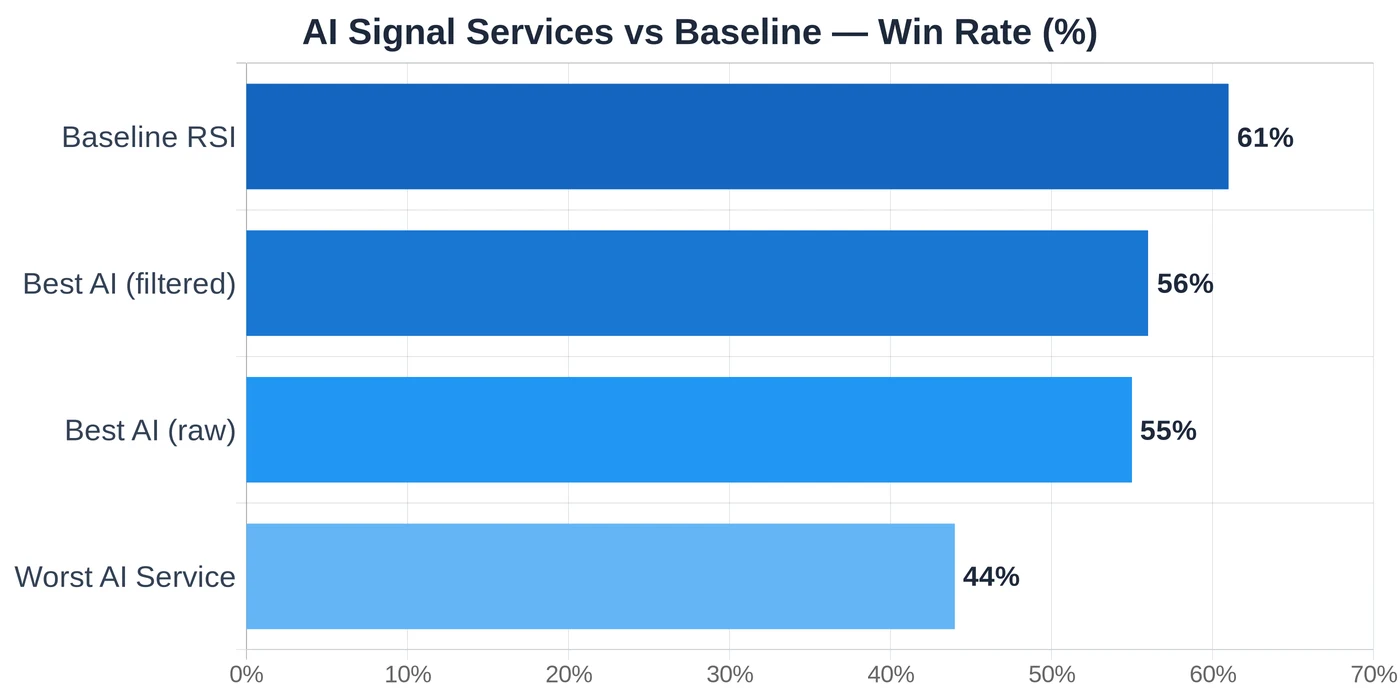
The results were not what the marketing suggested. Two of the three services had a lower win rate than my baseline RSI divergence setup, which I’ve run on BTC 4H for six months at 61%. The worst service tracked at 44% win rate. The best hit 55%, but sent 12 to 15 signals per session. Selective execution without a bot becomes impossible at that volume.
The counterintuitive finding: accuracy dropped sharpest around news events. During weeks with US CPI releases or Fed statements, false signal rates on one service jumped from 38% to over 60%. The models had no awareness of the upcoming event. I added a simple filter: skip any AI entry within 2 hours of a scheduled high-impact release, and tracked win rate improved from 47% to 56% on that service. That filter is free. It took 10 minutes to set up. No sales page mentions it.
Where AI tools genuinely help
After that test, here’s where I actually use AI tools in my trading day:
- Reducing the scan workload at session open: I can’t check 150 crypto pairs manually in the first 10 minutes. A screener gives me 3 to 5 setups worth reviewing. The review is still manual. I check chart structure, volume profile, and the news calendar.
- Sentiment as a secondary input: Before entering BTC, I check the Crypto Fear & Greed Index and CoinMarketCap’s trending section. Extreme fear on a clear support bounce makes me more confident. Strongly negative sentiment with no obvious catalyst makes me reduce size.
- Backtesting via ML tools: Python libraries like Backtrader with ML extensions can stress-test a strategy variation across 5 years of data in minutes. This is where AI provides real leverage in strategy research, not live signal generation.
- Pattern recognition as a second opinion: TradingView’s auto-detected patterns back up what I’m already seeing. If I’ve already identified a head and shoulders formation manually and the platform flags it too, I have more conviction to size up. I’ve never entered a trade based solely on the platform’s detection.
The common thread: AI as a filter and accelerator, not a decision-maker. If you’re new to day trading, build the manual process first. Our day trading for beginners guide covers what to learn before any AI overlay makes sense.
How to choose an AI trading tool
Before paying for any service, run through this checklist:
- Verified track record with timestamps: Legitimate AI signal providers publish audited signal history: asset, entry time, exit, outcome. If that data isn’t available or can’t be independently verified, assume the published win rate isn’t worth disclosing.
- Timeframe match: A model trained on daily candles does not predict 5-minute price action. Ask explicitly what timeframe and asset class the model was trained on before assuming it applies to your setup.
- Paper trade first, always: My 60-day test started with 3 weeks in demo mode. The failure patterns I found, especially the news-event degradation, only appeared after enough data accumulated. No sales page reveals this.
- Start with free tools: TradingView’s built-in screener, the Crypto Fear & Greed Index, and on-chain data from CoinGecko handle 80% of what most day traders need from an AI layer. Premium subscriptions make sense only after you’ve clearly outgrown what’s free and identified the specific gap.
A practical AI-assisted day trading workflow
This is the workflow I run, integrating AI tools without replacing judgment:
- Session open (5 minutes): Run screener on crypto CFD watchlist. Get a shortlist of 3 to 5 flagged setups.
- Manual review (10 to 15 minutes): Check each setup: chart structure, key levels, volume profile. Discard anything that doesn’t hold up on the 1H chart.
- News calendar check: Filter anything within 2 hours of a high-impact scheduled release. Non-negotiable.
- Sentiment check: 60-second scan of Fear & Greed Index and trending data for directional context.
- Execute: Enter manually with pre-set stop loss. Size at 1% to 2% risk. On a small starting account, that translates to roughly 0.01 to 0.02 lots on BTC/USDT.
- Log: Record whether the AI flag matched your own analysis, and the outcome. After 30 entries, the data tells you which signal service aligns with your edge and which contradicts it constantly.
For the full range of day trading approaches where these tools apply, see our day trading strategies guide. It covers manual, system-assisted, and scalping methods in detail.
Common mistakes with AI day trading tools
- Mistaking volume for quality: 15 signals per session isn’t 15 opportunities. It’s usually 2 or 3 real setups buried in noise. An AI tool sending more alerts is not providing more value.
- Ignoring the news calendar: Every AI model I tested degraded around scheduled macro releases. Add a manual calendar check to your process. This one adjustment improved my tracked win rate by 9 percentage points.
- Automating before validating: Execution bots require a strategy with verified edge. Running an untested bot on live capital is not an experiment. It’s paying for a lesson. Paper trade any bot for at least 3 weeks before risking real money.
- Abandoning position sizing: AI signals tell you when and where to enter. They don’t manage risk. My 2% per trade rule holds regardless of signal confidence or account size. Blowout losses come from oversizing on high-conviction signals that fail.
- Blaming the tool: When an AI signal loses, beginners diagnose the AI. Experienced traders diagnose the market condition the model failed to handle. The latter leads to improvement. The former leads to buying the next subscription.
Our day trading guide covers position sizing, risk management, and the mental framework for evaluating any trade, AI-assisted or otherwise.
FAQ
Is AI day trading actually profitable?
What's the best free AI tool for day traders?
Can I run AI trading bots on retail CFD brokers?
How much does AI day trading software cost?
Does AI day trading work for complete beginners?
What's the difference between AI trading and algorithmic trading?
Real-time trade setups with entry, stop loss and take profit. Daily market analysis. No subscription, no complicated theory.
🌍 Our recommended brokers


Reader Reviews
The news calendar filter is the single most actionable thing I took from this article, and I cannot believe no paid service mentions it. I had been using an AI signal tool on BTC/USDT for about six weeks and was frustrated with the inconsistency; some weeks it felt like I was just donating money to the market. After reading this I went back through my trade log and the losing clusters mapped almost perfectly to CPI and FOMC weeks. I added the 2-hour pre-release filter, adjusted my position size on high-impact event days, and the results improved noticeably within three weeks. The win rate number went from around 48% to closer to 57% on the same signal source. One paragraph changed how I use the tool.
The framing of AI as a filter and accelerator rather than a decision-maker is exactly the mental model I needed. I had been treating my signal scanner like an oracle and sizing up every alert it sent. Once I started treating it as a shortlist generator and doing my own manual review before entering anything, the results started making sense.
I appreciate that the 60-day test was run on a live account with a real dollar amount disclosed, not a hypothetical backtest on paper capital. The difference between 44% and 55% win rate across services is smaller than the marketing would suggest, and the article does not pretend otherwise. The practical conclusion: start with free tools and only upgrade when you can identify a specific gap. Most AI trading reviews are written by people trying to sell you a subscription.
The section on execution bots should be mandatory reading for anyone who has ever looked at a bot marketplace on MT4. I bought a bot last year that had a verified backtest showing 73% win rate over three years on EUR/USD. Ran it live for 5 weeks and lost 18% of the account. Reading this article I recognized exactly what happened: the bot had no awareness of market regime, it was trained on a trending period, and it degraded as soon as volatility patterns changed. The advice to paper trade any automated system for at least 3 weeks before risking real capital would have saved me that lesson. The article explains why bots fail before they fail, not after.
Used TradingView's screener and the Fear & Greed Index together for the first time after reading this. The Fear & Greed context made a concrete difference on two trades, both support bounces I was hesitant about. Extreme fear readings gave me the conviction to enter at target size rather than scaling in slowly. Neither trade was because of the AI flag alone.
Win rate at 55% sounds good until you factor in risk-to-reward. I had been making the same mistake the article describes: measuring success by win rate without tracking average winner vs average loser. The breakdown of how to actually evaluate whether an AI signal service is adding value changed how I log my trades.
The 3-week demo phase recommendation before running any AI tool live is something I followed exactly, and I am glad I did. The service I was evaluating looked very promising in weeks one and two, hitting around 61% win rate on crypto signals. By week three I had enough data to see that the win rate was skewed by a specific market condition: BTC trending upward with low volatility. When that condition ended in week three, accuracy dropped to 49%. I would not have caught that without the demo logging period. I did not buy the subscription. The article gave me the framework to make that decision before losing money finding out.
The point about signal volume versus signal quality is one I needed to read. My previous AI tool was sending 15 to 18 signals per session and I kept feeling like I was missing trades. After reading this I realised the volume was a product weakness, not a product strength. Switched to a service sending 4 to 6 signals with higher selectivity criteria, and my selective execution rate went up from about 30% to 70% because the setups were actually worth reviewing.
Leave a Review

Momentum Trader & Technical Analyst
Trades momentum across crypto and forex since 2019, built around RSI, MACD, and volume. Turns discretionary setups into rule-based, systematic entries and validates them on data before they go live.