

What is margin trading, in plain terms
Margin trading is trading with borrowed money. You put up a slice of the position’s value, your broker effectively covers the rest, and you control the full size.
That slice is the margin. Think of it as a deposit the broker holds, not a cost you pay.
Here is the part that trips up most beginners. When you open a leveraged trade, the margin is not spent, it is ring-fenced.
The broker freezes it inside your account as collateral, held until you close the position, then released back to you.
A quick contrast makes it click. A cash account lets you trade only the money you have deposited, dollar for dollar.
A margin account lets you post a fraction and borrow the difference from the broker. Every forex and CFD (contract for difference) account you open is a margin account by default, which is why a $500 balance can command a position worth ten or twenty times that.
The whole appeal is capital efficiency. You tie up a small deposit to get the price exposure of a much larger one.
The whole danger is the same sentence read backwards. A small deposit is all that stands between you and a position large enough to erase it.
Leverage: the number that decides everything
Leverage is just the ratio between the position you control and the margin you post. Traders write it as a ratio, and it maps directly onto a margin percentage.
The relationship is one simple division. Divide 100 by the leverage and you get the margin percent.
- 1:30 leverage means margin of 100 ÷ 30, about 3.33%. To open a $30,000 position you post roughly $1,000.
- 1:100 leverage means margin of 1%. The same $30,000 position needs just $300 of your own money.
- 1:500 leverage means margin of 0.2%. That $30,000 position ties up only $60.
Higher leverage frees up more of your cash. It also means a smaller adverse move burns through that cash.
This is the single idea the whole topic rests on, so it is worth seeing rather than reading. The chart below plots what happens to your account for a given move in the underlying price, at four different leverage levels.
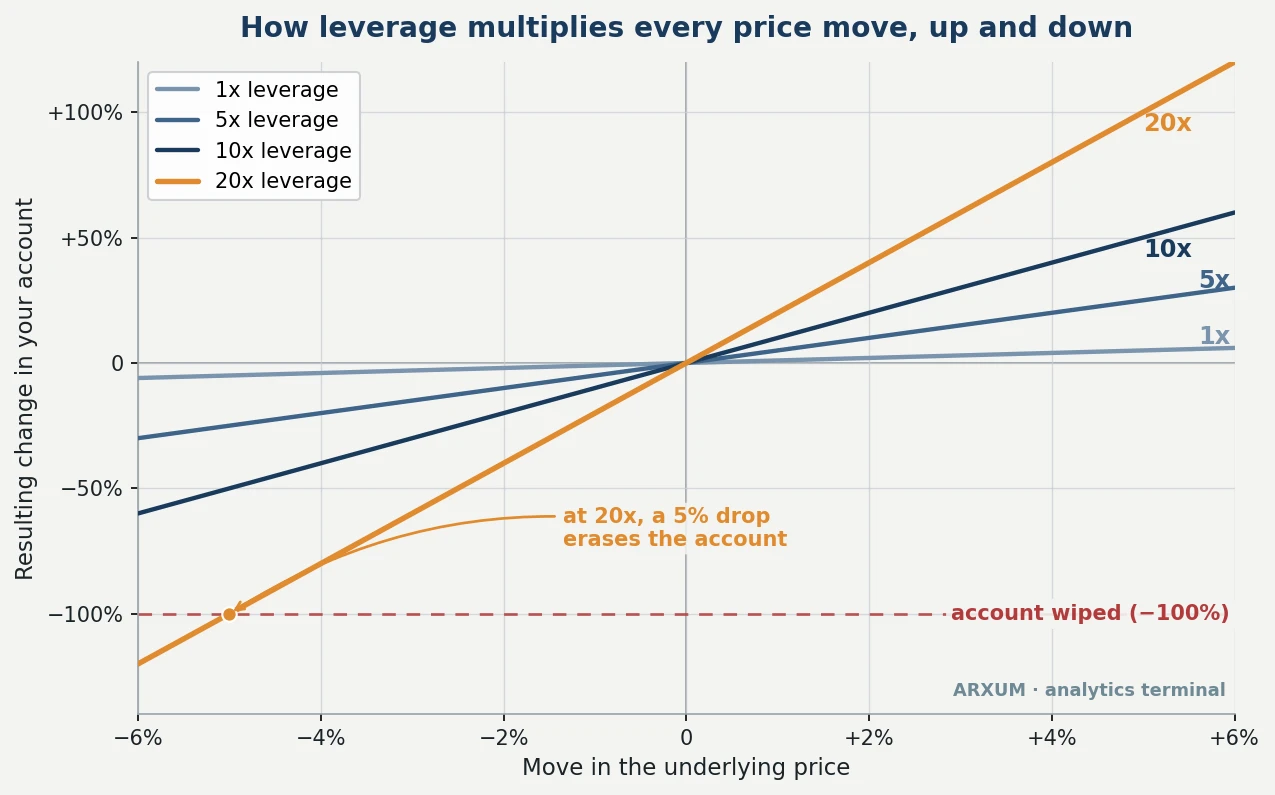
Read the fan from the flattest line up. At 1x, no leverage, the account simply tracks the market: a 5% move gives you 5%, up or down.
Crank the leverage and the line tilts steeper. At 10x a 5% move is a 50% swing in the account, and at 20x that same 5% wipes you out completely.
Notice the symmetry, because it is the honest heart of leverage. The line is exactly as steep above zero as below it.
Leverage does not make you more likely to be right. It only makes each outcome, win or lose, bigger by the same multiple.
The rule of thumb: your real leverage is not the broker’s advertised maximum, it is the position size you actually choose relative to your account. Posting less margin per trade is the same thing as running lower leverage, and it is the lever most beginners forget they control.
The moving parts of a margin account
Once a position is open, your account splits into several balances the platform tracks in real time. You do not need to calculate these by hand, but you must know what each one means, because a margin call is defined entirely in their terms.
- Balance: your cash when no trade is open, or your last settled figure. It does not move while a position runs.
- Used margin (or required margin): the deposit currently frozen as collateral for your open positions. This is the money you cannot touch until you close.
- Equity: your balance plus or minus the running profit or loss of open trades. Equity moves tick by tick with the market.
- Free margin (or available margin): equity minus used margin. This is what is left to absorb losses and open new trades.
- Margin level: equity divided by used margin, shown as a percentage. This is the gauge the broker watches, and the one that triggers a margin call when it falls too far.
Here is one worked account with a single open position, so the pieces stop being abstract. It is a $1,000 account holding a 0.1-lot EUR/USD position at 1:30 leverage.
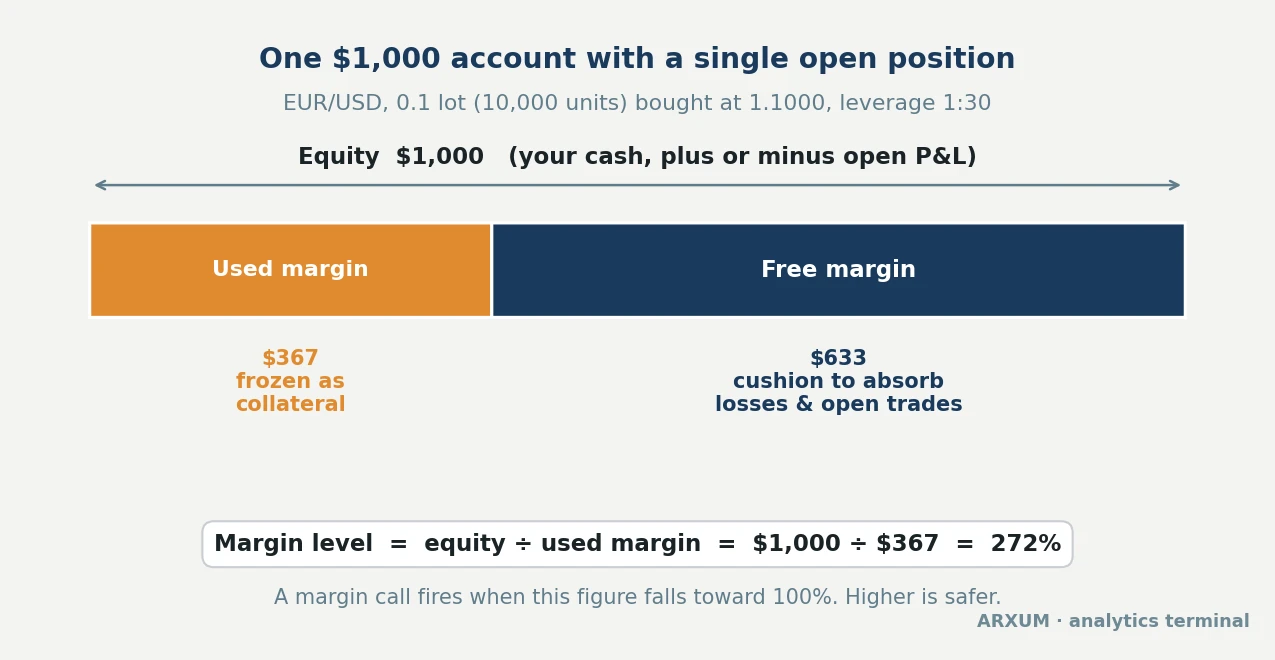
Read the bar left to right. That position freezes $367 as used margin, the orange block, and leaves $633 of free margin, the navy block, to absorb losses.
Divide the equity by the used margin and you get the margin level, 272% here, which is the single figure the broker watches. The higher it sits, the more room the account has before trouble.
Two of these deserve a plain-language anchor, because beginners blur them. Initial margin is what the broker asks for to open the position.
Maintenance margin is the smaller cushion you must keep in the account to hold it open. Let equity slide below that maintenance threshold and the broker steps in.
The margin level percentage is where all of this becomes actionable. When your open trades are winning, equity rises above used margin and the margin level sits comfortably high, often several hundred percent or more.
When trades move against you, equity falls, the margin level drops, and at a broker-defined line the trouble starts.
What a margin call actually is
A margin call is the broker telling you that your account no longer holds enough equity to support your open positions. It is not a penalty and not a surprise fee.
It is a threshold being crossed. Most brokers set a margin call level around 100%, meaning your equity has fallen to equal your used margin, and a stop-out level lower down, often 50%.
Here is the sequence, and it is worth knowing before it happens to you rather than during.
- Warning (the margin call). Your margin level touches the call threshold, say 100%. The platform flags it, you may get an email or an alert, and you can no longer open new positions. Nothing is closed yet.
- Stop-out (liquidation). If the market keeps moving against you and the margin level falls to the stop-out level, say 50%, the broker automatically closes your losing positions. It starts with the biggest loser and keeps going until the margin level climbs back above the line.
That second step is the one that hurts. The broker is not asking any more, it is acting, and it closes your trades at the current market price whether you like the level or not.
The key point most guides skip: by the time a stop-out fires, you have lost real money, not hypothetical money. The liquidation locks in the loss that pushed you there.
Here is that whole sequence as it plays out on a real account, tracking the equity rather than the price. This is an over-leveraged long on a genuine EUR/USD decline, the same trade we break down in full further down.
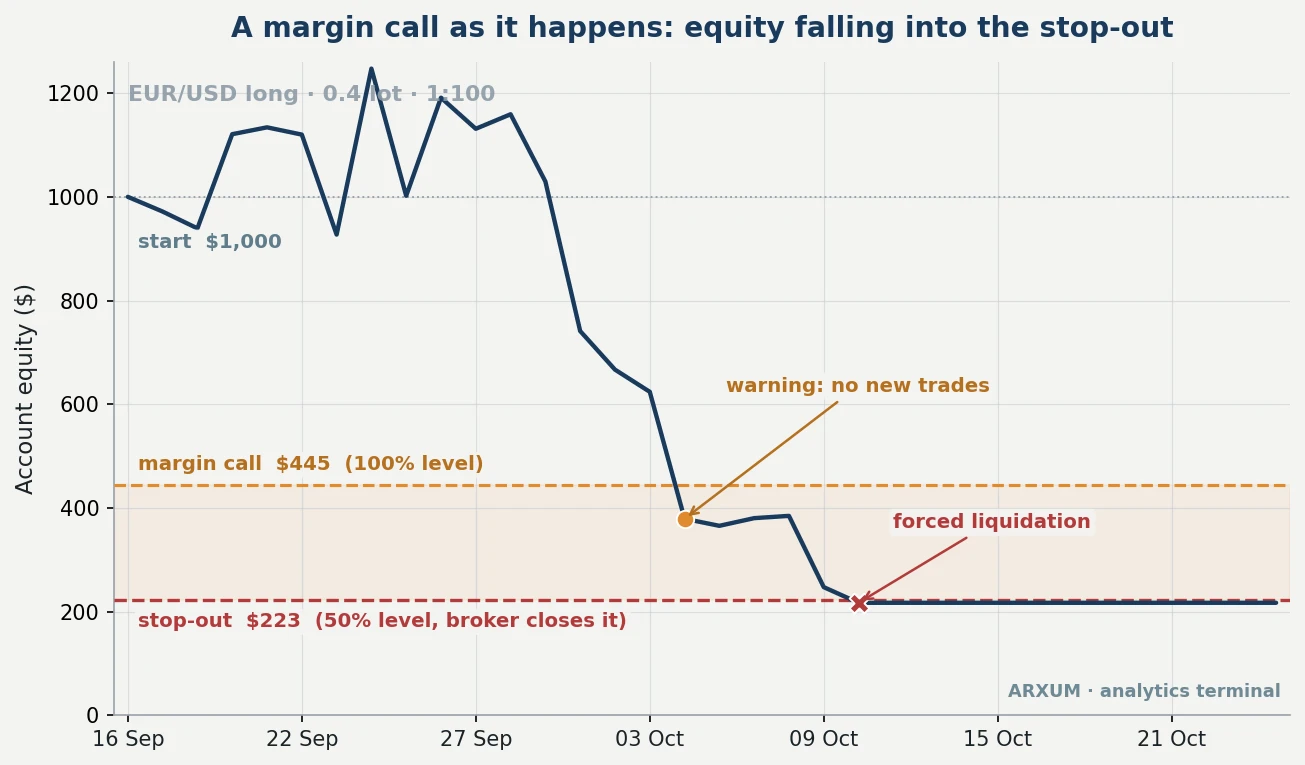
Notice the account never recovers on its own. The stop-out ends the trade at the worst point, which is exactly why the sequence is worth understanding before you meet it live.
If you want the mechanics of avoiding this in more depth, our guide to what a drawdown is covers how far an account can fall from its peak and still recover, which is the buffer a margin call is eating into.
Working out the exact price that triggers a call
Vague warnings do not help you place a trade, but a number does. So let us compute the precise level at which a margin call hits, step by step, on a small real account.
Take a $1,000 account trading EUR/USD. You open a 0.1-lot position, which is 10,000 units, buying at 1.1000.
A quick word on lot sizes, since the examples lean on them. A standard lot is 100,000 units, a mini-lot is a tenth of that (10,000 units), and a micro-lot is a hundredth (1,000 units), so a figure like a 0.4-lot just means four-tenths of a standard lot.
First, the margin required. At 1:30 leverage the margin is 3.33% of the position’s value.
- Position value: 10,000 units × 1.1000 = $11,000.
- Used margin at 1:30: $11,000 × 3.33% = about $367.
- Free margin left to absorb losses: $1,000 equity − $367 used = $633.
Now the pip, the smallest standard price step on a pair. On EUR/USD a pip is the fourth decimal, 0.0001, and on a 10,000-unit position each pip is worth about $1.
The stop-out on this broker is a 50% margin level. Margin level is equity ÷ used margin, so 50% means equity has fallen to half of $367, which is about $184.
- Equity at stop-out: 50% × $367 = $184.
- Loss that gets you there: $1,000 − $184 = $816.
- At $1 per pip on a 0.1 lot, $816 is 816 pips against you.
So on this setup the market has to fall 816 pips, from 1.1000 down to about 1.0184, before a forced liquidation. That is a large move, which tells you a single 0.1-lot position on a $1,000 account is not heavily leveraged.
Now change one thing and watch the danger appear. Switch the same trade to 1:500 leverage and the used margin drops to just $22.
- Used margin at 1:500: $11,000 × 0.2% = $22.
- Equity at a 50% stop-out: $11.
- But your real risk did not shrink. You still lose $1 per pip, and now the broker will let you pile on far more 0.1-lot positions against the same $1,000, because each one only freezes $22.
That is the trap of high leverage. It does not change the loss per pip, it just removes the guardrail that stopped you from opening a position big enough to blow up on a routine move.
The takeaway: the margin call level is not really about the leverage number, it is about how big a position you opened relative to your cash. The bigger the position, the fewer pips it takes to reach the stop-out.
A margin call on a real price move
Numbers on their own are easy to nod along to and forget. So here is the whole thing playing out on a genuine EUR/USD decline, with the exact call and stop-out prices marked.
The setup is deliberately over-leveraged, the kind that gets beginners liquidated. A 0.4-lot long (40,000 units) at 1:100 on that same $1,000 account, entered near a local high.
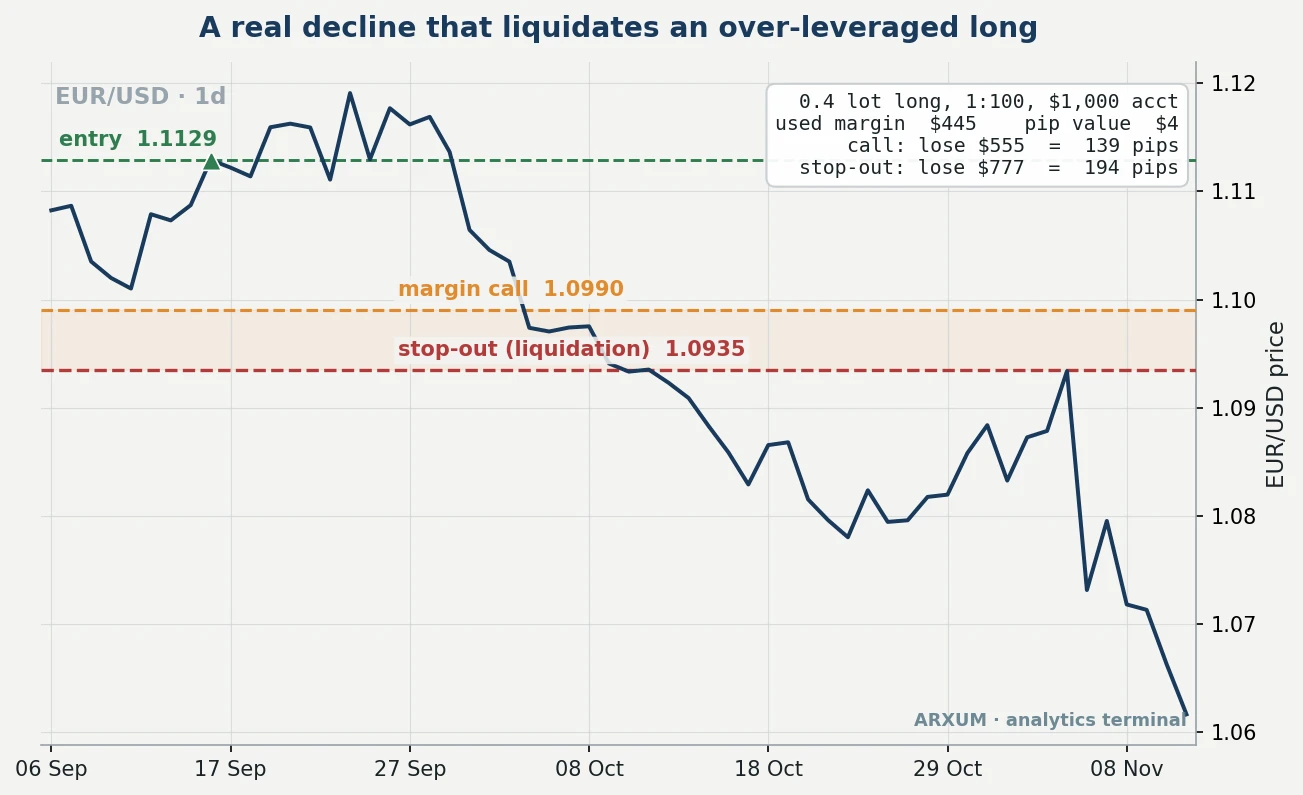
Follow the price line. It drifts up after entry, then rolls over into a sustained slide.
The math behind the two lines is fully reproducible. Used margin is the position value divided by leverage ($445 here), and the $4 pip value turns each loss into a pip distance, which is how a $555 loss puts the margin call at 1.0990 and a $777 loss puts the stop-out at 1.0935.
The point is the size of the move. The market took only weeks to cover it, and a “small” 1.7% slide to the stop-out price wipes out three-quarters of a real account.
The uncomfortable lesson sits in one comparison. That same $1,000 account trading a 0.1-lot position, ten times smaller, would have sailed through this entire decline untouched.
The move did not change. The position size did.
Leverage amplification, side by side
The fan chart earlier showed the shape. Here it is as concrete account numbers, because seeing the arithmetic once removes the mystery for good.
Say the underlying moves 2% against you. Your loss depends entirely on how much leverage you ran.
| Leverage | Margin posted | A 2% adverse move costs your account |
|---|---|---|
| 1x (no leverage) | 100% | −2% |
| 5x | 20% | −10% |
| 10x | 10% | −20% |
| 20x | 5% | −40% |
The same 2% wobble is a rounding error at 1x and a 40% gut-punch at 20x. Flip every sign and the upside scales identically: a 2% move in your favour is +40% at 20x.
This is why professionals talk about leverage as a magnifier, not a multiplier of skill. It enlarges whatever the market hands you.
A beginner who thinks in these rows before sizing a trade will almost never over-leverage. The question is never “how much can I control,” it is “how much of a normal daily move can my account survive.”
Margin across the markets you actually trade
The mechanics are the same everywhere, but the leverage on offer, and the rules around it, differ sharply by market and by where you live. This matters because the maximum leverage a broker shows you is often a regulatory ceiling, not a suggestion.
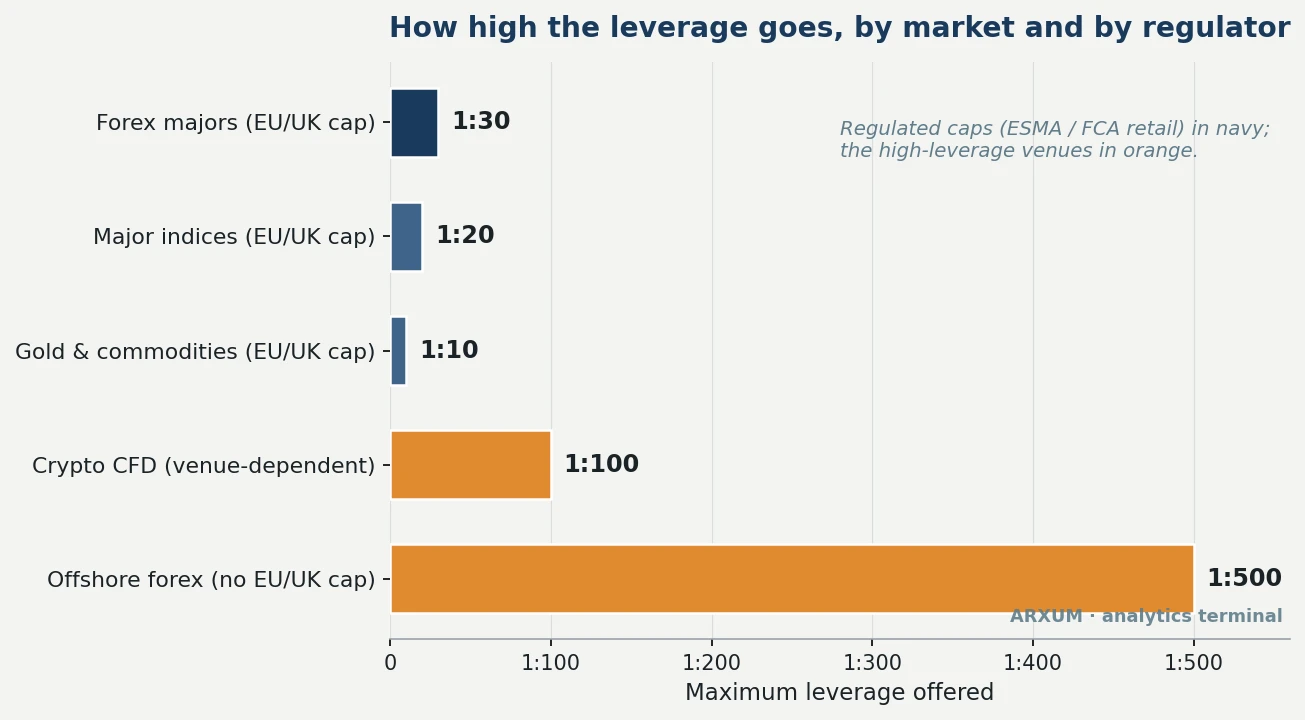
The pattern is worth reading off the chart before the detail below. The tighter the cap, the more a regulator judged that market able to hurt a retail account.
Forex. In regulated regions the caps are firm and low. Under European (ESMA) and UK (FCA) rules, retail forex leverage on major pairs is capped at 1:30, and less on minors, gold, and crypto.
Offshore and in some other jurisdictions, brokers advertise 1:500 or higher on the same pairs. The pair does not become riskier offshore; the guardrail is simply removed, and the responsibility shifts entirely onto you.
CFDs on indices and commodities. These sit in the middle. Regulated caps run around 1:20 for major indices and 1:10 for commodities like gold and oil, reflecting their bigger daily ranges.
Gold is the instructive one here. Spot gold (XAU/USD) has been in a powerful bull run and now trades in the thousands of dollars per ounce, so its dollar swings are large and the leverage on it is deliberately tighter than on a currency pair.
If you want the fuller picture of trading it with size, our guide to trading gold walks through position sizing on a market this volatile.
Crypto. This is the wild end. Centralized exchanges and crypto CFD venues offer leverage from a modest 2x up to 100x or more on perpetual futures, the contracts that never expire.
Perpetuals add a wrinkle called the funding rate: a small periodic payment between long and short traders that keeps the contract price tethered to spot. Hold a leveraged perp for days and funding quietly nibbles your position, which is a cost the forex trader never meets.
Higher leverage plus funding plus crypto’s raw volatility is why margin trading crypto liquidates accounts faster than any other market.
The plain read across all three: the leverage number tells you as much about the regulator as about the market. A 1:30 cap is a seatbelt someone bolted on for you; a 100x crypto offer means you are the only seatbelt in the car.
Cross margin versus isolated margin
Once you trade crypto or some CFD platforms, you meet a second choice: how the account shares collateral across positions. The two modes behave very differently in a crisis.
- Isolated margin walls off each position with its own dedicated margin. If that trade gets liquidated, it loses only the margin you assigned to it, and the rest of your account is untouched. The risk is contained, but a small allocation liquidates sooner.
- Cross margin pools your whole balance as shared collateral for all open positions. A losing trade can draw on the entire account to stay alive, which delays liquidation, but it also means one bad position can pull your whole balance down with it.
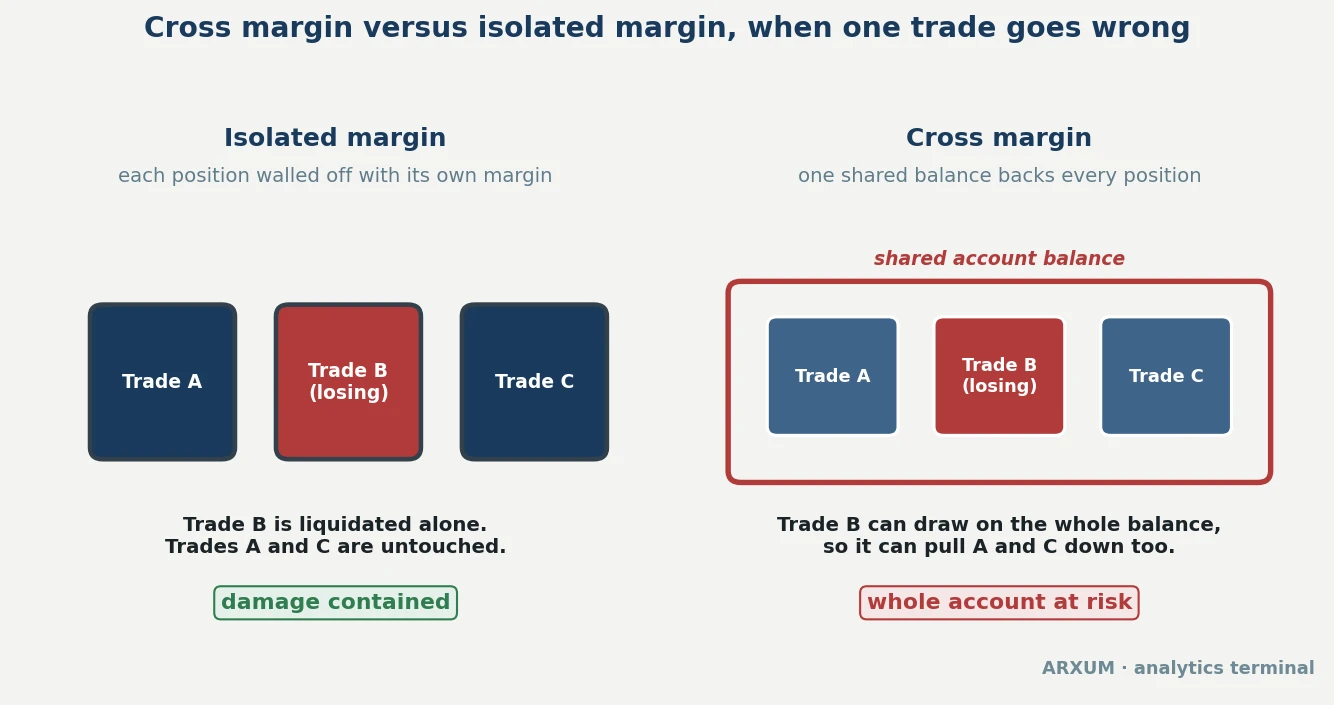
The trade-off is containment versus staying power. Isolated margin caps the damage of any single trade; cross margin gives each trade more room but puts everything on the table.
For a beginner, isolated margin is the calmer default. It turns every position into a known, capped bet, which is exactly the discipline a new leveraged trader needs before graduating to anything that pools risk.
Why leverage empties small accounts, and how to not be that statistic
The uncomfortable, well-documented fact: across regulated brokers, the majority of retail traders lose money on leveraged CFDs and forex. Most published broker disclosures put that figure somewhere in the 70% to 80% range.
Leverage is the reason, and the amplification math is the explanation. It is not that these traders pick the wrong direction more often than a coin flip.
It is that they run so much leverage that a normal, survivable market wobble reaches their stop-out and liquidates them before their idea has time to work. The account dies of position size, not of a bad forecast.
The chart below makes that concrete. It takes the same $1,000 account tying up the same $800 of margin, and asks how far price can move before the stop-out at three leverage levels.
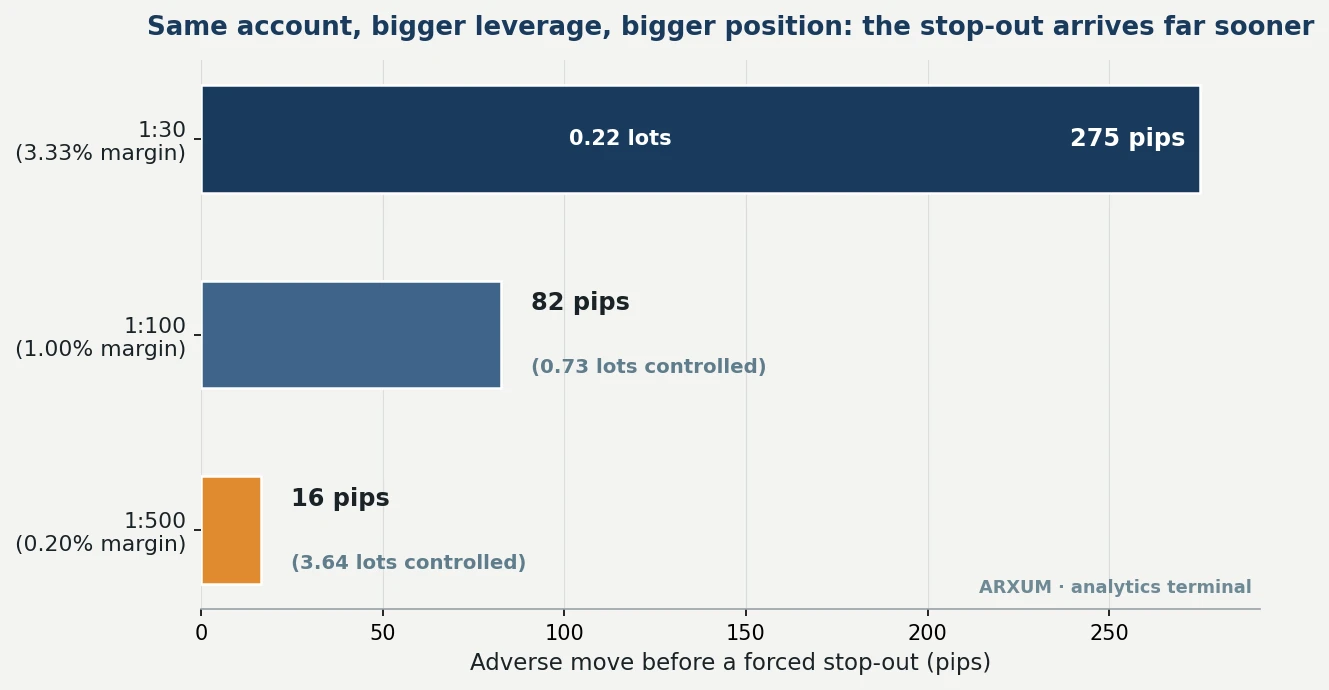
That is the trap in one picture. At 1:30 that $800 controls only 0.22 lots, but at 1:500 it controls 3.64 lots, seventeen times bigger, so a tiny 16-pip move liquidates the account.
The leverage number itself is harmless; what it permits is a position size large enough that an ordinary daily wiggle wipes you out.
The fix is entirely in your hands, and it is boring, which is why it works. Here is the discipline, tied to the exact math above rather than to slogans.
- Risk a small fixed slice per trade, around 2%. On a $1,000 account that is $20 at risk, and the sizing example below turns that $20 into an exact lot. Keep it that small and no single loss can dent the account meaningfully.
- Run lower effective leverage than the broker allows. The cap is a maximum, not a target. Choosing a smaller position is choosing lower leverage, and it pushes your stop-out level far away from any ordinary move.
- Keep a free-margin cushion. Do not open positions that freeze most of your balance as used margin. The free margin is your shock absorber; a thin cushion means a small move touches the call.
- Use a stop-loss, and never widen it. A stop is a loss you chose in advance. Widening it to dodge a hit just converts a capped, planned loss into the uncapped kind that reaches the stop-out.
None of this is about predicting the market better. It is about sizing so that being wrong, which happens constantly, stays survivable.
A related discipline is matching your stop distance to a sensible reward, and our explainer on the reward-to-risk ratio covers how to frame every trade as risking one to make some multiple of that. The two habits, small fixed risk and a defined reward, are what keep a leveraged account alive long enough to learn.
Where regulated, one more layer sits underneath all of this: negative-balance protection. It guarantees you cannot lose more than your deposit, even if a violent gap blows straight through your stop.
Under ESMA and FCA rules, retail accounts get it automatically. Many offshore venues do not offer it, so a large gap can theoretically leave you owing the broker, which is worth checking before you fund an account.
A placeable forex example, sized for $500
Enough theory. Here is a leveraged EUR/USD trade a beginner can actually place on a small account, sized properly from the account down.
You have a $500 account and you want to risk the standard 2%, which is $10 on this trade. Your plan is a long on EUR/USD with a 50-pip stop below your entry.
First the sizing, one division at a time.
- Risk budget: 2% of $500 = $10.
- Stop distance: 50 pips.
- Risk per pip you can afford: $10 ÷ 50 pips = $0.20 per pip.
- Position size: a 0.01 lot (1,000 units) is worth about $0.10 per pip on EUR/USD. So $0.20 ÷ $0.10 = a 0.02 lot.
Now the margin that position needs, to prove it fits. A 0.02 lot is 2,000 units, a position worth about $2,200 at 1.1000.
- Used margin at 1:30: $2,200 × 3.33% = about $73.
- Free margin remaining: $500 − $73 = $427.
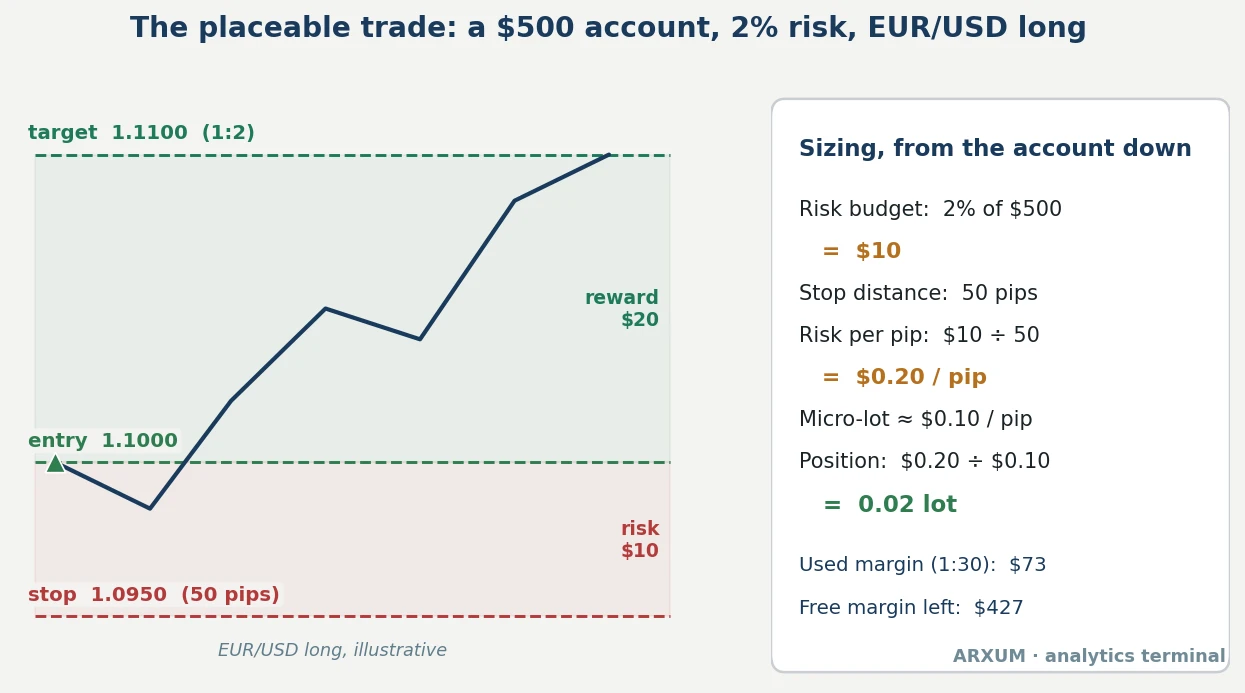
That is a comfortable trade. It freezes only $73 of your $500, leaves $427 as cushion, and risks exactly the $10 you planned if the 50-pip stop is hit.
The reconciliation matters, because the numbers have to agree. Risking 2% ($10) over a 50-pip stop genuinely produces that 0.02-lot size, and 0.02 sits above most brokers’ 0.01-lot minimum.
If you ever find a stop so tight that 2% sizes below a 0.01 lot, that is the market telling you to skip the trade or pick a cheaper instrument, not to oversize. To place the order itself: set a buy order at your entry, put the stop-loss field at 50 pips below, and a take-profit at whatever reward multiple you chose.
For the mechanics of measuring lots and pip values on any pair, our forex lot size calculator guide does the conversions, and the broader position sizing method shows how to run this same from-the-account-down math on every trade.
Common mistakes with margin and leverage
- Confusing margin with cost. The margin is a frozen deposit you get back, not money spent. Treating it as the trade’s price leads to wildly oversized positions.
- Chasing the highest leverage on offer. A 1:500 account does not make you money faster, it just lets you open a position big enough to be liquidated by a normal move. The leverage cap is a guardrail, not a goal.
- Ignoring free margin. Opening trades that freeze most of your balance leaves no cushion, so a small adverse move touches the margin call. Keep most of your equity free.
- Widening a stop to avoid a loss. This is how a capped, planned loss becomes an account-ending one. The stop is the plan; moving it is abandoning the plan at the worst moment.
- Forgetting funding on crypto perpetuals. A leveraged perp held for days bleeds funding payments on top of any price move. It is a cost that does not exist in spot forex.
Honest scope: what this guide is and is not
- This is education on the mechanics, not trading advice. The math of margin, leverage, and margin calls is universal; how you apply it is your call.
- The exact thresholds vary by broker. Margin call levels near 100% and stop-outs near 50% are common, but check your own broker’s figures, because they set the precise trigger.
- Leverage caps depend on your jurisdiction. The 1:30 forex figure is the ESMA and FCA retail cap; offshore and other regions differ, sometimes dramatically.
- Leverage is genuinely high-risk. Most retail leveraged traders lose money, and the honest reason is over-sizing, not bad luck. Small fixed risk is the antidote, and it is the whole point of the sizing example above.
Where to go from here
The whole guide in three lines, if you remember nothing else.
- Margin is a frozen good-faith deposit, not a fee. Leverage is its mirror: 1:30 means 3.33% margin, and it multiplies gains and losses by the same factor.
- A margin call fires when your equity falls to a broker threshold; a stop-out then liquidates your positions automatically. You can compute the exact price it happens at.
- Survival is sizing. Risk about 2% per trade, run less leverage than the cap, keep free margin, and never widen a stop.
If you are new to placing trades at all, the forex trading for beginners guide walks through opening an account and the first orders, and it pairs naturally with everything here about margin.
FAQ
What is margin trading, in plain terms?
What is the difference between margin and leverage?
How does leverage work in forex?
What happens during a margin call?
How do I avoid a margin call?
What is maintenance margin?
What is the difference between cross margin and isolated margin?
What is a stop-out level?
Is margin trading crypto riskier than forex?
How much money do I need to start margin trading?
Is margin trading worth it for beginners?
What do the key margin terms mean?
Real-time trade setups with entry, stop loss and take profit. Daily market analysis. No subscription, no complicated theory.
🌍 Our recommended brokers



Quant Researcher & Systems Builder
Quantitative researcher who builds the automated systems behind Arxum strategy testing. Works in Python and Pine Script, using AI alongside classic backtesting to validate strategies on years of real data.