

What the pattern day trading rule actually is
The pattern day trading rule is a counter, not a ban. It watches a rolling five business day window and tags your account once four day trades land inside it.
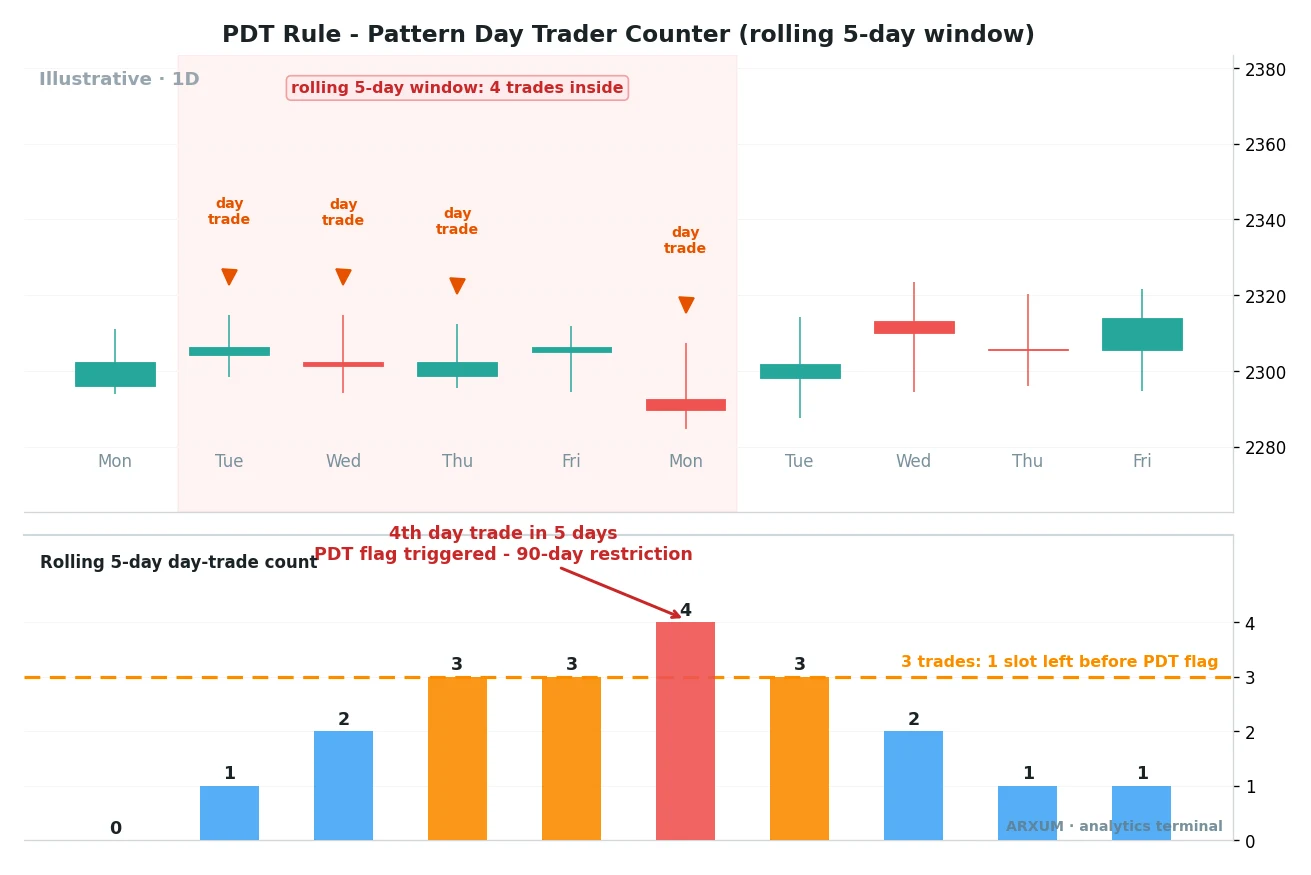
Everything the rule does hangs off that picture. Read it in three parts.
- The window rolls. It is not a calendar week. Every day the broker looks back five business days, so a trade drops off the count as the window slides forward.
- Four is the trip wire. Three day trades in the window is fine. The fourth is what flags the account.
- The flag sticks. Once tagged, the account is treated as a pattern day trader going forward, not just for that one week.
The rule only fires when three conditions line up at the same time. Miss any one of them and you are not a pattern day trader.
| Condition | What it means |
| Account type | A margin account at a US broker |
| Trade count | Four or more day trades in five business days |
| Share of activity | Those day trades are more than 6% of total trades |
| Instrument | Stocks, ETFs, or options, which count as securities |
A margin account is one where the broker lends you money against your positions. The 6% clause rarely matters for an active trader, since day trades are usually most of what they do, but it is why a long-term investor who scalps once by accident does not get flagged.
What actually counts as a day trade
A day trade is one thing only: opening and closing the same position on the same day. Hold it past the close and it stops counting.
| This is a day trade | This is not |
| Buy and sell the same stock the same session | Buy today, sell tomorrow |
| Short and cover before the close | Hold a position for days or weeks |
| Several in-and-out trades on one ticker in a day | One position carried overnight |
The overnight line is the whole trick, and it shows up cleanly on an intraday chart.
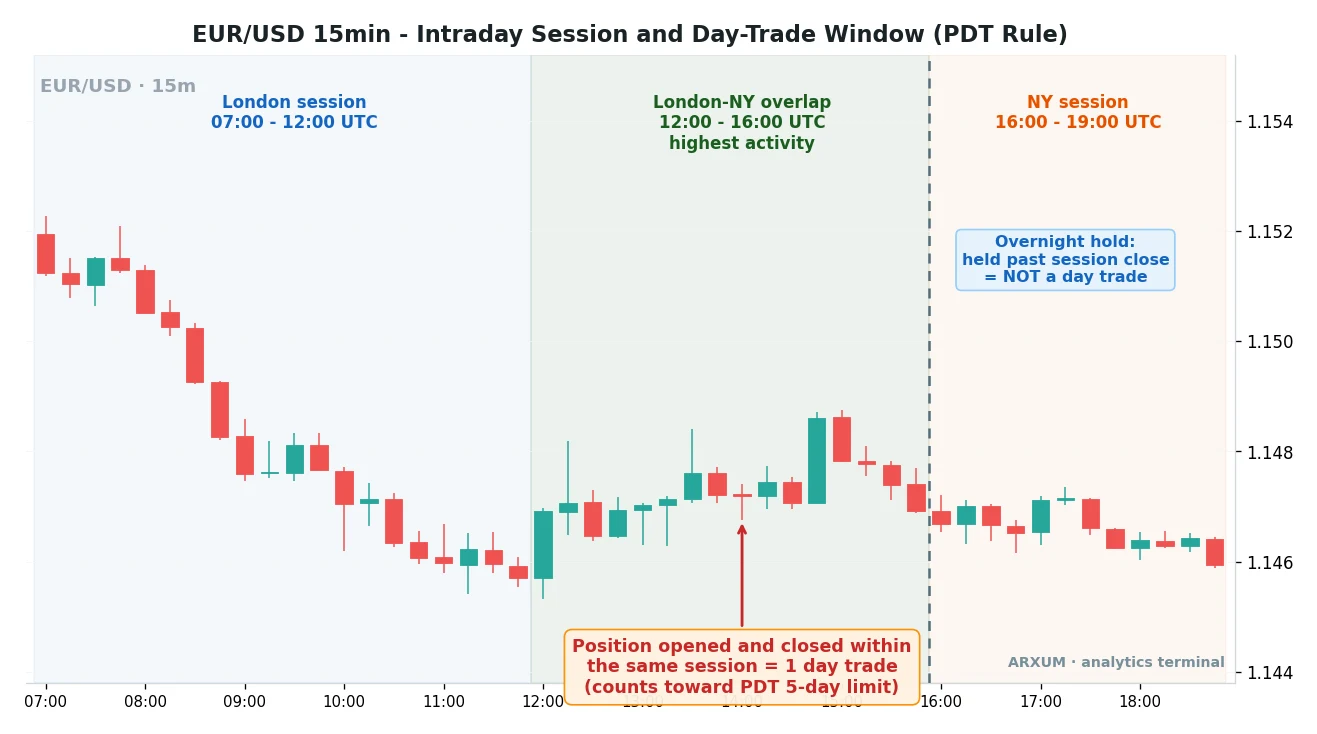
A few points fall straight out of that chart.
- Same session in and out equals one day trade. It does not matter if you make $5 or $500. The count only cares that you opened and closed.
- Held past the close, a trade is a swing trade, and swing trades never touch the counter. That is the simplest workaround of all, covered below.
- Round trips add up fast. Four quick scalps on one busy morning can flag you by lunch if the window already holds trades.
- The rule counts trades, not shares. Buying a stock in three lots and selling it in one still nets out to one day trade on that ticker.
Who the rule binds, and who it skips
This is the part that matters most for anyone trading forex, futures, or crypto. The PDT rule lives in US securities law, so it only reaches securities.
Everything else is outside it.
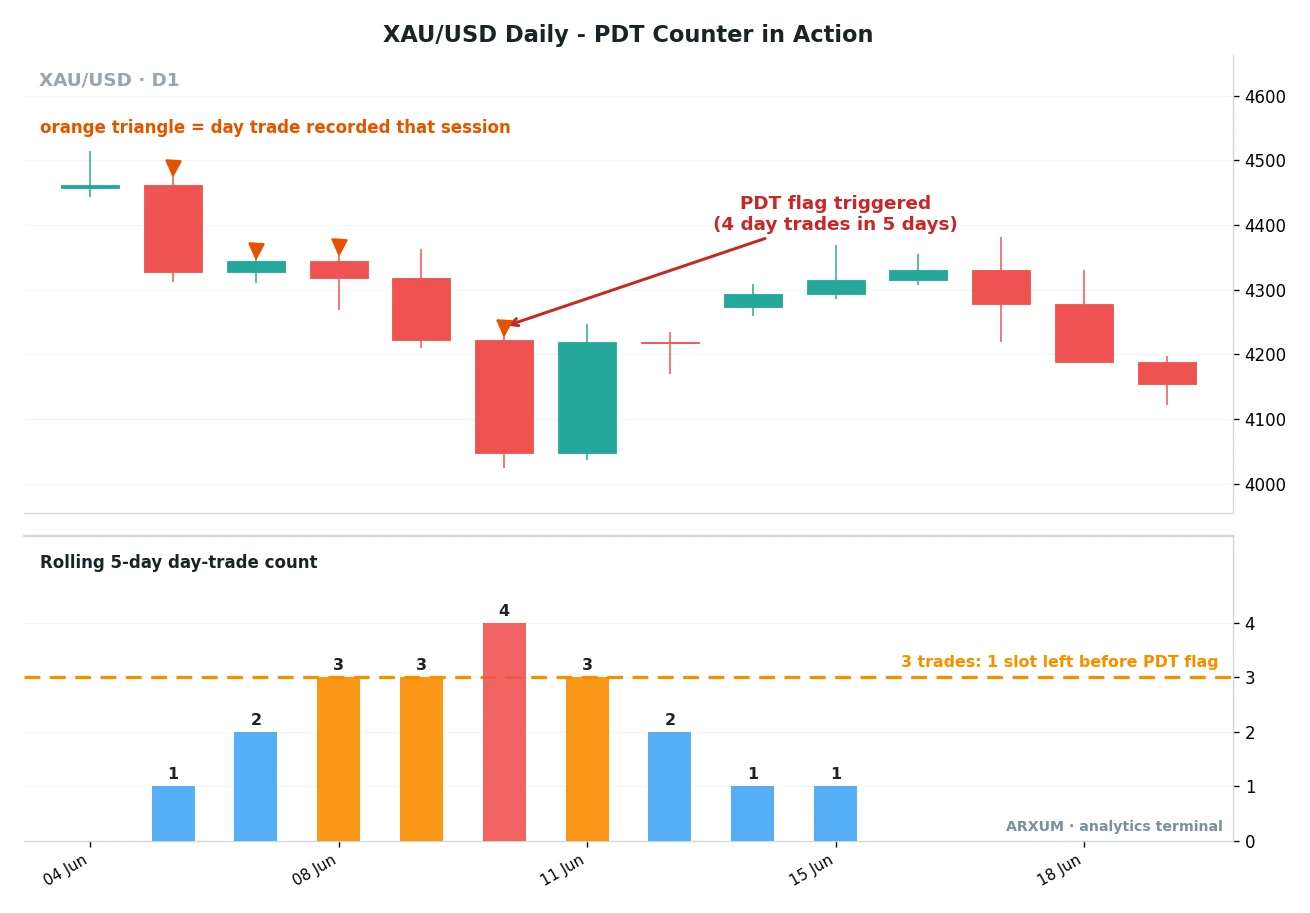
Here is the same counter running on daily bars. The mechanic is identical no matter the market.
What changes is whether the rule is even allowed to look.
| Market | Covered? | What applies instead |
| US stocks and ETFs | Yes | The $25k minimum once flagged |
| US options | Yes | Same securities rule |
| Spot forex | No | NFA leverage caps, no equity floor |
| Futures | No | Day-trade margin set per contract |
| Spot crypto | No | Exchange rules, no PDT |
The practical read for an active small account is short.
- Trade a US stock margin account under $25k and the rule is a real ceiling. Four round trips a week is your limit until you fund the account.
- Spot forex is regulated in the US by the NFA, not the securities rules, so there is no $25k floor and no five-day counter. There are leverage caps instead.
- Futures answer to a different regulator again. Your day-trade limit there is set by contract margin, not a headline equity number.
- Crypto is not a security, so a spot crypto account has no PDT rule at all. See our crypto day trading guide for how the sessions and volatility differ.
That gap is the reason so many under-funded day traders drift toward forex and futures. They are not dodging a law.
Those markets were simply never inside it.
What happens if you get flagged
Getting flagged is not a fine or a penalty. It is a set of restrictions the broker switches on, and the details depend on how much equity you hold.
| Your situation | What the broker does |
| Flagged, holding $25k or more | You keep day trading, up to 4x intraday buying power |
| Flagged, below $25k | Day trading blocked until you top up to $25k |
| Blow past day-trade buying power | A day-trade margin call, five days to fund it |
| Ignore that margin call | Restricted to a cash-available basis for 90 days |
A couple of terms there are worth pinning down.
- Equity is your cash plus the value of your open positions. The $25,000 can be cash or eligible securities, not necessarily all cash sitting idle.
- Buying power over $25k jumps to 4x intraday. A flagged account above the line can day trade with up to four times its margin cushion, which cuts both ways.
- A day-trade margin call is what you get for trading beyond that 4x. You have five business days to deposit. Push it and you are restricted, meaning you can only trade with settled cash, for 90 days.
- Below $25k, the block is the real sting. You are not banned from the account, just from day trading it, so you can still hold positions and swing trade.
- Many US brokers grant a one-time flag reset. If a first flag was an accident, you can often call and ask for it to be removed once, as a courtesy. It is a single get-out, not something to lean on, so treat it as a favour rather than a plan.
The one myth to kill: the $25,000 is not a fee. It is your own capital, sitting in your own account, and you can withdraw it whenever you stop day trading.
If a forced deposit turns into a real one, our margin call explainer walks through what a call is and how to avoid triggering one.
How to trade around the PDT rule
Every workaround here is legal and widely used. They fall into two camps: change the account, or change the market.
Pick by how you actually want to trade.
| Route | How it dodges the rule | The trade-off |
| Cash account | No margin, so PDT never applies | Wait for cash to settle, no shorting |
| Two brokers | Three day trades each stays under four | Splits your capital and focus |
| Trade futures | Not a security, no counter | Contract size, leverage risk |
| Trade spot forex or CFDs | Outside the securities rules | Different leverage caps |
| Trade crypto | Not a security | Volatility, custody risk |
| Prop firm account | You trade the firm's capital | Fees, a profit split, firm rules |
| Swing trade instead | Overnight holds are not day trades | Slower, needs wider stops |
A few of these deserve a plain-language note.
- The cash account is the cleanest fix for a US stock trader. No margin means no PDT, full stop. The catch is settlement: after you sell, that cash takes a day to clear, so you cannot instantly recycle it into the next trade.
- Two brokers is a blunt but common trick. Three day trades at each broker keeps both under the four-trade line. It works, but managing two accounts and half the capital in each is a real cost.
- Swing trading sidesteps the rule entirely. Hold past the close and no trade ever counts. If day trading is not sacred to you, our swing versus day trading comparison lays out the trade-off in full.
- A prop firm lets you trade size without your own $25k. You pass an evaluation, then trade the firm’s money under its rules, not the PDT rule. See what prop trading is for how the model works.
One more angle worth knowing: the rule is a US thing. It rides on US securities regulation, so a trader outside the US, or one using a non-US broker that is not bound by FINRA, is generally not subject to the five-day counter at all.
Regulation and deposit safety vary widely between jurisdictions, so that route is about knowing the rule’s borders, not chasing the loosest broker you can find.
For a genuinely active trader with under $25k, the honest answer is usually to move markets rather than fight the rule. Futures and forex were built for intraday size, and neither has a five-day counter.
Cash account versus margin account
Most of the confusion around the rule comes from mixing up these two account types. The PDT rule only ever touches one of them.
| Feature | Cash account | Margin account |
| PDT rule | Does not apply | Applies once flagged |
| Day trades allowed | Limited by settled cash | Unlimited over $25k |
| Short selling | No | Yes |
| Leverage | None | Up to 4x intraday |
| Main catch | The settlement wait | The $25k minimum |
The choice really comes down to two costs.
- A margin account buys you speed and shorting, at the price of the $25k floor. If you can fund it, the rule stops being an issue. If you cannot, it caps you at three round trips a week.
- A cash account escapes the rule but ties you to settlement. You can only trade with money that has cleared, so a very active trader runs out of settled cash fast. For the mechanics of borrowing and margin, our margin trading guide covers how the borrowed side works.
Which route fits you
The right move depends on your capital and your style, not on which trick sounds cleverest. Match your situation to a row.
| You are | Best route |
| A small US stock account under $25k | Cash account or swing trade |
| An active intraday trader under $25k | Futures, forex, or crypto |
| After big size without your own capital | A prop firm evaluation |
| Happy to hold overnight | Swing trading, the rule never bites |
| Able to fund $25k or more | A standard margin account |
None of these is a loophole in the sneaky sense. They are just the account and market choices US regulators left open on purpose.
What to remember
Strip the rule down and three things carry the whole topic.
- The rule is a five-day counter on a US stock or options margin account. Four day trades inside five business days flags it, and a flagged account needs $25,000 to keep day trading.
- It does not touch forex, futures, or crypto. Those markets sit outside US securities law, so there is no counter and no equity floor to worry about.
- The workarounds are all legal. A cash account, a second broker, swing trading, a prop firm, or simply trading a market the rule cannot reach. Pick the one that fits how you trade.
If you are still new to intraday trading in general, start with our day trading for beginners guide, then come back to the rule once you know how often you actually want to trade.
Glossary
- Pattern day trader: an account flagged for making four or more day trades in five business days in a margin account.
- Day trade: buying and selling, or shorting and covering, the same security on the same day.
- Margin account: a brokerage account that lets you trade with money borrowed from the broker.
- Cash account: an account with no borrowing, where you trade only settled cash.
- Equity: your cash plus the current value of your open positions.
- Settlement: the short wait, one business day for US stocks, before a sale’s cash is usable again.
- Buying power: the total position size an account can hold, which margin multiplies.
- Securities: stocks, ETFs, and options, the instruments the PDT rule governs.
FAQ
What is a pattern day trader?
A pattern day trader is a US margin account that makes four or more day trades within five business days, where those day trades are more than 6% of its total trading. A day trade means opening and closing the same stock or option in the same session. Once an account meets that pattern, the broker flags it and applies the $25,000 minimum equity requirement going forward.
What is the pattern day trading rule in simple terms?
It is a counter. If you day trade the same US stock margin account four times inside a rolling five business day window, the broker tags it as a pattern day trader. From then on you must keep at least $25,000 of equity in the account to keep day trading. Stay under four day trades a week, or hold positions overnight, and the rule never fires.
What is the day trading minimum balance?
For a US stock or options margin account flagged as a pattern day trader, the minimum is $25,000 of equity, which can be cash or eligible securities. The balance has to be there before you day trade, not topped up afterward. If it drops below $25,000, the broker blocks further day trading until you restore it. Forex, futures, and crypto accounts have no such minimum.
What happens if you break the PDT rule?
Nothing dramatic, but the broker restricts you. If you are flagged and hold $25,000 or more, you keep day trading with up to 4x intraday buying power. If you are below $25,000, day trading is blocked until you top up. Trade beyond your buying power and you get a day-trade margin call with five business days to fund it. Ignore that and the account is limited to settled-cash trading for 90 days.
Does the PDT rule apply to forex?
No. The PDT rule lives in US securities law, and spot forex is regulated by the NFA and CFTC instead, not as a security. There is no five-day counter and no $25,000 minimum on a forex account. What applies instead is leverage caps on major and minor pairs. This is a big reason under-funded US day traders often move to forex.
Does the PDT rule apply to crypto?
No. Spot crypto is not treated as a security, so the pattern day trading rule does not reach it. A spot crypto account has no day-trade counter and no equity floor. The rules you do face come from the exchange, plus the practical risks of volatility and holding your own coins. You can day trade crypto as often as you like with any balance.
How do you avoid the PDT rule?
Several legal ways. Use a cash account, where no margin means the rule never applies, though you wait for cash to settle. Split trades across two brokers so each stays under four day trades. Trade futures, forex, or crypto, which sit outside the rule entirely. Trade a prop firm's capital under its own rules. Or swing trade, holding past the close, so no trade ever counts as a day trade.
Does the PDT rule apply to a cash account?
No. The rule only applies to margin accounts. A cash account has no borrowing, so it is never flagged as a pattern day trader. The trade-off is settlement: after you sell, that cash takes about one business day to clear before you can use it again. Very active traders run short of settled cash quickly, which is the cash account's real limit rather than any trade count.
Do prop firms have a PDT rule?
Not the FINRA one. When you trade a prop firm's capital, you are trading the firm's account under its own rules, not your personal margin account, so the $25,000 minimum does not apply to you. Prop firms have their own limits instead, like daily loss caps and profit targets. That is one reason a small trader who wants intraday size often takes a funded evaluation.
Is the $25,000 gone once I deposit it?
No. The $25,000 is your own capital, sitting in your own brokerage account, and you can trade with it or withdraw it whenever you stop day trading. It is a minimum balance you have to maintain to keep day trading a flagged margin account, not a fee paid to the broker or the regulator. Think of it as a floor you must stay above, not money you hand over.
Real-time trade setups with entry, stop loss and take profit. Daily market analysis. No subscription, no complicated theory.
🌍 Our recommended brokers


Reader Reviews
Be the first to review this — tell other traders what actually helped, or where it fell short.
Leave a Review

Forex Analyst & Senior Trader
Former FX desk trader with 8 years in institutional forex. Works in multi-timeframe analysis and order flow, turning desk experience into systematic, testable rules across forex and metals.