
The honest version of crypto day trading looks nothing like the YouTube clips. There’s no scalping 50 trades a day. The approach that’s actually worked for me, running live on BTC and ETH over the past two years - is closer to 3-5 trade setups per week, each planned before the session opens, each with a defined stop and target.
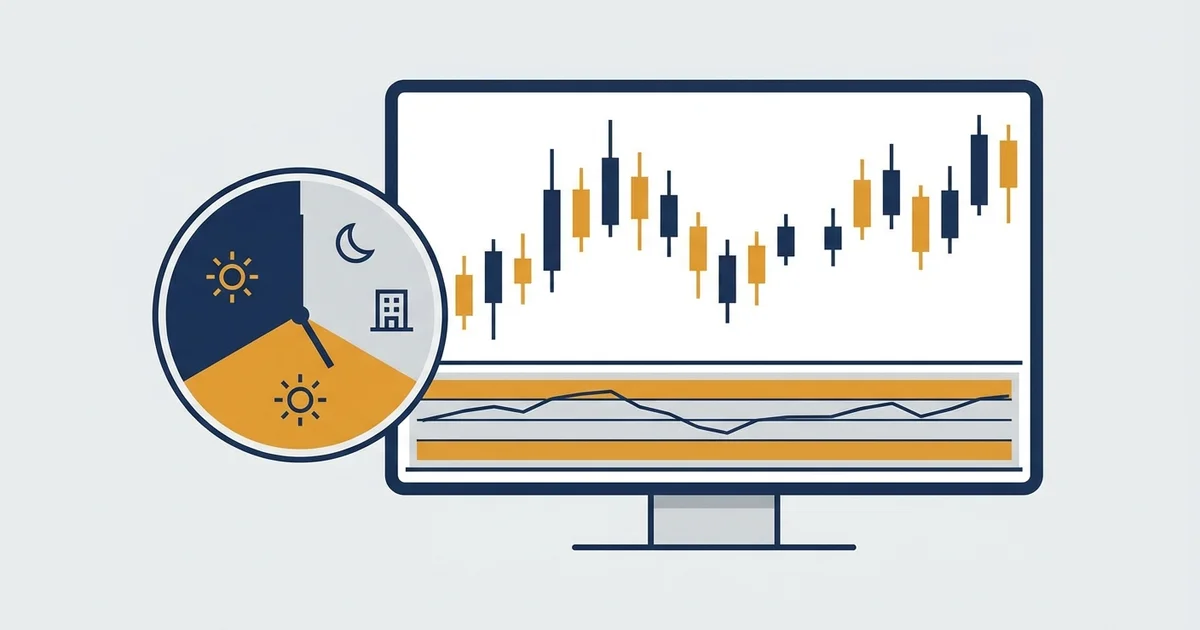
Crypto has one structural advantage over forex: it never closes. The Bitcoin London open, US pre-market, and Asian session all create predictable volume patterns you can exploit without watching screens around the clock.
How crypto day trading differs from forex
Most traders arrive at crypto from forex or stocks. The mechanics look similar on a chart, but three practical differences change your setup rules completely.
Volatility runs higher. BTC regularly moves 3-5% in a single session. EUR/USD might do 0.5-1%. That’s not a problem if your position sizing accounts for it, but most account blowups in crypto come from traders using forex-sized positions on a crypto-volatility asset.
The market runs 24 hours. No Sunday gaps, no hard open. But real volume still clusters during London and New York hours. The market is technically open continuously; the liquidity is not.
Liquidity drops fast below the majors. I stopped trading altcoin CFDs after finding that spreads widen significantly on anything outside BTC and ETH during consolidation periods. Stick to the two most liquid pairs until your results are consistent. Everything else dilutes edge on most retail CFD platforms.
Timeframes that actually produce clean signals
The 15-minute chart gets attention on social media. In practice, it generates more false signals than usable edge on crypto. Here’s how each timeframe fits into a working workflow:
| Timeframe | Role | What works | What breaks |
|---|---|---|---|
| 15M | Entry trigger only | Fast confirmation | High noise, spreads eat edge |
| 1H | Confirmation + entry | Balanced, manageable | Requires patience |
| 4H | Primary setup | Clean signals, less stress | Fewer setups per week |
| Daily | Direction filter only | Reduces bad trades | No entry timing |
My workflow: daily chart for direction, 4H for setup identification, 1H for entry timing. The 4H is where my current BTC momentum setup holds a 64% win rate across the last 28 trades. When I shifted to the 1H as my primary chart, that number dropped to 51%, barely worth the extra screen time.
Three setups that hold up in live markets
RSI momentum on the 4H chart
This is the setup I’ve tested most extensively on BTC/USDT. Entry condition: RSI crosses above 50 from below after a pullback, with price trading above the 20-period EMA. Stop goes below the prior swing low. Target is 2:1 reward-to-risk minimum.
Six months of live tracking on this setup produced 61% win rate with 1.8 average R:R. My current version adds a volume filter - enter only when the entry candle volume is at least 1.5× the 20-period average - which improved results without cutting too many signals. Win rate on the last 28 trades with this filter: 64%.
The setup breaks in ranging markets. When BTC trades sideways between levels for two to three weeks, RSI oscillates between 40 and 60 without clean crosses. I skip the setup entirely when there’s no clear directional structure on the daily chart.
One thing that surprised me: RSI overbought and oversold signals work better on the weekly crypto chart than the daily. On the daily, those extremes are common enough to be misleading. The 4H momentum cross is the signal worth trading - not the extreme levels.
VWAP reversal on the 1H chart
VWAP (Volume Weighted Average Price) acts as an intraday value reference for crypto. When price extends 1.5-2% below VWAP during an active session and RSI is in the 30-40 zone, a mean-reversion entry becomes viable. The full calculation and chart examples are in the VWAP indicator guide.
Entry: price returns to VWAP level with a confirmed green candle close. Stop below the session low. Target: prior resistance level or 1.5:1 minimum.
This setup works best during the London open between 08:00-10:00 UTC when volume is elevated. It fails consistently in overnight sessions - the price action looks structurally similar but lacks institutional backing to follow through.
Volume spike breakout entries
When BTC clears a resistance level with volume 2× the 20-period average, that’s an institutional entry signal. I’ve used this mostly in bull phase conditions. In ranging or bearish markets, the same volume spikes often mark exhaustion rather than continuation.
The critical filter: the entry candle body should be at least 60% of the full candle range. Wick-heavy candles on high volume tend to reverse fast. For broader context on reading volume signals across indicators, the best indicators for day trading guide covers this in detail.
Risk management for a 24-hour volatile market
Standard forex position sizing doesn’t transfer to crypto. BTC can move $3,000 in a session at current prices. The stop distance that works for EUR/USD is a fraction of the BTC daily range.
On a $1,000 account, 1% risk per trade equals $10. For a BTC position with a 200-point stop, the position size works out to 0.001 BTC or equivalent on a CFD platform. That’s workable but smaller than most new traders expect.
My current crypto allocation runs around $2,000, which gives enough room for 1% risk ($20) with meaningful position sizes on BTC and ETH CFDs without overexposing a single asset.
Session timing matters more than most traders acknowledge. My best entries come from the 14:00-16:00 UTC window: US pre-market overlapping with EU close. Volatility is elevated, volume is real, and both institutional sides are active. After 20:00 UTC, volume drops and spreads widen. I stop taking new positions at that cutoff.
Live results: BTC/USDT 4H RSI momentum setup, 28 trades (six-month period), my broker crypto CFD.
| $150 deposit entry | $600 deposit optimal | |
|---|---|---|
| Lot size | 0.01 | 0.04 |
| Risk per trade (1%) | $1.50 | $6.00 |
| Trades taken | 28 | 28 |
| Win rate | 64% | 64% |
| Net P&L | +$34 | +$135 |
| Account growth | +22% | +22% |
Trading involves risk. Past results do not guarantee future performance. Never risk more than you can afford to lose.
Mistakes that end crypto day trading accounts
Trading too many pairs. CFD spreads on smaller crypto assets often run 0.5-1% during volatile periods. That eliminates any edge before the trade starts. BTC and ETH only, at minimum until results are consistent on those two.
Using the 15-minute chart as the primary. The 15M feels active. It’s mostly noise. Use it for entry confirmation at best, never as your primary setup timeframe.
Ignoring session timing. A structurally identical 4H setup at 03:00 UTC executes differently than at 15:00 UTC with full liquidity. Volume filters help but timing awareness is equally important.
No defined stop at entry. Crypto can move 5-8% in an hour. “I’ll exit if it goes against me” is not a trading plan. Every trade needs a pre-set stop placed at entry, before the move develops.
Overleveraging. Most platforms offer 10-50× on crypto. A 5% adverse move at 20× leverage wipes the account. Keep it below 5× on 4H setups. At 2-3×, a bad trade stings but does not end your session.
Treating social media pumps as trade signals. By the time a 20% move is trending, the liquidity event is over for day traders. Your setup must be defined before price moves, not after.
For traders newer to crypto mechanics, the how to trade crypto guide covers exchange setup, order types, and basic position mechanics before active day trading setups become practical.
Execution quality compounds across multiple entries per week. Platforms with tight crypto CFD spreads - Vantage is worth comparing specifically for crypto CFD conditions - make a material difference on the math when you’re entering several times weekly.
FAQ
Is crypto day trading profitable?
What is the best timeframe for crypto day trading?
How much money do you need to start crypto day trading?
Can you trade crypto without leverage?
Is crypto swing trading better than crypto day trading?
What are the best indicators for crypto day trading?
Which crypto pairs work best for day trading?
Real-time trade setups with entry, stop loss and take profit. Daily market analysis. No subscription, no complicated theory.
🌍 Our recommended brokers


Reader Reviews
I came to this article having traded the 15-minute chart on BTC for most of the past year, generating plenty of trades and a roughly break-even record after spreads. Shifting to the 4H RSI momentum setup described here was counterintuitive at first - fewer setups felt like less opportunity. Over eight weeks tracking 22 qualifying entries on BTC/USDT, I hit 15 targets and stopped out on 7, a 68% rate. Monthly return averaged 7.3% at 1% risk on a $2,400 Exness account. The volume filter was the piece I nearly skipped adding. After applying the 1.5x average volume confirmation, my false entry rate dropped on the first two-week sample. The observation about ranging markets invalidating the RSI cross signal saved me at least four bad entries in a three-week BTC consolidation period. I stopped trying to force setups when BTC was trading sideways between two levels and the daily chart had no directional structure.
The 14:00-16:00 UTC entry window was the single most useful piece of information in this guide. I had been entering at random times and wondering why identical setups produced different results. Running the same RSI setup exclusively in that window for three weeks improved my result from around 50% to 64% win rate on BTC 4H setups.
The VWAP reversal setup added a second reliable edge to my trading week. I had used VWAP as a reference before but never built a defined entry rule around it. The specification - price extends 1.5-2% below VWAP with RSI between 30-40, then closes green back above VWAP - removed the guesswork. Running it during London open specifically added two to three qualifying setups per week on ETH/USDT. Monthly return averaged 8.1% over six weeks at 1.5% risk per trade. The limitation about overnight sessions failing the setup has been accurate in my own tracking - I skip those entirely now.
The position sizing section fixed the problem that had ended both my previous attempts at crypto trading. I had been using forex-sized lots on a crypto-volatility asset and calling the resulting drawdowns bad luck. After recalculating lot sizes using the 1% risk formula from this article, I dropped to 0.005 BTC equivalent per trade. That felt uncomfortably small but survived three consecutive losses without pressure to deviate from the plan. Over ten weeks tracking 31 setups on the BTC 4H RSI momentum approach, I hit 20 winners and matched the 22% account gain example on a $600 starting balance. The session cutoff by UTC hour was equally important. My previous results in the 20:00-01:00 UTC window had a clearly negative edge that I had attributed to bad luck rather than low institutional volume. Having a structural explanation for that was what made it stick behaviorally.
Stopped trading altcoin CFDs entirely after reading the section on spread costs. I had been splitting attention between BTC, ETH, and three smaller crypto CFDs, and the spread math had not fully landed until seeing it expressed as a percentage of expected trade range. The argument that BTC and ETH are the only pairs where spreads are workable on retail CFD platforms has held in my experience. Win rate on BTC-only setups improved versus my mixed-pair period. Monthly return tracked at 6.8% over two months at 1% risk per trade.
Moved from the 15-minute to the 4H as my primary setup timeframe after reading the comparison table. The claim that 15M generates more false signals than usable edge matched my experience exactly - I just had not been tracking it numerically. Running only 4H setups for four weeks: 9 qualifying signals, 6 winners. That 67% compares to roughly 48% on 15M in the prior period.
The leverage section stopped me from a specific mistake I was about to make. I had set up a new crypto account with 20x enabled and was preparing to trade BTC with position sizes that looked reasonable on paper. The example of a 5% adverse move at 20x producing a full account wipe made me recalculate. I was one normal BTC session away from exactly that outcome. Dropped to 3x and sized the position to keep dollar risk at 1.5%. First month running the RSI momentum setup with corrected leverage: finished at +7.8% on a $1,200 account.
I had tried and failed at crypto day trading twice before finding this approach. Both previous attempts ended with drawdowns over 40% - one from following a social media pump while it was peaking, the second from using identical position sizes regardless of instrument volatility. The point about social media pumps being finished for day traders by the time they trend is something I wish I had read before those two losses. Running the 4H RSI momentum setup for three months with the session timing filter produced 28 qualifying trades and a 19% account gain at 1% risk on $1,800. The reason I rate this four stars rather than five is that the article could cover the transition from demo to live execution more directly. Everything else here is accurate and the results are repeatable if you follow the timing and risk rules.
Leave a Review

Momentum Trader & Technical Analyst
Trades momentum across crypto and forex since 2019, built around RSI, MACD, and volume. Turns discretionary setups into rule-based, systematic entries and validates them on data before they go live.