

What NFP is: the report that moves the dollar
Non-Farm Payrolls counts how many jobs the US economy added or lost last month, minus farm work. Traders care because jobs drive Federal Reserve policy, and Fed policy drives the dollar.
Here is what a release looks like on the chart before we break down the parts.
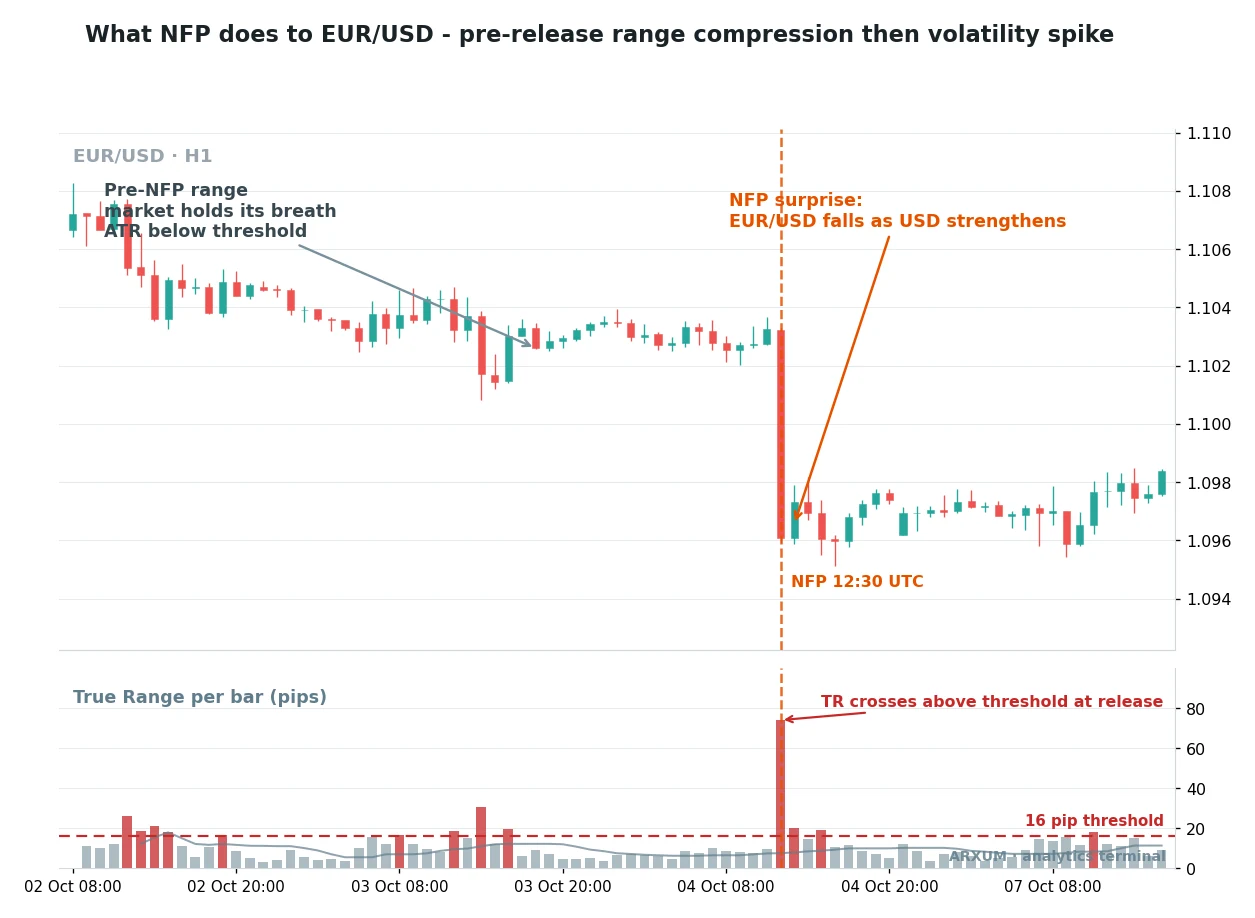
What the picture is telling you:
- The pre-NFP range is the calm. For hours before the number, price drifts in a tight band while the market holds its breath. Volatility drops below normal.
- The release is one violent bar. At 8:30 a.m. Eastern the number hits and price gaps in the direction of the surprise, here down as the dollar rallies.
- True Range measures the damage. True Range is just how far price travelled on a bar. It sits low through the quiet, then spikes far above its usual level the instant the data prints.
- ATR is the smoothed version. ATR, the Average True Range, averages that reading over the last 14 bars so you get one number for “normal” volatility. NFP blows it out for one bar, which is why your stops have to respect it.
The key point: nobody knows which way the bar breaks until the number is out. NFP is a volatility event first and a direction event second.
Why NFP moves forex and gold
The chain is short. Strong jobs mean a hot economy, which means the Fed can keep rates high, which makes the dollar more attractive.
Weak jobs mean the opposite.
| NFP result | US dollar | EUR/USD | Gold (XAU/USD) |
| Much stronger than forecast | Jumps | Falls | Falls |
| Roughly in line | Little move | Chops | Chops |
| Much weaker than forecast | Drops | Rises | Rises |
A few things to hold in your head:
- It is about the surprise, not the number. A payroll of 200,000 jobs is only bullish for the dollar if the market expected less. Price is set to the forecast, so only the gap moves it. This is the same rate-expectation logic behind the carry trade.
- EUR/USD is the cleanest read. For most NFP forex traders the euro is the other side of the dollar, so a strong number pushes EUR/USD down almost tick for tick. For the follow-through, the EUR/USD technical picture often decides whether the move holds.
- USD/JPY moves the same way as the dollar. Strong jobs, dollar up, USD/JPY up. It is the mirror of EUR/USD, not the opposite of it.
- Gold trades against the dollar. A strong number lifts the dollar and rate expectations, and gold, which pays no yield, tends to fall. A weak number does the reverse.
Gold deserves its own picture, because the safe-haven angle can muddy the read.
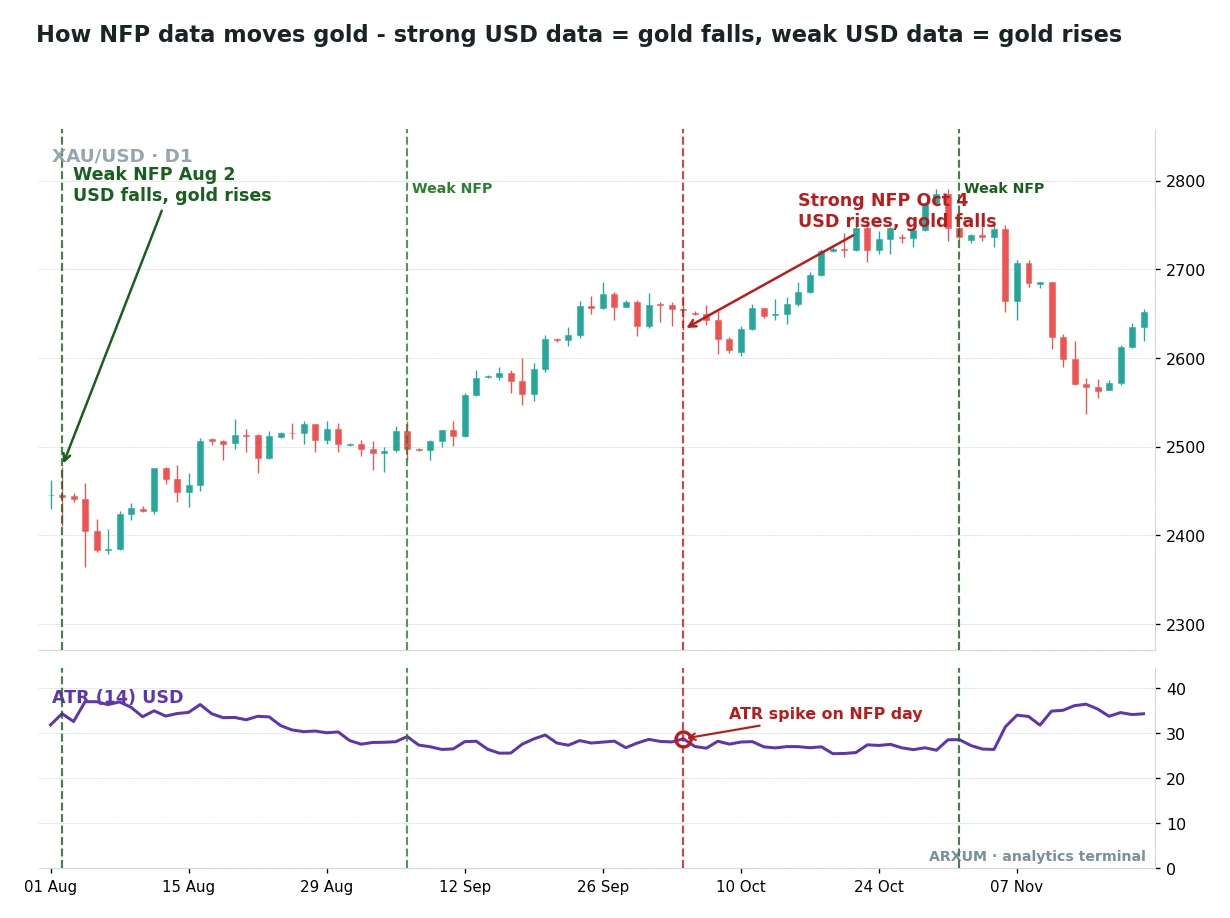
Reading that gold chart:
- Weak data, gold up. Twice on the chart a soft jobs print knocked the dollar and gold rallied into it.
- Strong data, gold down. The red line is a hot number that lifted the dollar and pressured the metal.
- The trend can still win. Gold was in a strong uptrend, so even a bearish NFP was a dip inside a bigger move, not a reversal. Never trade the release against a powerful trend without a reason.
The two NFP trade patterns
You do not need to predict the number. You need to recognise which of two shapes the release takes, and there are only two worth trading.
| Pattern | When it fires | How to trade it |
| Spike and reverse | Data close to forecast | Fade the spike after it stalls |
| Breakout continuation | Big beat or miss | Join the pullback, ride the trend |
Spike and reverse is the more common one:
- The first print sends price flying, then the move runs out of buyers or sellers within minutes and snaps back.
- You wait for the initial candle to stall, then trade the reversal, usually 5 to 15 minutes after the release.
- It works because the first spike is often algorithms and stop-hunting, not a real repricing of the dollar.
Breakout continuation is rarer but pays more:
- When the data massively beats or misses, the move is real and keeps going for hours, sometimes days.
- You let the release bar close, wait for a small pullback, then enter in the direction of the break. This is textbook breakout trading, just triggered by news instead of a chart level.
- The tell is size: if the surprise is far outside the forecast range, treat it as continuation, not a fade.
Here is a continuation on the 4-hour chart, where the whole point is the trend that follows.
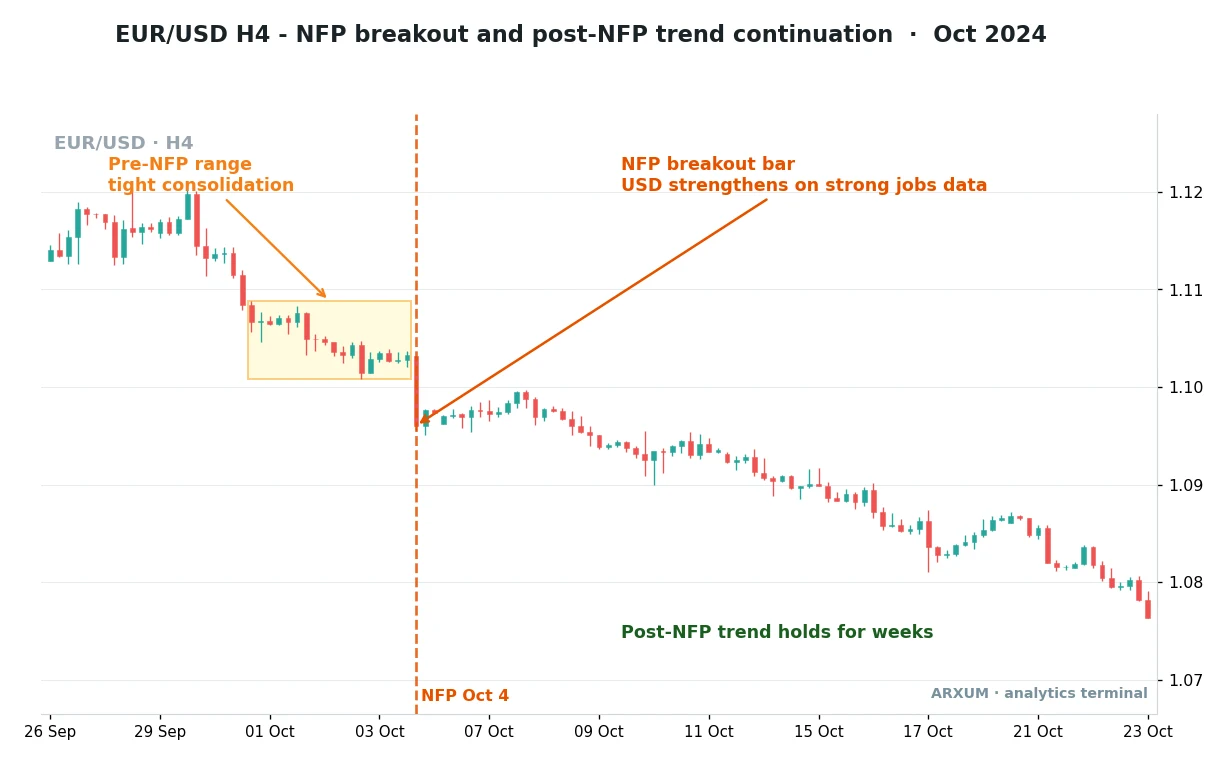
The read on that breakout:
- The range is the coil. Tight consolidation before the release, marked by the box, is stored energy. Traders sit on their hands until the number frees it.
- The break sets the direction. A strong number broke the box downward and the dollar ran.
- Continuation is a gift when it comes. Most releases fade, so a clean break that trends is the higher-reward play, worth waiting for the pullback rather than chasing the first bar.
Risk management for NFP
This is the part that actually keeps your account alive. The release will hunt tight stops and blow through normal position sizes, so you change the rules for one hour.
| Normal trade | NFP trade | Why |
| Full position size | Half or less | Ranges are far wider |
| Tight stop | Wide stop, 3 to 5x ATR | Spikes hunt tight stops |
| Enter any time | Wait 5 to 15 minutes | The first print whipsaws |
| Normal spread | Expect it to widen | Brokers pull liquidity |
The rules that matter, in order:
- Cut your size in half, at least. If you normally risk a set amount, risk less into NFP, because the stop is wider and the slippage is real. Wider stop plus normal size equals an oversized loss.
- Give the stop room. Place it 3 to 5 times the current ATR away, not at your usual tight distance. A stop inside the release range is a donation.
- Never enter in the five minutes before the print. You are guessing a coin flip with a widening spread. Let the number land first.
- Respect the spread. Brokers widen spreads around the release and can slip your fill badly. A market order at 8:30:01 can fill points away from the screen price.
- Check the reward against the risk. Only take the trade if the target is worth the wide stop. The risk-reward ratio has to still make sense once the stop is 3 to 5x ATR, or you skip it.
Rule of thumb: if you are new, do not trade the first bar at all. Watch the release, let it settle, and trade the reaction with the trend once the dust clears.
FOMC and the other events that move price
NFP is the biggest recurring event, but it is not alone. The Federal Open Market Committee, the Fed’s rate-setting body, moves the dollar just as hard, and a handful of others matter too.
FOMC works differently from NFP, because the decision is often known and the tone is the surprise.
| What moves it | Watch for | Typical reaction |
| The rate decision | Hike, hold or cut | Often priced in already |
| The statement | Wording changes | The first sharp move |
| The press conference | The Chair's tone | The bigger move, often here |
How to think about an FOMC trading day:
- The Fed meets eight times a year. The decision drops at 2 p.m. Eastern, with a press conference half an hour later.
- The number is usually expected. Markets price the rate move in advance, so the decision itself often does little.
- The words do the damage. Buy the rumour, sell the news is the classic pattern: price runs into the meeting on expectations, then reverses once the actual tone lands.
- Watch the loaded phrases. Words like “data-dependent”, “transitory” and “restrictive territory” in the statement flip the dollar in seconds, because they hint at the next move.
For breadth, here is where NFP and FOMC sit among the events worth marking on your calendar, ranked by how hard they typically move EUR/USD.
| Event | Frequency | Typical EUR/USD move |
| NFP | Monthly | Large |
| FOMC rate decision | 8 times a year | Large |
| US CPI (inflation) | Monthly | Large |
| GDP | Quarterly | Medium |
| Retail sales | Monthly | Medium |
| PMI surveys | Monthly | Small to medium |
- CPI has grown into NFP’s equal. In an inflation-driven cycle, the inflation print can move the dollar harder than jobs. Treat it with the same care.
- The rest are context. GDP, retail sales and PMI rarely move price like the top three, but a big miss can, and they colour how the market reads the next NFP.
How to read the economic calendar
Trading economic events starts on the economic calendar, a free schedule of upcoming releases. The skill is reading three numbers, not one.
| Column | What it means | Why it matters |
| Forecast (consensus) | What economists expect | The bar price is set to |
| Actual | The released number | Compared against forecast |
| Previous | Last month's figure | Context and revisions |
| Deviation | Actual minus forecast | The size of the move |
The habits that make the calendar useful:
- Trade the deviation, not the actual. A strong number that only matches the forecast does nothing. The gap between actual and forecast is what moves price.
- Filter by impact. Every calendar colour-codes events, usually red for high impact. For news trading, only the red rows matter.
- Watch the revisions. NFP revises last month’s figure alongside the new one. A good headline number with a big downward revision can flip the reaction cold.
- Know your time zone. The calendar shows release times; convert 8:30 a.m. Eastern to your local clock so you are at the screen, not caught out.
How to actually trade an NFP release
Put it together and a clean NFP routine looks like this, top to bottom. No prediction required.
- Mark the date. Find the first Friday of the month on your economic calendar and note the forecast for payrolls.
- Read the pre-NFP range. In the hour before, price coils and volatility drops. Draw the top and bottom of that range as your support and resistance lines.
- Stand aside for the print. Do not enter in the final five minutes. Watch the number land and see which way price breaks the range.
- Pick the pattern. Close to forecast, expect spike-and-reverse and fade the overshoot. Big surprise, expect continuation and wait for the pullback.
- Size down and widen the stop. Half your normal size, a stop 3 to 5x ATR away, and a target that still beats the risk.
- Trade the reaction, not the first bar. Enter 5 to 15 minutes after the release, in the direction the data and the trend agree on.
- Set your indicators. On TradingView, type EUR/USD and add the ATR indicator to size the stop. On MT4 or MT5, use Insert then Indicators then Oscillators to add ATR. The economic calendar lives on any broker platform or a free news site.
Which pattern to expect, at a glance:
| The data comes in | Likely pattern | Your move |
| Close to forecast | Spike and reverse | Fade the overshoot |
| Big beat or miss | Breakout continuation | Join the pullback |
| Mixed with revisions | Chop | Stand aside |
What actually works with NFP
The short version to remember:
- NFP is a volatility event, not a direction bet. You cannot know the number, so you trade the reaction. Smaller size and wider stops beat any forecast.
- The surprise moves price, not the print. Only the gap between actual and forecast matters, which is why the calendar’s deviation is the number to watch.
- Two shapes, two plays. Fade the spike when the data is close to forecast, ride the breakout when it is a shock. Standing aside is the third, and often the smartest, option.
Key terms
- NFP (Non-Farm Payrolls): the monthly US jobs report, released the first Friday at 8:30 a.m. Eastern, the biggest scheduled forex event.
- FOMC: the Federal Open Market Committee, the Fed body that sets interest rates eight times a year.
- Consensus (forecast): the number economists expect. Price is set to it, so only a miss or beat moves the market.
- Deviation: actual minus forecast. The bigger the deviation, the bigger the move.
- ATR (Average True Range): a gauge of normal volatility, used here to size stops around the release.
- Spike and reverse: the first release move overshoots then snaps back, faded after it stalls.
- Breakout continuation: a big surprise drives a move that keeps trending, joined on the pullback.
- Buy the rumour, sell the news: price runs into an expected event, then reverses once the actual result lands.
FAQ
What is NFP trading, in plain terms?
NFP trading means placing trades around the US Non-Farm Payrolls report, the monthly jobs figure released on the first Friday at 8:30 a.m. Eastern. Because it drives expectations for Fed interest rates, it is the single most impactful scheduled event in forex. Traders either fade the first spike once it stalls or ride a breakout when the number surprises badly. You are trading the market's reaction, not predicting the jobs figure itself.
How does NFP move forex?
A strong jobs number suggests a hot economy, which lets the Fed keep rates high and makes the dollar more attractive, so the dollar rises. That pushes EUR/USD down and USD/JPY up. A weak number does the reverse. Only the surprise matters: price is already set to the forecast, so the market moves on the gap between the actual number and what was expected, not the headline figure alone.
What are the two NFP trade patterns?
The first is spike and reverse: when the data is close to forecast, the initial move overshoots and snaps back, so you fade it five to fifteen minutes after the release. The second is breakout continuation: when the number massively beats or misses, the move is real and trends for hours or days, so you join it on the first pullback. Recognising which shape is forming matters more than guessing the number.
How should I manage risk around NFP?
Cut your position size to half or less, widen your stop to three to five times the ATR, and never enter in the final five minutes before the release. Spreads widen and slippage is real, so market orders can fill points away from the screen price. Only take the trade if the reward still beats the wider risk. If you are new, watch the release rather than trading the first bar.
What time is the NFP release?
Non-Farm Payrolls is released on the first Friday of each month at 8:30 a.m. Eastern time. Convert that to your own time zone so you are at the screen when it lands. The hour before is usually a tight, quiet range as the market waits, and the release itself is a single violent bar that sets the tone for the session.
Does NFP move gold?
Yes. Gold trades against the dollar, so a strong jobs number that lifts the dollar and rate expectations tends to pressure gold, while a weak number lifts it. The catch is the bigger trend: when gold is in a powerful uptrend, a bearish NFP is often just a dip inside the move rather than a reversal. Read the release in the context of the trend, not on its own.
How is FOMC trading different from NFP?
With NFP the number is unknown, so the figure is the surprise. With the FOMC rate decision the number is usually priced in, so the tone is the surprise. The statement wording and the Chair's press conference half an hour later often move the dollar more than the decision itself. Watch for loaded phrases like "data-dependent" or "restrictive", and expect a buy-the-rumour, sell-the-news reversal.
How do I read an economic calendar for news trading?
Focus on three numbers: the forecast (consensus), the actual release, and the previous figure. The market moves on the deviation, which is actual minus forecast, so a strong number that only matches expectations does little. Filter the calendar by impact and trade only the high-impact rows, usually flagged in red. Watch for revisions to last month's data too, since a big revision can flip the reaction to an otherwise good number.
🌍 Our recommended brokers


Reader Reviews
Be the first to review this — tell other traders what actually helped, or where it fell short.
Leave a Review

Forex Analyst & Senior Trader
Former FX desk trader with 8 years in institutional forex. Works in multi-timeframe analysis and order flow, turning desk experience into systematic, testable rules across forex and metals.