
What the options greeks actually measure
An option price is not one moving part. It is several risks bundled together, and each greek isolates one of them.
Think of the greeks as the dials on a dashboard, each answering a different “what happens if” about your option.
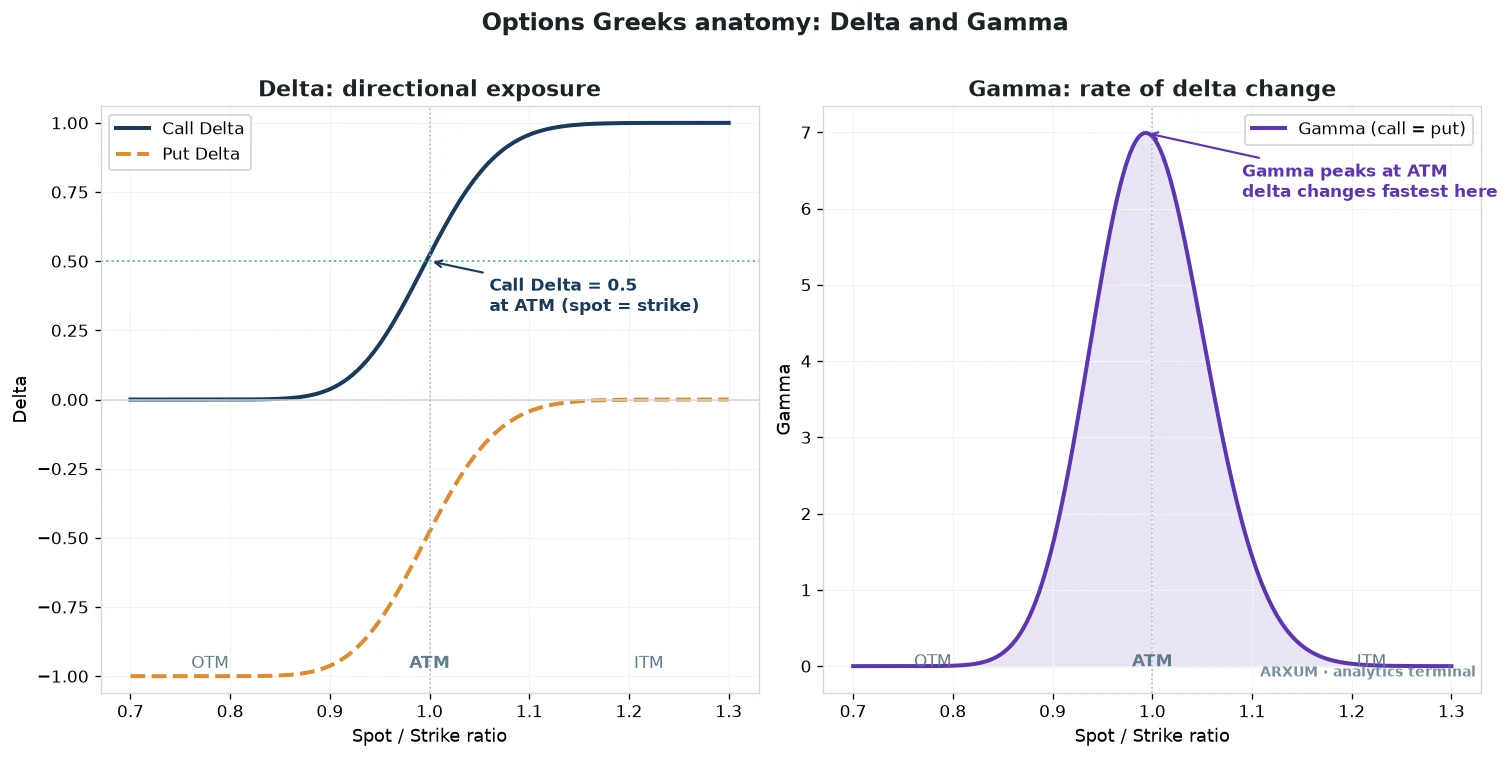
Read the anatomy chart above from the left panel. As the underlying moves from out of the money on the left to in the money on the right, the call’s delta sweeps from near zero up to near one, crossing 0.5 right at the money.
The right panel is gamma, and it peaks in the same spot. That is the whole relationship in one picture: delta is the slope, gamma is how sharply that slope bends.
Here is the full set before we take each one in turn.
| Greek | What it measures | Plain read |
|---|---|---|
| Delta | Price change per 1 point in the underlying | Your directional exposure, and rough odds of finishing in the money |
| Gamma | How fast delta itself changes | How quickly your exposure grows or shrinks as price moves |
| Theta | Value lost per day from time passing | The daily rent you pay to hold the option |
| Vega | Price change per 1% shift in expected volatility | Your exposure to the market getting more or less nervous |
| Rho | Price change per 1% shift in interest rates | The slow one, safe to ignore on short-dated trades |
A quick vocabulary note, because these three abbreviations run through the whole guide:
- ITM (in the money): the option already has real value, a call below spot or a put above it.
- ATM (at the money): the strike sits right at the current price. This is where gamma and time decay are strongest.
- OTM (out of the money): the option is all hope and no intrinsic value yet. Cheap, and mostly decay.
What is delta in options
Delta is the greek you learn first, because it answers the question every trader actually cares about: if the market moves, how much do I make.
A call delta of 0.40 means the call gains about 0.40 of a point for every 1 point the underlying rises. A put delta of -0.40 means the put gains 0.40 when the underlying falls.
A point here just means one full unit of the underlying’s price, one dollar on gold or Bitcoin, and one full step in the quoted rate on EUR/USD.
So a 0.40 delta gold call gains roughly $0.40 for every $1 gold rises, per unit the contract controls.
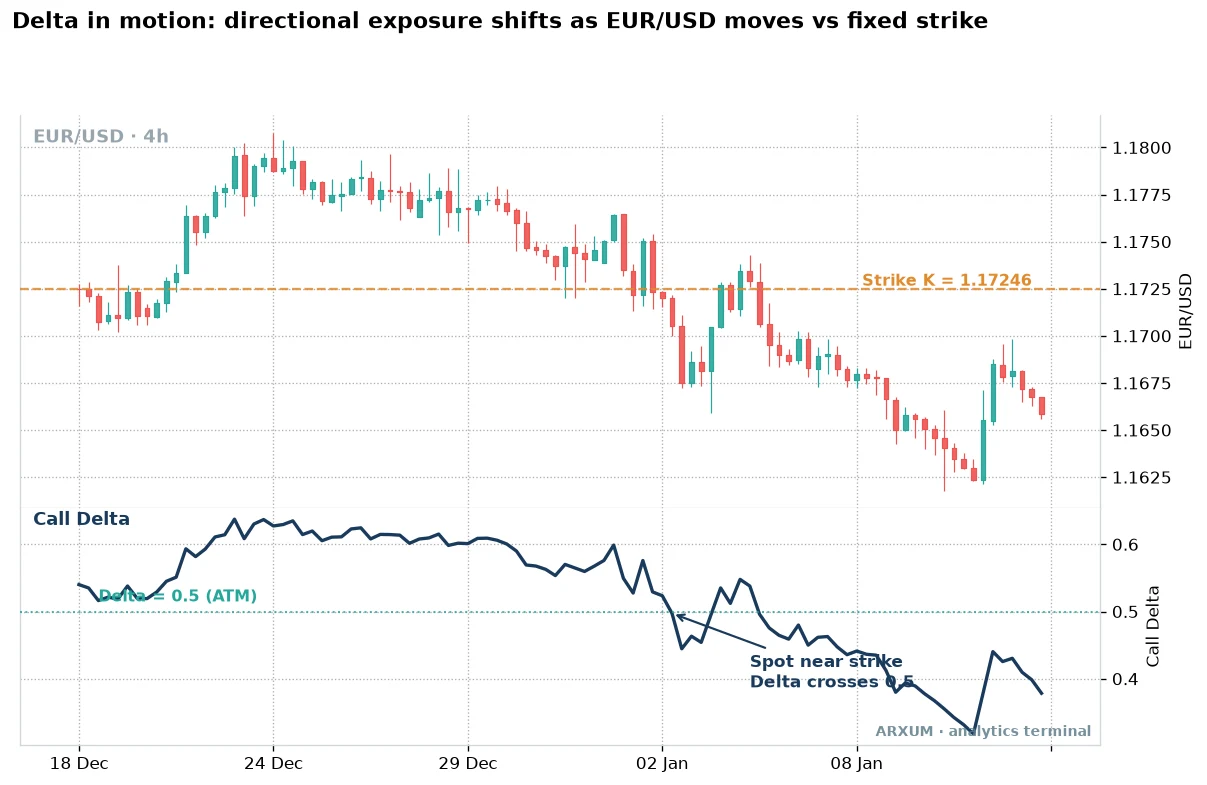
Watch the EUR/USD panel. The strike, marked K on both charts, is the fixed price the option is measured against.
The strike stays put, but delta does not, because delta depends on where spot sits relative to that strike.
When the pair traded well above the strike, the call was in the money and its delta ran above 0.6, so it tracked spot closely. As price fell back through the strike, delta slid toward 0.4, and the call started reacting less to each move down.
How delta behaves:
- Calls run 0 to 1, puts run 0 to -1. Deep in the money approaches the extreme, deep out of the money approaches zero.
- At the money, delta is roughly 0.5 for a call and -0.5 for a put. The anatomy chart shows this crossing point.
- Delta doubles as a probability read. A 0.30 delta call finishes in the money about 30% of the time, loosely speaking.
- Delta is not fixed. It drifts every time spot moves, which is exactly what gamma measures.
The one-line read: delta is your live share-equivalent exposure, and it changes as the market moves.
How you actually use delta:
| Role | How you use it | Best read |
|---|---|---|
| Directional exposure | Pick a higher delta to track the underlying more closely | 0.60 to 0.80 delta calls on EUR/USD for a trend view |
| Odds gauge | Read delta as rough probability of finishing in the money | 0.30 delta on gold weeklies for a lower-cost punt |
| Position sizing | Match total delta across contracts to the risk you want | See the sizing section below, on any instrument |
| Hedging | Offset spot or futures exposure with opposite delta | Delta-neutral books on BTC, rebalanced as gamma bites |
For the hedging use, delta is the whole game. A trader holding long spot can sell calls or buy puts until the book’s net delta sits near zero, which is the core idea behind a basic hedge.
What is gamma in options
Gamma is delta’s accelerator. It tells you how much delta will change for the next 1 point move in the underlying.
Low gamma means your delta is stable and your exposure drifts slowly. High gamma means delta can swing fast, so your position can flip from tame to aggressive in a hurry.
Look back at the right panel of the anatomy chart. Gamma is a hill that peaks at the money and falls away on both sides.
How gamma behaves:
- Gamma peaks at the money, so an at-the-money option has the twitchiest delta of all.
- Gamma is highest near expiry. A short-dated at-the-money option can see its delta lurch from 0.4 to 0.7 on one candle.
- Deep in or out of the money options have low gamma. Their delta is already pinned near 1 or near 0, so it barely moves.
- Long options have positive gamma, which helps you. Short options have negative gamma, which works against you as price runs.
The catch, stated plainly: gamma is why a small move against a short at-the-money option near expiry hurts far more than the option’s starting delta suggested.
| Role | How you use it | Best read |
|---|---|---|
| Speed of exposure | Expect delta to move fast when gamma is high | ATM options inside the last two weeks to expiry |
| Risk flag on shorts | Respect negative gamma on sold options near the money | Short BTC weeklies, where price can gap through a strike |
| Rebalance trigger | Re-hedge a delta-neutral book more often when gamma is high | Gold options into a data release |
| Calm zone | Lean on deep ITM options when you want a steady delta | Longer-dated in-the-money calls on EUR/USD |
What is theta in options
Theta is the cost of waiting. Every day that passes, an option loses a little value even if the underlying does not move, and theta is that daily drip stated as a number.
Theta is almost always negative for the buyer. You paid for time, and time is running out on you.
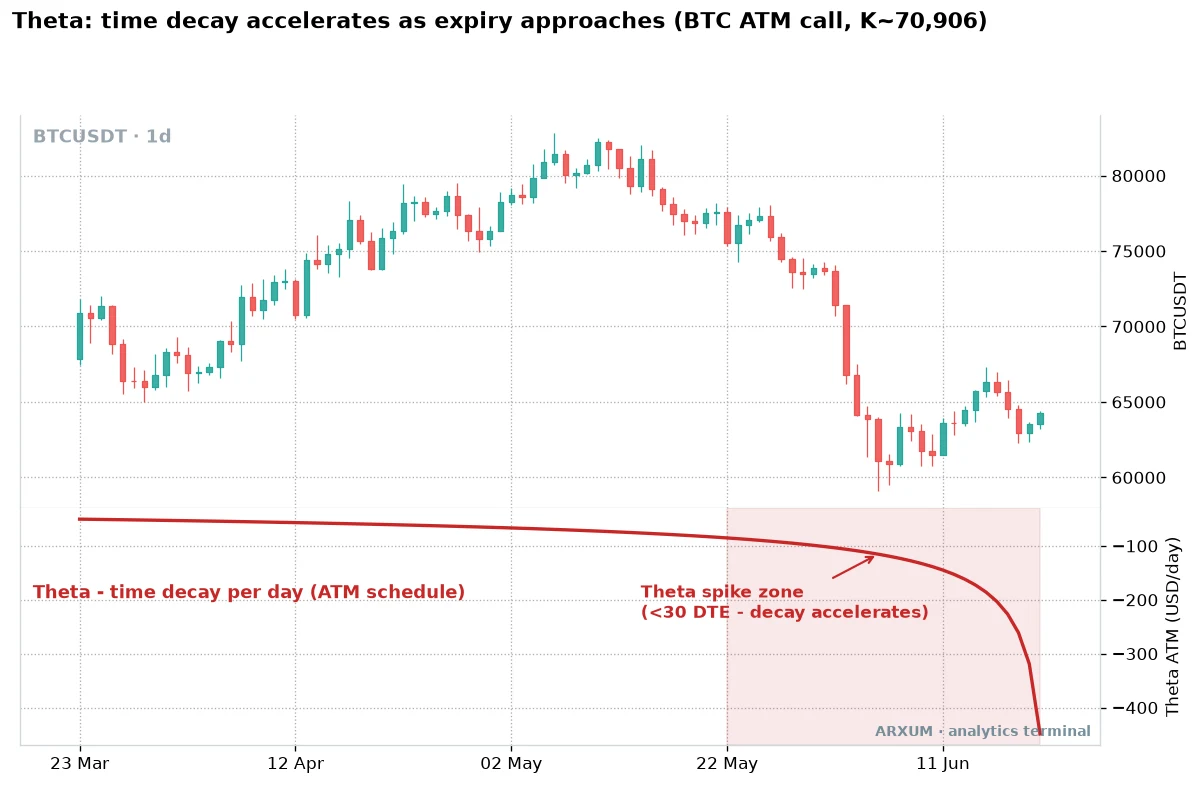
The Bitcoin panel shows the single most important fact about theta. Decay is not steady.
It is slow when expiry is far away, and it speeds up as expiry closes in.
The shaded band marks the last 30 days to expiry, the point traders call DTE, or days to expiry. Inside that zone the daily bleed on an at-the-money option turns steep, which is why sellers love this window and buyers dread it.
The vertical axis is stated in dollars per day, so this reads as real money. Far from expiry the call loses a small amount each day, but near the close that at-the-money BTC call bleeds a few hundred dollars a day just from time passing.
How theta behaves:
- Theta is worst for at-the-money options, and it accelerates as expiry approaches, as the spike zone shows.
- Time decay is not linear. A 90-day option loses value slowly, then the loss curve steepens sharply inside the final month.
- Out-of-the-money options decay to zero if the move never comes. That is the risk with cheap lottery tickets.
- Theta is the seller’s income. Sellers of options collect what buyers lose to time, which is the engine behind income strategies.
The one-line read: if you buy options you are fighting theta every day, so you need the move to come soon.
| Role | How you use it | Best read |
|---|---|---|
| Cost of holding | Budget the daily bleed before you buy | Avoid buying ATM options with under 30 DTE unless you expect a fast move |
| Income engine | Sell time to collect theta as the option decays | Selling OTM gold or EUR/USD options inside 30 DTE |
| Expiry choice | Buy more time to soften the daily drip | 60 to 90 DTE calls on BTC for a slower-burning trend view |
| Structure builder | Combine long and short strikes to run theta positive | Range-bound income trades, see the condor below |
Theta is the reason the iron condor exists. That structure sells options to run theta positive, so time decay works for you instead of against you, as long as price stays inside a range.
What is vega in options
Vega measures your exposure to a change in expected volatility, meaning how nervous the market thinks the underlying will be. Expected volatility is itself quoted as a percentage, so a 1 percent shift means the estimate moving from, say, 20 percent to 21 percent.
When traders expect bigger swings that number rises, option prices rise with it, and vega tells you how much.
This one trips people up because it has nothing to do with the underlying moving right now. Vega moves your option even when spot sits still, purely on a shift in mood.
Traders who hunt vega options, meaning positions built to trade volatility itself rather than direction, lean on long-dated at-the-money strikes for exactly this reason.
How vega behaves:
- Vega is highest for at-the-money options with plenty of time left. Long-dated at-the-money options have the biggest vega.
- Buyers are long vega. If expected volatility jumps, your option gains value even before spot moves.
- Sellers are short vega. A volatility spike works against a short option, on top of any directional loss.
- Short-dated options have small vega. Close to expiry, mood matters less than the clock and the strike.
The one-line read: vega is why an option can lose money after you were right on direction, if volatility collapsed while you held it.
| Role | How you use it | Best read |
|---|---|---|
| Volatility exposure | Buy vega when you expect swings to grow | Longer-dated ATM calls on BTC before a known catalyst |
| Mood filter | Avoid buying options when expected volatility is already rich | After a spike on gold, when premiums are bloated |
| Seller's edge | Sell vega when expected volatility looks too high to last | EUR/USD options once a data event has passed |
| Event trade | Weigh vega against theta around scheduled news | Any instrument into a central bank decision |
There is a classic trap here worth naming. Buy an at-the-money option right before a big scheduled event, and expected volatility is already high, so premium is rich.
The event resolves, volatility drops, and vega can wipe out your gain even if spot moved your way.
Rho, and why it usually waits
Rho measures how an option’s price responds to a shift in interest rates. It is the greek most traders can safely park.
For short-dated retail trades in Forex, crypto or gold options, rho barely registers against the daily swings from delta, theta and vega.
- Rho matters most on long-dated options, the ones with many months or years to run.
- Calls have positive rho, puts have negative rho, because rates change the cost of carrying the position.
- On weekly and monthly options, rho is a rounding error next to the other four greeks.
- Keep it on the dashboard, but do not size a short-term trade around it.
How the greeks interact, and which one matters most
No greek acts alone. A real option position lives and dies on how they pull against each other.
The tension every buyer faces is simple. You want the move (delta and gamma) to arrive before time (theta) eats your premium, and you want expected volatility (vega) to hold up while you wait.
| Your position | Greek that helps | Greek that hurts | What to watch |
|---|---|---|---|
| Long call or put | Delta, gamma, vega | Theta | The move must come before decay bites |
| Short call or put | Theta | Gamma, vega | A fast move or volatility spike is the danger |
| Long straddle | Gamma, vega | Theta | Needs a big move or a volatility jump, soon |
| Iron condor | Theta | Gamma, vega | Wants price quiet and inside the range |
So which greek matters most depends entirely on what you are doing.
- If you buy directional options, delta and theta rule. You need enough delta to profit and enough time that theta does not kill you first.
- If you sell options for income, theta and gamma rule. Theta is your paycheck, and gamma is the risk that a sharp move erases weeks of it.
- If you trade events, vega rules. The volatility shift around news can matter more than the direction.
- Rho only rules on very long-dated positions, which most active traders never touch.
Using delta for position sizing
Delta is not just a signal. It is the cleanest way to size an options position, because it converts the option back into plain underlying exposure.
One standard option contract on a delta of 0.50 behaves like half a contract of the underlying. Stack the deltas across your options and you get your true directional exposure, which is what you actually risk.
Two words to define first. Notional is the full face value the contract controls, and on Forex a standard lot is 100,000 units of the base currency.
Here is the logic on a EUR/USD option, worked from the exposure down.
- Say one option covers 100,000 of EUR/USD notional, one standard lot of exposure at full delta.
- A call with a 0.30 delta gives you 100,000 times 0.30, so 30,000 of effective EUR exposure, about 0.30 of a lot.
- Want 60,000 of exposure instead? Two of those 0.30 delta calls give 100,000 times 0.30 times 2, which is 60,000.
- As spot moves and delta drifts, your real exposure drifts with it, so recheck the total delta rather than the contract count.
To feel it in dollars, work the same idea on a gold call. These figures are illustrative, so read the shape, not the exact number.
- You buy one at-the-money gold call with a 0.50 delta, and the contract controls 100 units of gold.
- Gold rises $20. Delta is per unit, so the option gains about $20 times 0.50, which is $10 per unit.
- Across 100 units that is roughly $1,000 on the move, or $20 times 0.50 times 100.
- If gold instead fell $20, the same math runs the other way, so delta sizes both your upside and your risk.
The takeaway is that contracts lie and delta tells the truth. Two cheap out-of-the-money options can carry less real exposure than one at-the-money option, because the greek, not the count, sets your risk.
Size to a delta budget the same way you would size a spot trade to a stop, matched to your risk and reward plan.
Where to see the greeks
You do not compute these by hand. Every real options platform prints the greeks live on the option chain, the list of every available strike and expiry, next to each strike.
| Market | Where the greeks show | Note |
|---|---|---|
| Stock and index options | The option chain in a broker platform | Delta, gamma, theta, vega listed per strike |
| Crypto options | A crypto options exchange chain | Same greeks, often on BTC and ETH weeklies and quarterlies |
| Forex and gold options | A broker offering FX and metal options | Check the contract covers the notional you expect |
Two honest notes before you go hunting for a strike:
- The greeks on the chain are a snapshot. They shift the moment spot, time or expected volatility changes, so treat them as a live reading, not a fixed label.
- Crypto options behave the same way as stock options on the greeks, but the underlying can gap harder, so gamma and vega risk on short-dated BTC options is real. The mechanics carry over from crypto derivatives you may already trade.
What works: the three things to remember
If you keep only three points from this guide, keep these.
- Delta is exposure and odds in one number. It tells you how much you make per point and roughly how likely the option is to pay, and it changes as price moves.
- Theta is the clock you are fighting. Buyers lose to time every day, and the loss accelerates inside the last month, so buy enough time or expect a fast move.
- The greeks trade off against each other. Delta and gamma want the move, theta wants patience, vega wants the mood to hold. Your strategy decides which one rules.
Learn the greeks and you understand the gamble instead of just taking it. The risk is still real, but the profile is now something you can read in advance rather than hope about.
That is the whole point of the dashboard.
Start with delta and theta, add gamma and vega once those feel natural, and read the greeks off the chain the way you would read any options position before you commit.
FAQ
What is delta in options, in plain terms?
How does delta affect an option's price?
What is theta in options, and what does it mean for traders?
What is gamma in options?
What is vega in options?
Which options greek matters most?
Are the greeks the same for calls and puts?
Do the greeks work the same on Bitcoin and gold options as on stocks?
Where do I see the greeks for an option?
What do the key options greek terms mean?
Real-time trade setups with entry, stop loss and take profit. Daily market analysis. No subscription, no complicated theory.
🌍 Our recommended brokers


Reader Reviews
Be the first to review this — tell other traders what actually helped, or where it fell short.
Leave a Review

Forex Analyst & Senior Trader
Former FX desk trader with 8 years in institutional forex. Works in multi-timeframe analysis and order flow, turning desk experience into systematic, testable rules across forex and metals.