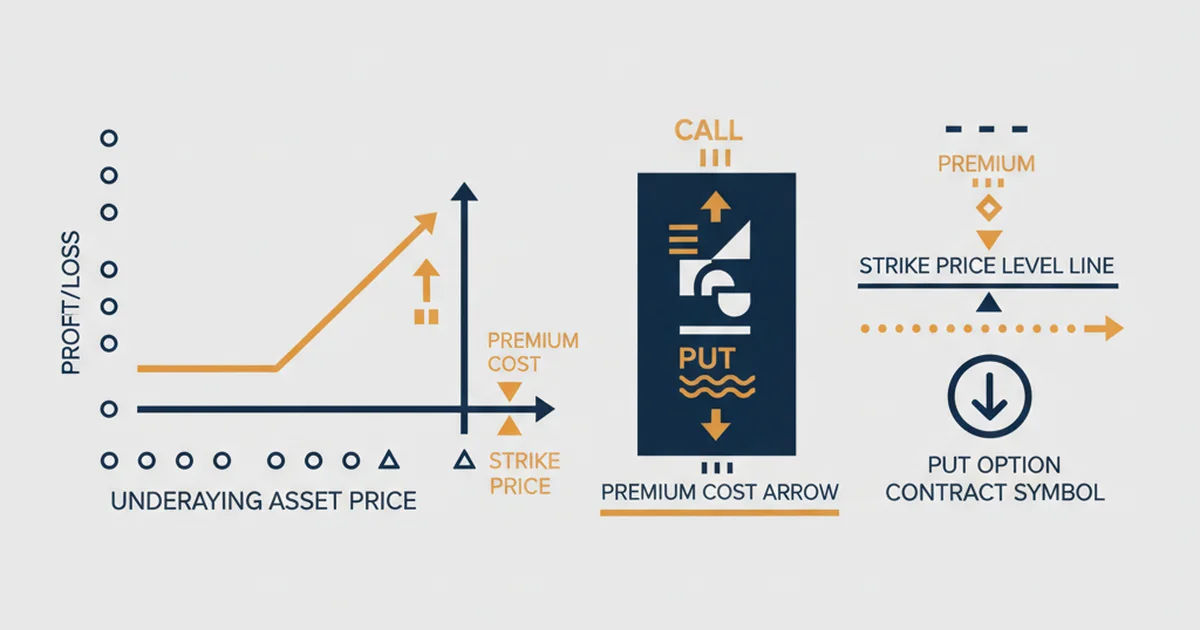

Why Traders Add Options to Their Toolkit
Most people start with spot trading or CFDs. Options come later, usually after one painful experience of getting stopped out during a spike that immediately reversed.
That’s exactly what happened to me. I was long BTC/USDT on Binance Futures in Q4 2023. Held through a 12% drawdown, got liquidated, then watched price recover to my original target within 48 hours. A long call option would have kept me in the trade. My maximum loss would have been the premium (defined before entry, no forced exit).
That trade made me take options seriously. They solve a specific problem that spot and futures trading can’t: defined downside, uncapped upside, zero liquidation risk on the buy side.
The catch is cost. Options aren’t free. You pay for implied volatility, and if you don’t understand that number, options will drain your account in a different way than margin calls, slowly through premium decay on positions that were right about direction but wrong about timing.
This guide covers the mechanics, the instruments available, and the strategies I’ve actually tested with real capital.
How Options Work: Core Mechanics
An option contract gives you a right, not an obligation. Two types:
- Call option: right to buy the asset at the strike price before expiry
- Put option: right to sell the asset at the strike price before expiry
Key terms before anything else:
- Strike price: the price at which you can exercise the option. Buy a $70,000 BTC call when BTC is at $63,000. You’re betting it breaks $70k before expiry.
- Expiry date: the deadline. After this point, the option expires worthless or gets exercised. Most retail traders close positions before expiry.
- Premium: what you pay upfront. This is your maximum loss on any long options trade.
- In the money (ITM): the option has intrinsic value. A $63,000 BTC call is ITM when BTC is trading at $67,000.
- Out of the money (OTM): no intrinsic value yet. Pure time value. A $70,000 BTC call when BTC is at $63,000.
- Implied volatility (IV): the market’s expectation of future price movement, baked into the premium. High IV means expensive options. This is the variable that catches most new traders off guard.
An OTM call option is pure time value. Every day that passes without price moving toward your strike, that option loses value. This decay is called theta — and it works relentlessly against buyers, in favor of sellers.
Understanding theta before your first trade isn’t optional. Plenty of traders have bought calls on a stock or coin that moved in the right direction, then watched their option lose value anyway because the move was too slow.
Where to Trade Options: Crypto vs Forex vs Indices
Options exist across multiple markets. The mechanics are the same; liquidity and structure differ sharply.
Crypto Options
The most accessible entry point for retail traders. Binance offers BTC and ETH options with daily, weekly, and monthly expiries. Deribit is the institutional standard: deeper liquidity, more strikes, European-style settlement, and the DVOL index (a BTC-specific implied volatility gauge worth tracking before any trade).
I trade BTC options primarily on Binance for shorter momentum plays. Familiar platform, flexible contract sizes from 0.001 BTC, and the ability to track the underlying spot price in the same interface.
One thing to expect: crypto options carry extremely high implied volatility compared to forex. A 30-day ATM BTC call can cost 15-25% of the notional in premium. That’s expensive. You need a significant move to profit as a buyer, which is why most advanced crypto options traders eventually shift toward selling premium or using spreads to reduce net cost.
Forex Options
Vanilla FX options trade through platforms like Saxo Bank and Interactive Brokers for retail access. CME Group lists standardized EUR/USD, GBP/USD, and JPY options if you want exchange-listed contracts with central clearing.
Most CFD retail brokers don’t offer true vanilla FX options. They may offer barrier or digital options products in certain jurisdictions, but these are structurally different and carry higher risk. Confirm exactly what product you’re trading before entering.
Index Options via CFD
Options on the Nasdaq 100, S&P 500, and DAX are available through CFD providers to European and international retail traders. They behave similarly to exchange-listed index options but settle as CFDs. The advantage: you can take a directional view on an index without the full margin requirements of index futures contracts.
Three Core Options Strategies for New Traders
Skip the complex structures (straddles, iron condors, ratio spreads) until you’ve logged real time with the basics. Three directional plays cover 90% of what beginners need.
Long Call: Betting on an Upside Move
Buy a call when you expect a significant price increase before expiry.
Tested example: BTC at $63,000. Bought a 10-day $70,000 call for $420 premium before the April 2024 halving. BTC hit $72,400. Intrinsic value at expiry: $2,400. Minus the $420 premium: $1,980 profit on a $420 defined risk, a 471% return on premium.
Ran this three times around the 2024 halving event. Won two, lost one. The loss was the full $420 premium on an OTM call that expired below the strike. No liquidation, no margin call, no interest cost from holding futures overnight.
The risk is simple: if BTC stays below $70,000, the $420 is gone. That’s the entire downside. It doesn’t get bigger.
Long Put: Betting on a Downside Move
The mirror of a long call. Buy the right to sell at the strike price when you expect a decline.
Long puts are useful for hedging spot positions without liquidating them. If you hold ETH and expect a short-term correction, buying a put option insures your position for the cost of the premium. The ETH stays in your wallet. The put covers the downside to the strike price.
For directional bearish bets without a hedge, long puts work on any market where options are available.
Covered Call: Generating Income on a Sideways Position
If you hold BTC spot and price is grinding sideways, sell a call option above the current price and collect the premium as income. If price stays below the strike, you pocket the premium. If price breaks above the strike, your BTC gets called away at that price. You’ve effectively sold into strength.
This is the one strategy where you’re the seller, not the buyer. As a seller, you receive premium upfront. The tradeoff: if BTC rips 40%, your gains are capped at the strike. This strategy works best in ranging conditions with low IV, not in breakout environments.
Options vs CFDs vs Futures
Most traders at the beginner level hit CFDs first. Here’s how the products compare at a structural level:
| Options (buyer) | CFDs | Futures | |
|---|---|---|---|
| Maximum loss | Premium only | Margin + unlimited | Margin + unlimited |
| Leverage type | Built into premium cost | Explicit multiplier | Built into contract |
| Expiry | Fixed date | None (open-ended) | Quarterly rollover |
| Liquidation risk | None (buyers) | Yes | Yes |
| Complexity | High | Low | Medium |
CFDs are simpler to execute and better suited for active swing and intraday trading. Options give buyers a structural advantage (defined risk) that matters most in volatile conditions where stop placement is difficult. They’re not better or worse than CFDs. They’re a different tool.
If you’re still building your foundation across different trading approaches, the trading strategies guide gives a broader overview of where each instrument fits.
Reading an Options Chain
An options chain is the table showing all available strikes and expiries for a given asset. It looks overwhelming the first time. It’s a price list.
Each row is a strike price. Columns you care about:
- Bid/Ask: what you pay to buy (ask) or receive to sell (bid). The spread is friction cost. For liquid BTC options on Deribit, the bid/ask spread is tighter than on Binance for the same strike.
- Open interest: total contracts outstanding at that strike. Higher open interest means more liquidity and tighter spreads.
- Implied volatility (IV): the volatility priced into that specific strike. OTM options typically carry higher IV than ATM options, creating the “volatility smile” you’ll see on any options chain.
- Delta: how much the option price changes for a $1 move in the underlying. ATM options have delta near 0.5. Deep ITM approaches 1.0. Far OTM can be 0.05 or lower.
For beginners: focus on strikes with delta between 0.35 and 0.65, and expiries at least 2 weeks out. Far OTM options are lottery tickets with poor risk-to-reward. Short-dated OTM options suffer the fastest theta decay.
Risk Management Specific to Options
Long options have defined maximum loss. This advantage disappears if you size positions incorrectly.
Rules I follow:
- Cap single options positions at 3-5% of active trading capital. The defined loss feature means nothing if one bad position represents 20% of your account.
- Size by premium cost, not contract count. If a premium costs 2% of your account, that’s your risk, not the notional value of the underlying.
- Close or roll positions 3-5 days before expiry. Theta decay accelerates sharply in the final week. Don’t hold OTM options into expiry hoping for a late move.
- Track implied volatility before buying. On crypto, check Deribit’s DVOL index. For equity indices, the VIX equivalent. Buying options when IV is below its 30-day average gives you cheaper entry prices.
One counterintuitive finding: IV often spikes sharply just before major events (halvings, Fed meetings, major data releases), then collapses after the event passes. If you buy options at peak IV, you can be right about direction and still lose money because the premium deflates faster than the move rewards you. Buy before the IV spike, not during it.
This lesson connects directly to broader trading psychology: patience on entry timing matters as much for options as it does for any other instrument. The trading psychology guide covers the behavioral side of managing defined-risk positions.
Common Mistakes Options Beginners Make
Chasing far OTM options for the payout story. A $90,000 BTC call when BTC is at $63,000 sounds cheap at $80 premium. It’s cheap because the probability of expiring in the money is around 3-5%. The expected value is negative by design.
Ignoring theta. Long options lose value every day even when price holds flat. Traders used to spot or CFD positions (where “doing nothing” has no daily cost) consistently underestimate how fast this eats into OTM positions.
Overleveraging through position sizing. The defined loss feature doesn’t mean you should run 15-20% of your account in options simultaneously. Three consecutive OTM trades losing their full premium erodes capital efficiently, just more slowly than a margin call.
Confusing product types. Binary options (fixed payout on yes/no outcome) are structurally different from vanilla options and are banned in the EU and UK as retail products. Barrier options have knockout conditions that can close positions prematurely. Always confirm exactly which product your broker is offering.
Not accounting for the bid/ask spread. On illiquid strikes, the spread can represent 10-20% of the premium cost. That’s a tax on every trade. Stick to the most liquid strikes and expiries, especially when learning.
For traders looking to access options through funded accounts rather than using personal capital, some prop firms now support options strategies. The prop trading options guide covers which firms allow this and what their specific rules are.
Getting Started: Practical Steps
Paper trade before committing real premium. Binance and TradingView offer simulated environments where you can practice reading chains and managing positions without cost.
When you move to real capital:
- Start with long calls on high-conviction directional setups. If your analysis says BTC is breaking out, try a 2-week ATM call instead of a futures long. Compare the mechanics to what you’d experience in spot or CFDs.
- Check IV before buying. If DVOL is above its 30-day average, premiums are elevated. Consider waiting or moving closer to the money to reduce premium cost.
- Set a monthly options budget. 10-15% of active trading capital is a reasonable ceiling. Options are a complement to your trading, not a replacement for a systematic approach.
- Close before expiry. Exit or roll positions when you’re 3-5 days from expiry. Let time work for you in your exit, not against you.
Options aren’t a shortcut to outsized returns. They’re a tool for specific situations: holding through volatility without liquidation risk, hedging spot positions, and expressing high-conviction directional views with defined capital at risk.
FAQ
Is options trading legal for retail traders?
Can you lose more than your premium as an options buyer?
How much money do I need to start options trading?
What is implied volatility and why does it affect my options cost?
Are options better than CFDs for crypto trading?
What's the difference between American and European-style options?
Can you trade options through a prop firm?
Real-time trade setups with entry, stop loss and take profit. Daily market analysis. No subscription, no complicated theory.
🌍 Our recommended brokers


Reader Reviews
The DVOL explanation was the single most useful part of this article for me. I had been buying BTC options with no reference to whether volatility was cheap or expensive - without that context, you are essentially pricing blindly. Checking DVOL against its 30-day average before entry cut my average premium cost on three consecutive setups by a meaningful amount.
I ran almost the same setup described in the long call section - bought BTC calls a week before the April 2024 halving. Went with a 10-day $68,000 strike when BTC was at $63,500, paid $380 premium. BTC reached $71,200 and I closed for $2,740 on a $380 risk - roughly 620% return on premium. What I had not tracked before was how fast OTM calls lose value when price moves sideways for a few days before a big move. I had three setups where I was right on direction but bled premium while waiting. The theta section here explains exactly why that kept happening. Switching to 14-21 day expiries instead of weekly options gave the timing buffer the setups needed. My average monthly return from options around high-IV events ran at +7.4% over the last quarter.
The comparison table between options, CFDs, and futures is the clearest breakdown I have found. I spent about two years using only CFDs on forex before trying options. The liquidation risk difference is real - I got stopped out of a EUR/USD CFD during a spike three times in one quarter, each time watching price return to my original level within an hour. A long put with defined loss would have kept me in all three setups. Switching to options for swing positions while keeping CFDs for intraday improved my monthly returns from roughly flat to averaging 6.8% over the last quarter.
Three months of paper trading BTC options on Binance before putting real capital in was exactly the right preparation. The article recommendation to practice chains and position management without cost first is solid advice for anyone coming from CFDs or spot. The product type confusion section alone saved me from opening a binary options account that was being marketed as vanilla options.
The position sizing section reframed how I think about risk. I had been sizing options by contract count, not by premium cost as a percentage of account. Going back through my last 12 months of trades, I found individual options positions ranging from 2% to 34% of account with no consistency. The 3-5% cap per position is something I had read before but never seen explained in terms of what consecutive losses actually cost in practice. My last three consecutive OTM losses at 3% each cost 9% of account - painful but recoverable. At my old sizing, the same three losses would have been 18-22% drawdown, and I have had quarters like that. Since applying the premium-based sizing rule and capping total options exposure at 12% of active capital, I finished last month at +7.8% net. Writing calls on my ETH spot during the sideways period in March added 4.8% income without touching the underlying.
The article changed how I think about time as a cost in trading. I had three EUR/USD FX options positions that moved in the right direction but still lost money - because I held them through the final week before expiry and theta accelerated against me. Closing positions 3-5 days before expiry is now a hard rule in my process. The two months with that discipline: up 6.2% and 8.1% net on options premium. The bid/ask spread warning for illiquid strikes was a detail I had not seen covered clearly elsewhere.
The far OTM options section describes what I spent about eight months doing. I had a mental model that $80-120 premium BTC calls were low risk because my maximum loss was defined. What I missed was that a 3-5% probability of finishing in the money means the expected value is negative regardless of direction. Shifting to ATM calls with delta between 0.4-0.6 as described here took my premium win rate from roughly 1 in 8 to 3 in 7 on similar directional setups. Running +7.1% on options over the last two months.
The index options section was the part I came for and it delivered. I had been looking for a way to hedge my Nasdaq 100 CFD long positions during earnings season without closing the position entirely. The CFD-settled put option structure described here works as explained - I bought a DAX put in February before a volatile ECB week, held my long equity CFD through it, and the put covered roughly 80% of the drawdown. Premium cost was about 1.2% of the notional - a reasonable hedge cost for a five-day event window. What I did not find here was more detail on selecting strike and expiry specifically for hedging rather than directional trades. Still the most practical resource I found on this topic. My CFD and options combination finished the quarter at +8.3% net.
Leave a Review

Momentum Trader & Technical Analyst
Trades momentum across crypto and forex since 2019, built around RSI, MACD, and volume. Turns discretionary setups into rule-based, systematic entries and validates them on data before they go live.