
Most traders lose money in the first year. That is not a hot take; it is what the data consistently shows. The reason is rarely bad luck. It is the absence of a defined trading strategy.
Traders hop between setups, change their rules mid-trade, exit early on winners while holding losers too long. After 8 years on an FX trading desk and five more trading independently, I have watched this pattern repeat across hundreds of retail accounts. The traders who survive share one trait: they follow a system, not a feeling.
This guide breaks down the main strategy types, what each one actually requires to execute, and how to find one that fits your reality, not the version sold in $997 courses.
Why most strategies fail before they start
The problem is not the strategy. It is the mismatch between strategy and trader.
A scalper who needs 6 hours of screen time per day will fail with a full-time job. A swing trader who cannot stomach a 100-pip drawdown will panic-exit positions that would have been profitable after three days. A trend follower who needs weekly profits will abandon their system during the inevitable six-week flat period.
Before picking any strategy, answer three questions:
- Screen time available per day. One hour? Four hours? Full-time?
- Capital available. A small starting balance gets you in the door. A larger one gives you proper risk management room.
- Drawdown tolerance. Can you hold a losing position for two weeks if the setup is still valid?
Your answers eliminate most strategies immediately.
The four main strategy families
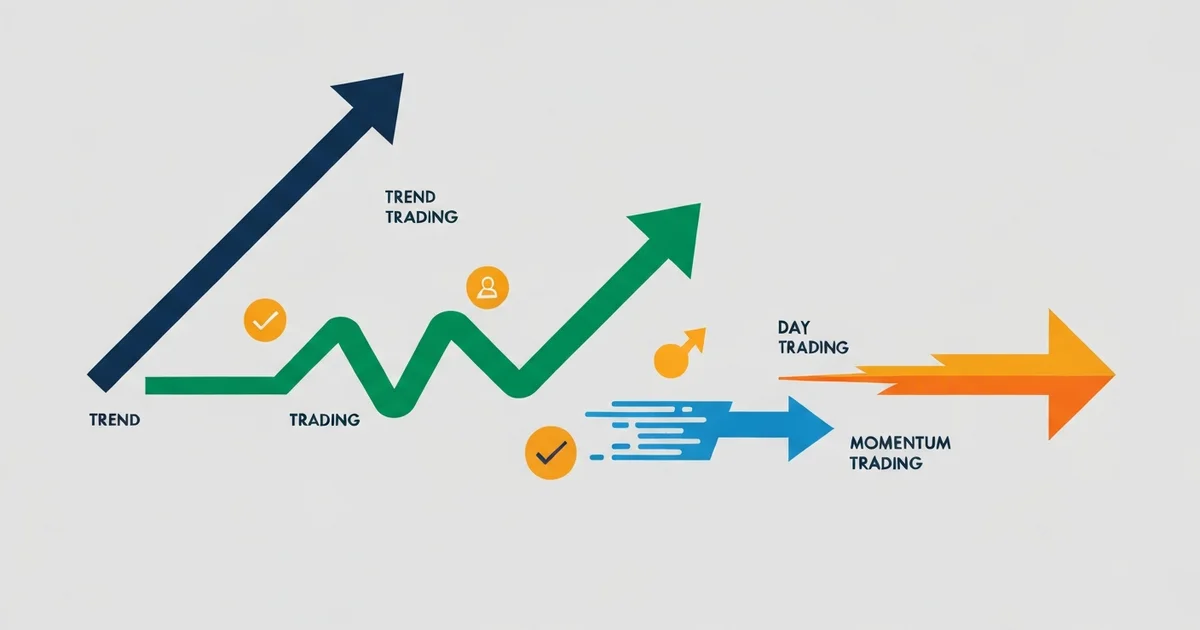
Every trading strategy falls into one of these four categories:
- Trend following: Enter in the direction of the dominant trend on higher timeframes. Hold for days to weeks. Low trade frequency, higher win expectancy per trade.
- Swing trading: Capture 50-300 pip moves over one to five days. Works on the 4H to Daily charts. Suits traders who can check charts twice a day.
- Day trading: Open and close positions within a single session. Requires active screen time during market hours. Higher frequency, smaller targets per trade.
- Momentum trading: Enter when price accelerates in one direction after a catalyst. Short holding time. Works in trending markets, falls apart in consolidation.
None of these are universally better. They are tools for different conditions and different traders.
Trend following: slow, steady, and harder than it looks
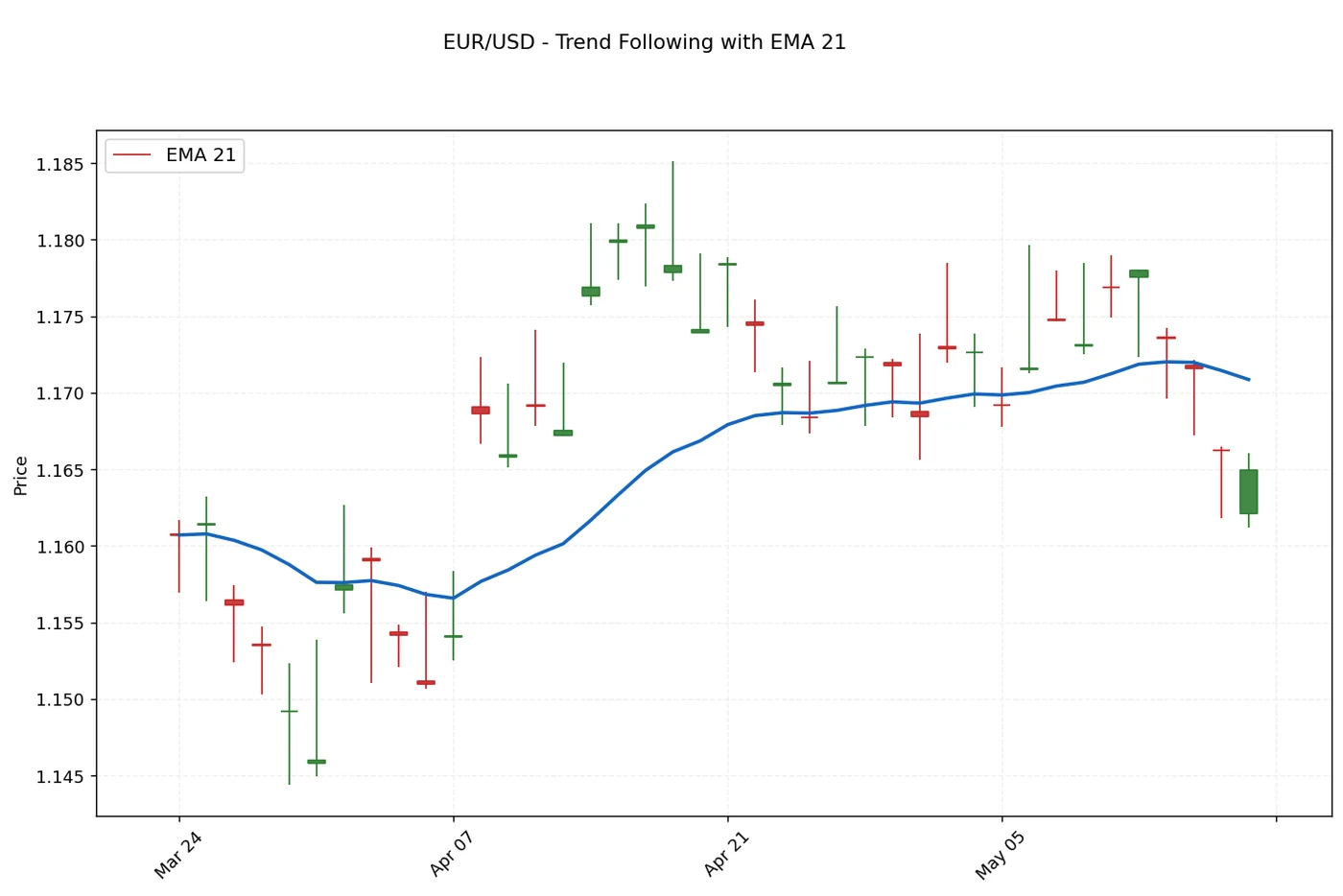
Trend following is the strategy I ran the longest on the desk. The core idea is simple: find a market in a strong directional move, enter after a pullback, hold until the trend breaks.
My EUR/USD trend-following setup on the Daily chart, combined with COT (Commitment of Traders) data, ran at a 68% win rate over four years of documented live trades. That is not a backtest cherry-picked for a clean chart. That is a live account, with spreads, with slippage, through ECB meetings and US election volatility.
The catch: trend following requires patience most retail traders do not have. You might wait 10 days for a proper setup. You will hold a position through a 60-pip retracement that feels like the trend is breaking, but is not. Traders who need constant action abandon this approach inside two weeks.
A basic trend-following entry looks like this:
- Identify the higher timeframe trend (Weekly or Daily)
- Wait for a pullback to a key level: moving average, previous support, or Fibonacci zone
- Enter when price shows rejection of the pullback level on the 4H chart
- Risk 1-2% of account per trade. Stop below the pullback low.
The position-sizing math matters here. On a small trading account, 2% risk is a small, fixed amount per trade. At 0.02 lots on EUR/USD, a 60-pip stop keeps that risk tightly bounded. That is disciplined, survivable position sizing that lets you stay in the game through a losing streak.
Swing trading strategies
Swing trading sits between trend following and day trading in terms of time commitment.
Swing trading strategies typically target two to five day moves on the 4H chart. The most common setups are:
- Pullback entries in an established trend: wait for a 50% retracement, enter when momentum resumes
- Range trading: buy support, sell resistance in a defined range, with stops outside the range boundaries
- Breakout entries: enter when price closes above or below a consolidation zone with increased volume as confirmation
The advantage of swing trading is flexibility. You do not need to watch the screen all day. Set your entry orders and alerts at key levels. Check charts in the morning before markets open, again in the evening. Thirty minutes of actual screen time per day can be enough.
On a small starting account, you can trade 0.01 lots and keep risk to roughly 1-1.5% per trade on major pairs. This works for learning execution. It is not the path to replacing income, but that is not what a small account is for. Use it to learn without catastrophic consequences.
Day trading: high commitment, steep learning curve
Day trading is the most misrepresented strategy category in retail trading. It is regularly sold as the accessible path to trading income. The reality is the opposite; it demands the most screen time, the fastest decision-making, and the tightest emotional control of any approach.
Day trading strategies operate on the 1H, 15-minute, and 5-minute charts. Session timing matters as much as setup quality. The London session (8am-12pm GMT) and the New York open overlap (1pm-4pm GMT) provide most of the usable volatility for retail day traders.
A key finding from my desk years: the “9:30 NY open reversal” pattern, where price reverses direction within the first 30 minutes of the US session, works about 55% of the time. Not enough edge to build a strategy around it alone. Pair it with a directional bias from the Daily chart and a volume filter, and the win rate moves toward 62-65%. That is a workable edge.
Day trading requires a committed three to four hour window during market hours and hard rules: a daily target and a daily loss limit. Hit either: stop trading. The traders who blow accounts day trading are not necessarily bad at analysis. They are bad at stopping.
Momentum and breakout strategies
Momentum strategies enter when price is already moving fast in one direction. The logic is that strong moves tend to continue, at least briefly.
Momentum trading works best after catalysts: economic news releases, major technical breakouts on high-timeframe charts, or volume spikes on opening sessions. The challenge is that momentum fades quickly, and entries even ten minutes late often catch the top of a spike rather than the continuation.
For retail traders, momentum setups need three filters to be worth trading:
- Volume confirmation: only enter if volume is significantly above average for the timeframe
- Time filter: avoid entries in the final 30 minutes of a session when liquidity thins
- Hard stop: momentum trades use tight, fixed stops, usually 20-40 pips. No adjustments mid-trade.
One counterintuitive finding from position management on the desk: the best momentum entries feel uncomfortable. If a move looks clean and obvious to enter, it is usually already over. Entries with real edge feel like controlled chasing, where you are entering after a brief pause in an accelerating move, not the explosive start.
How to pick a strategy that fits you
Do not start with the strategy. Start with your constraints.
If you have one hour per day: Trend following or swing trading on the Daily chart. Set price alerts at key levels. Spend 20 minutes in the morning, 15 minutes in the evening. Do not watch intraday charts; they will make you second-guess positions that are fine on the Daily.
If you have three to four hours during the London or New York session: Swing trading on the 4H with selective day trade setups on high-conviction days. You can manage live positions and make real-time decisions without being glued to a tick chart.
If you are starting small: Pick one strategy, one pair, one timeframe. Learn that combination until you can identify setups without thinking. Diversify only after you are consistently profitable on the single setup. A small account forces small size; use that constraint as education, not frustration.
If you have a larger balance: You have room for proper risk management. On a standard raw-spread account, 0.03-0.05 lots on EUR/USD gives you a 50-70 pip stop with 1.5-2% risk. Swing trades can breathe through normal retracements without forcing you to close early.
Once you choose a direction, test the strategy on historical data before trading live. According to FXStreet’s trading education research, strategies that look profitable in backtests often underperform out-of-sample when trader execution is factored in. Know what you are actually getting into.
Common mistakes to avoid
Switching strategies after five losing trades. Every strategy has losing streaks. Abandoning a system during a normal drawdown period is how traders end up cycling through setups indefinitely, never giving any one enough time to show its real edge.
Trading multiple setups as a beginner. Two strategies in parallel means double the cognitive load and half the attention per setup. Pick one. Get good at it. Add a second only after consistent documented profitability on the first.
Using a strategy designed for the wrong market condition. Breakout strategies perform in trending markets and fall apart in ranges. Trend-following systems flatline during choppy, news-driven weeks. Know what condition your chosen strategy needs, and recognize when the market has shifted out of that condition.
Ignoring spread costs. On a small account trading 0.01 lots, a EUR/USD spread of 1.0 pip costs about $0.10 per trade. That sounds trivial. Over 100 trades, it adds up to a meaningful share of a small starting balance, paid in spread before a single profitable trade. Factor every cost into your expected return before you ever open a live position.
Skipping the backtest entirely. Retail traders regularly trade setups they have seen once in a video. Running even a rough manual backtest across 3-6 months of charts separates strategies with genuine edge from those that only look good on the curated examples used to sell them. It is the most boring step in the process and the most important one.
FAQ
What is the most profitable trading strategy?
Can beginners trade with a small account?
How long does it take to learn a trading strategy?
Is day trading or swing trading better for beginners?
Do trading strategies stop working over time?
How many strategies should a beginner learn at once?
Real-time trade setups with entry, stop loss and take profit. Daily market analysis. No subscription, no complicated theory.
🌍 Our recommended brokers


Reader Reviews
The 9:30 NY open reversal analysis is the section I returned to most. Most content describes the pattern as a reliable setup without qualification. The specific finding here, that it runs at about 55% in isolation but moves toward 62 to 65% when paired with a Daily chart directional bias and a volume filter, is the conditional detail that converts a mediocre edge into a workable one. I had been running a similar setup for two months without the volume filter and sitting at 57% win rate on 31 trades. Added the two conditions and my next 20 trades came in at 63%, which matches what the article describes within normal sample variance.
The strategy selection framework based on actual constraints changed my approach more than any specific setup has. I had spent four months on day trading while working a full-time job with at most 40 minutes available around the London open. Every time a position moved against me I checked it from my phone, exited early, and missed the recovery. The article identified the mismatch before I finished the second section. Moved to swing trading on the 4H and Daily charts with alerts at key levels. My premature exit rate dropped sharply over the next 30 trades because I was no longer making decisions under conditions that force bad execution.
The COT data confirmation detail for trend following is worth the attention the article gives it. Most trend following guides work with price action and moving averages and stop there, ignoring positioning data that shows whether institutional money is behind a move or fading it. The EUR/USD setup combining trend structure with COT confirmation running at 68% over four years of documented live trades is the kind of auditable claim that distinguishes this from general strategy content.
The section on switching strategies after five losing trades is the one I needed in my first six months. I cycled through four different setups in that period, abandoning each during normal drawdown sequences any strategy would produce. The point that every system has losing streaks which will appear indistinguishable from system failure is something most trading education glosses over, probably because it removes the possibility of selling a new system as the fix.
The momentum section covers the most misunderstood setup category in retail trading. The three-filter approach, volume significantly above average, time filter excluding the final 30 minutes of a session, and a fixed 20 to 40 pip stop, removes the main failure modes of momentum entries. What I had not seen stated clearly elsewhere is that the best momentum entries feel like controlled chasing rather than obvious clean setups. Looking back at 60 trades over five months, almost every late-stage obvious entry ended near the top of a spike. That observation alone reshaped how I screen entries.
The account sizing logic at $150 and $600 is specific in a way most guides avoid. At $150 with 0.01 lots the 1 to 1.5% rule limits you to $1.50 to $2.25 per trade, which is only useful for learning execution without catastrophic losses. The $600 level at 0.03 to 0.05 lots is where risk management starts producing consistent feedback rather than noise from under-sized positions.
Solid overview of the four main strategy types. The matching framework for screen time and capital is the most useful part. Would have liked more depth on backtesting methodology since that section is brief compared to the rest.
The drawdown tolerance question at the opening eliminated two strategies I had been considering before I finished the first section. That filter is a better starting point than any specific setup comparison.
Leave a Review

Forex Analyst & Senior Trader
Former FX desk trader with 8 years in institutional forex. Works in multi-timeframe analysis and order flow, turning desk experience into systematic, testable rules across forex and metals.