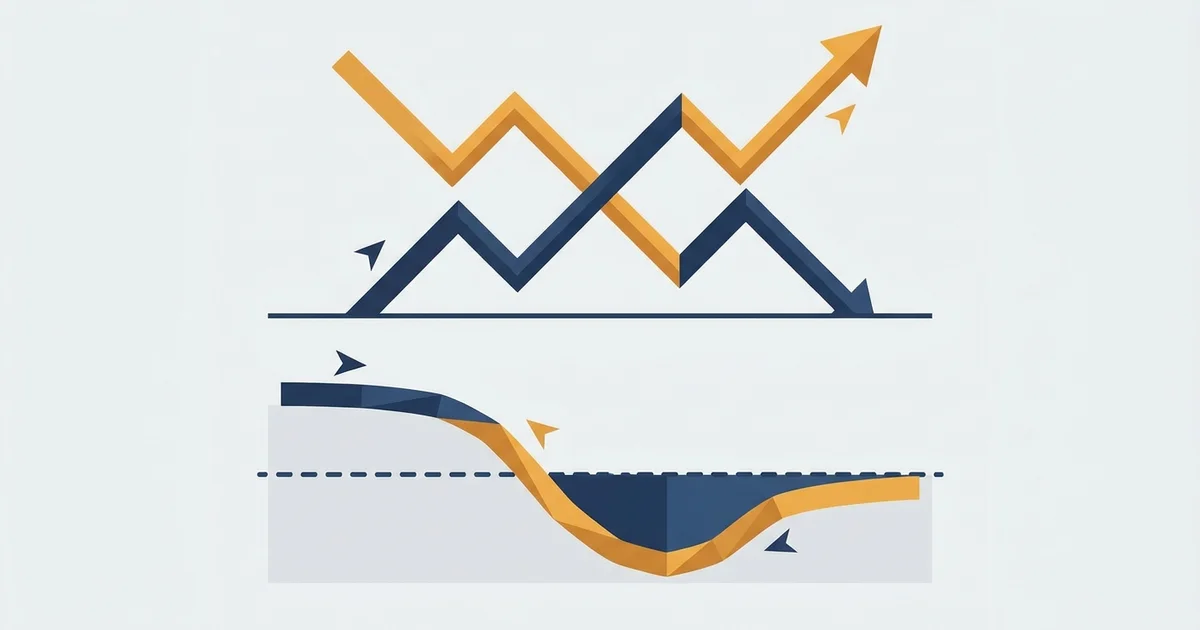

What a hedge actually is
A hedge is a paired bet. You keep your original position and add a second one that gains when the first one loses, so the two partly cancel out.
The clearest way to see it is two markets that move in opposite directions. Here is that on a real chart before we name the parts.
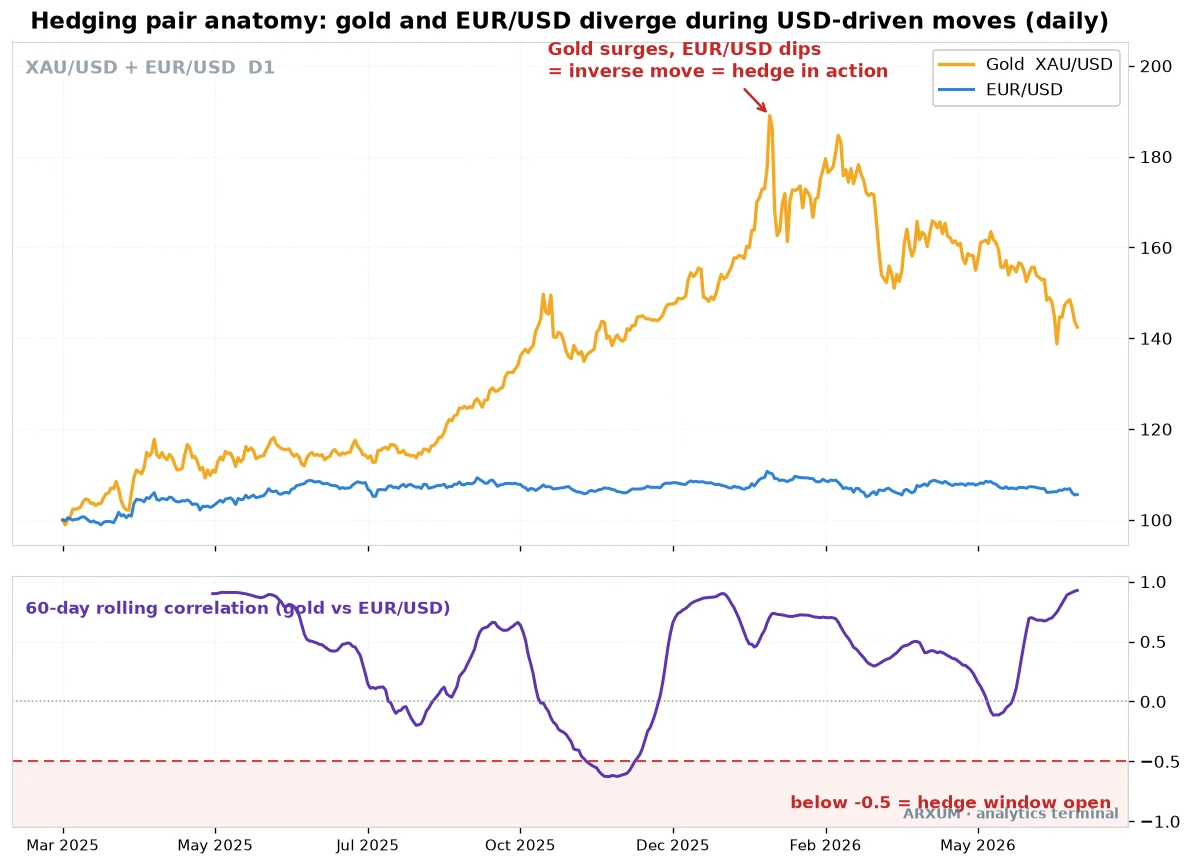
Now the picture is on screen, the parts are easy to read.
- The two price lines are the two instruments. Gold is the orange line, EUR/USD is the blue one, both scaled to 100 at the start so their movement lines up.
- The inverse move is the whole idea. Where gold jumps and EUR/USD slides at the same time, a loss on one would be offset by a gain on the other.
- The rolling correlation in the lower panel is the timing gauge. Correlation is a single number from plus 1 to minus 1: plus 1 means two markets move in lockstep, 0 means no relationship, minus 1 means they move in exact opposition.
- The hedge window opens when that line drops below minus 0.5. That is when the inverse pairing is strong enough to actually protect you, not just in theory.
Two facts frame everything that follows.
- A hedge trades away upside for safety. If both legs are open and the market moves your way, the offsetting leg eats part of the gain. That cost is the price of the insurance.
- No hedge is perfect. Correlations drift, spreads and overnight fees pile up, and the cover is never exactly one for one. A hedge shrinks risk; it does not delete it.
Why traders hedge
Hedging is a risk tool, not a profit engine. Reach for it when protecting what you have matters more than squeezing out the last bit of gain.
| Situation | Why hedge instead of just closing |
| Event risk overnight or over a weekend | Cover a gap without giving up the position |
| A big open profit you want to protect | Lock the gain in while staying in the trade |
| A long-term hold you cannot sell yet | Insure it short-term for tax or timing reasons |
| A correlated basket moving against you | Offset the whole exposure with one trade |
The honest counterpoint sits right next to the reasons.
- Closing the trade is often simpler and cheaper than hedging it. If you have no reason to stay in, just exit.
- A hedge held too long quietly bleeds money through fees while capping your upside. It is short-term cover, not a permanent state.
- Hedging is defence. It will not turn a losing idea into a winning one; it only buys you time and calm.
The three ways traders hedge
Four techniques cover almost everything retail traders actually use. The first three are the core of this guide; the fourth is a portfolio tool worth knowing.
| Method | What you do | Best for |
| Direct hedge | Open an opposite trade on the same instrument | Locking a forex position short-term |
| Correlation hedge | Offset with an inversely moving instrument | Gold, forex majors, cross-asset risk |
| Options hedge | Buy a put or a collar as insurance | Longer holds, defined-cost cover |
| Inverse or futures hedge | Short a future or hold an inverse product | Whole portfolios and index exposure |
Each row is a different trade-off between cost, precision and how much account you need. The next sections take the first three in turn.
Method 1: the direct hedge
A direct hedge is the simplest one to picture. You hold a buy and a sell on the exact same instrument at the same time, so any move is a wash until you lift one leg.
| Role | How you use it | Best read |
| Entry trigger | Open the opposite trade to freeze current profit/loss | Before news you can't sit through |
| Regime | Any, since both directions are covered | Choppy or uncertain markets |
| The lift | Close one leg once direction is clear | Keep the leg that agrees with the trend |
| Filter | Only on a hedging-enabled account | Check your broker's rules first |
| Cost | Double spread, plus overnight swap fees | Short holds only |
| Best timeframe | Intraday to a few days | Forex majors, gold |
The mechanics are worth spelling out, because the direct hedge trips up beginners.
- You open, say, a long EUR/USD, then add a short EUR/USD of the same size. From that moment your net position is flat and your profit or loss is frozen wherever it stood.
- Nothing you do while both legs sit open changes your money, minus the running fees. The hedge is a pause button, not a trade.
- The decision comes when you lift one leg. Close the short and you are long again; close the long and you are short. You have chosen a direction from a safe, flat starting point.
- It costs you twice the spread to enter and swap fees on both sides each night, so it only makes sense over a short window.
Is a direct hedge even allowed? This is where account rules bite.
In the United States, the NFA’s first-in-first-out (FIFO) rule stops retail traders holding opposite positions on the same pair in one account, so a true direct hedge is off the table there.
Most brokers outside the US offer a hedging account type that allows it. Check before you plan around it.
The direct hedge is really a way to buy time. If you find yourself using it often, a plain stop-loss and a clear exit usually do the same job for less.
Method 2: the correlation hedge
This is the method the charts in this guide are built around, and the one worth learning properly. Instead of trading the same instrument both ways, you offset your position with a different instrument that tends to move opposite to it.
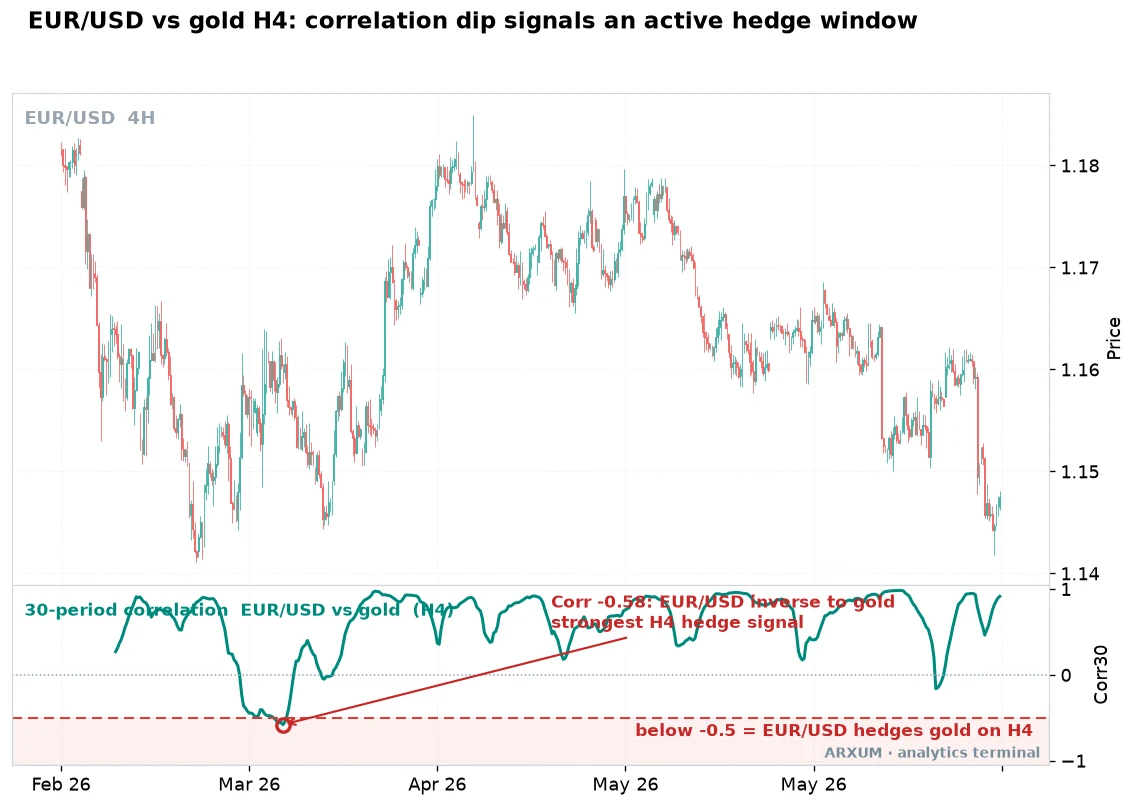
On that EUR/USD chart the lower panel does the work. The single teal line is the rolling correlation between EUR/USD and gold, measured over the last 30 four-hour bars.
The on-chart labels map straight to the plan.
- “Corr minus 0.58” marks the deepest dip, the point where the two markets were moving most strongly in opposite directions. That is the cleanest moment to pair them.
- The dashed minus 0.5 line is the trigger. Below it, the inverse relationship is strong enough that one instrument genuinely offsets the other.
- Above zero, the two drift back to moving together, and the hedge stops working. The correlation line is what tells you the window is open or shut.
Here is how a correlation hedge sets up in practice.
- You hold a position you want to protect, say long gold into a nervous session.
- You check the rolling correlation between gold and a candidate hedge instrument. EUR/USD and USD/CHF are the usual forex partners for gold and the dollar.
- When the correlation is deep enough, below minus 0.5, you open a position in the second instrument sized to offset the first.
- If gold falls, the hedge leg rises and cushions the loss. When the risk passes, you close the hedge and keep the original.
| Role | How you use it | Best read |
| Entry trigger | Add the hedge leg when correlation goes inverse | Rolling correlation below minus 0.5 |
| Regime | Works in USD-driven and risk-off moves | Gold and the dollar pulling apart |
| Confirmation | Both legs actually moving opposite in real time | Not just a historical correlation number |
| Filter | Skip it when correlation is near zero | No relationship means no hedge |
| Exit | Close the hedge leg once the risk passes | Keep the position you started with |
| Best timeframe | H4 to D1, where correlations are stable | Gold with EUR/USD or USD/CHF |
The one number that runs the whole method is the correlation coefficient, so keep the plain-language version in your head. Minus 1 is a perfect mirror, 0 is no link, plus 1 is a perfect match.
You want your two instruments deep in negative territory, because that is where a loss on one is genuinely paid for by a gain on the other.
The classic textbook pairing lives in forex: long EUR/USD hedged with long USD/CHF, two majors that are almost mirror images because the dollar sits on opposite sides of each. The gold-and-euro version on these charts is the same logic across asset classes.
For more on trading two correlated markets against each other, the pairs trading guide goes deeper, and the gold trading strategy guide covers the metal on its own.
The correlation hedge on crypto
Correlation hedging travels to crypto, but with a warning attached. Most large coins move together so tightly that there is usually nothing to hedge with, and you have to wait for that to break.
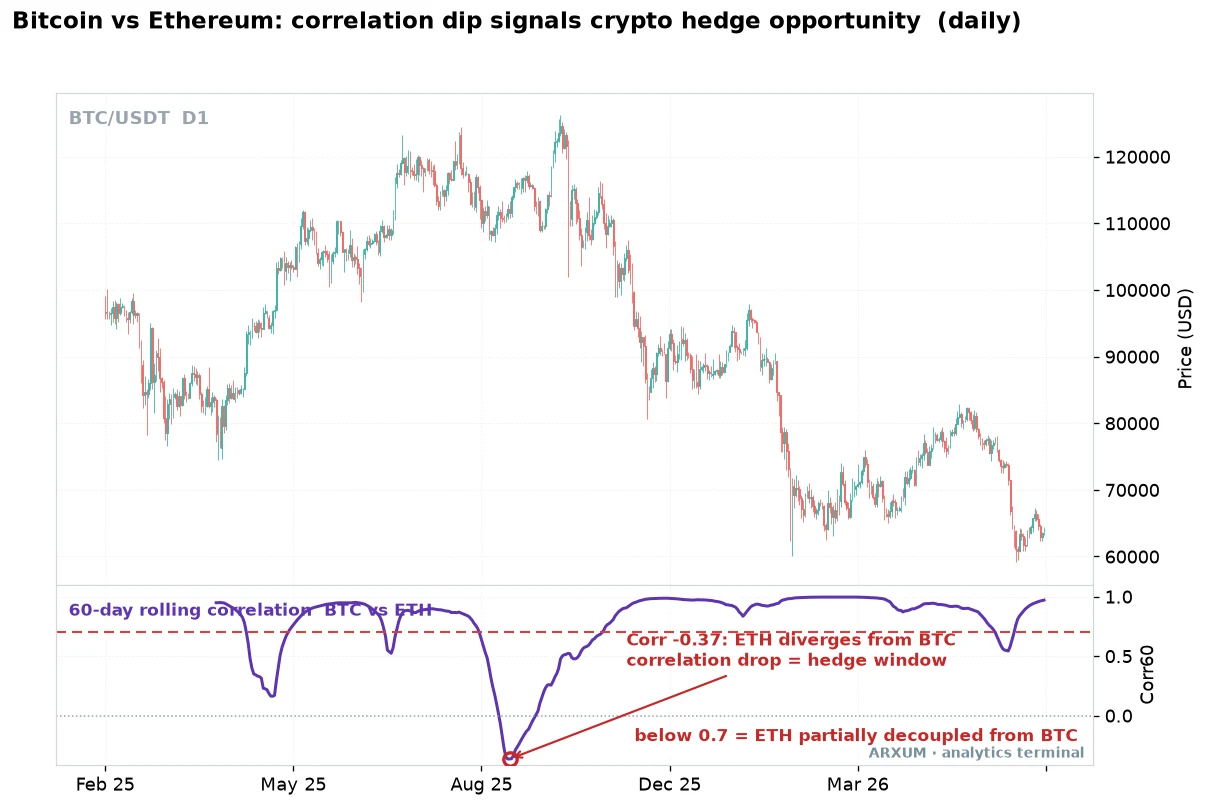
On the Bitcoin chart the lower line sits pinned near plus 1 most of the time. That is the problem and the point.
- The dashed 0.7 line is a watch level, not an entry. Below it, ETH is only partly decoupled from BTC, so the pair is worth watching, not yet worth hedging.
- “Corr minus 0.37” marks the one deep dip where the two genuinely moved opposite. Only a negative reading like that makes shorting ETH against long BTC a real hedge rather than doubling your bet.
- Most of the chart shows why you cannot casually hedge one coin with another. Near plus 1, a short in the second coin just cancels your first position and pays fees for the privilege.
The crypto read comes down to a few plain points.
- BTC and ETH are usually too correlated to hedge. Buying one and shorting the other in a normal market is close to holding nothing but costs.
- The opportunity is the decoupling window, when the correlation drops and the two start to diverge. That is when a pair hedge, or a pairs trade, has something to work with.
- If you want protection in a normal, tightly-correlated crypto market, an inverse or short futures position on the same coin is cleaner than trying to find a second coin that moves the other way. The crypto trading strategies guide covers the wider toolkit.
Method 3: the options hedge
An options hedge swaps the moving second position for a fixed-cost insurance policy. You pay a premium up front, and that premium is the most the hedge can cost you.
- The protective put is the core move. You hold a long position and buy a put option under it, which gains value if price falls, so the put offsets the drop.
- The strike price is the level your insurance kicks in at, like the excess on a policy. A strike close to price costs more and covers more; a strike far below costs less and only covers a crash.
- The premium is the fixed fee you pay for the option. Unlike a direct or correlation hedge, your worst case is known the moment you open it.
- The collar lowers that fee. You buy the put for protection and sell a call above price to help pay for it, which caps your upside in exchange for cheaper cover.
| Role | How you use it | Best read |
| Entry trigger | Buy a put under a long you want to protect | Ahead of a known risk event |
| Cost | A fixed premium, your maximum loss on the hedge | Budget it like an insurance fee |
| Coverage | Set by the strike you choose | Nearer strike, more cover, more cost |
| Cheaper version | A collar: sell a call to fund the put | When you accept a capped upside |
| Best for | Longer holds and defined-risk cover | Indices, stocks, larger accounts |
Two honest caveats keep options in their place for a beginner.
- Options add their own moving parts, expiry dates and time decay, that take real study before you trade them with size.
- You need an options-enabled broker to place one, common for US stocks and indices, rare for a plain forex account.
- In pure forex and gold, most retail traders reach for a direct or correlation hedge first, because options on those markets are less accessible through a typical trading account.
Which hedge to use, and when
Pick the method by what you are protecting and what your account allows. The choice is usually obvious once you name the situation.
| If you want to... | Then... |
| Freeze a forex trade over a short event | Direct hedge, if your account allows it |
| Protect gold when the dollar is driving | Correlation hedge with EUR/USD or USD/CHF |
| Cover a long hold with a known cost | Options hedge, a protective put |
| Cap the cost of that put | Turn it into a collar |
| Hedge crypto in a normal market | Short futures on the same coin, not a second coin |
| Just get out of a bad idea | Close the trade; skip the hedge entirely |
That last row matters more than it looks. A hedge is for a position you have a reason to keep, not an excuse to avoid taking a loss.
What hedging costs you
Every hedge has a price, and the fees are easy to underestimate because they run quietly in the background. Count the full cost before you decide the cover is worth it.
| Cost | Where it comes from |
| Double spread | Paying the spread on a second position |
| Swap or overnight fees | Financing charges on both legs each night |
| Capped upside | The offsetting leg eats gains if you're right |
| Imperfect correlation | The hedge never offsets exactly one for one |
| Margin tied up | Two positions can hold more collateral hostage |
A quick sense of scale keeps it concrete without any invented numbers.
- On a correlation hedge, the two instruments rarely move the same distance, so you are left with a small residual gain or loss even when the hedge “works.” Perfect offset is a textbook idea, not a real fill.
- On a direct hedge, the swap can turn negative on both legs at once, so a hedge left open for days slowly drains the account while your net position sits flat.
- On an options hedge, the premium is spent the moment you buy, whether or not the risk you feared shows up. That is simply the cost of the insurance.
Hedging is a trade in CFD and forex accounts too, so the usual discipline still applies. Size each leg deliberately, risk only capital you can afford to lose, and treat the hedge as short-term cover you plan to remove, not a position you forget about.
When not to hedge
Sometimes the right hedge is no hedge. A few situations where reaching for one costs you more than it saves.
- You have no reason to stay in the trade. Closing is cheaper and cleaner than paying to offset a position you should just exit.
- The correlation is weak. If the second instrument is near zero correlation, it is not a hedge, it is a fresh, unrelated bet.
- The hold is long. Fees and capped upside compound over weeks. For a genuinely long-term view, position sizing and patience often beat a standing hedge.
- You are hedging out of fear, not a plan. A hedge slapped on to avoid booking a loss usually just locks the loss in and adds costs on top.
How to set it up
None of this needs exotic tools. A correlation reading and the right order types cover most of it.
- Read the correlation first. In TradingView, open Indicators and search “Correlation Coefficient,” then add your second instrument as the source. In MT4 or MT5, most traders eyeball two charts side by side or use a correlation script, since there is no one-click built-in.
- Size the hedge to the position. Match the value of the offsetting leg to what you are protecting, not just the lot count, since a pip on gold is worth a different amount than a pip on EUR/USD.
- Use the right order type. A market order opens the hedge now; a stop or limit can arm it to trigger only if the risk actually appears. The order types guide breaks down each one.
- For a direct hedge, confirm the account first. You need a hedging account, not a netting one (a netting account merges opposite trades into a single net position), or the second trade simply closes the first. This is also the FIFO rule that blocks it for US retail.
- Watch the calendar. Most hedges are put on ahead of a known event and lifted after. The forex market hours guide helps you time cover around session breaks and the weekend gap.
What works: the short version
Three ideas carry the whole method.
- Match the hedge to the job. Direct hedge to freeze a forex trade short-term, correlation hedge to offset with an inverse instrument, options hedge to buy defined-cost cover for a longer hold.
- Let correlation open the window. A correlation hedge only works when the two instruments are genuinely moving opposite, deep in negative territory, not merely paired on paper.
- Count the cost. Every hedge trades upside and fees for safety. Use it as short-term insurance on a position worth keeping, and take it off once the risk has passed.
Hedging sits alongside the other risk tools traders lean on. For sizing the trades underneath a hedge, the risk-reward ratio guide sets the frame, and the carry trade guide shows a related way traders pair currencies for a different reason.
Glossary
- Hedge: a second, offsetting position that gains when your first position loses, reducing overall risk.
- Direct hedge: holding a buy and a sell on the same instrument at the same time to freeze the net position.
- Correlation hedge: offsetting a position with a different instrument that tends to move in the opposite direction.
- Correlation coefficient: a number from minus 1 to plus 1 that measures whether two markets move together, apart, or unrelated.
- Decoupling: when two normally correlated markets, like BTC and ETH, start moving independently.
- Protective put: a put option bought under a long position, acting as price-fall insurance.
- Collar: a protective put funded by selling a call above price, cheaper cover with a capped upside.
- Premium: the fixed fee paid to buy an option, and the most that option hedge can cost.
- Netting vs hedging account: a netting account merges opposite trades into one; a hedging account keeps them separate.
- Swap: the overnight financing fee charged or paid on a position held past the daily rollover.
FAQ
What is hedging in trading, in plain terms?
Hedging is opening a second position that offsets your first one, so a loss on the first is softened by a gain on the second. The goal is protection, not profit. You give up some of your upside in exchange for a smaller drawdown if the market moves against you. There are three main ways to do it: a direct hedge opens an opposite trade on the same instrument, a correlation hedge uses a different instrument that moves the other way, and an options hedge buys a put as insurance. A hedge shrinks risk but never removes it, and it always costs something in fees or capped gains.
How do you hedge a forex position?
There are two common ways. The first is a direct hedge: open an opposite trade of the same size on the same pair, which freezes your net profit or loss until you close one leg. This needs a hedging-enabled account, not a netting one. The second is a correlation hedge: offset your pair with another that moves inversely, the classic being long EUR/USD hedged with long USD/CHF, since the dollar sits on opposite sides of each. Size the hedge leg to the value of the position you are protecting, and plan to remove it once the risk you were covering has passed.
Is hedging allowed in forex?
It depends where you trade. In the United States, the NFA's FIFO rule stops retail traders from holding opposite positions on the same pair in one account, so a true direct hedge is not allowed there. Most brokers outside the US offer a hedging account type that permits it. A correlation hedge, using two different instruments, sidesteps that rule everywhere because the positions are on separate markets. Always check your broker's account rules before you build a plan around a direct hedge.
What is a correlation hedge?
A correlation hedge offsets your position with a different instrument that tends to move in the opposite direction. Instead of trading the same market both ways, you pair, for example, a long gold position with a EUR/USD trade that moves inverse to it in dollar-driven markets. You judge the fit with the correlation coefficient, a number from minus 1 to plus 1. You want it deep in negative territory, below about minus 0.5, because that is where a loss on one leg is genuinely paid for by a gain on the other. When the correlation drifts back toward zero, the hedge stops working.
How does hedging with options work?
The core options hedge is a protective put. You hold a long position and buy a put option beneath it, which gains value as price falls, so the put offsets the drop. You pay a premium up front, and that premium is the most the hedge can cost you, which makes options cover a defined-risk choice. The strike price sets where the protection kicks in: nearer to price means more cover and a higher premium. To cut the cost you can build a collar, selling a call above price to help pay for the put, which caps your upside in return.
Does hedging cost money?
Yes, every hedge has a price. A direct hedge costs a second spread to open and swap fees on both legs each night, so it drains slowly if held for days. A correlation hedge rarely offsets exactly one for one, leaving a small residual gain or loss, and it ties up extra margin. An options hedge costs the premium, which is spent whether or not the risk shows up. On top of the direct fees, every hedge caps your upside, since the offsetting leg eats into your gain if the market moves your way. That trade-off is the cost of the insurance.
Can you hedge crypto like Bitcoin?
You can, but pairing one coin against another is harder than it sounds. Large coins like Bitcoin and Ethereum usually move together, near plus 1 correlation, so shorting one against a long in the other mostly cancels your position and pays fees for nothing. A pair hedge only works in a decoupling window, when the correlation drops and the two start moving independently. In a normal, tightly correlated crypto market, a cleaner hedge is a short or inverse futures position on the same coin, which offsets your spot exposure directly.
Does a hedge remove all risk?
No. A hedge reduces risk, it does not delete it. Correlations drift over time, so a pairing that offsets well today may loosen tomorrow. Spreads, swap fees and option premiums all chip away at the position while it is open. And no hedge offsets exactly one for one, so a residual gain or loss almost always remains. Treat a hedge as short-term insurance that lowers your exposure and buys you time, not as a guarantee against loss. When the risk you were covering has passed, take the hedge off so it stops costing you.
Real-time trade setups with entry, stop loss and take profit. Daily market analysis. No subscription, no complicated theory.
🌍 Our recommended brokers


Reader Reviews
Be the first to review this — tell other traders what actually helped, or where it fell short.
Leave a Review

Quant Researcher & Systems Builder
Quantitative researcher who builds the automated systems behind Arxum strategy testing. Works in Python and Pine Script, using AI alongside classic backtesting to validate strategies on years of real data.