
What a price gap is
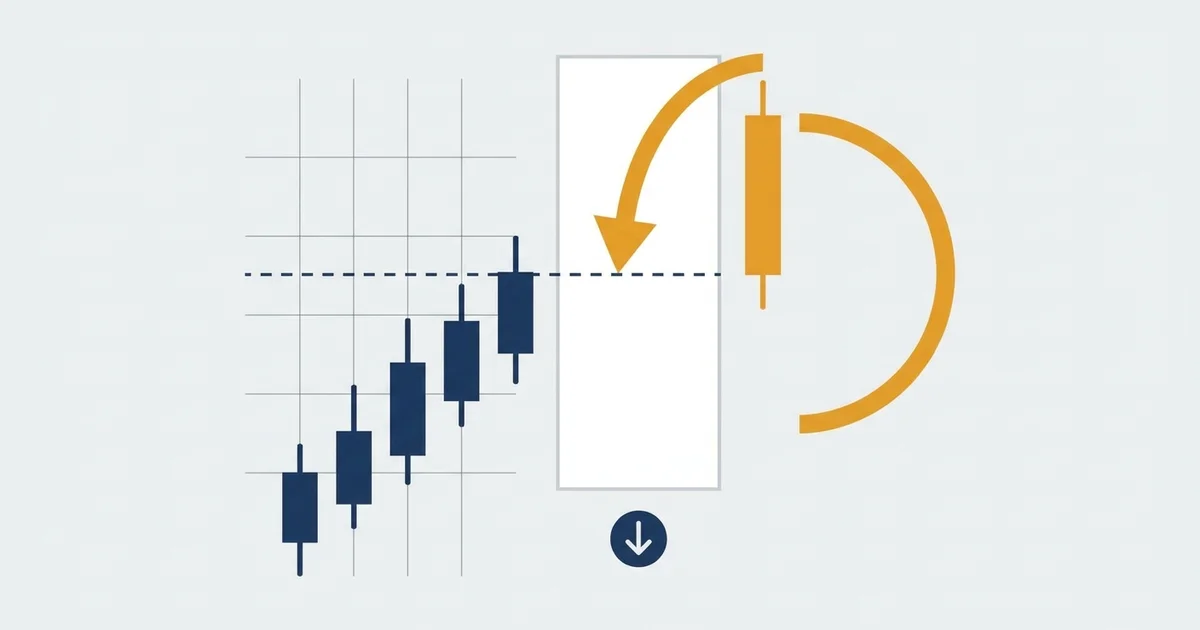
A gap is a jump. Price closes one session at one level and opens the next session at a different level, leaving a blank space on the chart with no trading in it.
Here is the shape on a real chart before we name the parts.
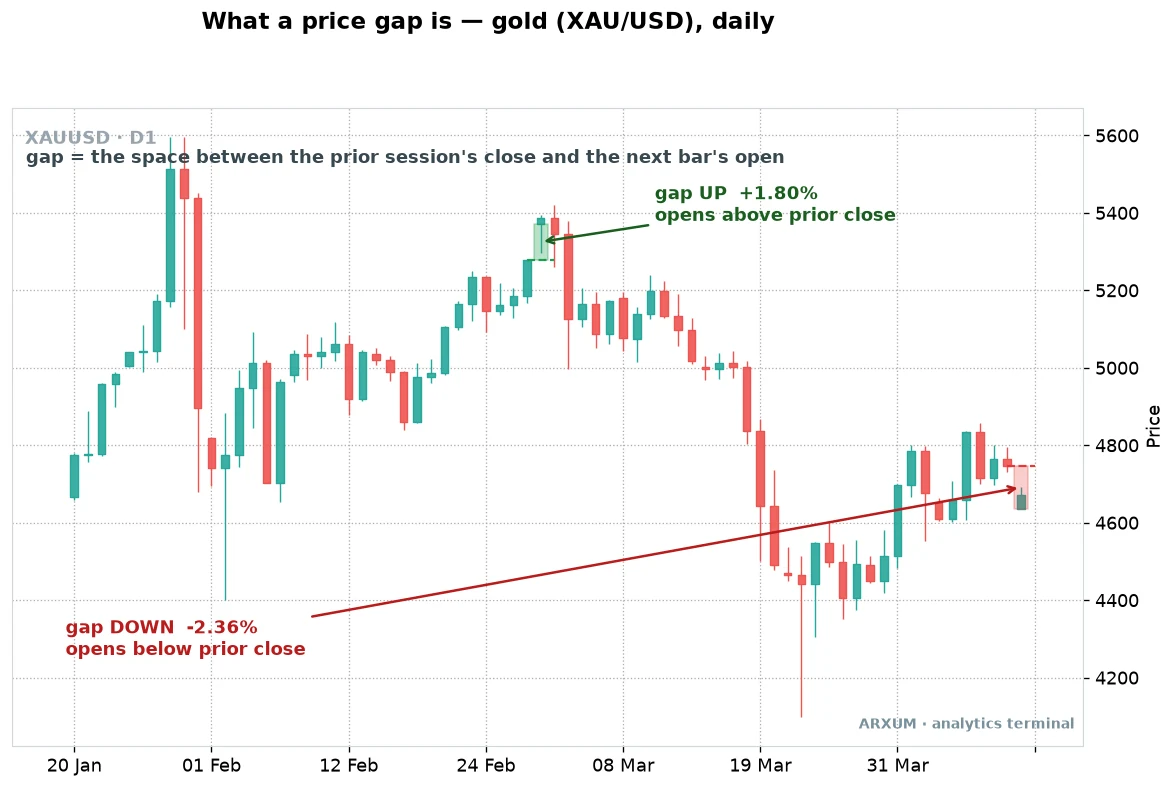
Now the picture is on screen, the two directions are easy to read.
- Gap up: the new session opens above the prior close. Buyers were willing to pay more before the market even reopened.
- Gap down: the new session opens below the prior close. Sellers pushed price lower while the session was shut.
- The prior close: the last traded price of the old session. This single level is the anchor for everything that follows.
- The empty space: the price range the gap skipped. No orders traded there, which is why it acts like a magnet or a launch pad later.
Two facts set up the whole method.
- A gap forms only when a market is closed, so it needs a session break. Stocks break overnight, Forex breaks over the weekend, crypto barely breaks at all.
- The bigger the gap and the stronger the reason behind it, the more likely it holds and runs, instead of filling back to the prior close.
The four types of gap
Not every gap means the same thing. The cause tells you which of the two systems to reach for.
| Gap type | Where it shows up | What it usually does |
| Common | Quiet market, thin liquidity, weekend or holiday | Fills fast; fade it |
| Breakaway | Start of a new move, breaks a range or level on news | Holds and runs; ride it |
| Runaway | Mid-trend, confirms momentum already in place | Holds and extends; ride it |
| Exhaustion | Late in a stretched trend, a last push | Fills and reverses; fade it |
The split is clean once you group them. Common and exhaustion gaps tend to close; breakaway and runaway gaps tend to hold.
- Common gaps carry no real story. They are noise from a quiet session, so price usually drifts back and fills.
- Breakaway and runaway gaps carry a catalyst, a data release or a level breaking, so the move has fuel and keeps going.
- Exhaustion gaps are a trap. They look like more of the trend but arrive when it is running out of buyers or sellers, and they fail.
The word “catalyst” does the heavy lifting there. A catalyst is a reason price moved: a jobs report, a rate decision, a war headline, or a big level giving way.
No catalyst behind a gap and it is probably common. A clear one and you treat it as a breakout.
Do gaps get filled?
“Gap fill” is the phrase you will hear most, so it is worth pinning down. A gap fills when price trades all the way back to the prior close and closes the empty space.
| Gap type | Fills? | The read |
| Common | Usually, and quickly | The default bet is a fade to the prior close |
| Breakaway | Rarely, or only much later | A fill is the exception, not the plan |
| Runaway | Rarely while the trend runs | Do not sit waiting for it to close |
| Exhaustion | Yes, as the trend rolls over | The fill is the whole trade |
A few things worth saying plainly about the fill.
- Most small weekend Forex gaps close inside the first day or two, because there is rarely a big story behind them.
- A gap on heavy news often does not fill for weeks, if at all. The move that caused it is real.
- The fill target is always the same level: the prior close. That is what makes gap fill trading simple to plan.
- “Gaps always fill” is a myth. Plenty never do. Trade the odds for the type in front of you, not a slogan.
System 1: fade the gap
The first gap trading strategy is the fade. You bet the gap is noise and price will drift back to the prior close, so you trade toward that level.
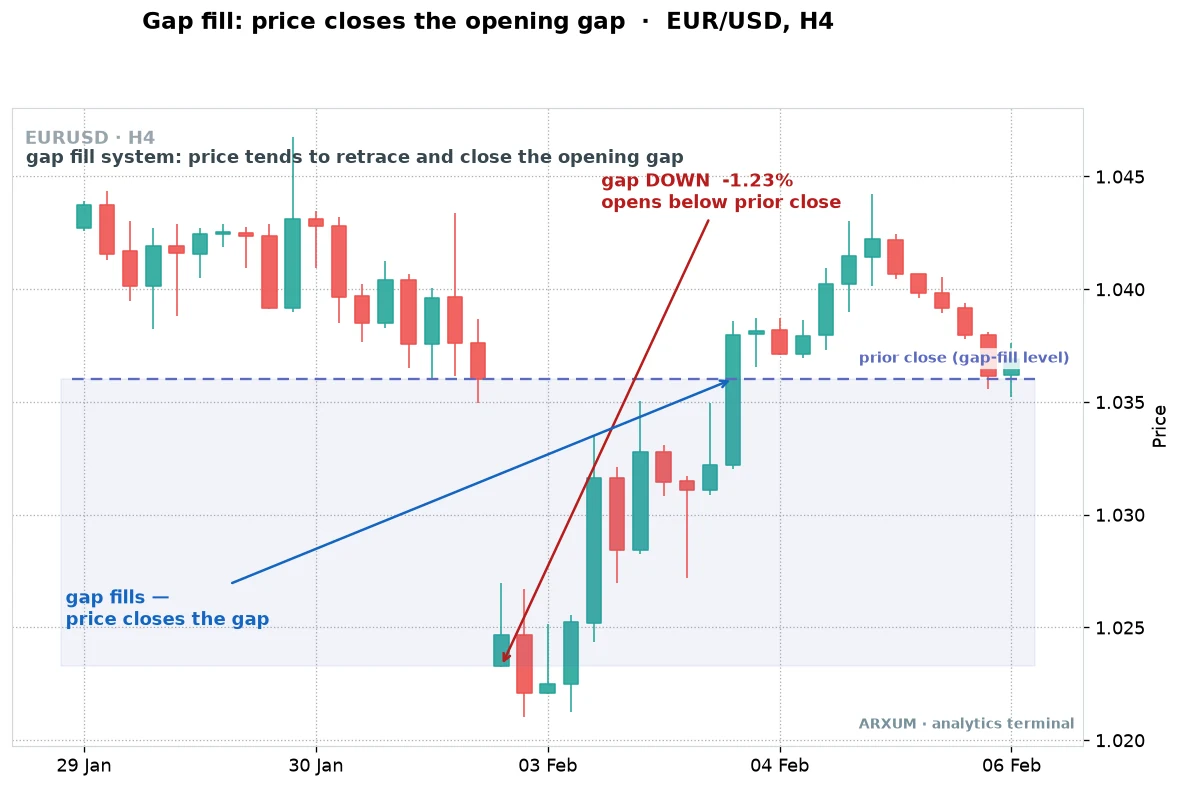
On that EUR/USD chart the gap opens below the prior session’s close. Price then retraces upward and closes the empty space, tagging the dashed prior-close line.
The on-chart labels map to the plan. “Gap down” marks the open below the old close, the dashed “prior close” line is the fill target, and “gap fills” is the moment price closes the space.
Here is what a fade looks like as it sets up.
- Price gaps away from the prior close on no real news.
- The gap stalls within a bar or two instead of running.
- A reversal candle prints at the gap edge, and price starts drifting back toward the prior close.
- You enter toward the fill, with the prior close as your target.
| Role | How you use it | Best read |
| Entry trigger | Trade toward the prior close once the gap stalls | Small common or weekend gap |
| Regime | Only fade a quiet, ranging market | Price flat around the 200-EMA |
| Confirmation | Wait for a reversal candle at the gap edge | H4 pin or engulfing bar |
| Filter | Skip fades on big-news gaps | Check the economic calendar first |
| Exit | Target the prior close, the fill level | The dashed prior-close line |
| Best timeframe | H1 to H4, intraday | Forex majors, index CFDs |
The trend filter in that table is the 200-EMA, the 200-period exponential moving average. It is one line your charting app draws from the last 200 candles, and it tells you the wider direction.
Price coiling flat around that line is a ranging market, which is exactly where fades pay. The fade is a range tool, close in spirit to support and resistance trading, where the prior close acts as the level price returns to.
System 2: ride the gap
The second gap trading strategy is the opposite bet. When a gap is strong and holds, you ride the gap in its direction and let the move extend, rather than fading it.
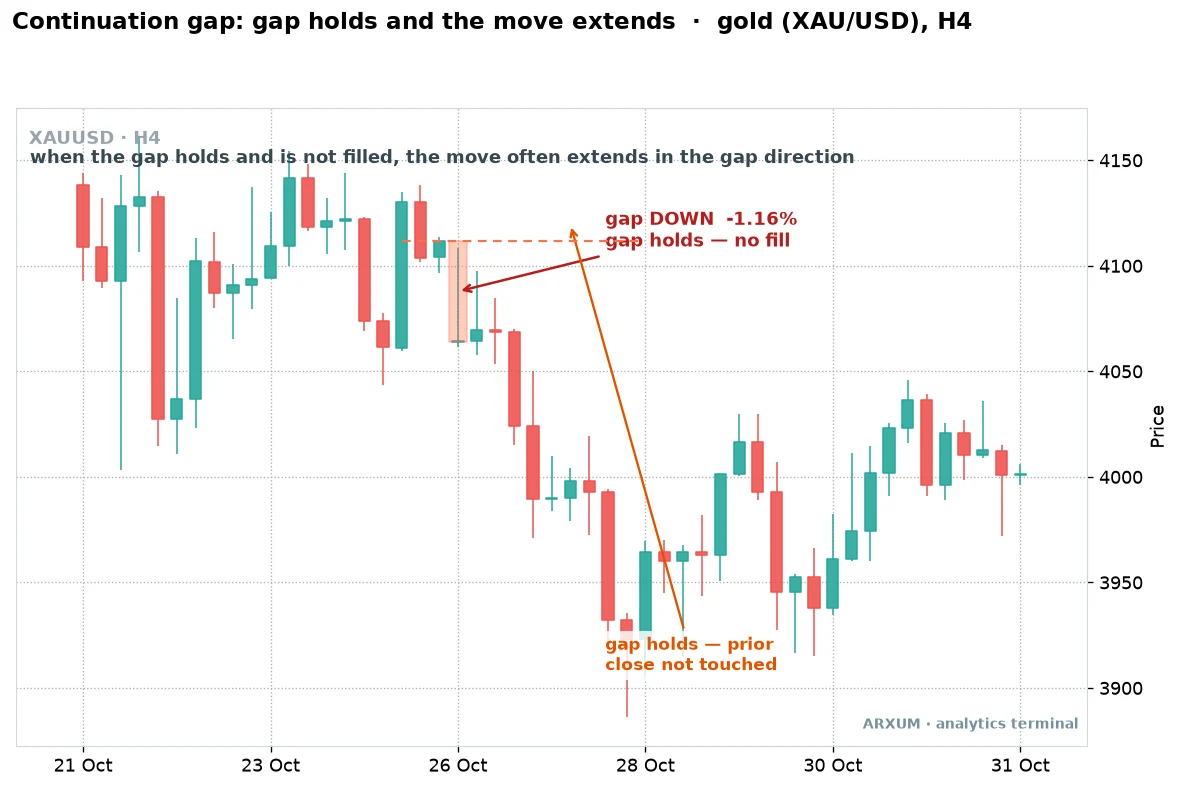
On the gold chart the gap opens below the prior close and simply keeps going. Price never trades back up to fill it, so this is a continuation gap, not a fade.
The labels tell the story. “Gap holds, no fill” marks a gap that stays open, and “prior close not touched” is the tell: the old close is never revisited, so the trend is still in charge.
A ride sets up like this.
- The gap arrives with a real catalyst, a breakout or a data release.
- It holds for a bar or two without any pull back toward the prior close.
- The gap direction agrees with the trend, gap up in an uptrend, gap down in a downtrend.
- You enter in the gap’s direction and trail the move, targeting the next structure.
| Role | How you use it | Best read |
| Entry trigger | Enter in the gap direction after it holds | Gap holds 1-2 bars, no fill |
| Regime | Only ride with the trend | Gap direction agrees with the 200-EMA |
| Confirmation | A wide close in the gap direction, no retrace | Strong first bar after the open |
| Filter | Needs a real catalyst behind it | Breakaway or runaway gap only |
| Exit | Trail behind swings; aim at the next level | Prior swing or structure |
| Best timeframe | H4 to D1 | gold (XAU/USD), trending majors |
Riding a gap is momentum trading with a head start. The gap itself is the breakout, so this is a close cousin of ordinary breakout trading and of momentum trading, just triggered by a session break instead of an intraday level.
The regime rule is the same 200-EMA line as the fade, read the other way. Gap in the direction of the trend, above the line for longs or below it for shorts, and the odds favour a ride.
Which one to use, and when
Fade or ride is the whole decision, and the gap type answers it. Read the cause first, then pick the system.
| If the gap is... | Then... |
| Small, no news, into a quiet range | Fade it; expect a fill to the prior close |
| Large, on news, breaking a level | Ride it; treat it as a breakout |
| With the trend, mid-move | Ride it; this is a runaway gap |
| Against a tired, stretched trend | Fade it; likely exhaustion |
| Unclear either way | Wait for the first bar to resolve |
The single tell that separates the two shows up in the first bar or two after the open.
- It fills fast: price turns straight back toward the prior close. That is a fade, the gap was noise.
- It holds: price sits in the gap direction with no pull back. That is a ride, the gap has fuel.
- When in doubt, wait. You lose nothing by letting the open resolve. The market will show you which one it is.
Forex gap trading and the weekend gap
For a Forex trader the only gap you meet regularly is the weekend gap, so forex gap trading is really weekend gap trading. It is worth its own section.
| Market | Character of the gap | Best use |
| Forex weekend (Monday open) | Small, usually fills | Fade on H1-H4 majors |
| Stock / index open | Frequent, news-driven | Both, depends on the catalyst |
| gold (XAU/USD) | Gaps on weekend or news, can run hard | Ride strong ones; mind the safe-haven bid |
| Bitcoin, crypto | Trades nearly 24/7; true gaps are rare | Watch CME futures gaps instead |
The mechanics are simple once you know the clock.
- Forex closes late Friday and reopens Sunday evening, so any price move over the weekend shows as a gap at the Sunday or Monday open. The exact hours are in the Forex market hours guide.
- Most weekend gaps are small and fill inside a day or two, which is why the majors are the classic home of the fade.
- A weekend gap on a big story, an election or a shock headline, is the exception. That one can hold and run, so treat it as a breakaway.
- Crypto barely gaps because it never really closes. The one place it does is the CME Bitcoin futures, which shut on weekends and leave a gap that often fills.
Risk and the reality of gaps
Gaps carry one risk that other setups do not, and it is the reason to size small. Because the market was shut, price can leap straight past your stop.
- A stop is not a guarantee at your price. If a market gaps through your stop-loss over the weekend, you exit at the next available price, which can be worse. That is slippage, and gaps are where it bites hardest.
- Do not hold naked size over the weekend if a gap against you would hurt. Trim or hedge into Friday’s close if the position is large.
- Size every gap trade small. A sensible rule is to risk about 2% of the account on any one trade, so a single bad gap is a dent, not a disaster.
- Fades fail when a gap turns out to be a breakaway. If you take three to six fade losses in a row, the market has probably shifted from ranging to trending, so stop fading and reassess.
A quick worked example keeps this concrete. Take a fade on EUR/USD, the market a small account can actually trade.
- The setup: a small weekend gap down opens at 1.0820, below a prior close of 1.0850. Price stalls and starts drifting back up toward that close.
- Risk budget: 2% of a $1,000 account is $20. That is the most you plan to lose.
- Entry: buy at 1.0825 as the reversal candle confirms, aiming for the fill.
- Stop: 1.0790, below the gap low. Entry to stop is 35 pips, your risk distance. A pip is the fourth decimal on a major pair, so 1.0825 to 1.0790 is 35 pips.
- Position size: $20 risk divided by 35 pips is about $0.57 per pip. A micro lot is worth roughly $0.10 per pip, so $0.57 divided by $0.10 is about 5, which you round to 5 micro lots (0.05 lots).
- Target: 1.0850, the prior close and the fill level, 25 pips of reward against 35 of risk, near 1:1 on a fast intraday fade.
Reward-to-risk written 1:X is the standard way to read a trade. The 1 is your risk, the entry-to-stop distance, and the X is how many times that risk the trade can pay.
The risk-reward ratio guide works it in full.
Fades run at tighter reward-to-risk than rides, so they lean on a high hit rate. Rides pay less often but run further, which is the trade-off between the two systems.
How to set it up
Gap trading needs no special indicator, just the prior close marked and the right order type. Here is the whole kit.
- Mark the prior close. In TradingView use the horizontal line tool and drop it on the last session’s close; in MT4 or MT5 use Insert then Line then Horizontal Line. That level is your fill target and your reference.
- Add the 200-EMA for regime. In TradingView open Indicators and search “Moving Average Exponential,” length 200; in MT4/MT5 go to Insert, Indicators, Trend, Moving Average, period 200, type Exponential.
- To fade, wait for the reversal candle at the gap edge, then enter with a market order toward the prior close, or leave a limit order partway back into the gap.
- To ride, leave a stop order just beyond the first bar’s extreme in the gap direction, so you only trigger if the move holds and pushes on.
- Always attach the stop and target in the same ticket, the stop-loss beyond the gap and the take-profit at your level, so the whole trade goes in at once.
What works: the short version
Three ideas carry the whole method.
- Match the gap to the market. Fade small, quiet, no-news gaps back to the prior close. Ride gaps that arrive with a real catalyst and hold.
- The targets are fixed by type. A fade aims at the prior close, every time. A ride aims at the next structure and trails behind the move.
- Respect gap risk. Because the market was shut, price can jump your stop, so size small and think twice about naked size over a weekend.
Gaps sit alongside the other price signals traders read at the open. For the wider picture, the fair value gap guide covers the ICT idea that shares the word but not the meaning.
Glossary
- Price gap: the empty space on a chart between one session’s close and the next session’s open.
- Gap up / gap down: an open above (up) or below (down) the prior session’s close.
- Gap fill: price trading all the way back to the prior close, closing the empty space.
- Prior close: the last traded price of the previous session, and the fill target.
- Common gap: a small, low-news gap that usually fills fast.
- Breakaway gap: a gap that starts a new move on a catalyst and tends to hold.
- Runaway gap: a gap mid-trend that confirms momentum and extends.
- Exhaustion gap: a late-trend gap that fails and fills as the trend reverses.
- Weekend gap: the gap Forex prints at the Monday open after the weekend close.
- Slippage: filling at a worse price than your stop when the market gaps through it.
FAQ
What is gap trading, in plain terms?
Gap trading is trading the empty space that appears when a market opens at a different price from where it closed. That space is a gap. There are two main ways to trade it. You can fade the gap, betting price drifts back to fill the space and touch the prior close, which works best on small quiet gaps. Or you can ride the gap, betting a strong gap holds and the move keeps running, which works best when a real catalyst like news is behind it. The gap type tells you which bet to make.
What is a gap fill?
A gap fill is when price trades all the way back to the prior session's close and closes the empty space the gap left. The prior close is always the fill target, which is what makes gap fill trading easy to plan. Small common gaps and weekend Forex gaps fill often and fast. Gaps driven by strong news frequently do not fill for a long time, because the move that caused them is real.
Do all gaps get filled?
No, and the saying that gaps always fill is a myth. Common gaps and exhaustion gaps usually fill. Breakaway and runaway gaps, the ones with a real catalyst behind them, often hold and run without filling for weeks or ever. The safe approach is to read the odds for the gap type in front of you rather than assume every gap closes.
How do you trade forex gaps?
In Forex, gaps show up almost only at the Monday open after the weekend close. Most weekend gaps are small and fill within a day or two, so the classic play is to fade them: wait for the gap to stall, then trade back toward the prior close as your target, with a stop beyond the gap. The exception is a weekend gap driven by a major headline, which can hold and run, so treat that one as a breakout and ride it instead of fading it.
Why does Forex gap on Monday?
Forex closes late on Friday and reopens on Sunday evening, so the market is shut for roughly two days. Any news or price move over the weekend has nowhere to trade until the reopen, so it shows up as a jump between Friday's close and the new open. That jump is the weekend gap. Because there is usually no big story behind it, most of these gaps are small and fill quickly.
Fade the gap or ride the gap, which is better?
Neither is better in general; each fits a different gap. Fade small, quiet gaps that open with no news into a ranging market, because they tend to drift back and fill the prior close. Ride gaps that arrive on a real catalyst and hold without pulling back, because those have momentum and extend. The first bar or two after the open usually tells you which one you have: a fast turn back means fade, a hold in the gap direction means ride.
What is the difference between a price gap and a fair value gap?
They share the word gap but are different ideas. A price gap is a real break in the chart, where a session opens at a different price from the previous close, and it needs the market to be shut. A fair value gap is an ICT concept: a three-candle imbalance left inside continuous trading by a fast move, with no session break involved. Gap trading here means the session-open kind. The fair value gap guide covers the other.
What timeframe is best for gap trading?
For fading Forex weekend gaps, the H1 to H4 charts are the home, because the fill usually plays out intraday over a few hours to a couple of days. For riding a strong gap, the H4 and daily charts give cleaner trends and less noise. The daily is also where you judge the wider regime with the 200-EMA before deciding to fade or ride.
Is gap trading risky?
Gaps carry one risk other setups do not. Because the market was closed, price can leap straight past your stop-loss, so you can exit worse than planned. That is slippage, and it is worst on weekend gaps. The way to handle it is to size every gap trade small, risk a fixed slice like 2% of the account per trade, and avoid holding large naked positions over the weekend if a gap against you would hurt.
How much money do you need to start gap trading?
You can start small if you pick the right market. A Forex pair like EUR/USD sizes cleanly on a $1,000 account: risking 2%, or $20, over a 35-pip stop works out to about five micro lots. Gold is harder to size on a small account because a sensible stop can push the position below the one-ounce micro-lot minimum. Whatever the market, risk a small fixed slice per trade and only use money you can afford to lose.
Real-time trade setups with entry, stop loss and take profit. Daily market analysis. No subscription, no complicated theory.
🌍 Our recommended brokers


Reader Reviews
Be the first to review this — tell other traders what actually helped, or where it fell short.
Leave a Review

Forex Analyst & Senior Trader
Former FX desk trader with 8 years in institutional forex. Works in multi-timeframe analysis and order flow, turning desk experience into systematic, testable rules across forex and metals.