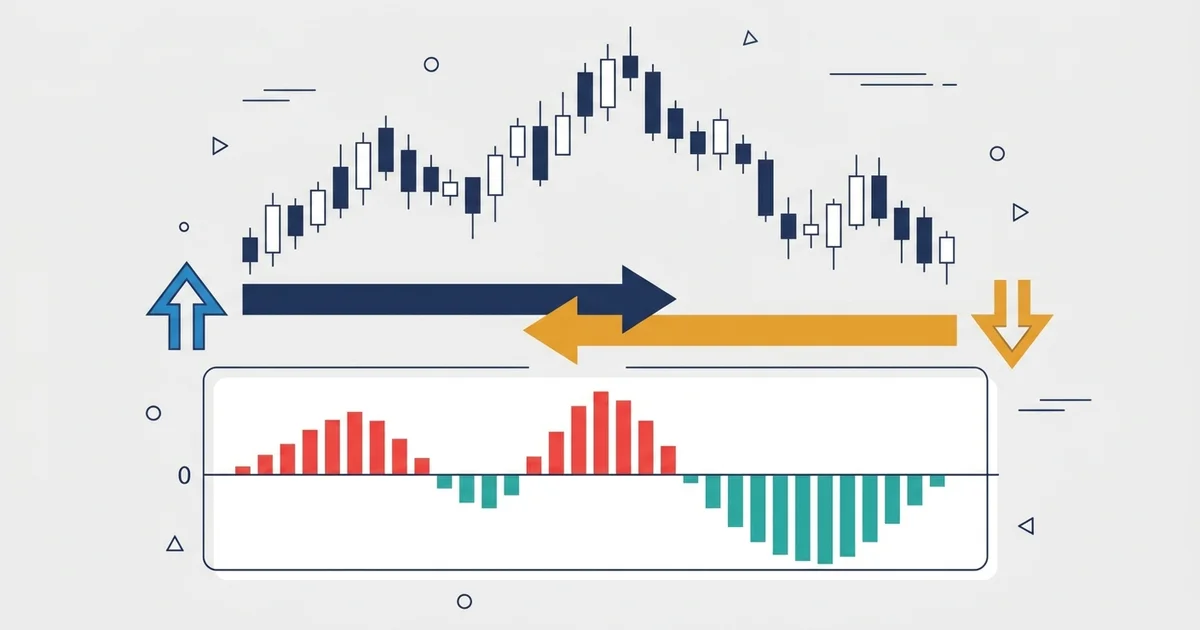

What a crypto funding rate actually is
A perpetual future never expires, so exchanges need a way to stop the contract price from drifting away from real spot. The funding rate is that mechanism, and it is a payment swapped between traders, not a fee taken by the venue.
Here is how the signal behaves when a market runs hot and then flips.
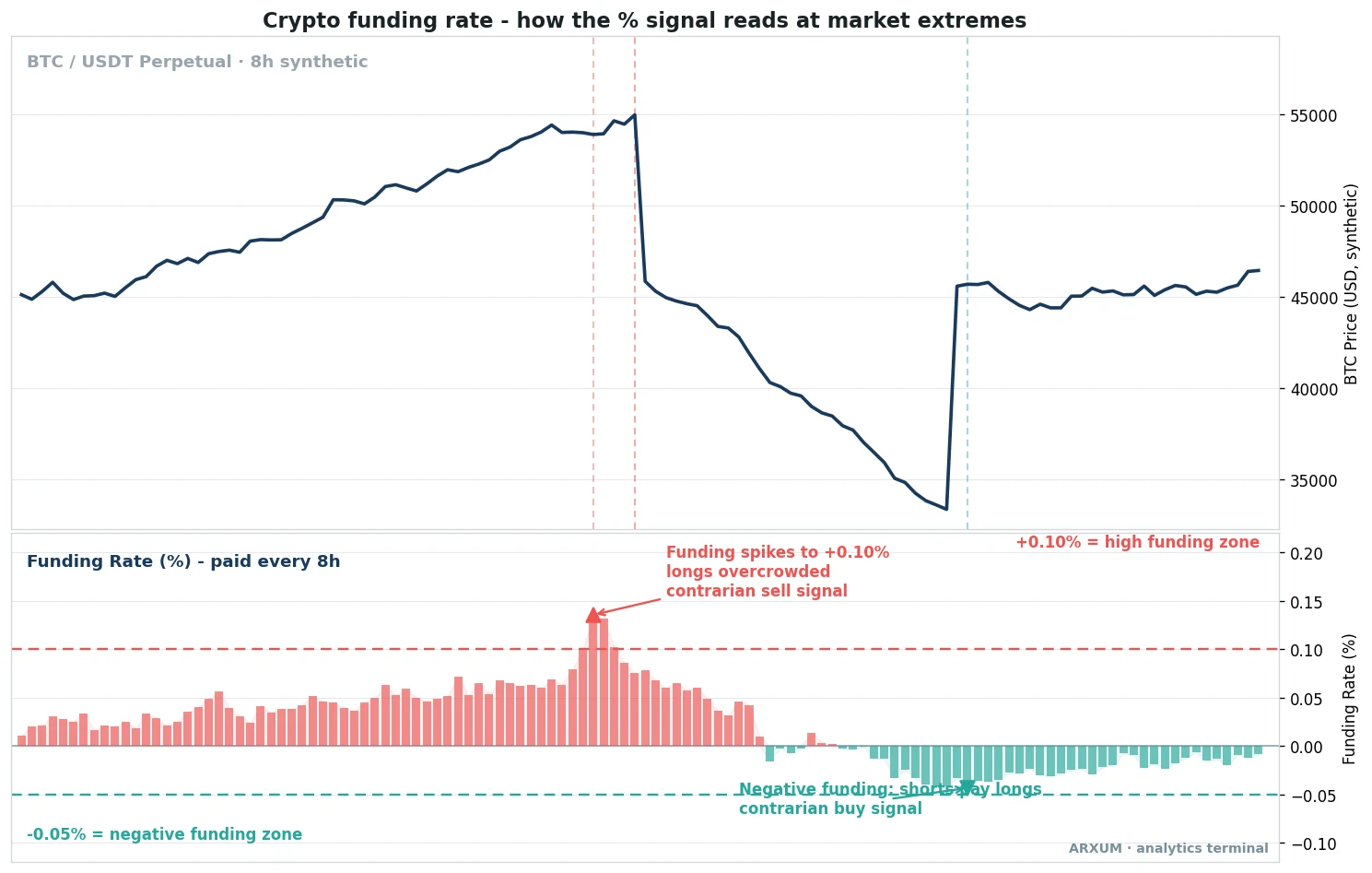
What the chart is showing:
- Top panel: the perp price rises into a top, dumps, then recovers.
- Bottom panel: the funding rate, one bar per 8-hour payment.
- Red bars sit above zero. That is positive funding, and longs are paying shorts.
- Teal bars sit below zero. That is negative funding, and shorts are paying longs.
- The funding spike to the +0.10% line lands right as price tops out. Crowded longs, then the drop.
- Funding turns negative into the low. Crowded shorts, then the bounce.
The plain read: funding tells you which side is crowded, and the crowded side usually loses. It does not tell you the exact minute, only who is leaning too hard.
Positive vs negative funding rate, side by side
The whole concept lives in one comparison. Positive and negative funding are just the two directions of the same tether.
| What you see | Positive funding | Negative funding |
| Perp vs spot | Perp above spot | Perp below spot |
| Who pays | Longs pay shorts | Shorts pay longs |
| Crowd is | Leaning long, greedy | Leaning short, fearful |
| Contrarian read | Caution on longs | Watch for a bounce |
| Common at | Rallies, blow-off tops | Capitulation, deep dips |
Two things to hold onto:
- Funding is a direct transfer between traders. If you hold the paying side, that cash leaves your account every interval. If you hold the receiving side, it lands in your account.
- The payment is charged on your position size, not your margin. A big leveraged position pays or collects far more relative to the cash you put up, which is why funding bites hardest on the crowded, over-leveraged side.
How the funding rate is calculated and paid
You do not need to compute it by hand, but knowing the parts tells you why the number moves. Funding has two ingredients and a cap.
| Component | What it does |
| Premium index | Measures how far the perp trades above or below spot |
| Interest rate | A small fixed base, often near 0.01% per interval |
| Clamp | Caps the rate so a single reading stays bounded |
| Interval | Applied on a fixed clock, most venues every 8h |
The premium index does the heavy lifting. When the perp trades well above spot, the premium rises, and the funding rate climbs to push longs to close and shorts to step in.
When the perp trades below spot, the premium goes negative and the rate flips.
Payment timing differs by venue, so check the clock before you hold through a snapshot:
- Every 8 hours: the default on most large exchanges, three payments a day.
- Every 4 hours or hourly: some venues shorten the interval when volatility spikes, or run a faster clock by design.
- You only pay if you hold at the snapshot. Close before the funding timestamp and you owe nothing for that interval.
Rule of thumb: the rate you see quoted is usually per interval, not per day. A +0.01% funding at an 8-hour clock is roughly 0.03% a day, so annualise it before you call a number “small.”
Funding differs by venue
The mechanism is the same everywhere, but the clock and the caps are not. Check before you assume one number fits all.
| Venue type | Typical interval | Note |
| Large perp exchanges | Every 8h | Three payments a day, the default |
| High-frequency venues | 1h to 4h | Faster clock, smaller per-payment |
| Decentralised perp DEXs | Hourly or streamed | Funding accrues more often |
Two things that trip people up:
- The same coin can show different funding on two venues at the same moment. That gap is exactly what the heatmap and the arbitrage key off.
- A shorter interval is not cheaper. Three 8-hour payments and twenty-four hourly ones can add up to the same cost over a day.
Reading funding rate as a sentiment signal
This is where funding earns its keep. Extreme readings mark where the crowd is over-committed, which is exactly where trends run out of fuel.
It works as a contrarian sentiment gauge, a cousin of the fear and greed index.
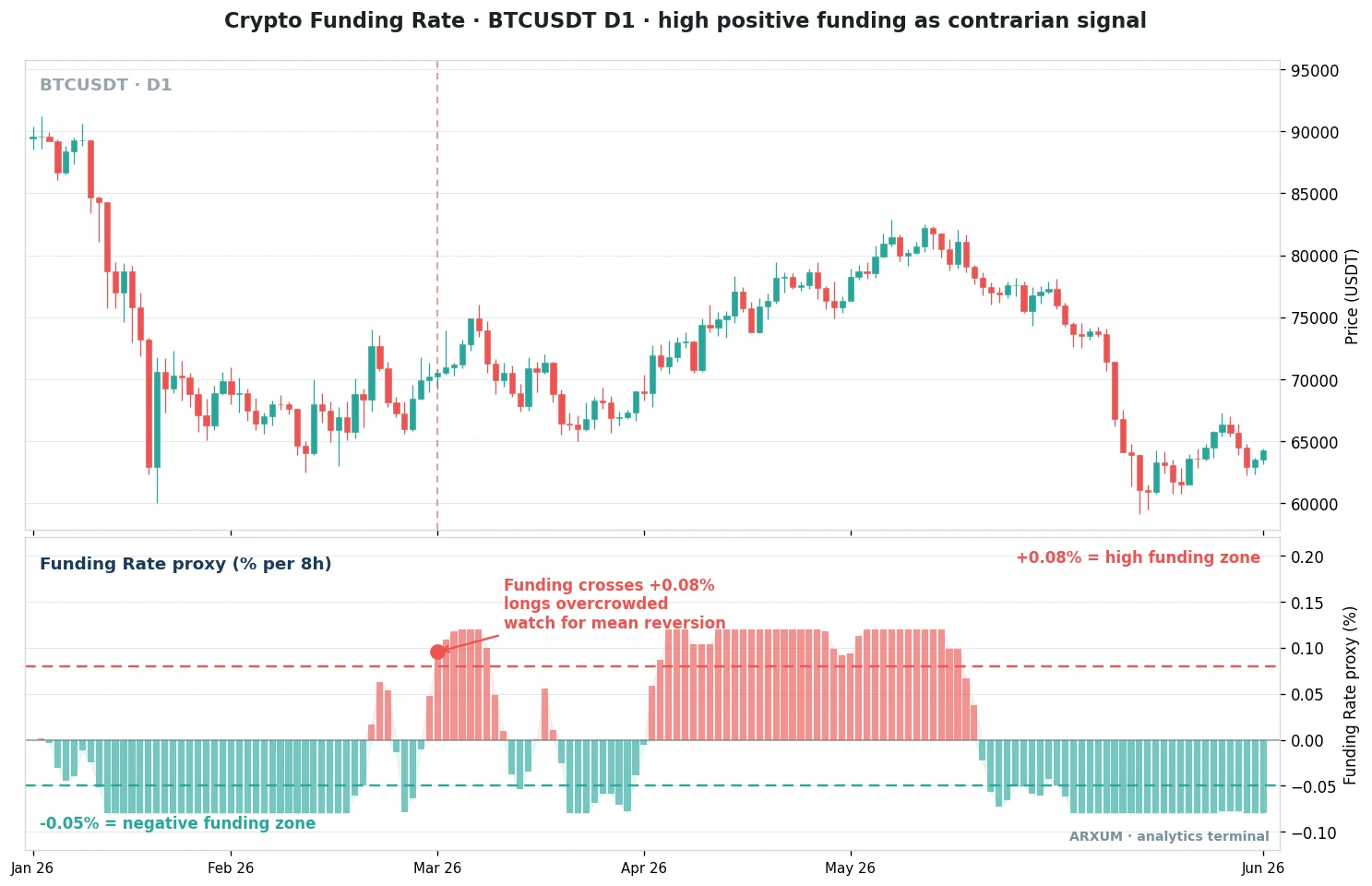
How to use the reading in practice, without pretending it is a magic trigger:
| Role | How to use it | Best read |
| Overcrowding warning | Trim or hedge longs on extreme positive funding | BTC / ETH daily |
| Capitulation tell | Watch for a bounce when funding goes deeply negative | BTC / ETH daily |
| Trend health | Steady mild positive funding backs a calm uptrend | H4 to D1 |
| Reversal confirm | Pair a funding flip with an RSI turn | H4 |
| Blow-off filter | Very high funding plus a vertical price = late | Any |
The honest limits, because a one-line signal gets people liquidated:
- Funding can stay extreme for a long time in a strong trend. High positive funding in a real bull run is not an instant short.
- The best use is confirmation, not standalone entry. A funding extreme that lines up with a price rejection and a momentum turn is worth acting on.
- Overcrowded longs are also fuel for a liquidation cascade, so extreme funding raises the odds of a fast, violent flush rather than a gentle drift.
Takeaway: treat funding as a crowd meter. It tells you the room is one-sided, then you wait for price to agree before you fade it.
The same signal on BTC, ETH and smaller alts
Funding runs hotter the smaller and more speculative the coin. The read is identical, the thresholds are not.
| Market | Funding character | How to read it |
| Bitcoin | Calmest, deepest book | Extremes are rarer and mean more |
| Ethereum | Slightly hotter | Follows BTC, leads it in alt rotations |
| Large alts | Swings wider | Extremes fire more often, more noise |
| Small alts | Wild and thin | Huge funding, easy to get squeezed |
An 0.08% reading that is a genuine extreme on Bitcoin can be an ordinary Tuesday on a small alt. Judge funding against that coin’s own history, not one fixed line.
How funding reads across a full cycle
Funding is not random. It tracks the mood of the cycle, so the same chart looks different depending on where you are in it.
| Market phase | Typical funding | What it tells you |
| Early bull | Mild positive | Healthy demand, ride it |
| Blow-off top | Extreme positive | Overcrowded, flush risk |
| Sharp crash | Deep negative | Forced selling, shorts pile in |
| Bear grind | Flat to mild negative | Little conviction either way |
| Capitulation low | Very negative | Max fear, bounce fuel |
Notice the symmetry. The best long setups tend to show up where funding is most negative, and the best moments to protect a long show up where funding is most positive.
The crowd is usually wrong at the edges.
Funding rate arbitrage: collecting the payment
You do not have to bet on direction to use funding. When funding is positive, the receiving side is the short, so you can build a market-neutral position and collect.
This is the basis trade, one flavour of crypto arbitrage.
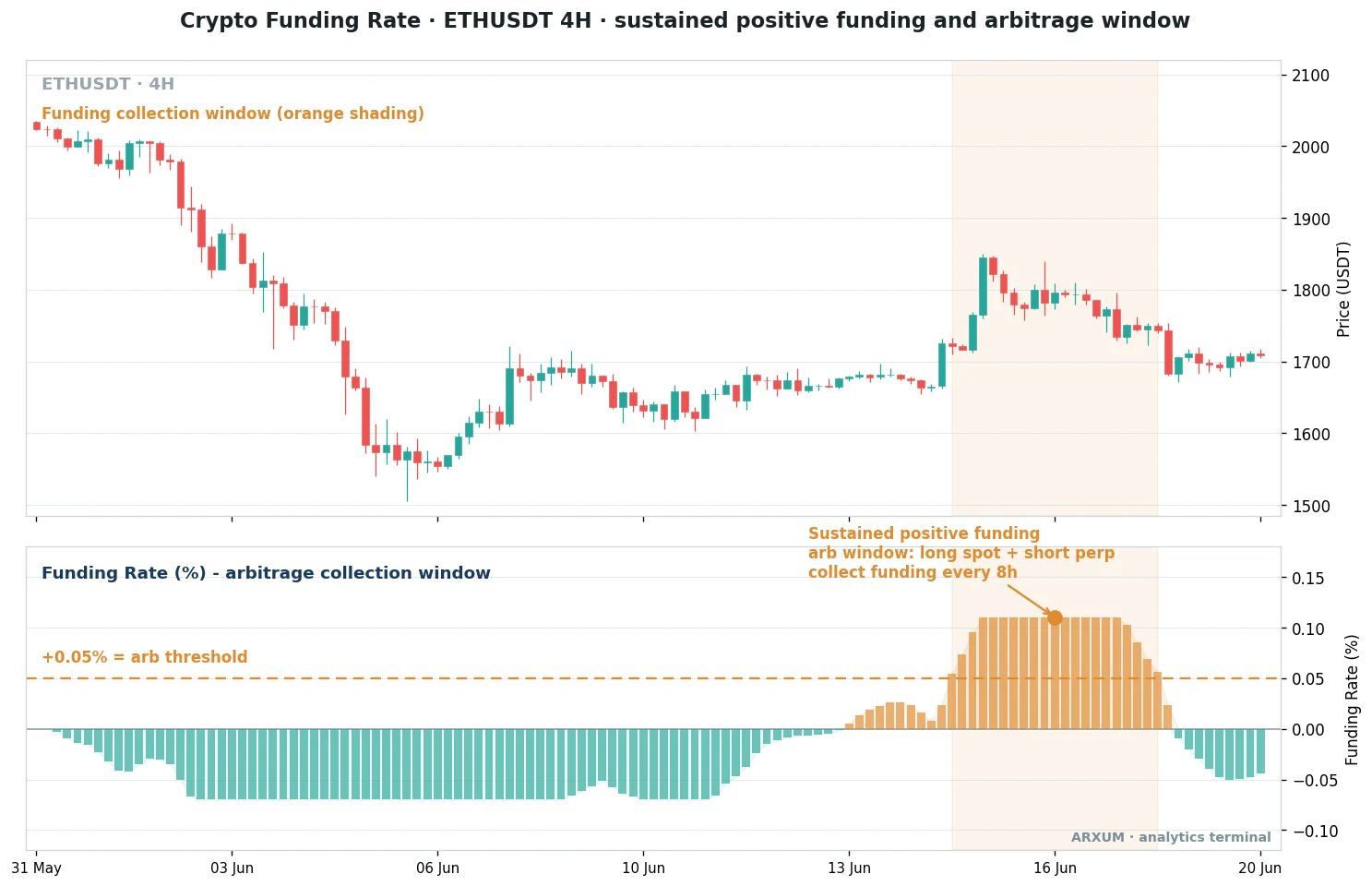
The structure is two legs that cancel each other on price:
| Leg | Action | Purpose |
| Spot | Buy the coin | Own the asset |
| Perp | Short the same size | Hedge price, receive funding |
| Net exposure | Roughly flat | Price moves cancel out |
| Income | Positive funding | Collected each interval |
How it plays out, step by step:
- Buy the coin on spot and short the same notional on the perp.
- If the coin rises, your spot gains and your short loses about the same. If it falls, the reverse. Direction is hedged.
- While funding stays positive, the short leg collects the payment every interval.
- You close both legs together when funding drops toward zero or turns negative.
A quick, illustrative sense of the income, using round numbers and no claimed history:
- Say funding sits at +0.01% per 8h. That is three payments a day, so about 0.03% daily.
- On a $10,000 short perp leg, 0.03% a day works out to roughly $3 a day before fees.
- Stretched across a year that is close to 11% on the hedged size, if funding held there the whole time, which it never does.
The point is the shape, not a promise. Your yield is only ever the funding you actually collect, minus fees, for as long as the positive window stays open.
The catches, because “risk-free yield” is a marketing phrase, not a real one:
- Funding can flip negative, and then your short pays instead of collects. The orange window closes fast.
- The short leg can be liquidated if it is under-margined during a sharp spot rally, even though your spot covers the loss economically. Keep the perp margin generous.
- Exchange and transfer risk is real. Your two legs may sit on different venues, and moving collateral is not instant.
- Net yield is funding minus trading fees and any spot-perp basis drift, so a thin positive rate can vanish after costs.
Which funding play to use, and when
Funding is one input with three separate jobs. Match the job to what the number is doing.
| If funding is | Do this | Why |
| Mild positive | Ride the trend, ignore it | Healthy, not crowded |
| Extreme positive | Trim longs, watch for reversal | Crowded, flush risk |
| Sustained positive | Consider the arb collect | Steady income window |
| Deeply negative | Watch for a bounce, fade shorts | Fear, capitulation |
| Choppy near zero | No funding edge | Balanced book |
Funding rate versus the other crowd gauges
Funding is one of several ways to measure positioning. They agree more than they clash, and the agreement is the real signal.
| Gauge | What it measures | Funding pairs with it by |
| Funding rate | Who pays to hold | The lean itself |
| Open interest | How much is at stake | Rising OI plus high funding = crowded |
| Long/short ratio | Headcount per side | Confirms which side is packed |
| Fear and greed | Broad market mood | Extreme greed backs high funding |
Read them together. High funding on its own is a lean.
High funding with rising open interest and greedy sentiment is a crowd, and crowds are what break.
Where to find live funding rates
You read all of this off free tools, no paid data needed:
- CoinGlass shows a funding heatmap across every major exchange at once, so you can spot when one venue runs hot or the whole market leans one way.
- Your exchange’s contract page lists the current rate, the countdown to the next payment, and the interval for each perp.
- TradingView carries funding data on many perpetual symbols, handy for lining it up against price and an indicator on one screen.
Check the interval and whether the quote is per-interval or annualised before you compare numbers between sites.
A fast way to check funding before you take a trade:
- Read the sign. Positive means longs are paying, negative means shorts are. That is your crowd.
- Read the size. Compare the current rate to that coin’s own recent range, not a fixed number.
- Read the trend. Funding pushing further into an extreme is a lean building. Funding easing back off an extreme is the crowd starting to unwind.
Common funding mistakes
- Shorting the first high reading. Funding can climb for weeks in a real trend. Wait for price to roll over first.
- Ignoring the interval. Quoting a per-8h rate as if it were daily overstates the cost by three times.
- Under-margining the arb short. A market-neutral position still gets liquidated if the short leg runs out of margin in a spike.
- Chasing tiny rates. A funding edge thinner than your round-trip fees is not an edge, so size the reward against the cost honestly.
What actually works with funding
The short version to remember:
- Funding is a crowd meter. Positive means longs are crowded, negative means shorts are.
- Extremes matter, mild readings do not. Fade the extreme only when price agrees.
- You can collect it with long-spot, short-perp when funding stays positive, and you close when it fades.
The risk, kept honest
Funding is a helper, not a system:
- It is early and imprecise. A crowded book can get more crowded before it breaks.
- The arb is market-neutral, not risk-free. Liquidation on the short leg and a funding flip are the two ways it bleeds.
- Size for the position you actually hold, not the margin you posted, since the payment scales with notional.
Key terms
- Perpetual future: a crypto derivative with no expiry, kept near spot by the funding mechanism.
- Funding rate: the periodic payment swapped between longs and shorts, usually every 8 hours.
- Positive funding: perp above spot, longs pay shorts, a crowded-long signal.
- Negative funding: perp below spot, shorts pay longs, a crowded-short signal.
- Premium index: the gap between perp and spot price that drives the funding rate.
- Basis trade: long spot plus short perp, a market-neutral way to collect positive funding.
FAQ
What is a funding rate in crypto, in plain terms?
It is a small payment that traders holding perpetual futures swap with each other to keep the contract price close to spot. Longs pay shorts when the rate is positive, and shorts pay longs when it is negative. The exchange does not keep it, it just moves between the two sides.
How often is the funding rate paid?
On most major exchanges every 8 hours, so three times a day. Some venues use a 4-hour or hourly clock, especially in high volatility. You only pay or collect if you are holding a position at the exact funding timestamp.
What does a positive versus negative funding rate mean?
Positive funding means the perpetual is trading above spot and longs pay shorts, which points to crowded, greedy buyers. Negative funding means the perp is below spot and shorts pay longs, which usually points to fear. The crowded side is the one under pressure.
What does a high funding rate mean?
A high positive funding rate means longs are heavily crowded and paying a lot to hold their position. It is a warning that the market is one-sided and vulnerable to a flush, but it is not an instant sell, since funding can stay high through a strong trend.
Can you profit from funding rate arbitrage?
Yes, by holding the coin on spot and shorting the same size on the perpetual, so price moves cancel out while you collect positive funding each interval. It is market-neutral, not risk-free. Funding can flip negative, the short leg can be liquidated if under-margined, and fees eat into a thin rate.
How do I collect the funding rate?
Take the receiving side. When funding is positive, shorts receive, so a short perp position collects the payment at each interval. Traders usually pair that short with an equal spot holding to hedge the price risk, then close both legs when funding fades toward zero.
Is the funding rate the same as a trading fee?
No. A trading fee goes to the exchange when you open or close. Funding is a payment between traders that only applies to perpetual futures and only while you hold across a funding timestamp. You can even be on the receiving side and get paid.
Does funding rate work as a trading signal on its own?
Not reliably on its own. It is best as confirmation. A funding extreme that lines up with a price rejection and a momentum turn, like an RSI reversal, is far more useful than the funding number by itself.
Where can I see live funding rates?
CoinGlass shows a funding heatmap across all major exchanges at once. Your exchange contract page lists the current rate, the next payment countdown and the interval. TradingView also carries funding data on many perpetual symbols so you can view it against price.
Real-time trade setups with entry, stop loss and take profit. Daily market analysis. No subscription, no complicated theory.
🌍 Our recommended brokers


Reader Reviews
Be the first to review this — tell other traders what actually helped, or where it fell short.
Leave a Review

Momentum Trader & Technical Analyst
Trades momentum across crypto and forex since 2019, built around RSI, MACD, and volume. Turns discretionary setups into rule-based, systematic entries and validates them on data before they go live.