
Crypto staking in one screen
Staking is renting your coins to a proof-of-stake blockchain so it can secure itself, and collecting a yield in return. The part most guides skip is that the yield and the coin’s price run on two different clocks, and the chart below is where they meet.
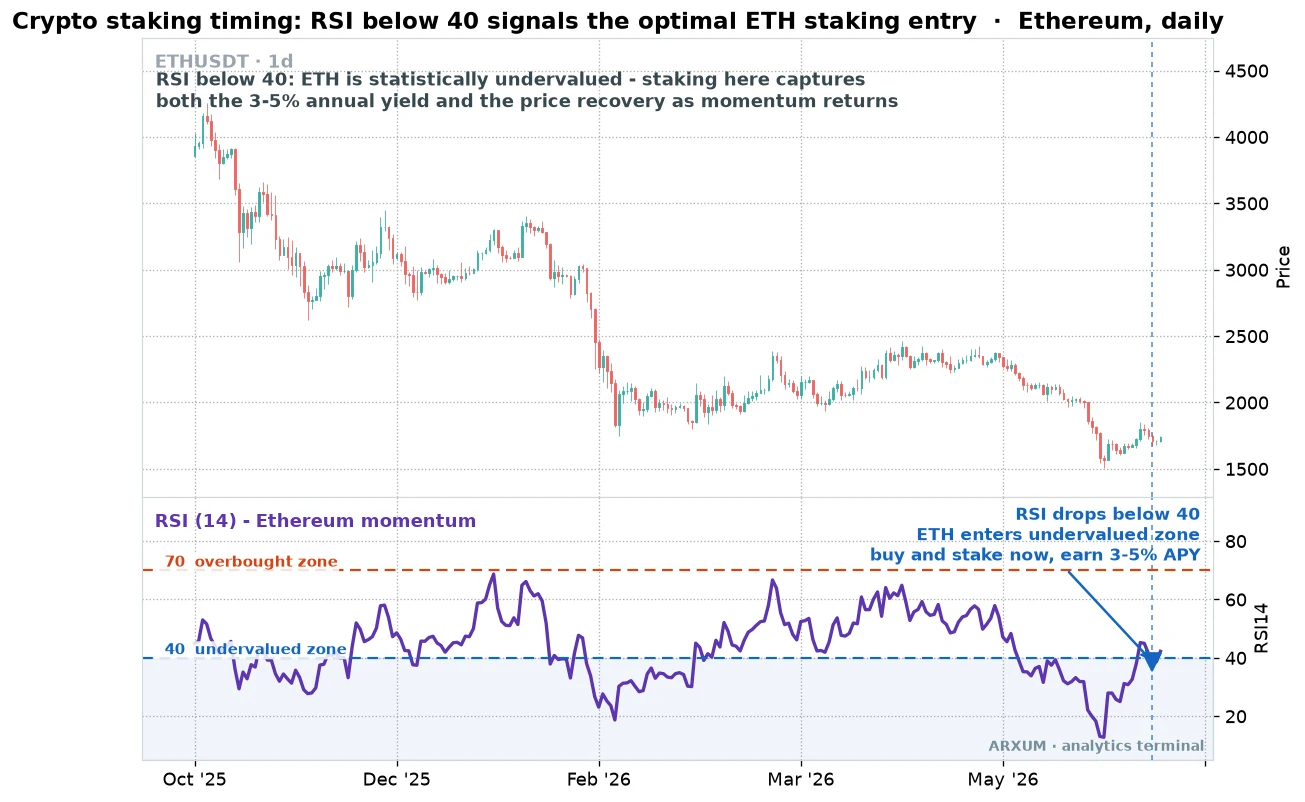
What the chart is showing:
- Top panel is the ETH price. The bottom panel is its RSI, a momentum gauge that runs from 0 to 100 and tells you whether the coin is stretched.
- The dashed orange line at 70 is the overbought zone, where a coin is hot and often near a short-term top. The dashed blue line at 40 marks the undervalued zone we care about here.
- The shaded band under 40 is the entry window. RSI dipping into it says price has fallen and momentum is exhausted, which is a friendlier place to lock coins away.
- The read: staking a coin that is already beaten down means the yield stacks on top of the price bounce, not on top of a further fall. Staking one that is overbought does the opposite.
Staking is not the same as a savings account, and not the same as simply holding. Here is the plain difference:
| What you do | You earn | Your coins are |
|---|---|---|
| Just hold | Only price moves | Free to sell any second |
| Stake | Price moves plus a yield | Often locked for days or weeks |
| Bank savings | A fixed interest rate | Cash, not a volatile asset |
The trade is simple to state. You accept less flexibility in exchange for a yield, and you take on the coin’s price risk the whole time it is locked.
How staking actually works
Proof-of-stake networks pick who confirms the next block of transactions by lottery, and your stake is your lottery ticket. The more coins committed, the more often you are chosen, and the more yield you collect.
You do not have to run the machine yourself.
- Validators run the software that confirms blocks. They need technical setup and, on some chains, a large minimum, such as 32 ETH for a solo Ethereum validator.
- Delegators are everyone else. You point your coins at a validator, they do the work, and you share the reward. This is what most people mean by staking.
- Bonding is the act of committing coins. Unbonding is pulling them back out, and on many chains it takes a waiting period before the coins are free again.
- Slashing is the penalty if a validator misbehaves or goes offline. Part of the stake can be burned, and delegators can share that loss.
Where the yield comes from matters, because not all of it is free money:
| Source | What it is | Catch |
|---|---|---|
| New issuance | Fresh coins the network prints for stakers | Dilutes holders who do not stake |
| Transaction fees | A share of fees paid by network users | Rises and falls with real usage |
A high number driven mostly by issuance is partly an illusion. If the network prints 12% new supply a year and you earn 12%, you have only kept pace with the dilution.
Real usage fees are the healthier part of any yield.
The five ways to stake
The mechanics are the same underneath, but the method decides your risk, your lock-up and your effort. Pick the row that matches how hands-on you want to be.
| Method | How it works | Typical yield | Main risk |
|---|---|---|---|
| Solo validator | You run the node yourself | Highest | Setup and slashing |
| Staking pool | Delegate to a validator | High | Validator downtime |
| Liquid staking | Get a tradeable receipt token | Medium | Smart-contract bugs |
| Exchange staking | The platform stakes for you | Lower | Counterparty, the platform holds keys |
| DeFi staking | Lock into an app or vault | Varies widely | Contract and protocol risk |
Short version of each:
- Solo validator: the most reward and the most control, and the most that can go wrong if your node drops offline. For confident, technical holders with the minimum stake.
- Staking pool: the default for most people. Your coins never leave your wallet on chains like Cardano, and you simply pick a validator.
- Liquid staking: you stake and receive a token that represents the staked coins, so you stay liquid and can use that token elsewhere. The extra layer is a smart contract, which is an extra thing that can break.
- Exchange staking: the easiest path. A few taps and the platform handles everything, at the cost of a lower yield and the platform holding your keys.
- DeFi staking: the widest range of yields and the widest range of risk. Read the contract, or trust someone who has.
What the main coins pay
Yields are not fixed. They float with how many people are staking and how busy the network is, so treat every number below as a typical range rather than a promise.
| Coin | Typical yield | Unbonding wait | Note |
|---|---|---|---|
| Ethereum (ETH) | 3 to 5% | Days, via an exit queue | Deepest liquid-staking options |
| Solana (SOL) | 6 to 8% | A few days | Fast to unstake |
| Cardano (ADA) | 2 to 4% | None | Coins stay in your wallet |
| Polkadot (DOT) | 10 to 14% | About 28 days | High yield, long lock |
| Cosmos (ATOM) | 15 to 19% | About 21 days | High yield, high inflation |
| Avalanche (AVAX) | 7 to 9% | Until the lock term ends | You choose a fixed term |
The headline number is a trap on its own. A 17% yield behind a 21-day exit and heavy coin printing is not obviously better than a 4% yield you can leave any day.
The next section is why.
When to stake: reading the crypto cycle
The single biggest lever on a staking return is not the coin, it is the market you lock into. Crypto moves in long cycles, and the cleanest clock is Bitcoin’s own 90-day return.
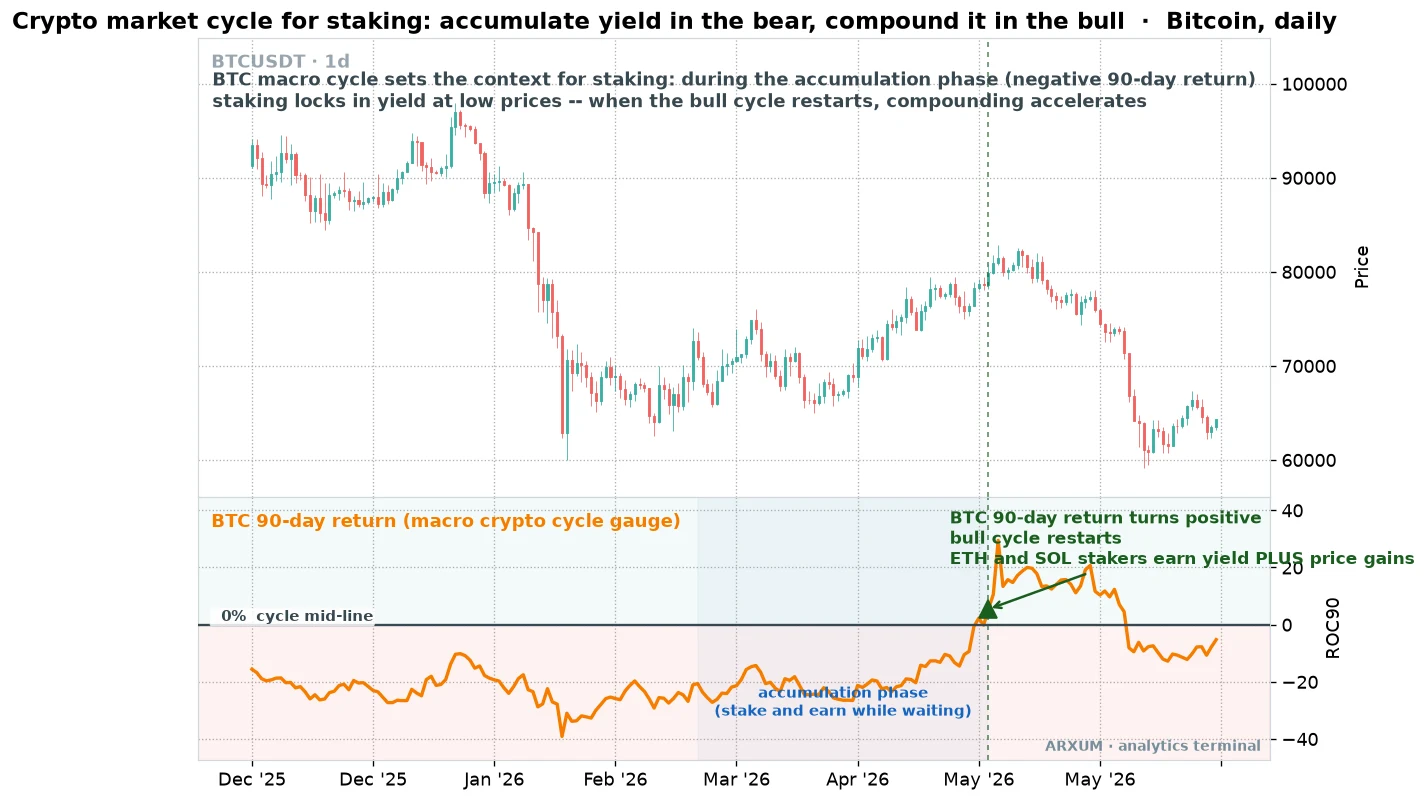
How to read the cycle for staking:
- The 90-day return is simply how much Bitcoin has gained or lost over the last three months, in percent. It is the market’s slow pulse.
- The red zone, below the zero line, is the accumulation phase. Prices are soft and momentum is negative. This is the boring stretch where staking earns yield while you wait for the turn.
- The green zone, above zero, is where the bull cycle restarts. Coins you staked cheap now pay yield on top of a rising price, and the two compound together.
- The dashed vertical line marks the crossing from negative to positive, the moment the cycle flips. That is the handoff from patience to payoff.
The lesson is uncomfortable but simple. The best time to lock coins away is when nobody wants them, deep in the red zone, not when every headline is screaming about a new high.
For a fuller read of that rotation, see how an altcoin season forms off the same Bitcoin momentum, and how the funding rate flags an overheated top you would rather not stake into.
The price risk the yield poster never shows
Every staking page leads with the yield. Almost none of them show you the chart of what your locked coin can do while you cannot touch it.
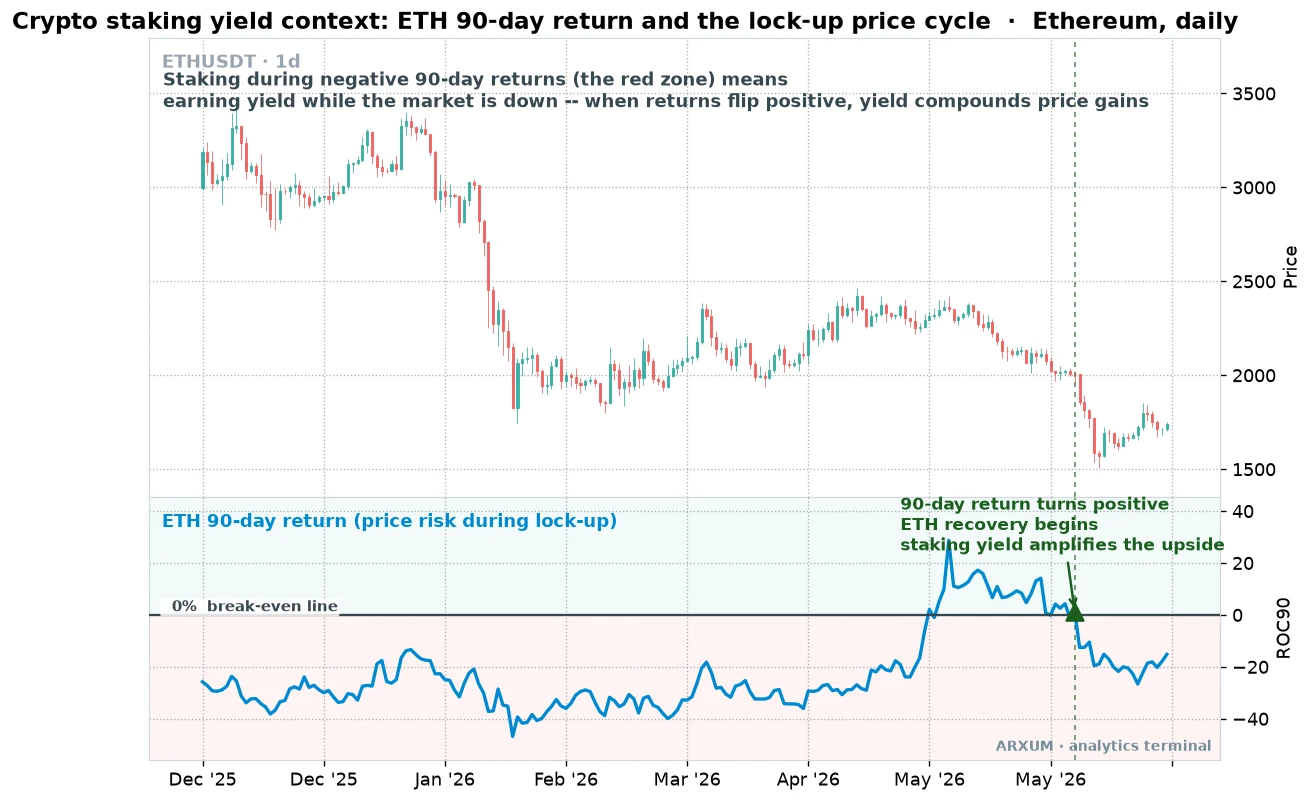
A yield does not protect you from a drawdown, it only softens it. If a coin pays 4% a year and falls 30% in a quarter while locked, you are still down heavily, and you could not sell.
That is the risk the poster hides.
| Risk | What it means | How to limit it |
|---|---|---|
| Lock-up | Coins frozen through the unbonding wait | Prefer short or no-lock chains |
| Price drawdown | The coin falls while you are locked | Stake in the red zone, not the top |
| Slashing | Validator penalty hits your stake | Pick validators with long uptime |
| Smart contract | A bug drains a liquid or DeFi pool | Stick to audited, large protocols |
| Counterparty | An exchange holds your keys | Use a wallet you control where you can |
| Real yield | Coin inflation eats the headline rate | Check issuance, not just the APY |
Two of these are worth reading twice. A stop-loss does nothing for a locked coin, so the sharp price swings that can trigger a liquidation elsewhere are pure exposure here.
And a validator you delegate to still needs to behave, because slashing can reach your share of the stake.
Real yield: what you actually keep
Nominal yield is the number they advertise. Real yield is what is left after the network dilutes you and after the price moves.
Work it in that order.
- Start with the headline APY. Say a chain pays 14%.
- Subtract the coin’s inflation. If the network prints roughly 10% new supply a year, your real earning rate is closer to 4%.
- Then layer on the price move, which dwarfs both. A 4% real yield means nothing if the coin drops 25% while locked, and it barely registers if the coin doubles.
So the ranking of what matters, largest first, is price, then real yield, then the headline APY. Most beginners rank it exactly backwards.
How to start staking, step by step
You do not need a validator or a server. The delegated path takes minutes.
- Pick the coin and the reason. Decide whether you want a no-lock chain like Cardano for flexibility, or a higher-yield chain like Cosmos and accept the wait.
- Choose your method from the five above. Beginners usually start with a staking pool in their own wallet, or exchange staking for the simplest route.
- Get the coins into the right place. A self-custody wallet for pool or liquid staking, or your account on the platform for exchange staking.
- Check the timing before you commit. Glance at the coin’s daily RSI and the 90-day cycle. Locking in near the top of an overbought move is the mistake to avoid.
- Delegate and confirm. In a wallet, open the staking tab, choose a validator with strong uptime and a fair commission, then confirm. On an exchange, tap stake and pick a term.
- Note the unbonding wait so it never surprises you. Write down the day your coins become free again.
For the wallet side of all this, our crypto trading guide walks through custody and getting a first position on chain.
Which method fits you
There is no best method, only the one that fits your patience and your risk appetite. Match yourself to a row.
| If you want | Best method | Why |
|---|---|---|
| The simplest start | Exchange staking | A few taps, no wallet setup |
| To keep control of keys | Staking pool | Coins stay in your wallet |
| To stay liquid | Liquid staking | You get a tradeable receipt token |
| The highest yield | Solo or DeFi | More reward, more that can break |
| No lock-up at all | A no-bond chain | Cardano and similar free you instantly |
What to remember
- Staking is two decisions, not one. The coin and method are the easy part. The timing, where the cycle is when you lock, is what separates a good stake from a painful one.
- Yield never beats price. A few percent a year is a cushion, not a shield. Stake into weakness, in the red zone, so the yield rides a recovery.
- Read past the headline APY. Subtract inflation for the real rate, and check the unbonding wait before you commit anything.
- Keep control where you can. A pool or a self-custody wallet keeps your keys yours. Convenience on an exchange costs you that.
Key terms
- Proof of stake: the system where committed coins, not mining power, decide who confirms blocks.
- Validator: the operator running the node that confirms transactions.
- Delegating: pointing your coins at a validator so you earn without running anything.
- Unbonding: the waiting period before staked coins become free to move again.
- Slashing: the penalty that burns part of a stake when a validator misbehaves.
- Liquid staking: staking that hands you a tradeable token representing your locked coins.
- Real yield: the headline APY after network inflation and price moves are accounted for.
FAQ
What is crypto staking, in plain terms?
It is locking a proof-of-stake coin to help run its network, and getting paid a yield for doing so. You are renting your coins to the blockchain, and the yield is the rent. Most people do it by delegating to a validator rather than running anything themselves.
Is crypto staking worth it?
It can be, but the yield is small next to the coin's price swings. A few percent a year is a cushion, not the main event. Staking is worth it when you already want to hold the coin for a long time and you lock in when the market is soft, not when it is overheated.
How much can you earn staking crypto?
Typical yields run from about 2 to 5% on Ethereum and Cardano up to 15% or more on Cosmos. Higher numbers usually come with heavy coin inflation and longer lock-ups, so the real rate you keep is often much lower than the headline.
Can you lose money staking crypto?
Yes. The main way is the coin's price falling while it is locked and you cannot sell. Smaller risks are slashing, where a misbehaving validator costs you part of your stake, and smart-contract bugs in liquid or DeFi staking. The yield softens a drawdown, it does not stop one.
What is the best time to stake?
When a coin is beaten down and its momentum is washed out, so the yield compounds into a recovery. On the charts, that is the daily RSI dropping toward or below 40, and the 90-day return sitting in negative territory. Locking in near an overbought top is the timing mistake to avoid.
What is the difference between staking and holding?
Holding earns only the price move and lets you sell any second. Staking adds a yield on top of the price move, but freezes the coins for a lock-up period on most chains. You are trading flexibility for the extra yield.
Which coin is best for staking beginners?
Ethereum and Cardano are the gentle starts. Ethereum has the deepest liquid-staking options, and Cardano has no lock-up at all with coins that never leave your wallet. Both pay modest yields, which is the honest trade for lower risk and easy access.
Is exchange staking safe?
It is the easiest method but not the safest. The platform holds your keys, so you carry counterparty risk if the exchange fails. If keeping control matters, a staking pool from your own wallet gives you the same yield without handing over custody.
What is liquid staking?
You stake a coin and receive a receipt token that represents it, which stays tradeable and usable elsewhere while the underlying coins earn. It solves the lock-up problem, at the cost of one extra smart contract that could hold a bug. Stick to large, audited protocols.
Do I have to lock my coins to stake?
Not always. Cardano and a few other chains let coins stay liquid in your wallet with no bonding period. Most chains do lock coins through an unbonding wait, from a few days on Solana to about a month on Polkadot, so always check that wait before you commit.
Real-time trade setups with entry, stop loss and take profit. Daily market analysis. No subscription, no complicated theory.
🌍 Our recommended brokers


Reader Reviews
Be the first to review this — tell other traders what actually helped, or where it fell short.
Leave a Review

Forex Analyst & Senior Trader
Former FX desk trader with 8 years in institutional forex. Works in multi-timeframe analysis and order flow, turning desk experience into systematic, testable rules across forex and metals.