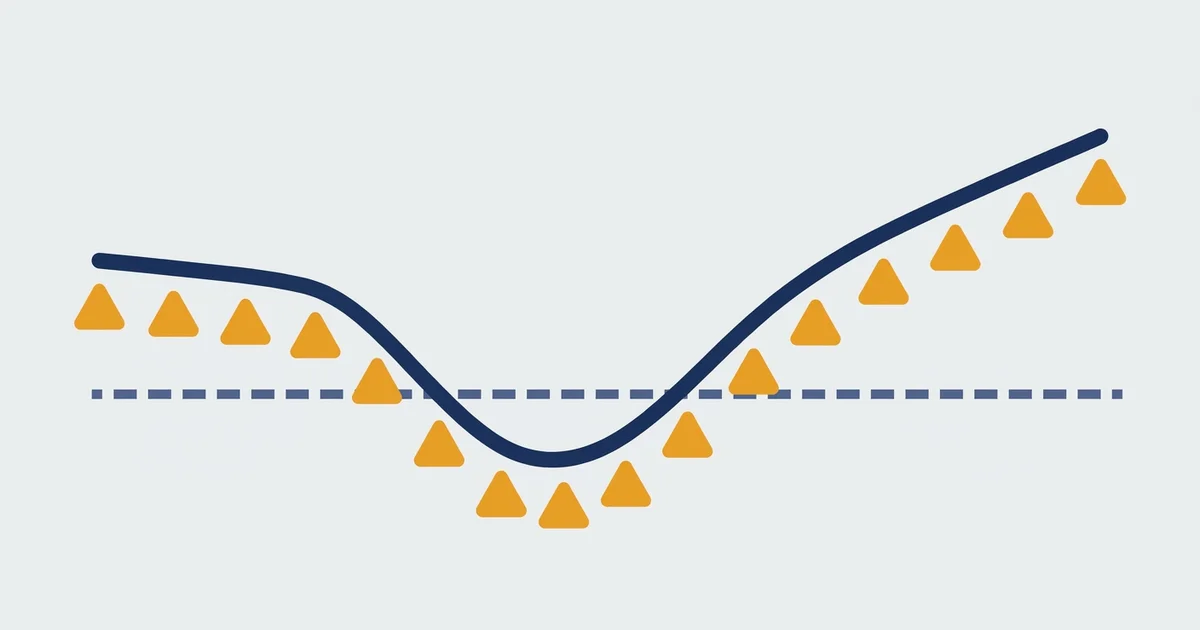

What dollar-cost averaging actually is
DCA is a schedule, not a signal. You decide an amount and an interval, then you buy on that schedule and ignore the noise in between.
Here is the whole idea on one chart before we break down the parts.
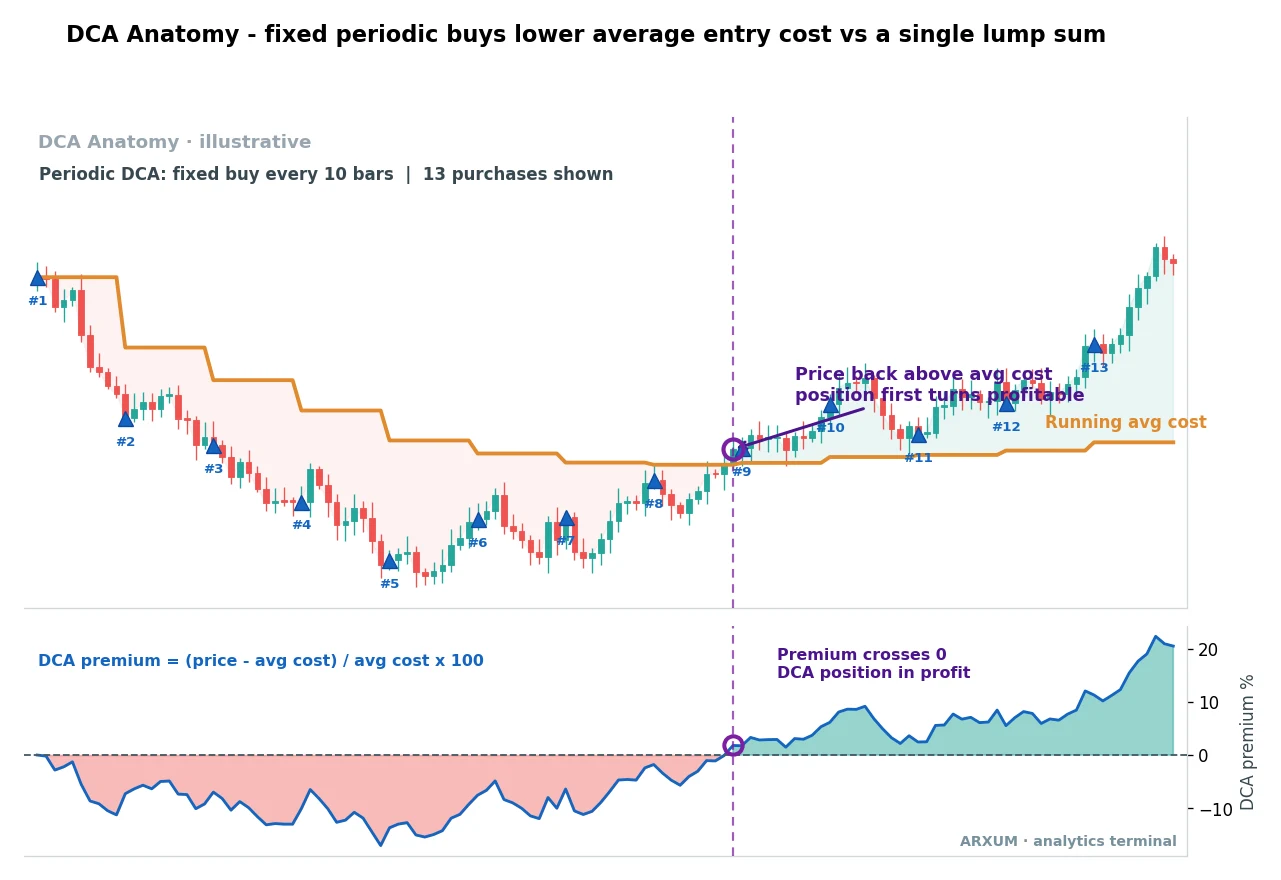
The chart shows the three moving parts of any DCA plan.
- The buys are the blue triangles, spaced evenly in time. Same money, same gap between them, regardless of price.
- The average cost is the orange step line. It is the running break-even for everything you have bought so far.
- The profit and loss is the shading. Above the average line you are up, below it you are down, and that is the only score that matters.
The single trick worth understanding is the average-cost line. Because your money is fixed but the price is not, a low price hands you more units for the same cash, and those cheap units drag the average down.
You buy more when it hurts and less when it feels good, automatically, without deciding anything.
Why DCA works: the average-cost engine
The whole edge is arithmetic, not prediction. Fixed money plus a moving price means you buy more units when price is cheap.
| Price on buy day | What your fixed sum does | Effect on average cost |
| High | Buys fewer units | Small pull upward |
| Middle | Buys a normal slice | Holds it steady |
| Low | Buys more units | Strong pull downward |
A couple of plain points fall out of that table.
- The dips do the heavy lifting. A scary drop is where DCA quietly loads up the most units.
- Your average cost is not the middle price. It leans toward wherever you bought the most units, which is the lows.
- You never need to call a bottom. The schedule catches the bottom for you, just not only the bottom.
That is why DCA suits people who cannot watch charts all day. The method does the discipline so you do not have to.
The three ways people run a DCA strategy
Most of what gets called “a DCA strategy” is one of three variants. They share the fixed-schedule spine and differ in how much you flex the buys.
Plain calendar DCA
The classic. Same amount, same interval, forever, and you never touch the dial.
This is what most people mean by DCA investing.
| Piece | How you set it | Best fit |
| Amount | One fixed sum every buy | Cash you can spare each month |
| Timing | Fixed date, ignore the price | Payday, first of the month |
| Dips | Do nothing, keep buying | The dips buy extra units for you |
| Instrument | Anything you plan to hold | Broad crypto, gold, index funds |
| Exit | Hold long term, or DCA out later | Multi-year horizon |
Why people default to it:
- Zero decisions. You can automate it and forget it.
- No timing regret, because you were never trying to time anything.
- It is the version brokers and exchanges let you schedule with one setting.
Dip-weighted DCA and value averaging
A step up in effort. You still buy on a schedule, but you buy bigger when price sits below your average cost, and smaller or not at all when it runs far above.
| Piece | How you set it | Best fit |
| Base buy | A normal fixed sum on schedule | The floor you always commit |
| Dip trigger | Add more when price is a set % below your average | A rule like 5% or 10% under |
| Extra cash | A reserve kept aside for dips | Money you can leave parked |
| Discipline | The rule buys, not your mood | People who panic-freeze on red days |
| Exit | Same as calendar, hold or scale out | Long horizon |
Value averaging is the same idea taken further. Instead of a fixed sum you target a fixed growth in portfolio value, then buy whatever it takes to hit that value each period.
It buys a lot in a crash and almost nothing in a melt-up.
- It lowers your average cost faster than plain DCA in a choppy or falling market.
- It needs a cash reserve and a firm rule, or it turns into guessing.
- It can leave money idle for long stretches while it waits for a dip that may not come.
DCA out: scaling out the same way
DCA is not only for buying. The same fixed-slice logic works on the way out, selling a set piece of your stack at each step so you never have to call the exact top.
| Piece | How you set it | Best fit |
| Slice | Sell a fixed % of the position each step | Locking gains gradually |
| Trigger | By interval, or by price rungs above cost | A parabolic run you distrust |
| Goal | Average a good exit, not a perfect one | People who sell too early or too late |
| Leftover | Keep a "never sell" core if you want | Long-term holders |
The trade-off is the mirror image of buying in. You give up the best possible exit for a decent average one you can actually execute without freezing.
DCA across markets: crypto, gold and Forex
The method ports anywhere you can buy in slices. What changes market to market is the volatility it has to chew through and how the average-cost line behaves.
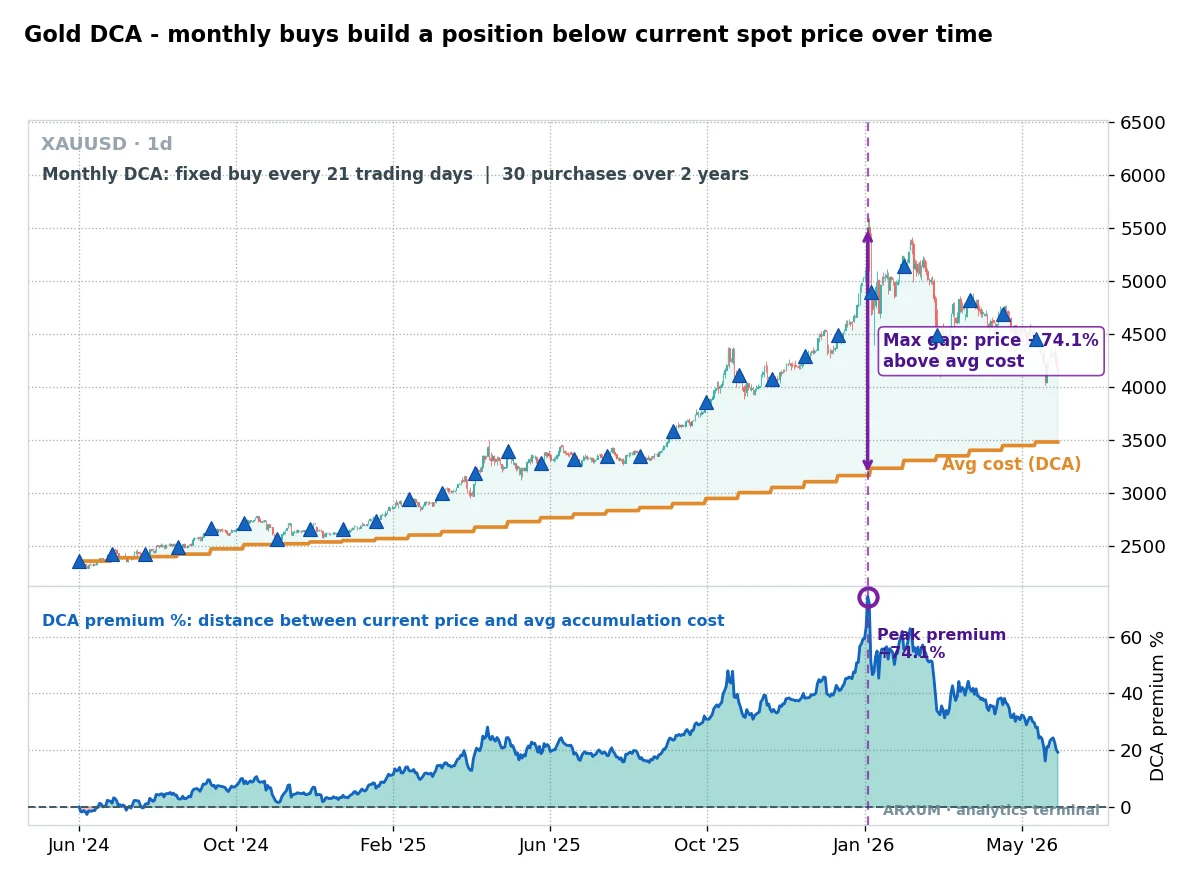
Gold is the calm end of the range. A monthly DCA into a rising metal keeps the average cost climbing but sitting comfortably under price.
Crypto is the wild end, and it is where DCA earns its reputation. Bitcoin swings hard enough that the dip-buying effect on your average cost is large, which is why “DCA crypto” is such a common search.
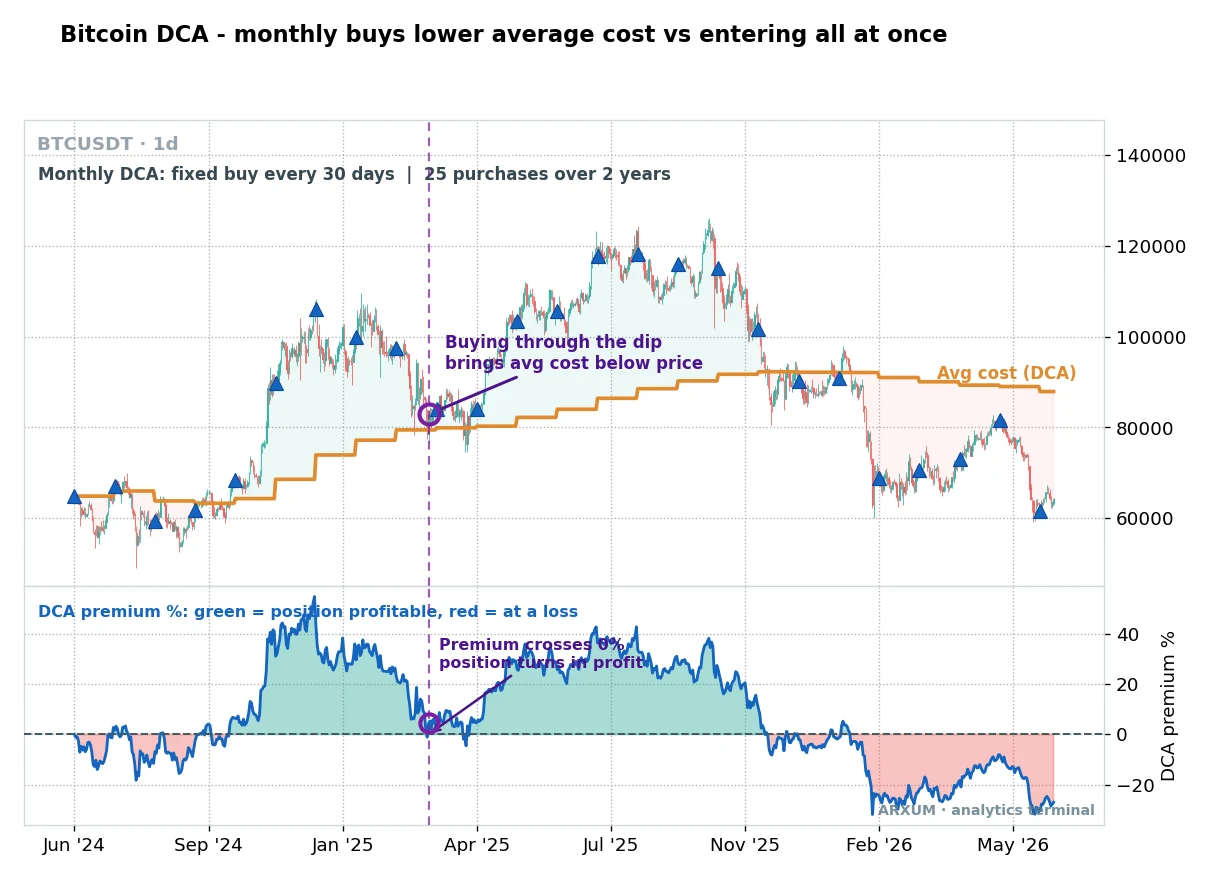
The catch is that the same volatility can leave you underwater for a long time before it pays.
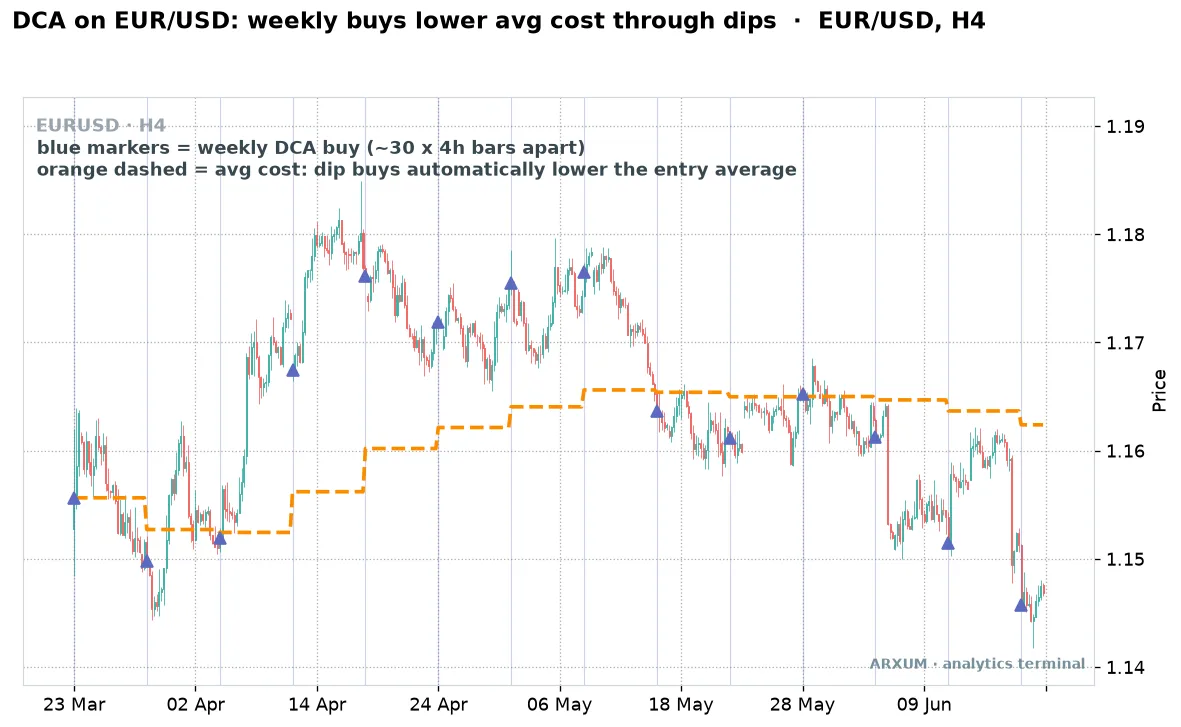
Forex sits in between, and it behaves differently again. A currency pair like EUR/USD spends long stretches ranging rather than trending, so a DCA average-cost line settles into the middle of the range instead of climbing.
| Market | How the average line acts | Watch out for |
| Crypto (BTC, ETH) | Big dips load lots of cheap units | Long underwater stretches |
| Gold (XAU/USD) | Steady climb, average trails price | Trend can outrun your buys |
| Forex majors (EUR/USD) | Settles in the middle of a range | No trend to carry the stack |
A few honest notes on the market fit:
- DCA rewards things that grind higher over years. It struggles on anything that just chops sideways with no long-run drift, which is often how a major currency pair behaves.
- On a Forex pair, DCA is really an accumulation habit, not a trade. It has no stop-loss and no target, so it is not a substitute for the position sizing you would use on an active setup. If you trade EUR/USD actively, see the position sizing guide instead.
- Crypto is the natural home because the volatility is the fuel. A bear market is exactly where a steady DCA plan quietly builds the cheapest part of the stack, and a full altcoin season is often what pays it off.
How often should you buy?
Frequency matters less than most people think, as long as you actually keep to it. Buying more often smooths the average a little but adds fees and admin.
| Interval | Buys per year | The trade-off |
| Daily | Around 250 to 365 | Smoothest average, most fees and clutter |
| Weekly | 52 | A good middle, easy to automate |
| Monthly | 12 | Fewest fees, lines up with payday |
The read on frequency:
- The gap between monthly and weekly is small in the end. Both catch the dips over time.
- Fees decide it more than smoothness does. On a market with a fixed fee per buy, buying daily can quietly eat the benefit.
- The best interval is the one you will not skip. A plan you follow beats a clever plan you abandon.
DCA versus lump sum
The honest comparison. If you already hold the cash and the market drifts up over time, dropping it all in at once usually wins on paper, because your money is in the market sooner.
DCA wins on the parts that are not on paper.
| Your situation | Lump sum | DCA |
| You have a big pile of cash now | Usually wins if markets drift up | Safer if the top is near |
| You earn and save monthly | Not an option, cash is not there yet | The natural fit |
| You are scared of buying the top | Hard to stomach | Spreads the risk out |
| You want zero decisions | One big decision | No decisions at all |
- Lump sum tends to win the maths in a rising market, because time in the market beats timing it.
- DCA wins the psychology, and psychology is what makes people actually stay invested.
- For most people who earn and save each month, it is not even a choice. You DCA because the money arrives in slices.
When DCA works and when it doesn’t
DCA is a tool with a job, not a magic setting. It fits some markets and horizons and quietly fails on others.
DCA works well when:
- You are buying an asset you believe grinds higher over years, like broad crypto exposure or gold.
- You have a long horizon and can leave the stack alone through drawdowns.
- Volatility is high, so the dip-buying effect on your average cost is real.
- You would otherwise freeze and never buy at all.
DCA works poorly when:
- The asset has no long-run drift and just chops, so there is no trend to carry the stack.
- You need the money soon, because a bad stretch can leave you underwater when you have to sell.
- You are DCA-ing into a single hyped coin near a blow-off top with no plan to hold through the crash.
- The fees per buy are high and your interval is short, so costs eat the benefit.
The honest limit worth repeating: DCA controls your entry risk, it does not remove market risk. If the thing you are buying goes to zero, a steady schedule into it just buys the whole way down.
Which approach to use when
A quick map from your situation to the version that fits.
| If you | Use |
| Want set-and-forget, zero effort | Plain calendar DCA |
| Have spare cash and can act on dips | Dip-weighted DCA |
| Want to buy the most on crashes | Value averaging |
| Are sitting on a big gain and fear the top | DCA out in slices |
| Trade a ranging Forex pair actively | Not DCA, size each trade instead |
The takeaway
Strip it back and dollar-cost averaging is three habits that work:
- Fix the amount and the interval, then buy no matter what. The schedule removes the timing decision that trips most people up.
- Let the dips do the work. Fixed money buys more units when price is low, so your average cost leans toward the cheap end on its own.
- Match it to the right asset and horizon. DCA rewards things that grind higher over years and a long time to hold. It does not fix a bad asset or a short deadline.
DCA will not hand you the best entry. It hands you a decent one you can repeat for years without flinching, and for most investors that is the trade worth making.
Glossary
- Dollar-cost averaging (DCA): buying a fixed amount at a set interval regardless of price.
- Average cost: the running break-even price of everything you have bought so far.
- Calendar DCA: the plain version, same sum on a fixed schedule, no adjustments.
- Dip-weighted DCA: buying extra when price sits below your average cost.
- Value averaging: targeting a fixed growth in portfolio value each period, buying whatever it takes to hit it.
- DCA out: selling a fixed slice at each step to average your exit instead of your entry.
- Lump sum: investing all your cash at once instead of in slices.
- Underwater: holding a position that is currently worth less than your average cost.
- Interval: the fixed gap between buys, such as weekly or monthly.
- Drawdown: the drop from a peak in value to a later low, the pain you sit through.
FAQ
What is DCA investing, in plain terms?
DCA investing, or dollar-cost averaging, means buying a fixed amount of an asset at a set interval no matter what the price is doing. For example, you might put the same sum into Bitcoin or gold on the first of every month and keep going for years. Because your money is fixed but the price moves, a low price buys you more units and a high price buys fewer, so your average cost settles in the middle of the swings. The point is to stop trying to time the market and just keep a steady habit you can stick to.
Does dollar-cost averaging actually work?
It works for what it is designed to do, which is remove the timing decision and lower your average cost through the dips. It does not guarantee a profit and it will usually lose to a perfectly timed lump sum in a rising market, because that money is in sooner. The real win is behavioural. DCA keeps people invested through scary drops instead of freezing, and staying invested is what actually builds returns over years. It works best on assets that grind higher over a long horizon.
How do you dollar cost average crypto?
Pick an amount you can commit regularly, pick an interval like weekly or monthly, and buy that fixed sum of the coin on schedule regardless of the price. Most exchanges let you automate this with a recurring buy so you never have to decide. Crypto is a common home for DCA because the volatility is large, so the dips load a lot of cheap units into your average cost. The trade-off is that the same volatility can leave you underwater for a long stretch, so only use money you can leave alone for years.
Is DCA better than lump sum investing?
It depends on your situation. If you already hold a big pile of cash and the market drifts up over time, a lump sum usually wins on paper because your money is working sooner. DCA wins when you are scared of buying near a top, when you cannot stomach putting it all in at once, or when you earn and save monthly so the cash arrives in slices anyway. For most regular savers it is not even a choice, because you DCA by default as each paycheck lands.
How often should I buy when I DCA?
Weekly or monthly is the sweet spot for most people. Buying more often, like daily, smooths your average cost a little but adds fees and admin, and on a market with a fixed fee per buy those costs can quietly eat the benefit. Monthly lines up neatly with payday and keeps fees low. The gap between weekly and monthly is small over time, so the honest answer is to pick the interval you will actually keep to without skipping.
What is the difference between DCA and value averaging?
Plain DCA buys the same fixed sum every period, and you never adjust it. Value averaging instead targets a fixed growth in your portfolio value each period, then buys whatever amount it takes to hit that target. That means it buys a lot after a crash and almost nothing after a big run, so it lowers your average cost faster in a choppy market. The cost is more effort, a cash reserve to fund the big dip buys, and stretches where your money sits idle waiting for a dip.
Can you lose money with dollar-cost averaging?
Yes. DCA controls the risk of buying at the wrong time, but it does nothing about the risk that the asset itself falls and stays down. If you steadily buy something that keeps dropping or goes to zero, a fixed schedule just buys it the whole way down. That is why DCA belongs on assets you believe grind higher over years, and why the money should be capital you can afford to leave invested through a long drawdown.
Does DCA work on Forex?
Less well than on crypto or gold, and for a clear reason. A major currency pair like EUR/USD tends to range for long stretches rather than drift steadily higher, so there is no long-run trend to carry your stack, and your average cost just settles in the middle of the range. DCA relies on an asset that grinds up over time. On Forex it is really an accumulation habit rather than a trade, with no stop-loss or target, so for active currency trading you are better off sizing each position properly instead.
When should you DCA out, or sell in slices?
DCA out uses the same fixed-slice logic on the way out. Instead of trying to call the exact top, you sell a set piece of your position at each step, either on an interval or as price climbs above your cost. It fits a parabolic run you distrust, or anyone who tends to sell way too early or hold way too long. You give up the perfect exit for a decent average one you can actually execute without freezing, and you can keep a core you never sell if you still believe long term.
🌍 Our recommended brokers


Reader Reviews
Be the first to review this — tell other traders what actually helped, or where it fell short.
Leave a Review

Forex Analyst & Senior Trader
Former FX desk trader with 8 years in institutional forex. Works in multi-timeframe analysis and order flow, turning desk experience into systematic, testable rules across forex and metals.