

The doubling math, and why it seduces everyone
Picture a bet you win about half the time, and you stake one unit. Lose, and you stake two.
Lose again, stake four, then eight, then sixteen.
The first win recovers everything you lost in the streak and leaves you one unit ahead. On paper it looks unbeatable.
That is the martingale betting system, and gamblers have chased it for three hundred years.
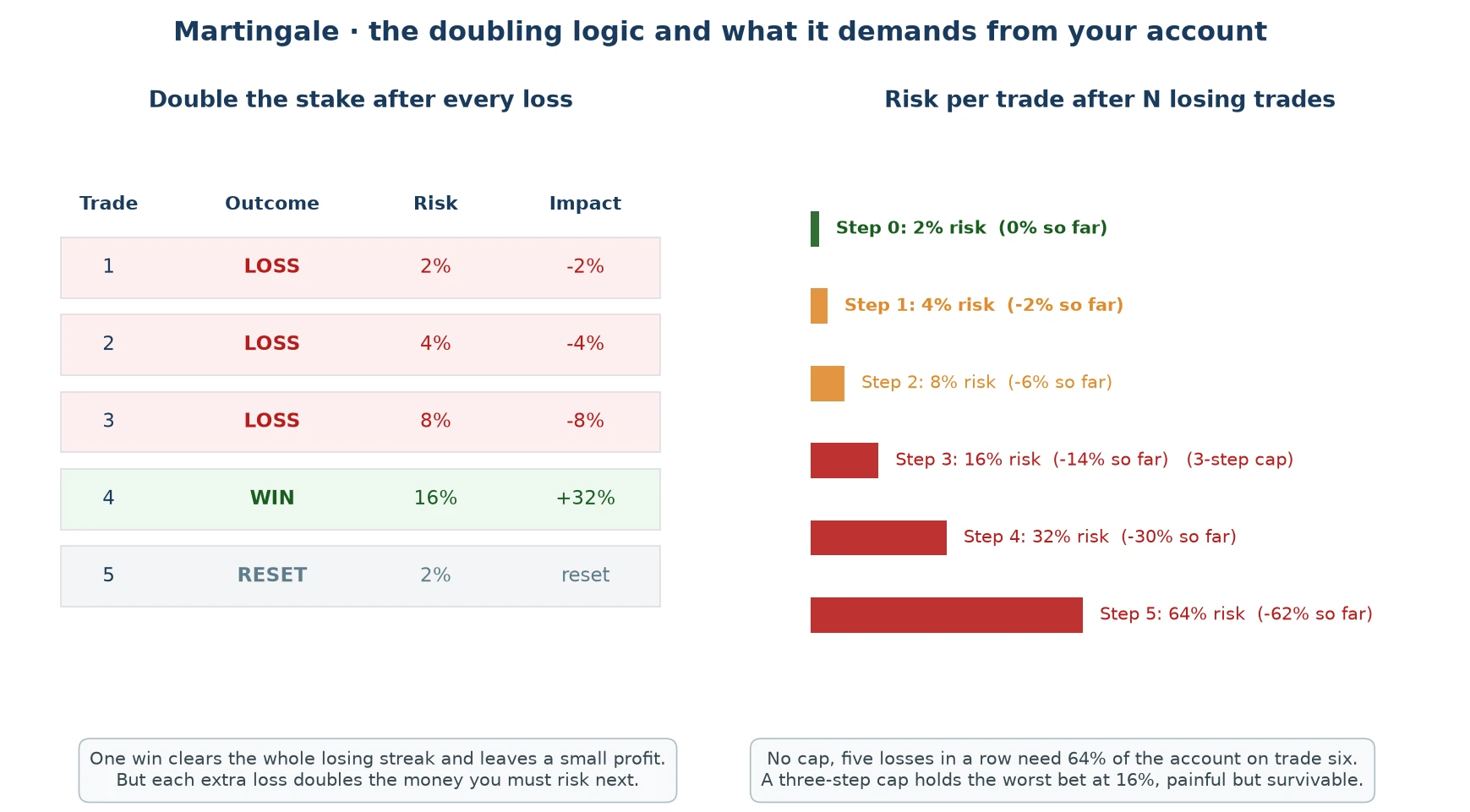
Look at how fast the right side of that ladder grows. Five losses in a row, and the sixth bet has to be 64% of the whole account just to claw back to even.
Here is the catch the sales pages skip. A losing streak longer than your capital can cover wipes you out completely, and markets serve up long streaks far more often than a fair coin suggests.
The whole idea lives or dies on one question. Is your edge good enough, and busy enough, to let the doubling recover before it ruins you?
That is the question we actually put numbers on.
What the martingale strategy really is
Martingale is not a way to find trades. As a martingale trading strategy it sits on top of a signal and only decides how big each trade is.
So it needs a base signal to ride. We compared three sizing rules on the exact same trades:
- Fixed: risk a steady 2% of the account on every trade, win or lose. The default, and the benchmark.
- Martingale: double the risk after each loss, reset to 2% after a win. Capped at three doublings so it cannot run to infinity.
- Anti-martingale: the mirror. Double after each win, reset after a loss. You press when you are hot, not when you are cold.
Same entries, same exits, same stops. The only thing that changes is the size of the bet.
That is the clean way to see what the sizing rule alone does.
We ran it on four real strategies, not a toy signal
To judge a sizing rule you need signals that already make money, plus one that does not, for contrast. So we did not invent a base strategy for this.
We took four setups straight from our own tests, kept each one’s exact trade sequence, and re-sized every trade three ways. Fixed 2%, martingale, and anti-martingale, on the same trades in the same order, with only the bet size changing.
Every run starts at $1,000 and risks 2% as the base unit. Martingale doubles that risk after a loss and resets on a win; anti-martingale doubles after a win and resets on a loss.
Both doublers are capped at three steps, so the most either ever stakes is 16% on a single trade. The win and loss sizes come from each strategy’s own tested history, with nothing re-tuned to flatter the result.
One note on the charts below. The extra lines and lower panels are each strategy’s own trend and momentum context, and you can ignore them for the sizing story, which only tracks the run of wins and losses.
Watch the max drawdown column in the tables too. That is the deepest the account ever fell from a high before recovering, so it measures the worst stretch you would have had to hold through.
Turtle breakout on gold: the trend the doubling loves
The Turtle breakout buys gold when it pushes to a fresh multi-week high and rides the move. It comes straight from the famous 1980s Turtle traders, who bought breakouts to new highs and let a running trend do the heavy lifting.
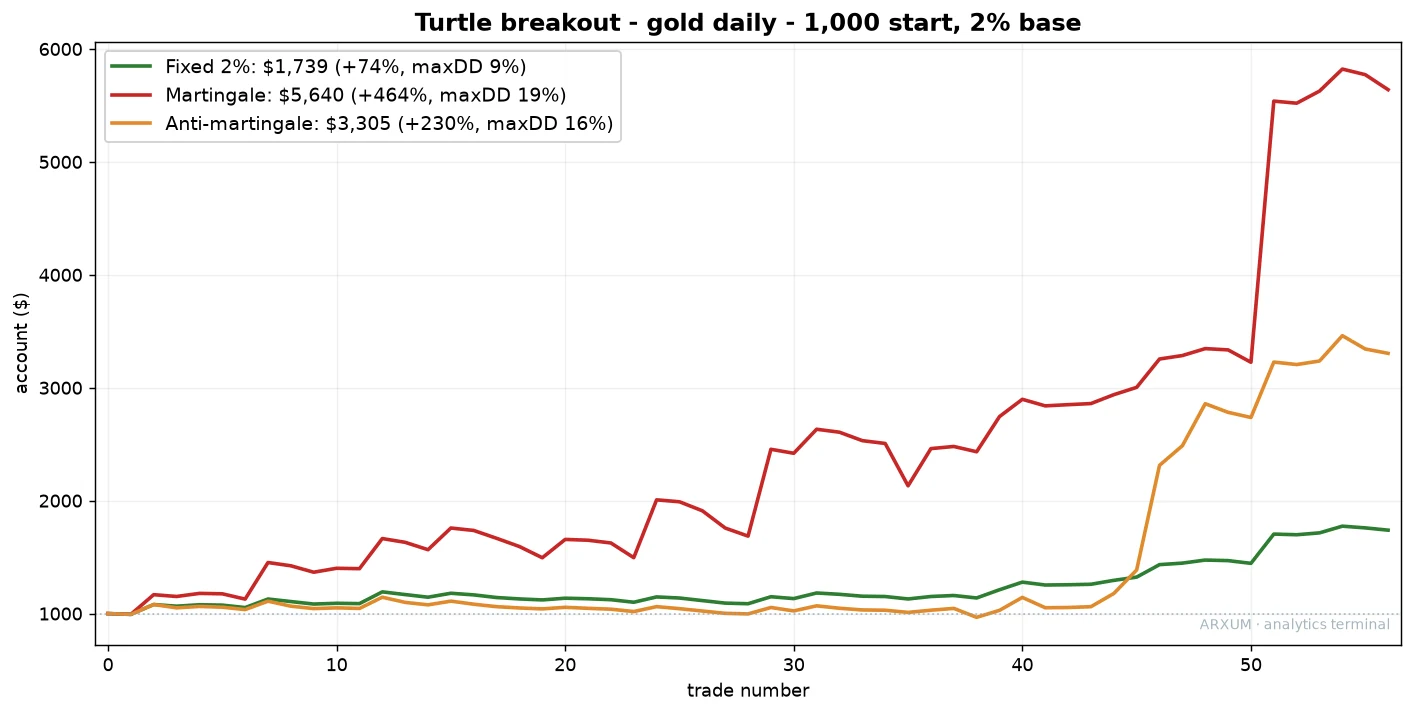
On fixed 2% it grew $1,000 into $1,739 over 56 trades, a calm +74% with a 9% worst dip.
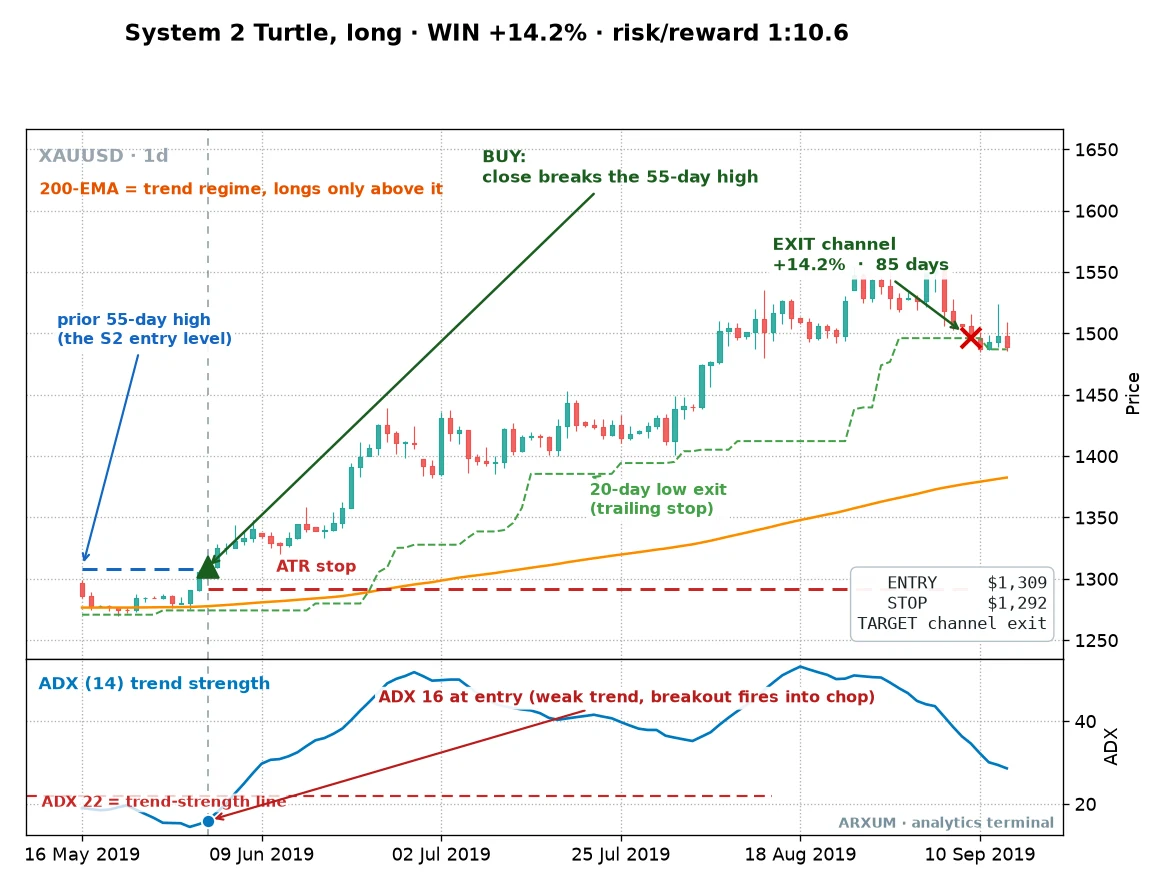
Now double after losses. Martingale rode the same 56 trades to $5,640, a +464% run, because a strong trend hands you long winning streaks and the doubling compounds them.
| Sizing rule | End balance | Growth | Max drawdown |
| Fixed 2% | $1,739 | +74% | 9% |
| Martingale | $5,640 | +464% | 19% |
| Anti-martingale | $3,305 | +230% | 16% |
The price of that +464% is the drawdown. It ran at 19% against fixed sizing’s 9%, so you more than doubled the swings to chase the bigger number.
VWAP reclaim on gold: where the drawdown balloons
The VWAP reclaim buys gold when price reclaims its volume-weighted average in an uptrend. VWAP is the average price weighted by how much traded at each level, so reclaiming it says buyers took control back at fair value.
Fixed 2% made a steady +43% across 45 trades with a 7% worst dip.
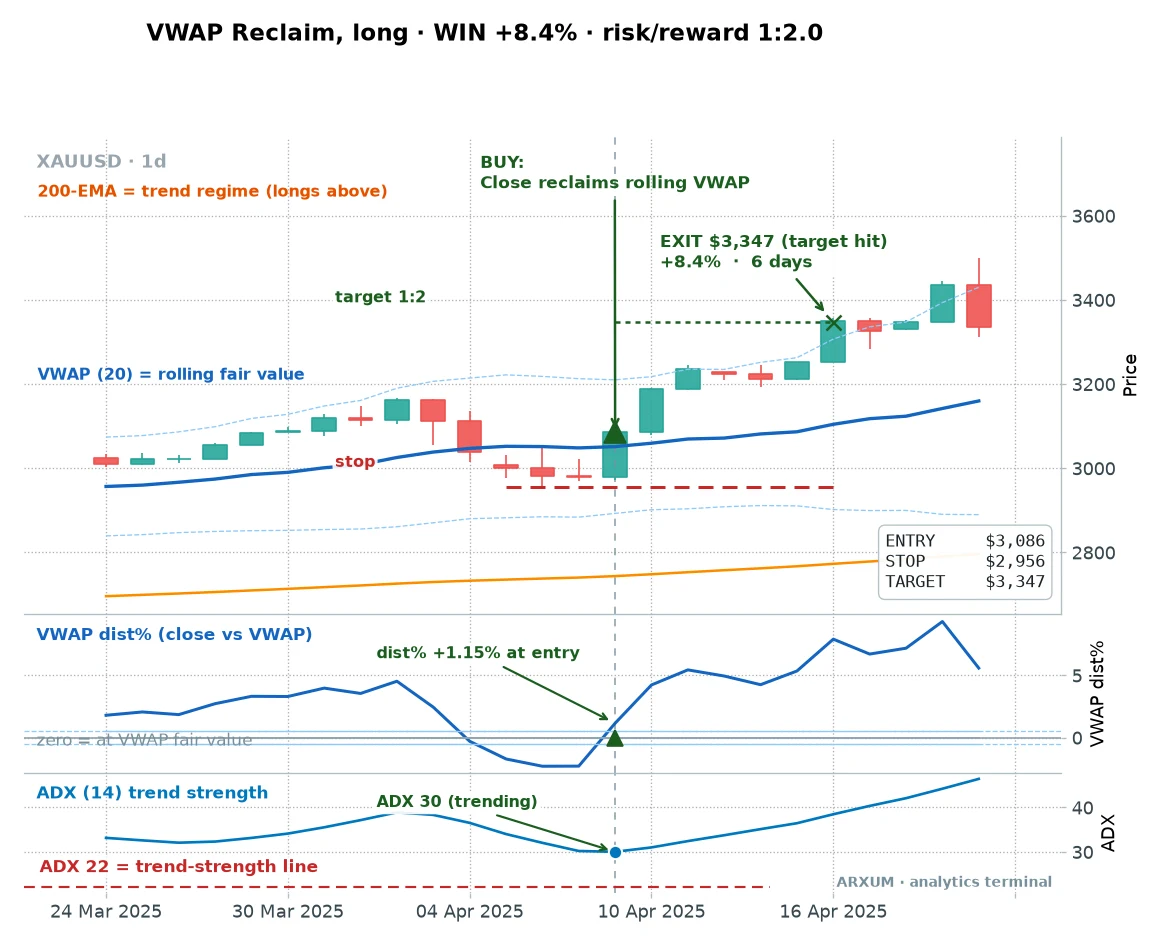
Here martingale barely lifted the return to +70%, but the worst drawdown ballooned to 40%. Anti-martingale won this one outright at +103%, and with half the pain.
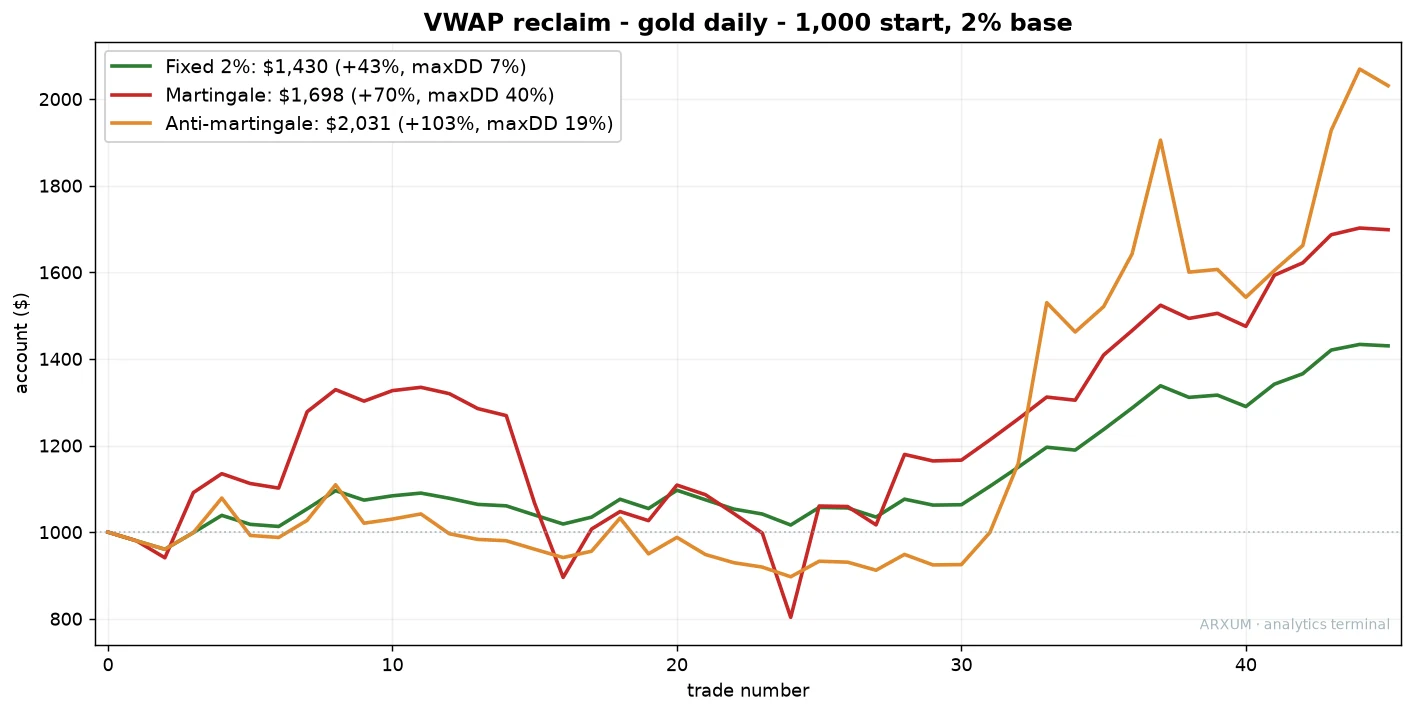
| Sizing rule | End balance | Growth | Max drawdown |
| Fixed 2% | $1,430 | +43% | 7% |
| Martingale | $1,698 | +70% | 40% |
| Anti-martingale | $2,031 | +103% | 19% |
This is martingale’s honest bill. When the losses cluster, the doubled bet lands on the wrong trades and the account caves in.
Relative Vigor Index on gold: amplified, and anti edges it
The Relative Vigor Index times gold with a momentum oscillator. The index reads where each bar closes inside its range, gauging whether momentum is quietly building or fading before price shows it.
Fixed 2% grew $1,000 to $1,572, a +57% climb over 64 trades.
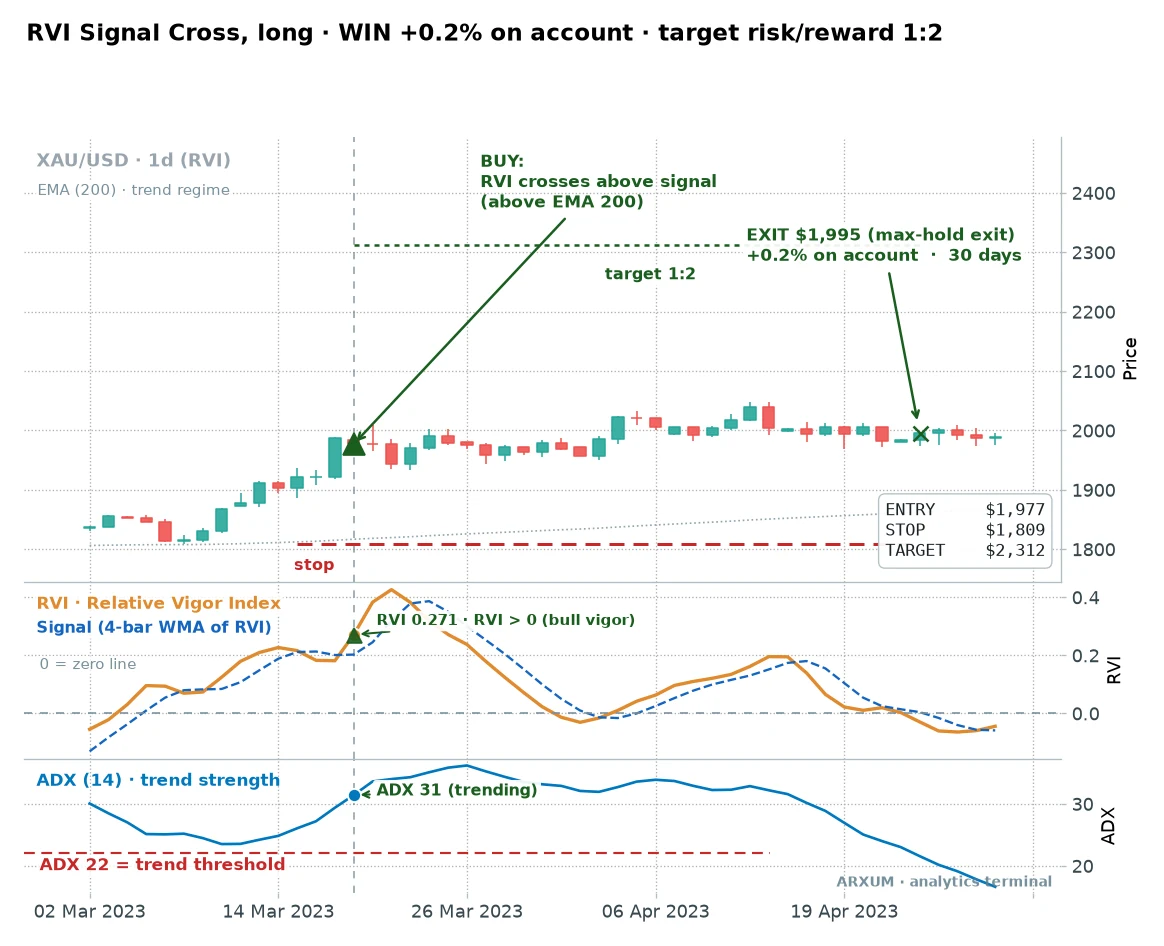
Both doublers amplified it hard. Martingale reached +187% and anti-martingale a touch more at +213%, because the larger trade count gave the streaks room to pay.
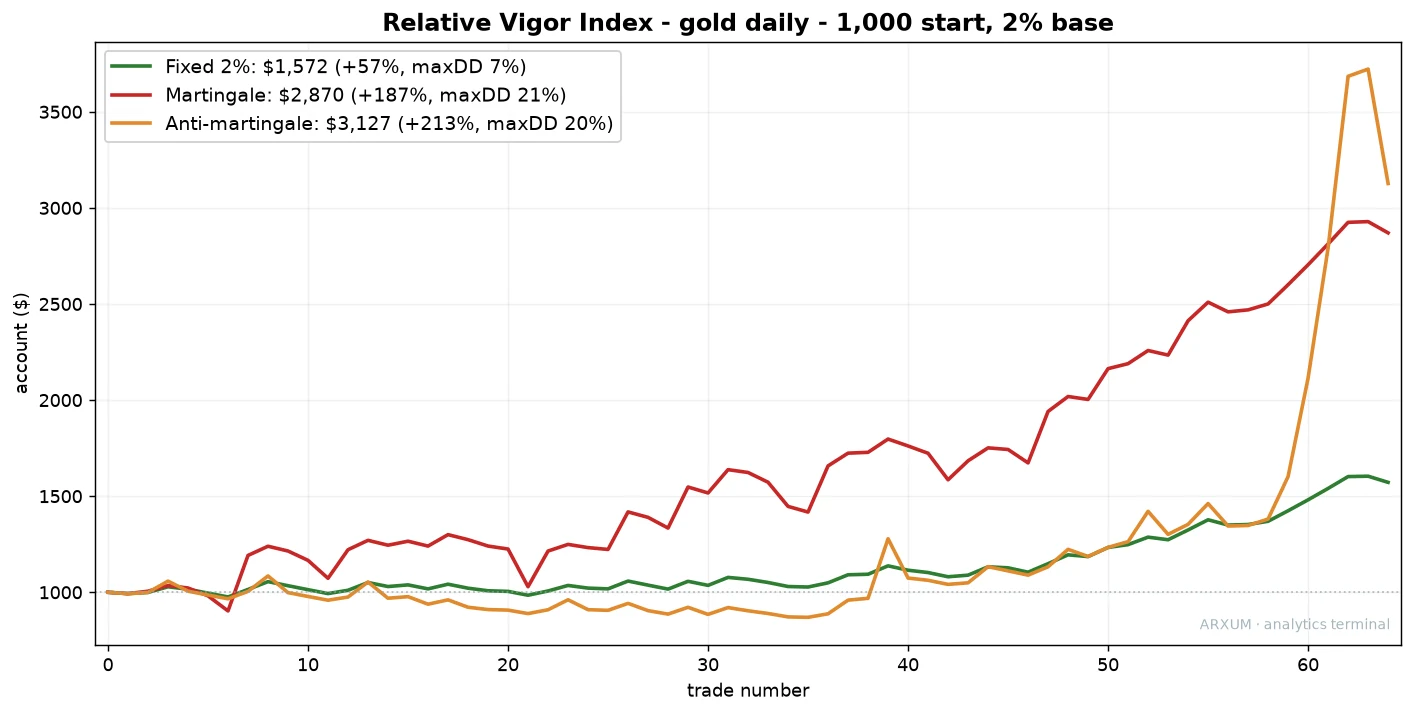
| Sizing rule | End balance | Growth | Max drawdown |
| Fixed 2% | $1,572 | +57% | 7% |
| Martingale | $2,870 | +187% | 21% |
| Anti-martingale | $3,127 | +213% | 20% |
A pattern is forming across the three winners. Anti-martingale keeps pace with martingale or beats it, and it does so from a shallower hole.
Ichimoku on EUR/USD: the losing edge martingale accelerates
Now the counter-example. Ichimoku is a popular multi-line trend system built around a cloud that marks support and resistance.
Our Ichimoku test never worked on EUR/USD, and this run shows it plainly: fixed 2% bled $1,000 down to $818, a -18% loss over 55 trades.
Feed a loser to the doubling machine and it does exactly what you fear. Martingale drove the account to $521, a -48% wipe, with a worst drawdown of 55%.
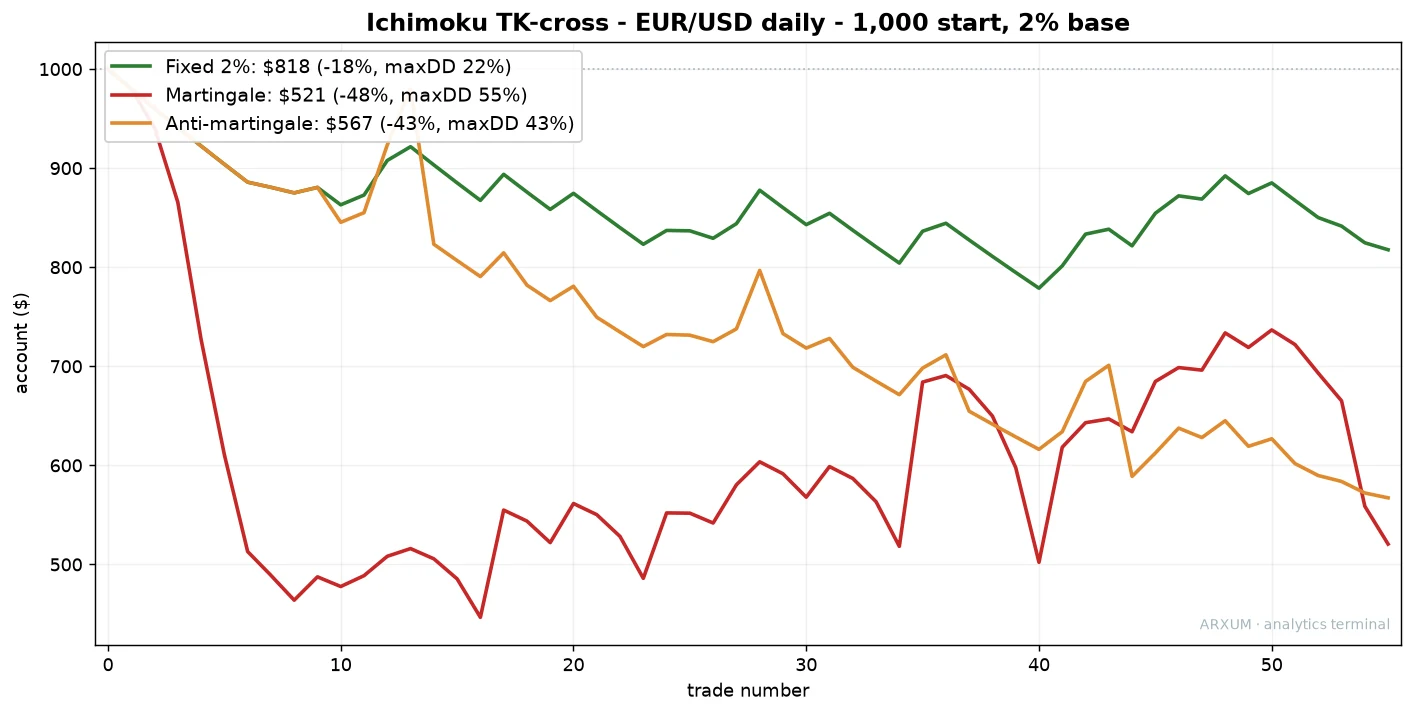
| Sizing rule | End balance | Growth | Max drawdown |
| Fixed 2% | $818 | -18% | 22% |
| Martingale | $521 | -48% | 55% |
| Anti-martingale | $567 | -43% | 43% |
Martingale has no opinion about whether your strategy is any good. It amplifies whatever is there, so a losing edge just loses faster.
What the four runs agree on
Line them up and the rule is simple. Martingale multiplies the direction of your edge, up or down.
On a strong trend like the Turtle it turned +74% into +464%. On the broken Ichimoku signal it turned a -18% bleed into a -48% wipe.
The cost is always the drawdown. Every winner paid for its bigger number with a deeper hole, and the losing signal reached a 55% drawdown that most accounts never come back from.
Anti-martingale was the quieter of the two doublers on every winner. Pressing winners and cutting size after a loss kept the swings smaller while matching or beating the return.
The honest default is still fixed 2%. It never posted the biggest number, but it never dug the scary hole either, and it does not need a strong edge or hundreds of trades to behave.
Why the doubling amplifies one way and bites the other
It helps to see why martingale reacted so differently across the four runs. The rule only changes your bet size after a loss, so what matters is what tends to happen right after a loss.
On a strong strategy like the Turtle, a loss is often followed by a win, because the trend keeps paying. Martingale places its biggest bet exactly then, so the win that follows a loss is sized up and the account jumps.
That is why the same 56 trades grew far past the fixed line. The doubling was catching the recoveries, not the losses.
The trouble starts when losses arrive in a cluster. Now the doubled bets stack on top of each other, and each one is bigger than the last.
Three losses in a row at 2%, 4% and 8% cost 14% of the account before a win can reset the ladder. On a winner that cluster is rare, so you pay it once in a while for the bigger upside.
On a losing strategy the cluster is the norm. The doubling keeps raising the stake into a stream of losses, and the account bleeds faster than fixed sizing ever would, which is exactly what the Ichimoku run showed.
The drawdown is the bill you actually pay
Every headline gain in the tables came with a deeper hole, and that hole is not a footnote. It is the number that decides whether you can actually hold the position through a bad run.
A 9% dip, like the Turtle on fixed sizing, is quiet enough that most traders sit through it. A 40% dip, like the VWAP run under martingale, means the account nearly halved before it recovered.
The recovery math is unforgiving. A 40% loss needs a 67% gain just to get back to even, and a 55% loss like the Ichimoku run needs a 122% gain.
That gap is why the biggest final number is rarely the best outcome. An account that swings 40% shakes most people out long before the strategy pays off, so the size that looks best on paper is often untradeable in real life.
This is the honest reason fixed sizing keeps winning the argument. It trades a smaller peak number for a hole you can actually live through.
What these numbers are, and are not
Two honest caveats before you act on any of this. These are sizing comparisons on tested history, so they show how each rule behaved on a known set of trades, not a promise about the next one.
They also do not try to beat buy-and-hold. Simply holding gold over these years returned more than most of the runs, because the metal climbed for most of the period.
The point was never the biggest number. It is control, and the choice between a rule you can hold through a bad stretch and one that looks great right up until it wipes you.
The ranking can also shift with the market. A rule that shone on a strong trend can lag through a choppy year, so treat the pattern as the lesson, not any single percentage.
The lever that beats any sizing trick
If you want to improve a strategy, the strongest lever is not a doubling scheme, it is skipping the wrong conditions. Across our tests, taking a signal only when the market was calm did more for the bottom line than any sizing rule.
Calm means a tight recent range under a rising trend gauge. That is when a fresh signal tends to follow through instead of whipsawing you.
Risk and discipline, the part that keeps you solvent
Every rule here rides losing streaks, so plan for them before they arrive. At a coin-flip win rate, four or five losses in a row is ordinary variance, not a broken system.
Size so that the worst plausible streak still leaves you trading. That is the whole reason the 16% cap exists, and the reason martingale on an uncapped account is how people go to zero.
One bad week is variance, not a verdict. Only risk money you can afford to lose, because no signal, no filter and no sizing rule removes the chance of a losing run.
Which sizing rule fits your strategy
You do not have to guess. The four runs point to a simple checklist for picking a rule before you risk a cent.
Start with fixed 2% unless you have a specific reason not to. It never dug a scary hole in any of the four tests, and it asks nothing of you except discipline.
Reach for anti-martingale only when your strategy wins more than half its trades and has a long, tested history. On every winner above it matched or beat martingale from a shallower dip, which makes it the risk-aware way to press an edge.
Treat plain martingale as the aggressive option you rarely need. It only rewarded the very strongest trend, and even then it doubled the swings to do it.
Never run any doubling uncapped, and never run it on a signal you have not proven pays over hundreds of trades. On a thin or losing edge the doubling is not aggression, it is just a faster way to lose.
The mistake that ruins most martingale accounts
Almost every blown martingale account fails the same way, and it is never the math. It is running the rule without a cap, or on a market that hands you a longer losing streak than your capital can cover.
The classic betting version has no cap at all, so a run of losses forces bets the account cannot make. That is the same reason it fails at the roulette table, where a long red streak outruns any finite bankroll.
A small account makes it worse. If you cannot size a doubled bet at real position sizes, the rule breaks before the strategy ever gets its chance to work.
The fix is the boring one we have used throughout. Cap the doubling, keep the base risk small, and only apply it to an edge you have already proven pays.
Do that, and martingale becomes a controlled way to press a genuine winner. Skip it, and you have simply bought a faster route to zero.
How to size any strategy without blowing up
You do not need a new indicator for this. Take a strategy you already trust and put the sizing rule on top of its signals.
- Start with fixed 2%. Risk 2% of the current account on every trade, measured from entry to your stop. That is the baseline every result here is judged against.
- If you want aggression, use anti-martingale, not martingale. Double the risk only after a win, then drop straight back to 2% after any loss. It matched or beat martingale on every winner above, from a shallower drawdown.
- Cap the doubling at three steps. The largest bet you ever place is then 16%. Past that the math outruns most accounts.
- Only double on a proven edge with a long history. On a thin or losing signal, plain 2% is the only sane choice, because the doubling just accelerates the bleed.
Here is what 2% actually means in dollars. On a $1,000 account you risk $20 per trade, so if gold sits at $2,000 and your stop is $100 below it, that $20 of risk covers about 0.2 ounces of gold, since a $100 move against you would then cost exactly your $20.
Real brokers trade gold in lots, and 0.2 ounces is a sliver of the smallest micro lot, which is why a tiny account often cannot place the trade at all.
After one loss, martingale doubles the risk budget to $40, so the next position is 0.4 ounces, exactly twice the size. That single step is the whole doubling, measured in real money rather than percentages.
The point is the sizing, not the entry. Each of the four strategies above links to its own full method if you want to trade the signal itself.
Honest scope
These are position-sizing results from each strategy’s tested history, not a live track record. We took each strategy’s own trade history and re-sized every trade three ways, so the entries are unchanged and only the bet size differs.
Every run is a long trade, because that is the side each strategy’s edge lived on over these years, and the same sizing lesson would hold on shorts with different numbers.
The runs cover gold (XAU/USD) and EUR/USD on the daily chart across eight-year windows, with fees included and 2% as the base risk. Both doublers are capped at three steps, and results always vary by data feed and broker.
None of this is financial advice, and past behaviour never guarantees the next run.
Where to go from here
If you want to feel the difference before risking a cent, take any strategy’s trade log and re-tally it two ways. Flat 2% per trade, then doubled after each win, and watch the second one both grow faster and swing harder.
From there, the useful next steps are the tools this rests on. Read the position sizing guide for the risk math, and the risk-to-reward guide for the per-trade unit every result here is quoted in.
FAQ
What is the martingale strategy in plain terms?
Does martingale work in forex?
Is the martingale forex strategy safe?
What is anti-martingale, and when should I use it?
Why does martingale fail on a bad strategy?
What timeframe and settings did you use?
How much money do I need to start?
Should I ever run martingale live?
Is martingale the same as the martingale betting system from roulette?
What do the key terms mean?
Real-time trade setups with entry, stop loss and take profit. Daily market analysis. No subscription, no complicated theory.
🌍 Our recommended brokers


Reader Reviews
Be the first to review this — tell other traders what actually helped, or where it fell short.
Leave a Review

Forex Analyst & Senior Trader
Former FX desk trader with 8 years in institutional forex. Works in multi-timeframe analysis and order flow, turning desk experience into systematic, testable rules across forex and metals.