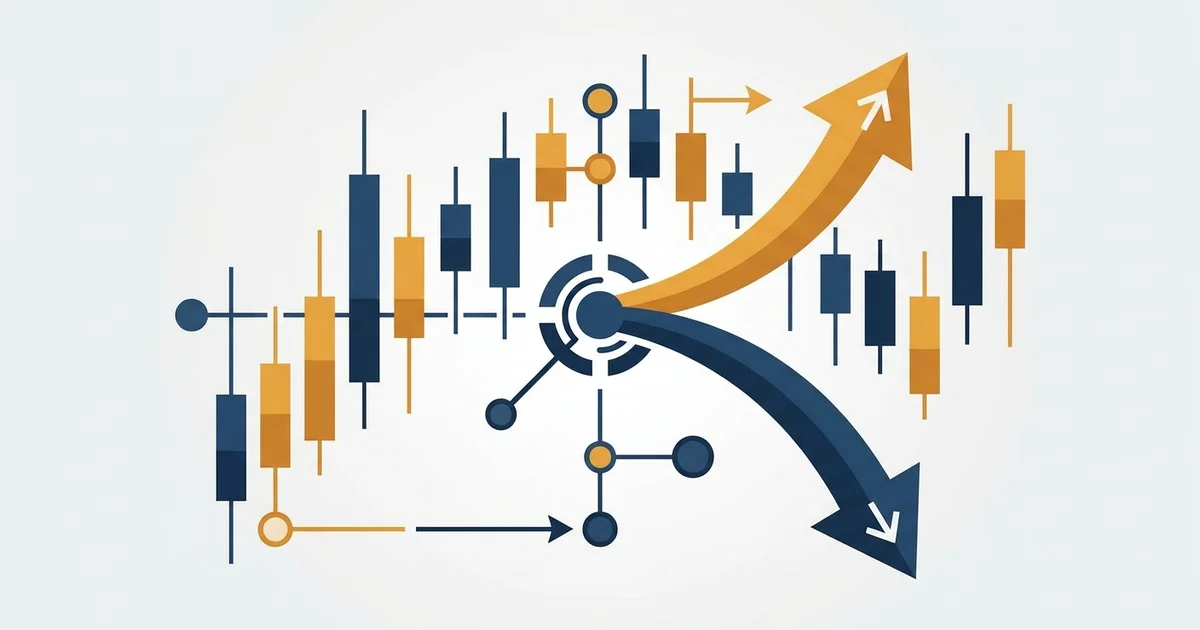

What going long and going short mean
A long position and a short position are just the two directions you can bet on. Long profits from a rise, short profits from a fall, and the whole first job is spotting which side the market currently favours.
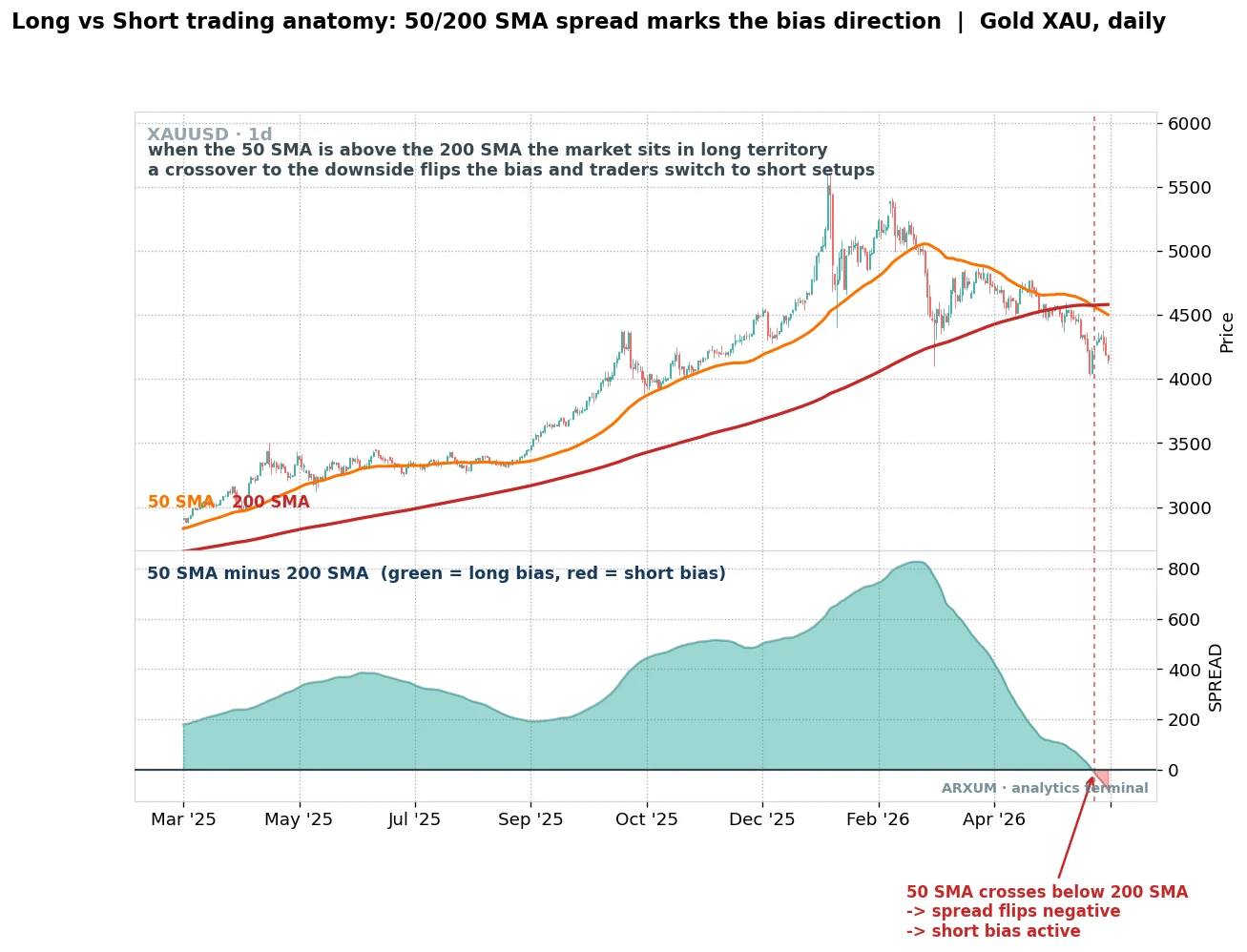
Look at the picture before the words. The gold chart is in long territory for almost the whole stretch, because the faster 50 SMA (a moving average is just the average price over the last 50 days, redrawn each day) stays above the slower 200 SMA.
That is the market telling you the path of least resistance is up, so longs have the wind behind them.
Everything else in this guide hangs off that one idea, so here is the core contrast in one table.
| Long (buy) | Short (sell) | |
| Your order first | Buy | Sell |
| You profit when | Price rises | Price falls |
| You lose when | Price falls | Price rises |
| Your market view | Bullish | Bearish |
| Close the trade by | Selling it back | Buying it back |
| Natural home | Uptrends, calm bull runs | Downtrends, sharp selloffs |
Two things trip up beginners, so hold onto them:
- Long is not “long-term” and short is not “short-term”. They describe direction, not how long you hold. You can day-trade a long and hold a short for weeks.
- A short is not gambling against the market. It is the same skill as a long, pointed the other way. In a real downtrend, the short is the trade with the wind behind it.
Long vs short, side by side: the P&L
The maths is simple arithmetic in both directions. These are illustrative “if price does this” examples, not results, so treat the numbers as teaching, not a claim.
Going long, on gold. Say spot gold (XAU/USD) trades near 4,000 and you buy one micro lot, which is one ounce.
- Entry: buy at 4,000.
- Price rises to 4,120.
- Result: 120 points in your favour, worth about $120 on that one-ounce size.
- If instead price fell to 3,940, you would be down 60 points, about $60.
Going short, on EUR/USD. Say the euro looks stretched and you sell one micro lot of EUR/USD, which is 1,000 units, worth roughly $0.10 a pip.
- Entry: sell at 1.1650.
- Price falls to 1.1550.
- Result: 100 pips in your favour, about $10 on that micro-lot size.
- If instead price rose to 1.1700, you would be down 50 pips, about $5.
Notice the symmetry, and the one asymmetry underneath it.
| Question | Long answer | Short answer |
| Direction that pays | Up | Down |
| Best case | Price keeps rising | Price falls to zero |
| Worst case on shares | Falls to zero, capped | Rises with no ceiling |
| Worst case with a stop | Capped at your stop | Capped at your stop |
That “no ceiling” row is the one genuine difference in the raw risk, and it only bites on real shares held without a stop.
A stock can only fall to zero, so a long has a floor. It can in theory rise forever, so a naked short does not.
On a stopped CFD or Forex trade the difference disappears, because your stop caps the loss either way. The lesson is not “shorting is dangerous”, it is “never hold a short without a stop”.
Shorting is not just “long in reverse”
Going long is easy to picture: you buy a thing, you own it, you sell it later.
Going short feels stranger, because you are selling something before you own it. How that actually works depends on the market.
| Market | How the short works | What it needs |
| Shares | Borrow shares, sell them, buy back later | A margin account and a borrow |
| Forex | Just sell the pair, both sides are symmetric | Nothing extra |
| CFDs (gold, indices, stocks) | Open a sell contract on the price | Margin, no borrow |
| Crypto | Sell a perpetual or futures contract | A futures or margin account |
For most retail traders the practical answer is a CFD, a Forex sell, or a crypto contract, where a short is one click and no shares change hands.
- Forex is fully symmetric. Selling EUR/USD is the same act as buying it, because you are always long one currency and short the other. There is no “borrow” step and no extra cost baked in for choosing the short side.
- CFDs never touch the underlying. You are trading a contract that tracks the price, so a sell CFD on gold is as ordinary as a buy CFD. A CFD broker handles both directions the same way.
- Crypto shorts run through contracts. You short Bitcoin with a perpetual or a dated future, not by borrowing coins. That is a step up in complexity, so read the crypto futures guide before you place one.
The other place long and short quietly differ is the running cost of holding.
| Cost | Long | Short |
| Spread on entry | Yes | Yes |
| Overnight swap | Pay or receive | Pay or receive |
| Borrow fee (shares, crypto) | None | Can apply |
That overnight swap is worth a full minute of your attention, because it is where a “correct” trade can bleed. Holding any position past the daily rollover charges or pays a small financing rate, set by the interest-rate gap between the two sides.
The direction of that fee is exactly what the carry trade is built on, and it can quietly run against a short you hold for weeks. Both sides also need margin, which is the deposit your broker holds to keep the position open, covered in the margin trading guide.
How to read which side the market favours
Direction is the whole game, so the useful question is not “what is a short”, it is “which way should I be trading this right now”. Three simple reads answer that, each looking at a different thing, and each shown below on a different market and timeframe so you can see it port.
| Read | What it measures | Long signal | Short signal |
| Trend (50/200 SMA) | Direction of the whole market | 50 above 200 | 50 below 200 |
| Extremes (RSI 30/70) | How stretched price is | RSI under 30 | RSI over 70 |
| Momentum (MACD zero) | Short-term push | Histogram above 0 | Histogram below 0 |
They are not rivals. The trend read sets the big-picture bias, the extreme read times a snap-back, and the momentum read catches a fast turn.
Most traders use the slower one to pick a side and a faster one to time the entry.
The trend read: the 50 and 200 SMA
The gold chart at the top of this guide is this read. Two moving averages, one fast and one slow, and the gap between them tells you the bias in a glance.
How it looks:
- The 50 SMA above the 200 SMA, and the spread panel green: long territory.
- The 50 SMA below the 200 SMA, and the spread green flips to red: short territory.
- The moment the fast line crosses the slow line is the bias change, the well-known golden cross up and death cross down.
This is the read James leans on first, top-down, before he looks at anything faster. The whole idea, and where it fails, is in the golden cross and death cross guide.
| Role | How to use it | Best read on |
| Set the bias | Trade only in the SMA's direction | Daily, weekly |
| Spot the flip | Watch for the 50/200 crossover | Daily |
| Filter | Skip longs while the 50 is below the 200 | Any timeframe |
The catch, in one line: the trend read is slow. It keeps you on the right side of a long move like gold’s, but it turns late, so it is a bias filter, not an entry trigger.
The extreme read: RSI 30 and 70
Where the trend read gives you the side, RSI helps you time it inside a range. RSI is a gauge that runs from 0 to 100 and measures how hard price has pushed lately.
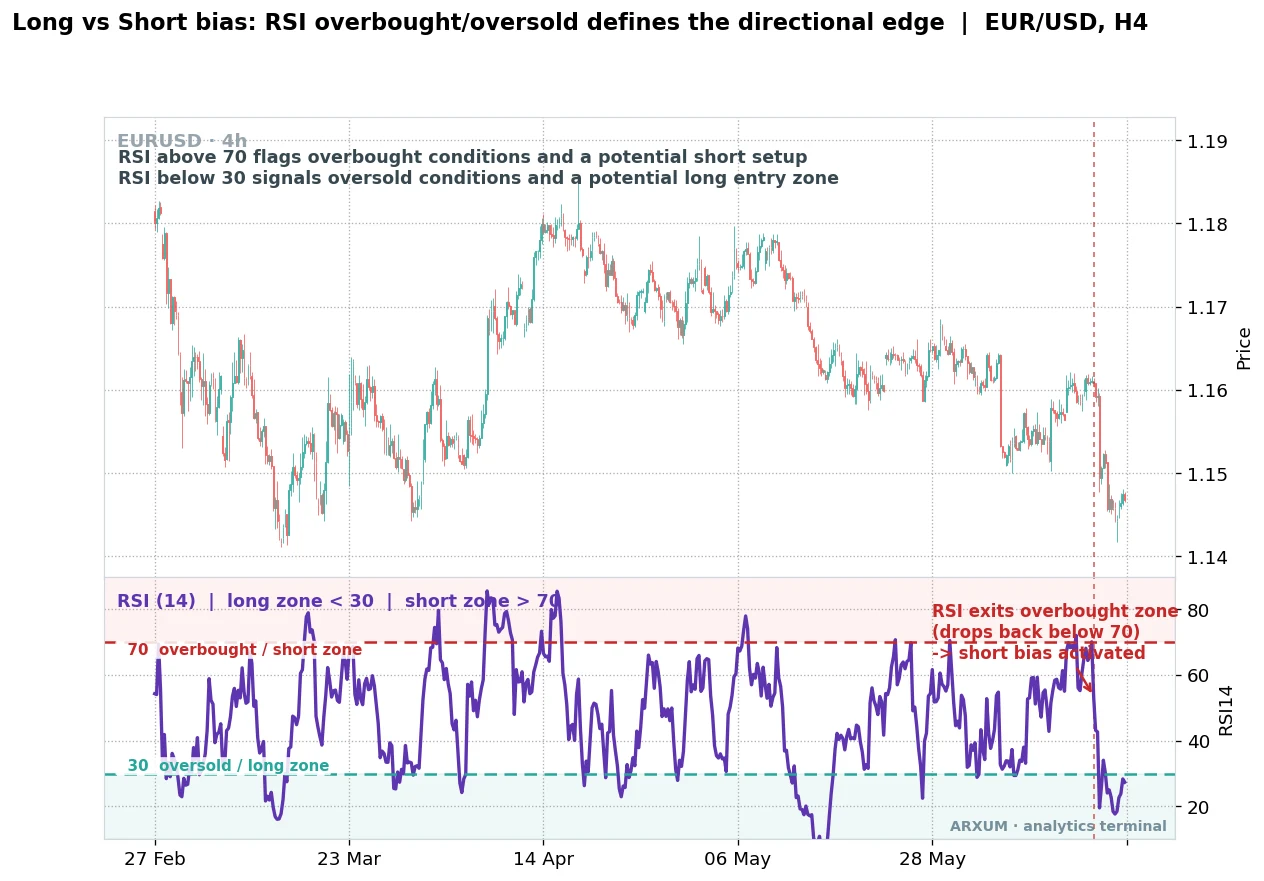
How it looks:
- RSI over 70, in the red band: price is overbought, stretched high, and a short becomes the higher-odds side.
- RSI under 30, in the green band: price is oversold, stretched low, and a long becomes the higher-odds side.
- The signal most traders wait for is RSI leaving the band, dropping back under 70 or climbing back over 30, not just touching it.
The full settings and the traps live in the RSI indicator guide.
| Role | How to use it | Best read on |
| Time a long | Buy as RSI climbs back above 30 | Ranging markets, H4 |
| Time a short | Sell as RSI drops back below 70 | Ranging markets, H4 |
| Warning | In a strong trend, RSI stays pinned | Avoid fading a trend |
One honest caveat, because it burns people: in a hard trend RSI can sit above 70 for days while price keeps climbing.
Fading an extreme works in a range, not against a freight-train trend. Check the trend read first, then use RSI inside it.
The momentum read: MACD across zero
The fastest of the three is MACD, which measures the momentum behind price rather than the trend or the stretch. Its cleanest long-vs-short read is simply which side of zero it sits on.
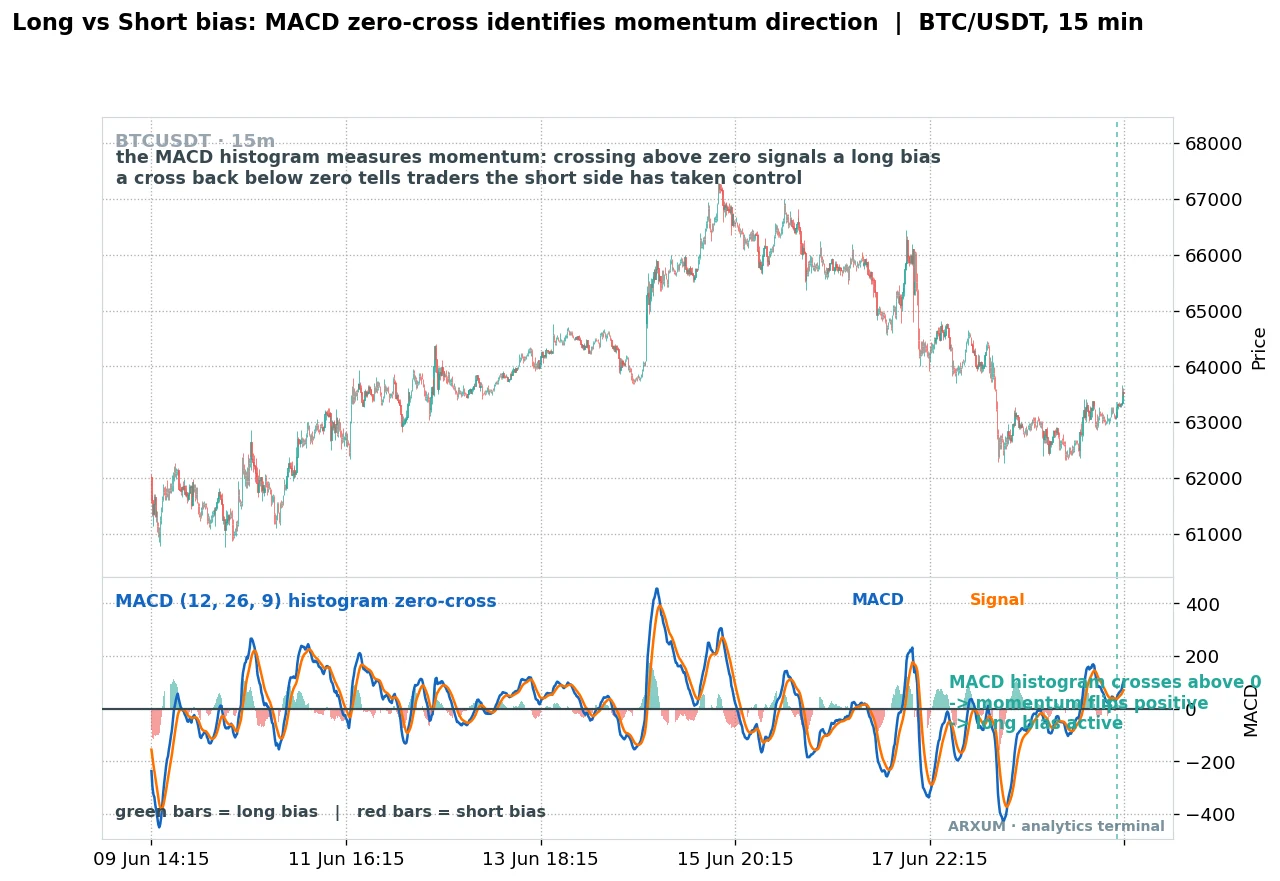
How it looks:
- The histogram above zero, bars green: momentum is positive, a long bias.
- The histogram below zero, bars red: momentum is negative, a short bias.
- On the fast 15-minute chart the flips come thick, which is the price you pay for speed.
Bitcoin trades around the clock with no sessions, so this read runs the same at any hour. The parts and settings are in the MACD indicator guide.
| Role | How to use it | Best read on |
| Catch a turn early | Flip bias when the histogram crosses zero | Intraday, M15 to H1 |
| Confirm a trade | Take longs only while the histogram is green | Any timeframe |
| Warning | Whipsaws in a flat, choppy market | Skip when price is ranging |
The trade-off in one line: MACD is quick but noisy. On a fast chart it will flip you long and short inside an hour, so it earns its keep as a confirmation on top of a slower read, not as a solo signal.
Which read to use when
None of the three is “best”. They answer different questions, and the honest move is to match the read to what the market is doing.
| Market looks like | Lean on | Why |
| Strong one-way trend | 50/200 SMA | Keeps you on the trend's side |
| Sideways range | RSI 30/70 | Fades the edges of the range |
| Fast intraday move | MACD zero-cross | Turns quickest at a shift |
| You want one filter | 50/200 SMA | Simplest bias, hardest to fool |
A practical stack for a beginner: let the 50/200 SMA decide whether you are hunting longs or shorts, then use RSI or MACD only to time an entry in that direction.
On the desk James would never trade a short while the higher timeframe was firmly long. The reads agree far more often than they fight, and when they disagree, that argument is itself a signal to stand aside.
Long and short are not equally forgiving
Direction is only half the trade. The risk around each side deserves a plain word, because it is where beginners quietly lose an otherwise correct call.
- A short needs a stop, always. On real shares the loss has no natural ceiling, so a stop is not optional. On a CFD or Forex short the broker will not force you out until margin runs low, which is far too late. Set the stop yourself.
- Both sides risk the same 2% rule. Whether long or short, a sensible cap is risking about 2% of your account on any one trade, sized so that hitting your stop costs that and no more. Direction does not change the sizing.
- Shorts can bleed on swap. A short held for weeks may pay a daily financing fee. It does not sink the trade, but it eats a slow, correct short, so factor it in.
- Countertrend is the hard mode. Shorting a rising market, or buying a falling one, means fighting the bias the trend read just showed you. Sometimes right, usually the lower-odds path. Respect it.
- Match the reward to the risk. Size the target against the stop so the win is worth more than the loss, the plain idea behind the risk to reward ratio. A 1:2 trade risks one to make two.
This is not a reason to fear shorting. In a genuine bear market the short is the correct trade and the long is the one fighting the current.
It is a reason to treat both directions with the same discipline: a defined stop, a sensible size, and a read that says the market is actually on your side.
What to remember
Long vs short trading is one idea seen from two directions, and you can carry the whole thing in a short list.
- Long buys to profit from a rise, short sells to profit from a fall. That is the entire difference in mechanics.
- A short is a normal sell order on Forex, CFDs and crypto contracts. No borrowing shares, no mystery.
- The only real extra risk is an uncapped loss on naked shares, and a stop erases it.
- Picking the side is the skill. Read the trend with the 50/200 SMA, the extremes with RSI, the momentum with MACD.
- Slow read for the bias, fast read for the timing, and never trade against the higher timeframe without a good reason.
Start on one market you follow, on the daily chart, and get in the habit of asking one question before every trade: which side does the market favour right now. Answer that honestly and the long-versus-short decision stops being a coin flip.
FAQ
What does going long mean in trading?
Going long means you buy an asset first, expecting the price to rise, and you profit from the increase. It is the direction most people already know from investing: buy low, sell higher. You close a long by selling it back. Long describes the direction of your bet, not how long you hold, so you can day-trade a long or hold it for months. Your maximum loss on a long is capped, because a price can only fall to zero.
What does going short mean in trading?
Going short means you sell an asset first, expecting the price to fall, and you profit from the decrease. You close a short by buying it back at the lower price. On Forex, CFDs and crypto futures this is simply a sell order, with no shares borrowed. Shorting lets you make money in a falling market, which a long cannot. Because a price can in theory rise without limit, a short should always be held with a stop-loss to cap the risk.
What is the difference between a long position and a short position?
A long position profits when price rises and loses when it falls, and you open it by buying. A short position profits when price falls and loses when it rises, and you open it by selling. Long suits uptrends and calm bull runs, short suits downtrends and sharp selloffs. The mechanics mirror each other, with one asymmetry: on real shares a long's loss is capped at zero while a naked short's loss has no ceiling, which is why shorts always need a stop.
Can you short crypto?
Yes. You short crypto through a derivative rather than by borrowing coins. The common routes are a perpetual swap or a dated futures contract on an exchange, or a sell CFD with a broker. Each lets you open a sell position on Bitcoin or another coin and profit if the price drops. Because crypto is volatile and these contracts use leverage, a stop-loss is essential, and beginners should understand futures and margin before shorting.
Is shorting riskier than going long?
Only in one specific case: a naked short on real shares held with no stop, because the price can keep rising and the loss has no ceiling. On a CFD, a Forex pair, or a stopped crypto short, the risk is the same as a long, because your stop caps the loss either way. The other small difference is cost, since a short held overnight may pay a financing fee. Managed with a stop and sensible size, shorting is no more dangerous than buying.
When should you go long versus short?
Go long when the market favours the upside and short when it favours the downside, then confirm with a simple read. The 50 and 200 SMA set the big-picture bias: long while the 50 is above the 200, short while it is below. RSI times entries in a range, with oversold under 30 favouring longs and overbought over 70 favouring shorts. MACD crossing zero catches a fast momentum shift. Use a slow read for the direction and a faster one for the timing.
How do you short Forex?
You short Forex by simply selling the pair, with no borrowing involved. Every Forex trade is long one currency and short the other, so selling EUR/USD means you profit if the euro weakens against the dollar. It is fully symmetric with going long: the same one click, the same spread, the same margin. This is why Forex is one of the easiest markets to short, and why traders switch direction freely with the trend.
Does going short cost more than going long?
Usually only a little, and only if you hold overnight. Both directions pay the spread on entry, and both are charged or paid a daily financing swap when held past the rollover. The direction of that swap depends on the interest-rate gap between the two sides, so a short sometimes pays a fee that a long would receive, and sometimes the reverse. On shares or crypto a short can also carry a borrow fee. For short intraday trades the cost gap is negligible.
What are the key long and short trading terms to know?
Long means you bought and profit from a rise; short means you sold and profit from a fall. Bullish is expecting up, bearish is expecting down. A stop-loss is an order that closes a losing trade to cap the loss. Margin is the deposit your broker holds to keep a position open. Swap is the overnight financing fee. The SMA is a moving average that shows the trend, RSI is a 0 to 100 gauge of how stretched price is, and MACD is a momentum gauge that reads long above zero and short below.
🌍 Our recommended brokers


Reader Reviews
Be the first to review this — tell other traders what actually helped, or where it fell short.
Leave a Review

Forex Analyst & Senior Trader
Former FX desk trader with 8 years in institutional forex. Works in multi-timeframe analysis and order flow, turning desk experience into systematic, testable rules across forex and metals.