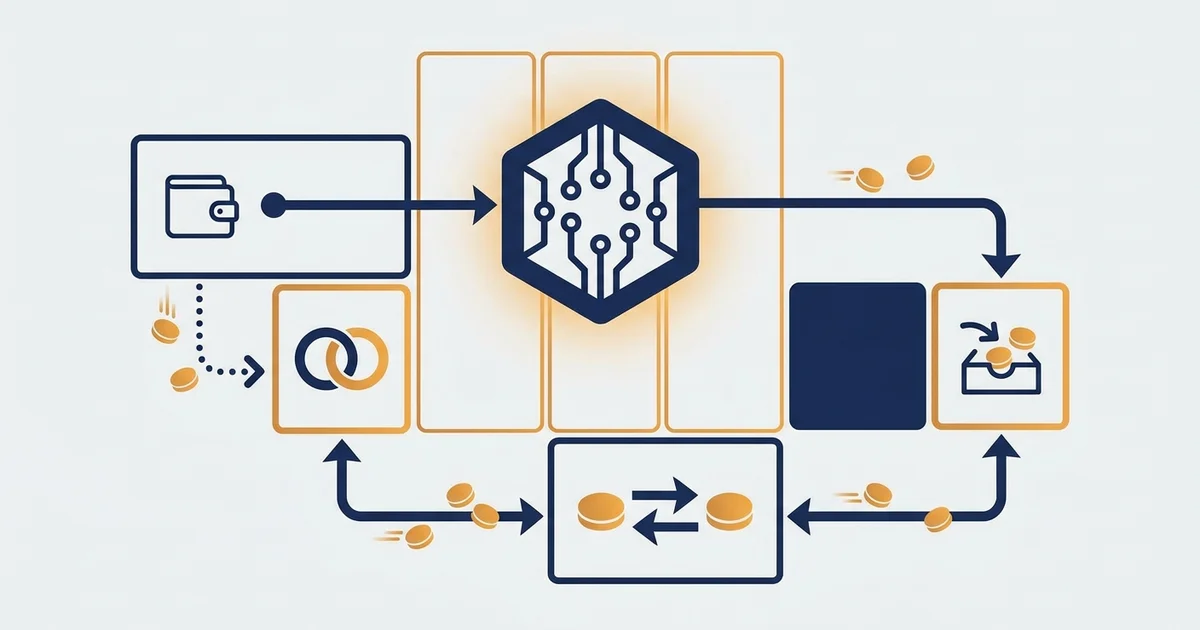

What is DeFi, and why it is built this way
DeFi is finance rebuilt as open software. Instead of a bank approving a loan or an exchange matching a trade, a smart contract does it automatically, and anyone with a wallet can use it.
Its home base is Ethereum, so the single cleanest gauge of when DeFi is thriving is the ETH/BTC ratio: Ethereum’s price measured in Bitcoin.
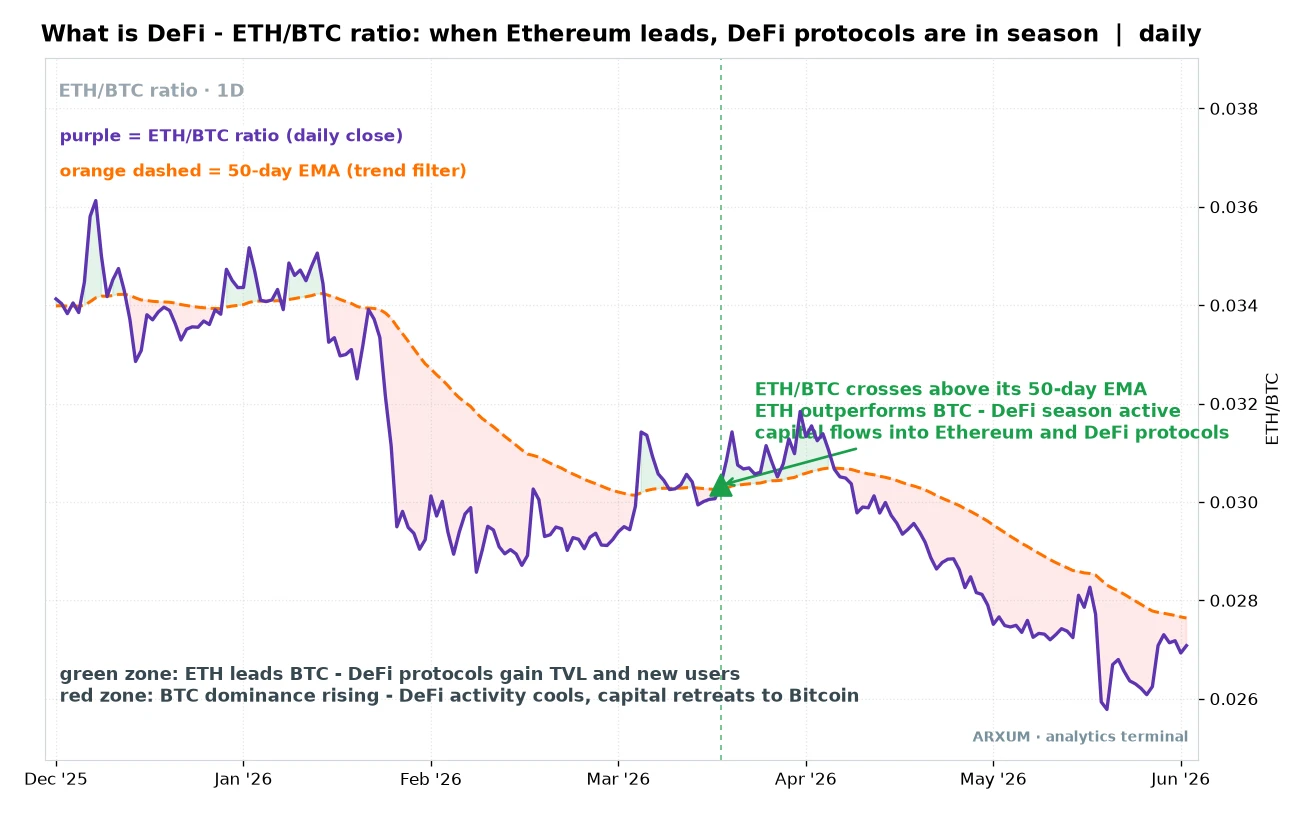
What the chart is showing:
- The purple line is the ETH/BTC ratio, Ethereum’s daily price in Bitcoin. Up means Ethereum is outrunning Bitcoin.
- The orange dashed line is the 50-day EMA, a moving average that smooths the ratio into a trend. Above it, Ethereum is leading; below it, Bitcoin is.
- The green zones are where Ethereum leads Bitcoin. This is when DeFi protocols pull in new users and locked capital.
- The red zones are where Bitcoin dominance is rising and DeFi activity quietly drains back to Bitcoin.
- The green arrow and dashed line mark the ratio crossing back above its average. That cross is the moment Ethereum, and DeFi, starts leading again.
- The read: DeFi runs on Ethereum, so DeFi is busiest when money prefers Ethereum over Bitcoin. The ratio is that preference, drawn as one line.
The DeFi stack: the pieces that make it work
DeFi is not one product. It is a stack of open services that snap together, each one replacing a job a bank or exchange used to do.
| Building block | What it does | Example protocols |
|---|---|---|
| Decentralized exchange (DEX) | Swap one token for another, no account | Uniswap, Curve |
| Lending and borrowing | Earn interest or borrow against collateral | Aave, Compound |
| Stablecoins | Dollar-pegged tokens to price trades and park cash | USDC, DAI |
| Yield aggregators | Auto-shift funds to the best available rate | Yearn, Convex |
| Perpetuals and derivatives | Leveraged long and short, fully on-chain | dYdX, GMX |
| Bridges | Move assets between different blockchains | Cross-chain routers |
The one habit that ties it together:
- Everything is a token in a wallet. Deposit into a lending pool and you get a token that represents your deposit plus interest. That token can then be used somewhere else.
- The pieces compose. This stacking of services is called composability, and it is why DeFi is nicknamed money legos.
- No permission needed. Any of these can be opened by connecting a wallet. There is no application and no waiting.
DeFi vs CeFi: the difference that matters
The fastest way to understand DeFi is against its opposite. CeFi, centralized finance, is a normal crypto exchange or a bank: a company holds your coins and runs the rails.
| Feature | DeFi | CeFi |
|---|---|---|
| Who holds your coins | You, in your own wallet | The company |
| Sign-up and ID checks | None, just connect a wallet | Account and KYC required |
| Transparency | Open code, every move on-chain | Private internal books |
| Main risk | A bug in the code | The company failing or freezing you |
| Access | Anyone, anywhere, always open | Limited by region and hours |
| If something goes wrong | No undo, the code is final | Support can sometimes step in |
The trade-off in one line:
- DeFi gives you control and pays for it with responsibility. No company can freeze you, and no company can save you either.
- CeFi gives you a safety net and charges you trust. It is easier and has a help desk, but you are lending the company your coins to hold.
- Most people use both. They buy on a centralized exchange, then move coins to a wallet to use DeFi. The two are neighbours, not enemies.
How a DEX actually works: pools, not order books
A normal exchange matches a buyer to a seller. A DEX does not.
Instead it uses a pool of two tokens and a simple formula, called an automated market maker, or AMM.
- A pool holds two tokens, say Ethereum and a stablecoin. You trade against the pool, not another person.
- The formula keeps the pool balanced. The classic one is written as x times y equals k, where the two token amounts multiplied together must stay constant.
- Your trade moves the price. Buy Ethereum out of the pool and there is less of it, so the next buyer pays more. That price drift on a big order is called slippage.
- The people who fill the pool are liquidity providers. They deposit both tokens and earn a cut of every swap fee in return.
There is a catch built into providing that liquidity, and it has a name:
- Impermanent loss is when the two tokens in your pool drift apart in price, and you end up with less value than if you had simply held them in your wallet.
- It is worst on volatile pairs and mildest on pairs that move together, like two stablecoins.
- The swap fees are meant to pay you back for that risk. Whether they do depends on how much trading the pool sees.
Where DeFi yield comes from
The eye-catching part of DeFi is the yield. The honest part is knowing where each return comes from, because a yield with no clear source is a warning, not a gift.
| Yield source | Where the money comes from | The main catch |
|---|---|---|
| Lending | Borrowers pay interest on loans | Rates swing with borrower demand |
| Liquidity providing | Traders pay a fee on every swap | Impermanent loss on volatile pairs |
| Staking | The network pays you to help secure it | Funds are locked, and can be penalised |
| Yield farming | Extra reward tokens on top of the base | The reward token can lose its value fast |
How to read a yield before you chase it:
- Trace the source first. Real yield is paid by borrowers or traders. Reward-token yield is paid by printing a new coin, which only lasts while that coin holds up.
- A very high rate usually means a very high risk. A newer, smaller protocol pays more because more can go wrong.
- Compare it to just holding. For a related concept on smoothing entries rather than reaching for yield, see dollar-cost averaging. Sometimes the calm option wins.
Reading when DeFi is in season: Bitcoin’s macro momentum
DeFi does not float free of the rest of crypto. When the whole market turns risk-on, DeFi is where the sharpest growth in deposits shows up.
The broad switch is readable on Bitcoin’s own momentum.
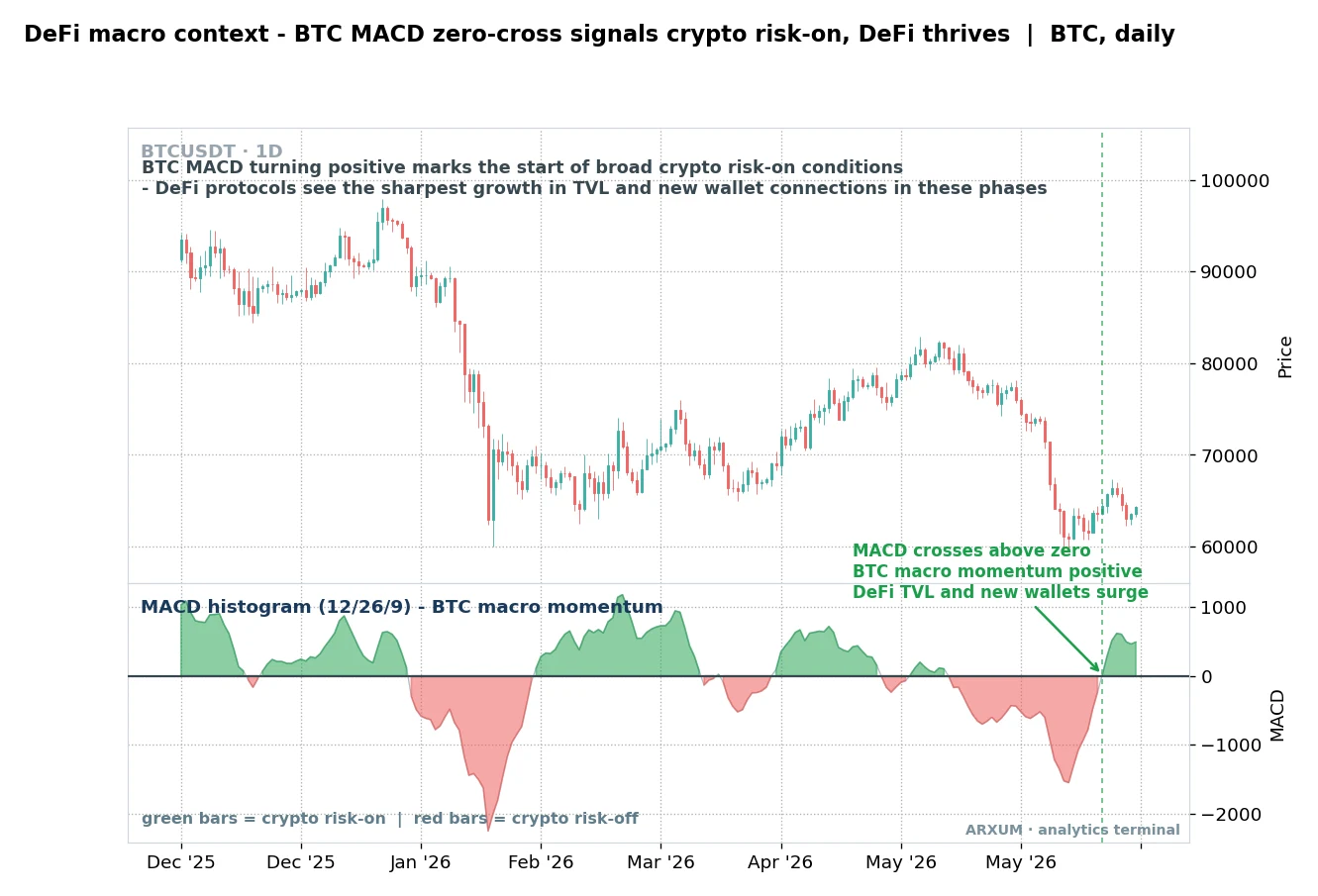
What the labels mean:
- The top panel is Bitcoin’s daily price. The bottom panel is the MACD, a momentum gauge built from two moving averages, set to the standard 12, 26, 9.
- The histogram is the bars. Green above the zero line means momentum is turning up, red below means it is fading.
- The dashed vertical line marks the histogram crossing above zero. That flip is the shift from crypto risk-off to risk-on.
- The read: when Bitcoin’s macro momentum turns positive, capital feels safe moving down the risk curve, and DeFi protocols see the fastest jump in locked value and new users.
How to use it:
| Role | How you use it | Best read |
|---|---|---|
| Regime read | Histogram green above zero, broad crypto risk-on | Daily, Bitcoin |
| Warning | Histogram red below zero, deposits tend to drain from DeFi | Daily, Bitcoin |
| Filter | Be slower to chase DeFi yield while momentum is falling | Daily, whole market |
| Confirming | A rising ETH/BTC ratio backs up a green MACD | Daily, ETH/BTC |
Rule of thumb: the MACD tells you the tide, not the coin. It says the water is coming in, not which protocol to swim to.
Ethereum’s own tempo: the RSI on DeFi’s home chain
The macro read sets the stage. The finer read is Ethereum itself, since that is where most DeFi lives.
Ethereum’s momentum crossing up is often the earliest sign protocol activity is picking up.
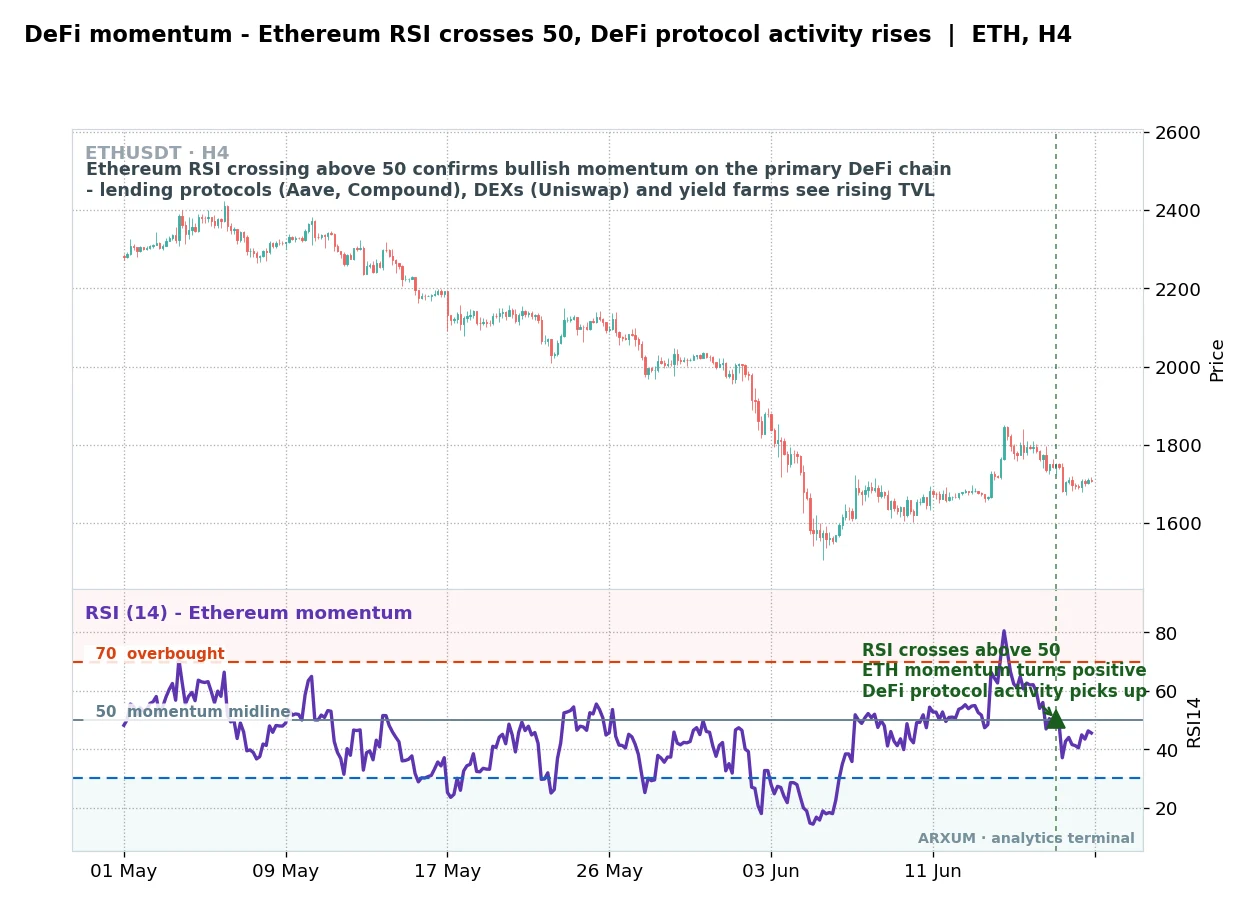
What the labels mean:
- The purple line in the lower panel is the RSI, a momentum gauge that runs from 0 to 100, set to the standard length of 14.
- The 50 line is the midline. Above it, momentum is bullish; below it, bearish. It is the honest middle, not overbought or oversold.
- The 70 line marks overbought and the 30 line marks oversold, the stretched extremes at either end.
- The green arrow marks RSI crossing up through 50. That cross is momentum turning positive on Ethereum.
- The read: Ethereum leading means its DeFi protocols, the lending markets like Aave and Compound and DEXs like Uniswap, tend to see rising deposits and trading right behind it.
How to use it:
| Role | How you use it | Best read |
|---|---|---|
| Timing | RSI crossing up through 50, momentum turning positive | 4-hour, Ethereum |
| Trend read | RSI holding above 50, the DeFi chain is in an uptrend | 4-hour, Ethereum |
| Caution | RSI pinned above 70, momentum is stretched, not fresh | 4-hour, Ethereum |
| Warning | RSI back under 50 and falling, protocol activity usually cools | 4-hour, Ethereum |
Rule of thumb: the fast RSI is a scalpel. It earns attention only when the slow macro read already leans risk-on.
DeFi for traders: perps without an exchange
For active traders, the headline DeFi use is perpetuals, leveraged long and short positions that never expire. They run on-chain instead of through a custodial exchange.
| Venue | Type | The trade-off |
|---|---|---|
| Centralized futures | Custodial exchange | Fast and deep, but you trust the exchange |
| dYdX, GMX | On-chain perps | You keep custody, but pay gas and get thinner liquidity |
- The mechanics rhyme with CeFi. Leverage, margin and funding rates all work the same way. If you know one, the concepts carry over. See crypto funding rates for the cost of holding a perp.
- The custody is the difference. On a DeFi perp, the position sits in a smart contract you can see, not on a company’s internal ledger.
- The risks carry over too. Leverage still liquidates you fast. Our guide to crypto liquidation covers how that plays out and how to avoid it.
The real risks of DeFi
DeFi hands you control, and control means the safety net is gone. These are the risks that actually cost people money, not vague warnings.
| Risk | What it is | How to limit it |
|---|---|---|
| Smart contract exploit | A code bug drains a protocol | Stick to older, heavily audited protocols |
| Oracle manipulation | A faked price triggers bad liquidations | Prefer protocols with reliable price feeds |
| Rug pull | The team abandons and dumps the token | Avoid anonymous, brand-new farms |
| Impermanent loss | Providing liquidity lags just holding | Use stable or closely correlated pairs |
| Stablecoin de-peg | A dollar token slips off its $1 value | Favour large, transparent stablecoins |
| Regulatory risk | Rules shift by country | Know your local status before you commit |
The mindset that keeps you safe:
- Old and boring beats new and shiny. A protocol that has held tens of billions through several cycles has survived more attacks than a farm launched last week.
- Your keys, your responsibility. Send to the wrong address or sign a bad approval and no one is refunding you. Slow down on every confirmation.
- Size for the worst case. Treat any single protocol as something that could go to zero overnight, and never park money there you cannot afford to lose.
How to start using DeFi, step by step
Getting in is simpler than it sounds. The whole flow is five steps, and you can do the first swap with a small amount to learn the ropes.
- Set up a wallet. Install a self-custody wallet like MetaMask. Write the recovery phrase on paper and never type it into a website.
- Fund it. Buy some Ethereum on a centralized exchange to cover both your trade and the network fee, called gas.
- Send the coins to your wallet. Withdraw from the exchange to your own wallet address. Send a tiny test amount first.
- Connect to a DEX. Open a DEX like Uniswap and connect your wallet. Read what each approval asks before you sign it.
- Make your first swap. Trade a small amount, check the slippage and the fee, and confirm. You have now used DeFi with no bank in the middle.
- Start on the main chain, then explore. Ethereum has the most protocols and the deepest liquidity, which makes it the safest place to learn.
- Keep the first amounts small. The lesson is the process, not the profit. Learn the clicks before the size goes up.
- For the wider picture of buying and moving crypto, our guide to trading crypto covers the exchange side that feeds your wallet.
Which gauge tells you what
The three reads in this guide are the same question at different speeds: is money flowing toward DeFi or away from it. Stack them slow to fast.
| Question | Gauge | Yes looks like |
|---|---|---|
| Is crypto broadly risk-on? | Bitcoin MACD, daily | Histogram green above zero |
| Is DeFi's home chain leading? | ETH/BTC ratio, daily | Above a rising 50-day average |
| Is Ethereum momentum turning up? | Ethereum RSI, 4-hour | Crossing up through 50 |
How to weigh them:
- All three aligned: the strongest backdrop for DeFi. Broad momentum is up, Ethereum is leading, and its own tempo agrees.
- MACD and ETH/BTC only: the season is on but you are waiting for a clean entry on the fast chart. Get ready.
- One gauge alone: treat it as a watch, not a go. A single read fakes out often.
- None aligned: risk-off. Deposits tend to leave DeFi and head back to Bitcoin or cash.
What actually works
The short version you can carry:
- 1. DeFi is finance without the middleman. Lending, swapping and earning run on code in your wallet, not inside a company.
- 2. Know DeFi from CeFi. Custody, sign-up and who carries the risk are the real differences. You hold the keys, and the responsibility.
- 3. Trace every yield to its source. Real yield comes from borrowers and traders. A rate with no clear source is a red flag.
- 4. Read the flow off crypto’s own gauges. Bitcoin’s MACD for the tide, the ETH/BTC ratio for the lead, Ethereum’s RSI for the timing.
- 5. Respect the risks. Old audited protocols, small sizes and careful signing are what keep DeFi from turning into an expensive lesson.
Glossary
- DeFi: decentralized finance, financial services built on public blockchains and run by smart contracts instead of a company.
- CeFi: centralized finance, a normal exchange or bank where a company holds your coins.
- DEX: a decentralized exchange that swaps tokens through a pool instead of an order book.
- AMM: the automated market maker formula a DEX uses to price swaps against a pool.
- Liquidity provider: someone who deposits two tokens into a pool and earns a share of the swap fees.
- Impermanent loss: the value a liquidity provider gives up when the two pooled tokens drift apart in price.
- Stablecoin: a token pegged to a currency, usually the US dollar, used to price trades and hold value.
- TVL: total value locked, the total amount of money deposited across DeFi protocols, the headline health metric.
- Gas: the network fee you pay to make a transaction on a blockchain.
- ETH/BTC ratio: Ethereum’s price measured in Bitcoin. Rising means Ethereum, and DeFi, is leading.
FAQ
What is DeFi, in plain terms?
DeFi is decentralized finance: lending, borrowing, trading and earning built on public blockchains and run by code. You use it straight from a crypto wallet, with no bank or company holding your money and no sign-up form.
What is DeFi in crypto, and how is it different from a bank?
A bank holds your money and decides what you can do with it. DeFi replaces the bank with a smart contract that runs automatically, so you keep custody of your coins and anyone with a wallet can use it, anytime, without permission.
How does DeFi work?
Smart contracts, small programs on a blockchain, do the jobs a bank or exchange used to do. A DEX swaps tokens through a pool, a lending protocol matches depositors with borrowers, and a stablecoin holds a steady value. You interact with all of them by connecting a wallet.
What is the difference between DeFi and CeFi?
CeFi, centralized finance, is a company like a normal exchange that holds your coins and runs the system. DeFi has no company in the middle: you hold your own coins and the code is open for anyone to inspect. DeFi gives more control, CeFi gives a help desk.
Is DeFi safe?
DeFi has no safety net, so the risks are real: code bugs, fake price feeds, rug pulls, stablecoins slipping off their peg and impermanent loss. You limit them by sticking to older audited protocols, keeping sizes small and reading every approval before you sign it.
What are the best DeFi platforms?
The most established names by category are Uniswap and Curve for swapping, Aave and Compound for lending, and dYdX and GMX for on-chain perpetuals. Older, larger protocols that have survived several market cycles are generally the safer place to start.
How do you make money in DeFi?
Four main ways: lending coins for interest, providing liquidity to a pool for swap fees, staking to help secure a network, and yield farming for extra reward tokens. Each has a catch, so always trace where the yield actually comes from before you commit.
How do I start using DeFi?
Install a self-custody wallet like MetaMask, buy some Ethereum on an exchange to cover your trade and gas fee, send it to your wallet, connect to a DEX and make a small first swap. Start with tiny amounts until the process feels routine.
Do I need Ethereum to use DeFi?
Not strictly, since DeFi runs on several chains, but Ethereum has the most protocols, the deepest liquidity and the longest track record. It is the standard starting point, and you will need a little Ethereum to pay gas fees on it.
When is DeFi most active?
When crypto is broadly risk-on. You read it off three gauges: Bitcoin's MACD turning green above zero for the macro tide, the ETH/BTC ratio rising above its average for the lead, and Ethereum's RSI crossing above 50 for the timing. When they line up, DeFi deposits and activity tend to climb.
Real-time trade setups with entry, stop loss and take profit. Daily market analysis. No subscription, no complicated theory.
🌍 Our recommended brokers


Reader Reviews
Be the first to review this — tell other traders what actually helped, or where it fell short.
Leave a Review

Momentum Trader & Technical Analyst
Trades momentum across crypto and forex since 2019, built around RSI, MACD, and volume. Turns discretionary setups into rule-based, systematic entries and validates them on data before they go live.