
What silver futures actually are
A silver futures contract is a standardised agreement traded on an exchange. It fixes a price now for a quantity of silver delivered later, and it moves tick for tick with the metal.
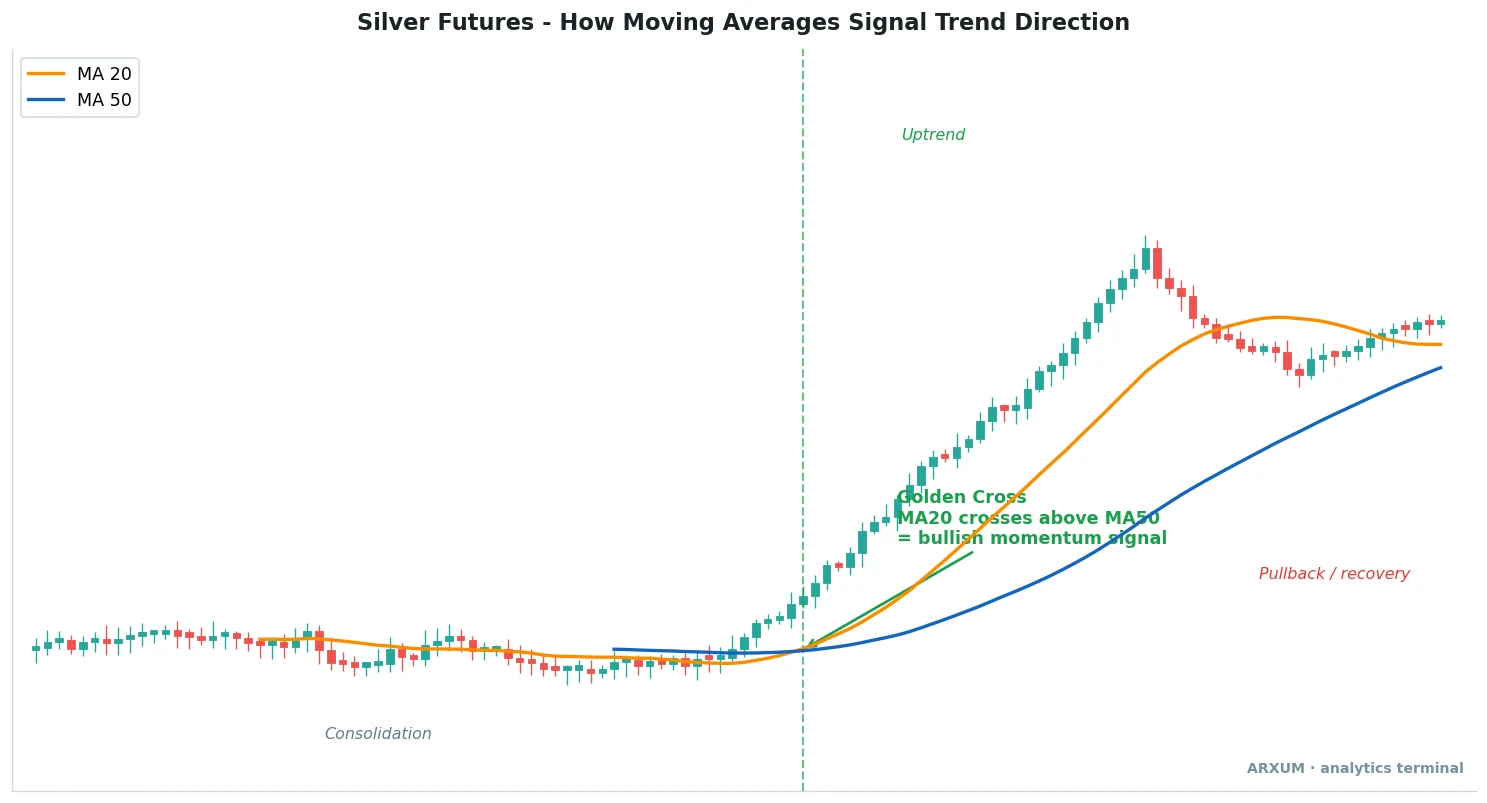
Here is a silver futures chart with the simplest trend read on it, two moving averages.
What the chart is showing:
- The candles are the silver futures price. Green closed up, red closed down.
- MA20 (orange) tracks the recent average price. It turns quickly, so it leads.
- MA50 (blue) is the slower average. It turns late but filters out noise.
- The golden cross is the moment the fast line crosses above the slow one. That is the market shifting from going nowhere to trending up.
- The read: price above both rising lines is an uptrend, price below both falling lines is a downtrend, tangled lines mean no trend and no trade.
That single picture is the whole job in miniature. Everything below fills in the contract details, the drivers, and the second read that keeps you out of stretched entries.
The contract, in plain specs
Silver trades in a family of contracts, same metal, different sizes. The size decides how much each tick is worth and how much account you need.
| Contract | Symbol | Size | Best for |
|---|---|---|---|
| Full silver | SI | 5,000 oz | Funded, active desks |
| E-mini silver | QI | 2,500 oz | Mid-size accounts |
| Micro silver | SIL | 1,000 oz | Smaller accounts, tighter risk |
A few plain-language notes on the mechanics:
- Tick size. Silver moves in ticks of half a cent an ounce. On the full contract that half cent is worth about 25 dollars a tick, so a one-dollar move in the metal is roughly 5,000 dollars. The micro is a fifth of that.
- Leverage. You post margin, a fraction of the notional, to hold the contract. That is what makes futures efficient and also what makes them punishing if you oversize.
- Expiry. Each contract has a delivery month. Active traders roll to the next month before expiry rather than take delivery of metal.
- Always check the exchange. Sizes, ticks and margins are set by the venue and change. Confirm the current spec sheet before you trade, do not trust a blog number as gospel.
If a full contract is too big and even a micro feels heavy, a silver CFD is the retail alternative. It tracks the same spot price (XAG/USD) in flexible sizes, which is why many beginners start there.
Our how to trade silver guide walks the CFD route in detail.
What actually moves silver
Silver has a split personality: half of it trades like gold’s smaller, wilder cousin, the other half on factory demand. Knowing which driver is in charge tells you what to watch.
| Driver | Effect on silver | Why |
|---|---|---|
| US dollar | Usually inverse | Silver is priced in dollars, a stronger dollar makes it dearer abroad |
| Gold | Moves broadly together | Both are precious-metal, safe-haven assets |
| Real interest rates | Falling rates lift it | Metals pay no yield, so they shine when cash pays less |
| Industrial demand | Direct support | Solar panels and electronics eat real silver |
| Risk sentiment | Two-sided | Haven bid in fear, industrial bid in growth |
The two takeaways worth remembering:
- The dollar sets the tide. When the dollar is falling, precious metals usually have the wind at their back. A rising dollar is a headwind. Keep a dollar chart open beside your silver chart.
- Silver amplifies gold. When metals trend, silver tends to run harder than gold in both directions. That extra range is the opportunity and the risk in one.
Reading the trend with moving averages
Silver is a metal, and metals move with the broader precious-metals trend. So the cleanest trend read on silver is the same one you run on gold.
Here is that trend confirmation on spot gold, silver’s larger, steadier twin.
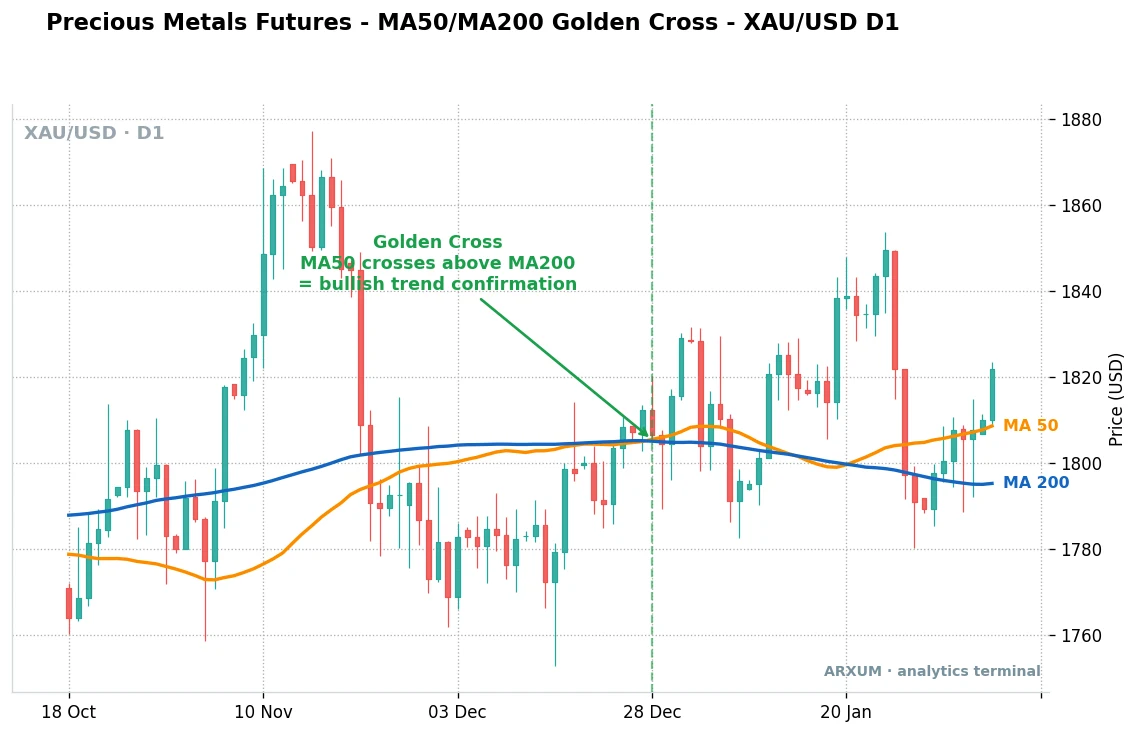
Why gold and not silver here: the two metals move together, and gold’s steadier chart shows the signal more cleanly. The read is identical on silver, just with wider swings.
- The 200-day average is the slow line everyone watches. Price above it is a long-term uptrend, below it a downtrend.
- The 50-day over the 200-day is the classic golden cross, covered in full in our golden cross and death cross guide. The reverse, the 50 dropping under the 200, is the death cross.
- The faster MA20/MA50 pair from the first chart is the shorter-term version of the same idea, better for timing than for the big picture.
How to actually use moving averages on silver:
| Role | How you use it | Best read |
|---|---|---|
| Trend direction | Price above rising MA200 = longs only | Daily (D1) |
| Trend confirmation | MA50 golden cross over MA200 | Daily (D1) |
| Entry timing | MA20 crossing MA50 in the trend's direction | 4-hour (H4) |
| Dynamic support | Pullbacks holding the MA50 | H4 to D1 |
Rule of thumb: let the slow chart pick the direction, let the fast chart pick the moment. Fighting a daily downtrend with a 4-hour buy is how good reads turn into bad trades.
Reading momentum with RSI
A trend tells you which way, momentum tells you whether the move is fresh or exhausted. That second read stops you buying silver right as it runs out of gas.
The tool is the Relative Strength Index, RSI. Here it is flagging an over-extended push, shown on EUR/USD where the signal is textbook-clean.
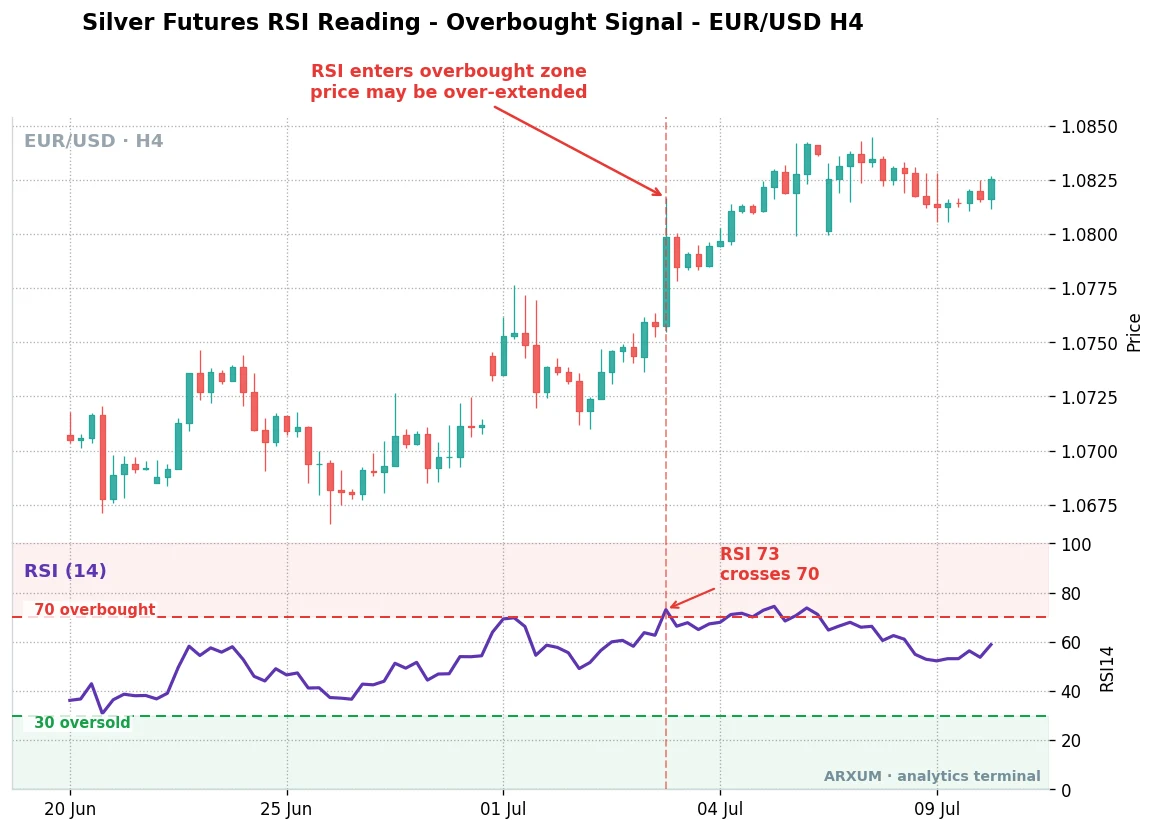
RSI is a portable momentum gauge, so we illustrate it on a clean EUR/USD example, then apply it to silver exactly the same way. Full detail is in the RSI indicator guide.
- RSI runs 0 to 100. It measures how one-sided recent momentum has been.
- Above 70 is overbought, the move is stretched. Below 30 is oversold, the drop is stretched.
- The trap: in a strong trend RSI can sit overbought for a long time. Overbought is not a sell signal on its own, it is a warning to stop chasing.
- The 50 line is the quiet tell. Momentum above 50 leans bullish, below 50 leans bearish.
How to put RSI to work on silver:
| Role | How you use it | Best read |
|---|---|---|
| Momentum bias | Above 50 bullish, below 50 bearish | H4 to D1 |
| Stretch warning | Above 70, stop adding to longs | H4 |
| Pullback entry | RSI dips near 40-50 inside an uptrend | H4 |
| Divergence tell | Price new high, RSI lower high | D1 |
Rule of thumb: use RSI to time entries inside the trend the moving averages already confirmed, never to pick a top against a strong trend. Silver punishes counter-trend heroics harder than most markets.
Silver versus gold: the ratio and the swing
Most silver questions are really gold questions with more volatility. The gold-silver ratio and the swing gap are the two comparisons that matter.
| Feature | Silver | Gold |
|---|---|---|
| Typical swing | Wider, faster | Steadier |
| Main role | Precious and industrial | Mostly haven |
| Trend clarity | Noisier | Cleaner |
| Position sizing | Smaller for the same risk | Larger |
Two things to hold onto:
- The gold-silver ratio is simply the gold price divided by the silver price. A high ratio means silver is historically cheap relative to gold, a low ratio means it is dear. Traders watch the extremes for mean-reversion ideas between the two metals.
- Silver swings roughly twice as hard as gold. That is why a position size that feels calm on gold can shake you out of silver. Size silver down for the same dollar risk. Our gold trading strategy guide is a useful contrast for the steadier metal.
The two reads together
Trend and momentum are the whole toolkit for reading silver, and neither works alone. Stacked, they filter each other.
| What you see | Trend (MAs) | Momentum (RSI) | The read |
|---|---|---|---|
| Best long setup | Up, price over MA50 | RSI pulls back to 40-50 | Buy the dip in the trend |
| Stretched long | Up | RSI over 70 | Hold, do not add |
| No trade | Tangled MAs | RSI near 50 | Stand aside |
| Warning | Up but MA50 flattening | Lower RSI high on new price high | Trim, trend tiring |
The core play: direction from the moving averages, timing from RSI, size from silver’s volatility. That order does not change.
Ways to get silver futures exposure
You do not need the full contract to trade silver. Pick the vehicle that fits the account, not the ego.
| Vehicle | What it is | Fits |
|---|---|---|
| Silver CFD (XAG/USD) | Contract for difference on spot silver | Retail, flexible size |
| Micro futures (SIL) | 1,000 oz exchange contract | Small funded accounts |
| E-mini futures (QI) | 2,500 oz exchange contract | Mid-size accounts |
| Full futures (SI) | 5,000 oz exchange contract | Active, funded desks |
| Silver ETF | Fund that holds or tracks silver | Slower, no leverage |
How to choose in one line each:
- Silver CFD: the flexible retail entry, size it to your account, watch the overnight financing cost. A silver CFD is the lightest way in.
- Micro and E-mini futures: exchange-traded with transparent pricing, a step up in size and discipline once a CFD feels limiting.
- Full futures: for accounts that can absorb a 5,000-dollar-per-dollar swing without flinching.
- Silver ETF: the buy-and-hold route, no leverage and no expiry, but no intraday edge either.
Which route, and which read, to use when
A quick decision table so you are not guessing at the screen.
| If you are | Use this vehicle | Lead read |
|---|---|---|
| New, small account | Silver CFD or micro | D1 trend first |
| Swing trading the trend | Micro or E-mini | MA50 direction on D1 |
| Timing an entry | Same, smaller size | RSI on H4 |
| Just holding a view | ETF | MA200 on the weekly |
Common mistakes
- Trading the full contract too early. A 5,000-ounce contract turns a small mistake into a big loss. Start on a micro or a CFD.
- Sizing silver like gold. Silver swings roughly twice as hard. Same lot size, double the pain.
- Shorting a strong uptrend on an overbought RSI. Overbought can stay overbought for weeks in a trending metal. It is a caution, not a sell.
- Ignoring the dollar. Buying silver into a rising dollar is swimming against the tide. Check the dollar first.
- Forgetting the roll. Futures expire. Hold past the roll date without a plan and you can be forced into settlement.
- Confusing the contracts. SI, QI and SIL are different sizes. Know exactly which one you clicked before you size the trade.
Trading it without getting hurt
Silver is a high-range market, so the discipline matters more than the setup. The read shifts the odds, it does not remove the risk.
- Size for the swing, not the excitement. Risk a small, fixed slice of the account per trade and let the stop distance, not the mood, set the position size.
- Plan the exit before the entry. Know your stop and target up front. Check the reward-to-risk ratio is worth it before you click, ideally a reward at least twice the risk.
- Respect the leverage. Futures margin lets you hold far more silver than the cash in the account. That cuts both ways, so keep positions modest.
- Only commit money you can afford to lose. Leveraged metals are a fast market. Treat every read as odds, not a promise.
The honest bottom line: the trend read and the momentum read stack the deck in your favour when they agree. When they disagree, the trade is not there, and standing aside is a position too.
What works, in three lines
-
- Direction from the moving averages. Price above a rising MA200 for the trend, MA20 over MA50 for the shorter-term shift. No long against a daily downtrend.
-
- Timing from RSI. Buy the dips toward 40-50 inside an uptrend, stop adding when RSI runs past 70, and never fade a strong trend on overbought alone.
-
- Size from the volatility. Silver moves like gold on double espresso. Start on a micro or a CFD, size down for the swing, and only scale up when the account and the discipline can take it.
Glossary
- Silver futures: exchange contracts to buy or sell silver at a set price on a future date.
- COMEX: the exchange where the main US silver and gold futures trade.
- Contract size: the amount of silver one contract controls (5,000 oz full, 1,000 oz micro).
- Tick: the smallest price move, half a cent an ounce for silver.
- Margin: the deposit you post to hold a leveraged futures position.
- Roll: moving a position from the expiring contract month to the next one.
- Moving average (MA): a smoothed average of recent price that shows trend direction.
- Golden cross: a faster MA crossing above a slower one, a bullish trend signal.
- RSI: a momentum gauge from 0 to 100, above 70 overbought, below 30 oversold.
- Gold-silver ratio: the gold price divided by the silver price, a relative-value gauge.
- XAG/USD: the ticker for spot silver against the US dollar.
FAQ
What are silver futures, in plain terms?
They are standardised exchange contracts to buy or sell a fixed amount of silver at an agreed price on a future date. They let you trade the metal with leverage, moving tick for tick with the price, without ever holding physical bars.
How big is a silver futures contract?
The full COMEX contract (symbol SI) controls 5,000 ounces. There is also an E-mini at 2,500 ounces (QI) and a micro at 1,000 ounces (SIL) for smaller accounts. Always confirm the current spec on the exchange before trading.
How much money do I need to trade silver futures?
It depends on the contract and the broker's margin. The full contract needs a well-funded account because each one-dollar move is worth about 5,000 dollars. Most beginners start on a micro contract or a silver CFD, which need far less and let you size the risk down.
Silver futures or a silver CFD, which is better for a beginner?
A silver CFD is usually the easier start. It tracks the same spot price (XAG/USD) in flexible sizes, so you can risk small amounts. Futures give transparent exchange pricing and no financing spread, but come in fixed, larger sizes. Many traders begin on a CFD, then step up to micro futures.
How do I read the trend on silver?
Use moving averages. Price above a rising 200-day average is a long-term uptrend, and a 50-day crossing above the 200-day (a golden cross) confirms it. For shorter-term timing, watch the 20-period crossing the 50-period. Trade in the direction those lines point.
Do moving averages and RSI work on silver?
Yes. Silver responds to the same trend and momentum reads as gold and the major currencies. Moving averages show direction, RSI shows whether momentum is stretched. The only difference is silver's wider swings, so treat overbought and oversold readings as warnings inside a strong trend, not automatic reversals.
Why does silver move so much more than gold?
Silver is a smaller, less liquid market and it is half industrial, so it reacts to both precious-metal and factory demand. That mix makes it swing roughly twice as hard as gold in both directions. Size your positions smaller to keep the dollar risk the same.
What is the best timeframe for silver futures?
Use the daily chart to decide the trend direction, and the 4-hour to time entries inside it. The daily filters out noise, the 4-hour catches the pullbacks. Fast charts below the hourly are mostly noise on a market this volatile.
What is the gold-silver ratio and why does it matter?
It is the gold price divided by the silver price. A high ratio suggests silver is cheap relative to gold, a low ratio suggests it is dear. Traders watch the extremes for relative-value ideas between the two metals, buying the cheaper one against the dearer.
Do silver futures expire?
Yes. Each contract has a delivery month. Active traders roll their position into the next month before expiry rather than take physical delivery. If you hold past the roll date without a plan, you risk being pushed toward settlement, so track the dates.
Real-time trade setups with entry, stop loss and take profit. Daily market analysis. No subscription, no complicated theory.
🌍 Our recommended brokers


Reader Reviews
Be the first to review this — tell other traders what actually helped, or where it fell short.
Leave a Review

Forex Analyst & Senior Trader
Former FX desk trader with 8 years in institutional forex. Works in multi-timeframe analysis and order flow, turning desk experience into systematic, testable rules across forex and metals.