

Why world market hours shape your trades
Most retail traders treat market hours as a curiosity. They check whether the NYSE is “open” and leave it there. On the desk, we tracked session overlap windows obsessively, because the periods where major exchanges run simultaneously generate most of the day’s tradeable volatility.
The numbers: the London/New York overlap (13:00–16:00 UTC) accounts for roughly 50–60% of the day’s EUR/USD trading volume, compressed into just three hours. Understanding which exchange is active tells you whether you’re trading with institutional backing or pushing against thin air.
If you trade index CFDs, gold, or any major forex pair, knowing world market hours is the foundation of any session-based approach.
Major stock exchange opening times (UTC)
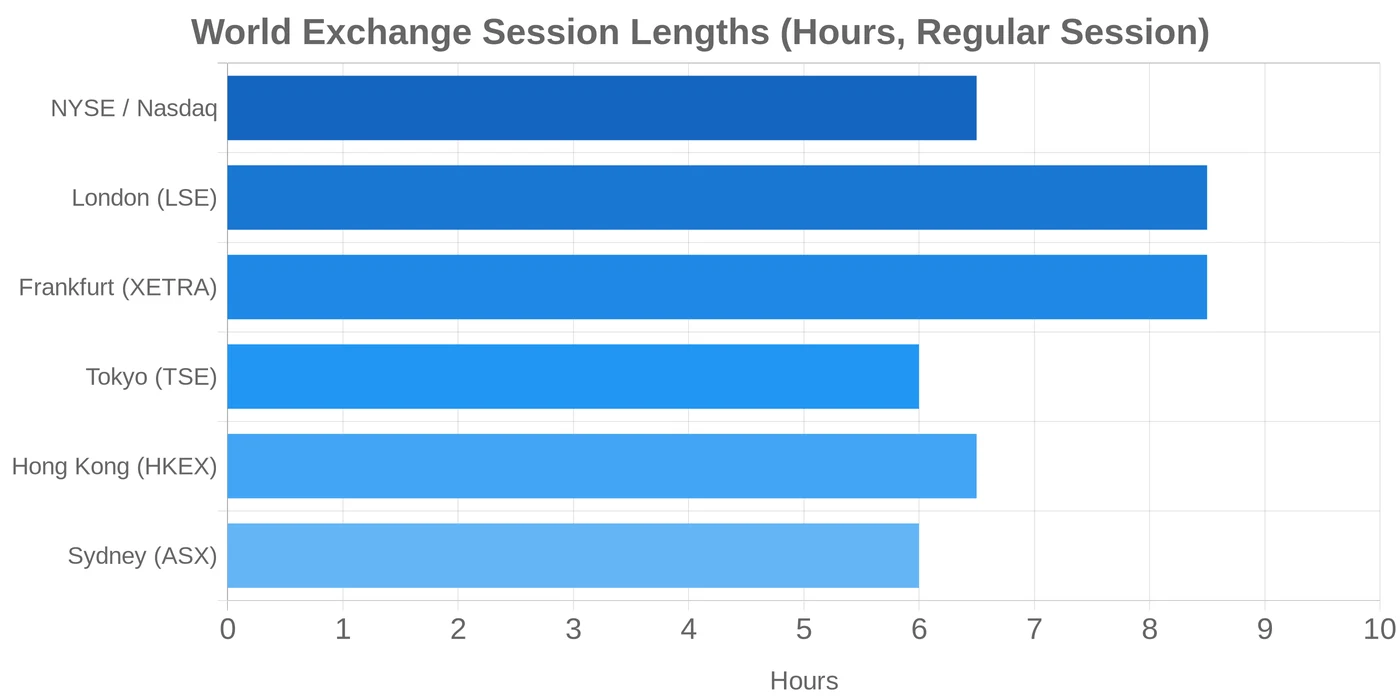
All times below are in UTC. The tables cover regular trading sessions; pre-market and after-hours vary by exchange and broker.
Americas
| Exchange | Opens (UTC) | Closes (UTC) | Days |
|---|---|---|---|
| NYSE (New York) | 14:30 | 21:00 | Mon–Fri |
| Nasdaq | 14:30 | 21:00 | Mon–Fri |
| TSX (Toronto) | 14:30 | 21:00 | Mon–Fri |
| B3 (São Paulo) | 13:00 | 20:55 | Mon–Fri |
Europe
| Exchange | Opens (UTC) | Closes (UTC) | Days |
|---|---|---|---|
| LSE (London) | 08:00 | 16:30 | Mon–Fri |
| XETRA (Frankfurt) | 08:00 | 16:30 | Mon–Fri |
| Euronext (Paris/Amsterdam) | 08:00 | 16:30 | Mon–Fri |
| SIX (Zurich) | 08:00 | 16:20 | Mon–Fri |
| MOEX (Moscow) | 06:00 | 15:50 | Mon–Fri |
Asia-Pacific
| Exchange | Opens (UTC) | Closes (UTC) | Days |
|---|---|---|---|
| TSE (Tokyo) | 00:00 | 06:00 | Mon–Fri* |
| HKEX (Hong Kong) | 01:30 | 08:00 | Mon–Fri* |
| SSE (Shanghai) | 01:30 | 07:00 | Mon–Fri* |
| SGX (Singapore) | 01:00 | 09:00 | Mon–Fri |
| ASX (Sydney) | 23:00 | 05:00 | Sun–Thu** |
| BSE/NSE (Mumbai) | 03:45 | 10:00 | Mon–Fri |
*Lunch breaks: Tokyo 02:30–03:30 UTC | Hong Kong 04:00–05:00 UTC | Shanghai 03:30–05:00 UTC
**ASX opens Sunday 23:00 UTC for Monday’s session (Sydney is UTC+10/+11).
A note on daylight saving time: These times shift when markets switch clocks. US markets change in March and November; EU markets in late March and late October. The shifts are 1 hour in both directions. If your broker’s chart timestamps don’t match the table during transition periods, check whether DST is active for that exchange’s local time zone.
Forex market sessions
| Session | Opens (UTC) | Closes (UTC) | Most Active Pairs |
|---|---|---|---|
| Sydney | 21:00 | 06:00 | AUD/USD, NZD/USD |
| Tokyo | 00:00 | 09:00 | USD/JPY, AUD/JPY, EUR/JPY |
| London | 07:00 | 16:00 | EUR/USD, GBP/USD, EUR/GBP |
| New York | 12:00 | 21:00 | USD/CAD, EUR/USD, USD/JPY |
The overlap windows concentrate most of the day’s volume:
- Tokyo/London (07:00–09:00 UTC): moderate volume, active for EUR/JPY and GBP/JPY
- London/New York (13:00–16:00 UTC): the highest-volume window globally
The London/New York overlap is where the EUR/USD and GBP/USD move with real institutional weight behind them. Outside this window, the same moves can reverse without follow-through because there isn’t enough two-sided flow to sustain direction.
For a deeper look at forex session strategies and how to time entries around session opens, see our guide to forex market hours.
CFD and futures market hours
Here’s where world market hours get interesting for active traders. CFDs on indices like the Nasdaq 100 or DAX trade almost around the clock through most retail brokers, but CFD hours differ from the underlying exchange.
Typical CFD trading hours for major index products:
| CFD Product | CFD Hours (UTC) | Underlying Exchange Session |
|---|---|---|
| Nasdaq 100 CFD | 00:00 – 20:55 | NYSE: 14:30 – 21:00 |
| S&P 500 CFD | 00:00 – 20:55 | NYSE: 14:30 – 21:00 |
| DAX 40 CFD | 07:00 – 20:00 | XETRA: 08:00 – 16:30 |
| FTSE 100 CFD | 08:00 – 20:00 | LSE: 08:00 – 16:30 |
| Nikkei 225 CFD | 23:00 – 21:00 | TSE: 00:00 – 06:00 |
The gap between CFD hours and exchange hours matters more than most traders realise. Outside the underlying exchange session, CFD prices track futures markets on thin volume. I’ve watched the spread on US30 (Dow Jones CFD) jump from 2 points to 12 points during off-hours on standard accounts. On raw-spread accounts, off-session index spreads still run 3–5× the peak rate, reduced versus standard, but not negligible; it is worth understanding how brokers widen spreads off-hours before you hold a position through one. If you’re trading index CFDs outside the cash session, factor wider spreads into your stop calculation.
Gold (XAU/USD) and oil (WTI, Brent) behave differently. They trade via futures markets almost 23 hours a day, with a 1-hour daily pause around 22:00–23:00 UTC. The gold price stays active through the London open, peaks in activity during the London/NY overlap, and thins out after 21:00 UTC. Crypto trades 24/7, with no scheduled close, but volume patterns still follow the NY session window (14:00–22:00 UTC).
For index CFDs, trading during the actual exchange session gets you tighter spreads, better depth, and price moves that reflect real institutional order flow rather than futures-driven approximations.
When to trade each market
Session knowledge converts into trading decisions at the individual market level.
Index CFDs (Nasdaq, DAX, FTSE): Trade during the underlying exchange session. DAX CFD is most liquid from 07:00–11:00 UTC (German open through mid-morning), with a secondary activity spike at the US open (14:30 UTC). Trading DAX at 02:00 UTC puts you in a market with wider spreads and price moves that don’t carry institutional backing, the setup might look clean on the chart, but there’s no order flow to support it.
Forex: The London open (07:00 UTC) and the NY open (13:30 UTC) generate the most directional moves. I stopped trading EUR/USD after 16:00 UTC years ago. The moves after London close are mostly position-squaring and liquidity provider hedging, not directional flow. Setting a hard cutoff at 16:00 UTC on EUR/USD filtered out roughly 40% of my losing trades without affecting the winning setups.
Gold (XAU/USD): Most directional gold moves happen during London session and the first two hours of the London/NY overlap. Gold also reacts to the 10:30 UTC London gold fix and NY options expiry around 15:00 UTC. Trading gold outside these windows means working against a thin market with no anchor, moves can look technical but reverse randomly.
Crypto: Bitcoin volume is highest during the US session (14:00–22:00 UTC) and lowest in the 04:00–08:00 UTC window. On our live accounts, BTC setups entering between 14:00–16:00 UTC consistently outperform those placed outside that window, documented across two dozen-plus recent trades. Outside that window, we pass.
For anyone building a day trading routine around sessions, see our day trading guide for how session timing integrates with specific intraday setups.
What most traders get wrong about market hours
Treating the open as the best time to trade. The first 15–30 minutes after any major exchange opens are chaotic. On the desk, we had a rule: no new positions in the first 15 minutes of London open. The initial price action is driven by retail orders queued overnight, institutional desks clearing Asian session positions, and algorithmic systems hunting stop clusters sitting near yesterday’s close. It’s not directional trading, it’s a shakeout. Better setups appear 20–30 minutes after the open, once the noise settles into a cleaner structure.
The same applies to the NY open at 14:30 UTC. The 14:30–15:00 window on EUR/USD shows high volatility but low directional reliability. The 15:00–16:00 window, after the initial reaction, is where the actual trend for the day typically sets.
Ignoring the session close. The last 30 minutes of major sessions sees position-squaring that can reverse the day’s trend. On US equity close (20:30–21:00 UTC), index CFDs often reverse the afternoon direction as funds rebalance positions. If you’re holding an index CFD trade long into the close, set a hard time exit at 20:30 UTC or expect a potential reversal with no fundamental cause.
Assuming CFD and exchange hours align. As the table above shows, CFD hours extend beyond the exchange close. But extended-hours CFD prices track futures markets and thin volume. A DAX CFD move after 16:30 UTC bears little relation to XETRA’s actual closing price discovery. Treat extended-hours CFD moves as noise unless you have a specific futures-based reason for the trade.
Missing the DST window. Twice a year, US market open shifts by 1 hour relative to UTC. The UK and US don’t switch on the same date, which creates a 2–3 week window where the London/NY overlap shifts by 1 hour. For traders running session-based alarms or automated entries, this is a consistent trap. Set calendar reminders for US DST (second Sunday of March and first Sunday of November) and EU DST (last Sunday of March and October).
Common mistakes to avoid
- Trading EUR/USD during the Sydney session. Volume is thin on major pairs between 21:00–00:00 UTC. Moves that look decisive on a 5-minute chart often reverse without follow-through. Reserve major pair trades for the London and NY windows.
- Ignoring the Tokyo lunch break. Tokyo’s mid-session pause (02:30–03:30 UTC) and Shanghai’s lunch (03:30–05:00 UTC) create a dead zone in Asian markets. Trading JPY pairs during this window means working against thin liquidity with no institutional direction.
- Using local time instead of UTC. Local time varies by DST, region, and broker server settings. Build your session schedule in UTC and keep it fixed. Convert to local time only for your own scheduling convenience, never anchor your strategy to a local time that changes seasonally.
- Leaving positions open through the weekend gap. Forex closes Friday 21:00 UTC. The gap between Friday close and Sunday 21:00 UTC open regularly produces 15–50 pip jumps on EUR/USD, depending on weekend news flow. Any position held over the weekend carries gap risk that cannot be managed with a stop order, gaps skip over stops.
FAQ
What are world market hours in UTC?
When is the best time to trade global markets?
Do CFD markets follow stock exchange hours?
What time does the stock market open in different countries?
Does the forex market ever close?
How does daylight saving time affect market hours?
What are NYSE pre-market and after-hours trading times?
🌍 Our recommended brokers


Reader Reviews
The London/NY overlap section quantified something I had observed but never measured: roughly 50–60% of EUR/USD daily volume compresses into just three hours. Before reading this I was trading EUR/USD from early morning through late afternoon without a session filter, which meant roughly half my setups were entering during low-volume windows where moves reversed unpredictably. Setting a hard trading window of 12:30–16:30 UTC reduced my setup frequency by about 45% and improved win rate from 52% to 67% over two months. Monthly return moved from 4.8% to 7.1% on the same account and risk parameters.
The ASX Sunday night UTC open timing is clarified better here than anywhere else I have read. Saved me from a Monday morning mistake.
The CFD-versus-exchange-hours table is practical in a way that most trading references aren't. I knew CFD markets had extended hours but didn't understand that off-session CFD prices track futures on thin volume rather than cash market activity. The spread data on US30 jumping from 2 points to 12 points in off-hours matches what I see on my broker platform exactly. I now treat any index CFD trade outside the underlying session as a different risk profile, wider stops, smaller position.
The DST transition warning paid off immediately. The guide describes a 2–3 week window twice a year where the London/NY overlap shifts by an hour because US and UK clocks change on different dates. I set a calendar reminder for both US DST transitions and caught the March shift, my session alarms would have triggered an hour late without the reminder. For automated or rule-based strategies, this is a real failure point that most traders only discover after losing a session.
The section on Tokyo and Shanghai lunch break dead zones is underappreciated. JPY pair trades during the 02:30–03:30 UTC window are the thinnest liquidity I see in any major pair during the trading week. Building a session exclusion rule for this window into my JPY pair strategy reduced noise entries by roughly a quarter.
Direct practical reference with actual UTC times, not vague 'European session' language. The note about broker maintenance pauses around 22:00 UTC is a detail I had never seen documented and explains a few fills I never understood.
The gold session timing data matches my own live forward-testing results closely. The 10:30 UTC London gold fix and the NY 15:00 UTC options expiry both produce predictable short-term directional moves on XAU/USD. I now mark both times on my chart every day and avoid placing new positions in the 15 minutes surrounding each event, the directional move happens, then reverses, and the initial direction usually doesn't reflect the session trend.
The weekend gap risk section is exactly the kind of practical warning that would have saved me early in my trading. Left an EUR/USD long open through a weekend twice in my first year, both times caught by Monday gaps. The point that stops cannot be filled during the gap, they skip to the opening price, is fundamental and not obvious to newer traders.
Leave a Review

Forex Analyst & Senior Trader
Former FX desk trader with 8 years in institutional forex. Works in multi-timeframe analysis and order flow, turning desk experience into systematic, testable rules across forex and metals.