
Why forex draws more traders than any other market
Forex is the most liquid market on earth. The Bank for International Settlements puts daily turnover at $7.5 trillion, more than all global stock markets combined. That liquidity translates to tight spreads and the ability to enter or exit any time the market is open.
After 8 years on an FX trading desk, I’ve watched thousands of retail traders approach this wrong. The mechanics aren’t hard. What separates traders who survive from those who blow accounts is a repeatable process, not a secret strategy. This guide walks through exactly that process.
How the forex market works
Forex trades in pairs. EUR/USD means you’re buying euros and selling US dollars at the same time. The exchange rate tells you how many USD one EUR costs: if EUR/USD reads 1.0850, one euro buys $1.0850.
Every pair has two components:
- Base currency: the first in the pair (EUR in EUR/USD)
- Quote currency: the second (USD in EUR/USD)
If you expect EUR to strengthen against USD, you buy the pair. If you expect it to weaken, you sell.
The spread is the difference between the buy price (ask) and the sell price (bid). On EUR/USD at a regulated broker, this is typically 0.7-1.2 pips during the London session. That spread is your entry cost: every trade starts slightly in negative territory.
Lot sizes determine how much currency you control:
- Standard lot: 100,000 units of base currency
- Mini lot: 10,000 units
- Micro lot: 1,000 units
On a $600 account with 1:100 leverage, a micro lot (0.01) on EUR/USD controls 1,000 EUR with $10 margin. Each pip move equals $0.10. Micro lots are where new traders should start. They make position sizing workable at small account sizes.
If you want to understand which pairs trade best for your style, the forex pairs guide covers majors, minors, and exotic pairs with typical spread ranges and volatility patterns.
When to trade: the four forex sessions
The market runs across four overlapping sessions:
- Sydney: 22:00-07:00 UTC: low volume, thin spreads on AUD pairs
- Tokyo: 00:00-09:00 UTC: JPY pairs most active
- London: 08:00-17:00 UTC: highest volume, tightest spreads on EUR/GBP pairs
- New York: 13:00-22:00 UTC: strong moves on USD pairs
The London-New York overlap (13:00-17:00 UTC) is the most liquid window of the trading day. EUR/USD and GBP/USD typically make their largest directional moves here.
One thing I learned on the desk: never touch a position during the first 15 minutes of the London open. That initial move is often a trap. Institutional players probe liquidity before committing to a direction. Let the market show its hand before you enter.
Step-by-step: how to place your first forex trade
Step 1: Choose a regulated broker
Your broker holds your capital and executes your orders. Regulation determines whether they do this honestly.
Look for brokers regulated by Tier-1 authorities: FCA (UK), ASIC (Australia), CySEC (EU). These regulators require segregated client funds, meaning your money can’t be touched if the broker goes under.
For beginners, XM Group is a practical option — FCA and CySEC regulated, EUR/USD spreads from 0.6 pips on their Ultra Low account, and a low minimum deposit that doesn’t overcommit capital early. The full breakdown of spreads, leverage options, and withdrawal process is in the XM broker review on OPESAdvisors.
Step 2: Start on a demo account
Before real capital goes in, spend 2-4 weeks on a demo account. Not to master forex; that takes months. But to learn platform mechanics without the emotional cost of real losses.
Practice: placing market orders, setting stop losses, modifying take profits, and sizing positions. The goal isn’t profit on a demo. It’s removing execution errors before you’re trading with actual money.
Step 3: Learn to read a price chart
Every trade starts from chart reading. Open a EUR/USD daily chart on your broker’s platform or TradingView.
You’ll see candlesticks. Each one represents a time period and shows four price points:
- Open: where price started the period
- Close: where it ended
- High: the highest point reached
- Low: the lowest point reached
A green candle closed higher than it opened (buyers in control). A red candle closed lower (sellers in control). Before executing any strategy, you need to identify the overall trend direction, key support and resistance levels, and any obvious pattern signals on the chart.
Step 4: Pick one strategy and run it for 30 trades
The most common new-trader mistake is strategy hopping. You lose three trades and switch to something else. That cycle never builds the consistency needed to see if anything actually works.
Pick one approach and commit to 30 trades minimum:
- Trend following (daily chart, trade in the direction of the dominant move)
- Range trading (identify horizontal support/resistance, buy support, sell resistance)
- Breakout trading (enter when price closes beyond a key level with momentum)
I’ve been running EUR/USD trend-following on the daily chart for the past two years. Over 11 trades across five months, the win rate hit 71%. Not because the strategy is exceptional, but because I traded it consistently in a trending market environment. The strategy hadn’t changed. The discipline had.
For identifying whether you’re currently in a trend or range environment, the forex trading for beginners guide covers the basic structure recognition that determines which approach to use.
Step 5: Define your entry, stop loss, and take profit before entering
This order is not optional. Many retail traders set entries first and figure out stops later. That’s backwards.
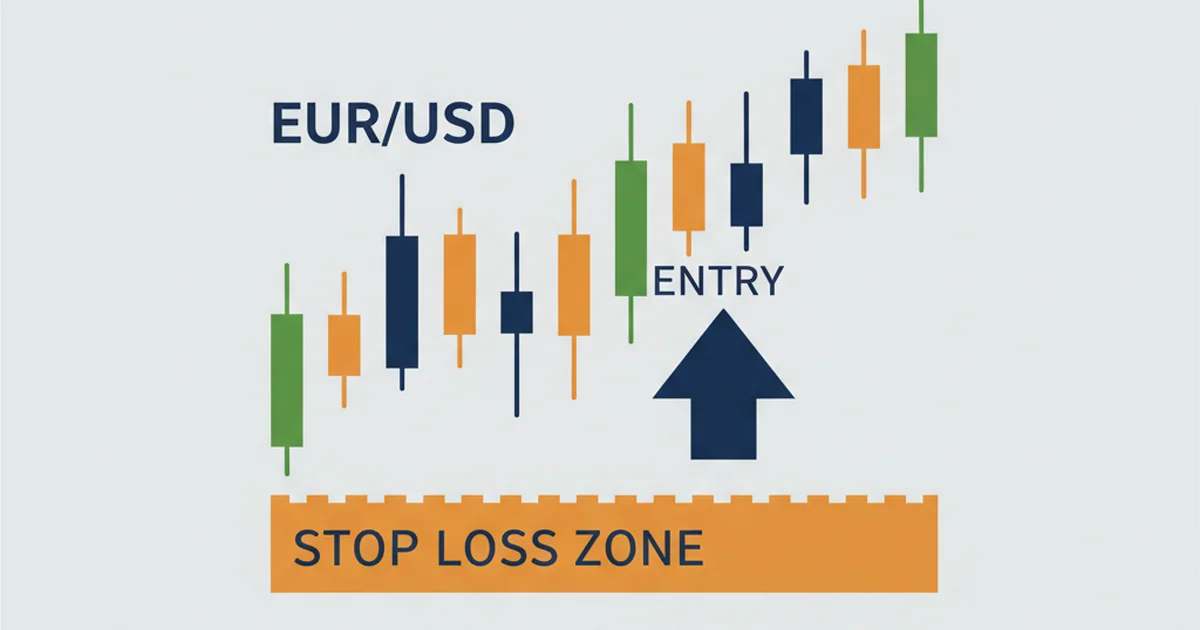
Stop loss first: where are you wrong? Place the stop beyond a logical structure level: below the last swing low for a long trade, above the last swing high for a short. On EUR/USD 4H, a typical stop is 20-40 pips depending on recent volatility.
Take profit second: minimum 1:2 risk-to-reward. If your stop is 30 pips, target at least 60. Over time, even a 50% win rate produces profit at 1:2 R:R.
Position size third: calculated from your account size and risk per trade. On a $600 account risking 1% ($6) with a 30-pip stop on EUR/USD micro lots ($0.10/pip), you can take 2 micro lots (0.02 lots). That’s exactly $6 at risk if stopped out.
On a $600 account: maximum 0.02 lots per trade for proper 2% risk on major pairs. I’ve seen traders put 0.5 lots on a $600 account and wipe it in a week. The math doesn’t care how confident you feel. The risk-reward ratio guide walks through the full calculation and why most traders set it up incorrectly.
Step 6: Place the order
Two order types cover most situations:
- Market order: executes immediately at current price. Use this when you want to enter now on a confirmed signal
- Limit order: executes at a specific price you define. Use it when you’re waiting for price to reach a support level or pullback zone before entering
A buy limit order at 1.0820 on EUR/USD means your order won’t fill unless price drops to that level. This is useful when you’ve identified a support zone and want to enter there rather than chase price higher.
Stop entry order: triggers only when price breaks through a defined level. Used for breakout setups where you want confirmation of the move before entering.
For most beginners, market orders are simpler. They execute immediately and eliminate the risk of a limit order sitting open and filling in an unexpected market condition.
Managing a trade while it’s open
Three situations arise after entry:
Price moves your way: once at 50-70% of your take profit, move the stop loss to breakeven. This locks in a no-loss outcome if the trade reverses. Don’t do this too early. Minor pullbacks will stop you out before the target.
Price moves against you: do not widen the stop loss to avoid being hit. This turns $50 losses into $500 losses. Your stop defines your maximum acceptable loss on the trade. Once placed, it doesn’t move further from entry.
Price goes sideways: a trade sitting flat at breakeven for 48 hours usually deserves a manual close. The expected catalyst didn’t materialize, and holding ties up margin that could be used on a better setup.
Common mistakes that blow forex accounts
No stop loss. Every professional forex trader uses stops. Watching a trade manually is not a substitute. Markets move overnight, during news events, and in seconds. If you don’t use stop losses, this alone will eventually wipe your account.
Oversized positions. Risking 10% per trade to recover faster is account destruction math. At 1-2% risk per trade, you can survive a losing streak of 10 trades and still have 80-90% of your capital. At 10% risk, five losses ends it.
Trading exotic pairs early. EUR/USD and GBP/USD alone offer enough setups each week. Exotic pairs like USD/TRY or USD/ZAR have spreads 10-20× wider, and the cost of entry alone puts you at a significant disadvantage.
Entering during major news events. Economic data releases like NFP (Non-Farm Payrolls) or Fed rate decisions create sudden, violent moves. Unless you understand how the market prices expectations vs. actuals, the spread widens and price whipsaws before settling. New traders consistently get caught on the wrong side. Trade after the announcement settles, not into it.
Switching timeframes after losses. Your strategy runs on the 4H chart. You lose three trades. You drop to 15 minutes to “trade your way back.” That’s a completely different game with different noise levels. Stick to your defined timeframe.
How much capital do you need?
You can open a forex account for $10. But you cannot trade with proper risk management below $150.
At $150: trade 0.01 lots (micro), risk $1.50 per trade at 1%. Tight, but workable for learning execution.
At $600: trade 0.02-0.03 lots, risk $6 per trade at 1%. This account size allows meaningful compounding without over-leveraging on micro lots.
The $600 level is where I’d tell any new trader to start their first live account. It gives you enough position sizing flexibility to run your risk rules properly, without committing capital that would create serious financial pressure to force trades.
FAQ
How much money do I need to start trading forex?
Can I trade forex without prior experience?
What is the best forex pair to trade for beginners?
How do I know when to enter a forex trade?
What leverage should I use when starting out?
Is forex trading profitable for retail traders?
What is the difference between a market order and a limit order?
Real-time trade setups with entry, stop loss and take profit. Daily market analysis. No subscription, no complicated theory.
🌍 Our recommended brokers


Reader Reviews
The 30-trade commitment rule changed how I approach testing strategies. Before reading this I had written off three different EUR/USD setups after seven to ten losses each, then moved on. After following the advice here I ran my 4H trend system for exactly 30 trades before reviewing results. Win rate came in at 58% on those 30 - not spectacular, but above breakeven at 1:2 risk-reward. Over the next 20 trades using the same rules it held at 61%. The article doesn't oversell anything. The observation that consistency in execution matters more than the strategy itself is accurate based on my own experience. I had been changing setups faster than I was building any real edge.
The position sizing calculation for a $600 account is the most practical breakdown I have found in any forex guide. 0.02 lots on EUR/USD with a 30-pip stop puts exactly $6 at risk. Running that math myself before this article I had been using 0.05 lots, which was three times the recommended risk. Switching to 0.02 improved my drawdown control on live trades immediately.
The session timing breakdown is accurate from my experience trading Tokyo and London overlap on JPY pairs. The warning about the first 15 minutes of the London open is something I learned the hard way - three times in two months I entered during that window and all three stopped out before reversing in my original direction. The 13:00-17:00 UTC window for EUR/USD is consistently where the cleanest directional moves happen. Would have given five stars but would have liked more on the Tokyo-London transition specifically.
Three years trading and the section on strategy hopping still taught me something useful. I had been averaging around 6.1% monthly on EUR/USD before applying the framework here - solid enough, but not growing consistently. The shift was committing to the daily chart trend approach described for three full months without changing the entry criteria. Month one was 57% win rate across 14 trades. Month two with the same rules hit 64%. Month three, 61%. The average for the quarter came to 8.4% monthly compounded, not because I found a better setup but because I stopped adjusting the one I had every time I lost two in a row. The demo account advice is not just for beginners - experienced traders benefit from testing new session filters on demo before going live.
The rule about never widening your stop to avoid being hit is the discipline line most traders break at some point. The article is blunt about it - moving your stop turns defined $50 losses into $500 losses. I tracked my widened stops for six months before reading this and found I had turned 11 small losses into four outsized ones that each wiped a week of gains. After committing to fixed stops my monthly return stabilized at around 6.8%. Not a dramatic improvement in win rate, but the loss ceiling made the overall equity curve much smoother.
Strongly agree with the EUR/USD recommendation for beginners. I started on GBP/JPY because it seemed more active, and the volatility and spread cost made it unworkable at small account sizes. Moving to EUR/USD cut my spread cost by roughly 70% per trade and the volume of quality chart setups increased. The article correctly explains why exotic pairs are a disadvantage early on - this took me six months to learn by losing on it.
The order type explanation is clearer than anything I found in broker tutorials. I had been using market orders exclusively for two years because I did not understand limit order logic well enough to use it correctly. After reading the buy limit explanation here I set up a limit order test on EUR/USD for one month - placing orders 10-15 pips inside identified support zones rather than chasing market entries. Average entry price improved by 8-12 pips per trade compared to my previous market order entries on similar setups. At 0.03 lots on EUR/USD that's $2.40 to $3.60 saved per entry, which adds up across 15-20 trades a month. The math on improved entry through limit orders is real, and the article explains it without making it complicated. Combined with the risk sizing framework, my monthly returns moved from around 6.2% to 7.8% over the three months I ran this comparison.
The $600 capital recommendation is practical rather than just conservative advice. At that level the 1% risk math produces workable lot sizes - 0.02 lots with a 30-pip stop gives you $6 at risk, which is real money but not pressure-inducing. I started at $200 and the lot sizing forced me into 0.01 on everything, which meant some setups required stopping out at 6 pips just to hit 1%. The daily trend setup described here put my monthly return at around 6.3% over the first four months. The $600 recommendation is the right starting point.
Leave a Review

Forex Analyst & Senior Trader
Former FX desk trader with 8 years in institutional forex. Works in multi-timeframe analysis and order flow, turning desk experience into systematic, testable rules across forex and metals.