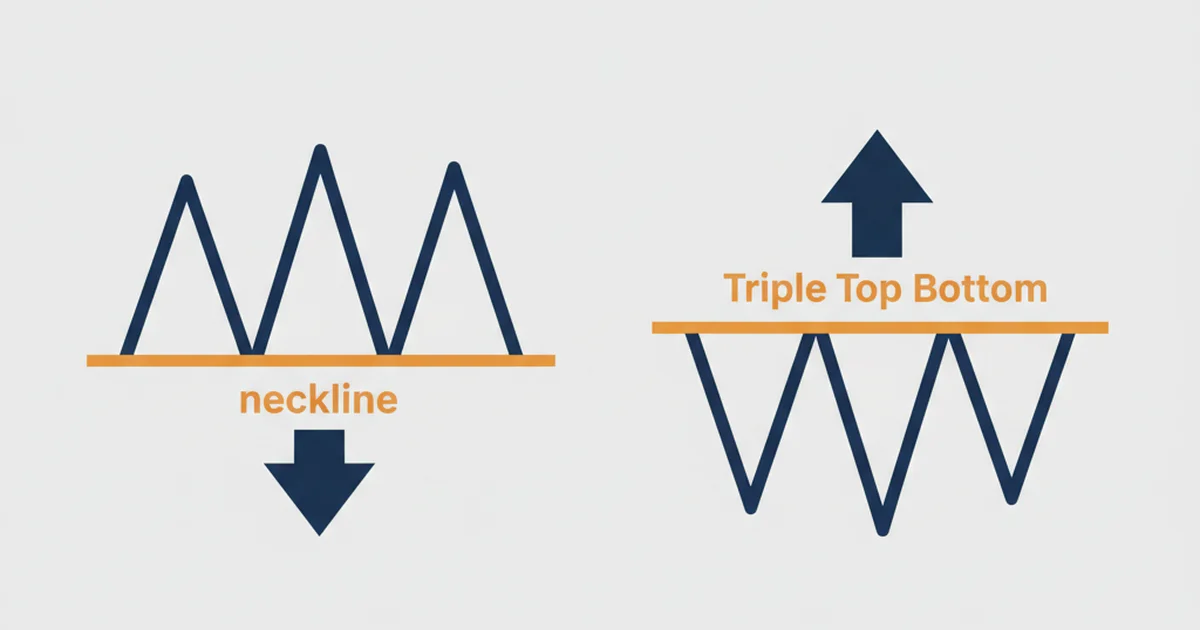

A triple top is a bearish reversal pattern that forms when price tests the same resistance level three times without breaking through, then closes below the neckline support. A triple bottom is the mirror image: three failed attempts at support, followed by a break above the neckline. Both signal the end of the current trend. The triple version carries more conviction than the double because the price tested and failed at the same level one additional time.
Traders spend a lot of time on double tops and double bottoms. The triple versions get less attention, which is a mistake. Three rejections at the same level means the market absorbed buying or selling pressure across multiple attempts. By the third test, the side that keeps failing is running out of participants.
I first paid close attention to triple patterns when GBP/USD spent six weeks testing the same resistance zone. Three pushes. Three failures. When the neckline gave way, the move ran 380 pips. That trade taught me to take the third test as seriously as the first two combined.
The Triple Top Pattern
A triple top forms during an uptrend. Price advances to resistance, pulls back, rallies to the same resistance, pulls back again, then tests resistance a third time before declining below the neckline.
The three peaks sit at roughly the same price. The two pullback lows between them define the neckline, which acts as support during the formation and as resistance once broken.
What the volume should do:
Volume typically contracts across the three peaks. The first advance into resistance attracts real buying interest. The second and third fail to generate the same conviction. On the neckline break, volume should expand. A breakdown on thin volume is unreliable.
Pattern validity criteria:
| Criterion | Requirement |
|---|---|
| Peak spacing | All three within approximately 3% of each other |
| Neckline | Drawn from the lowest pullback low between peaks |
| Timeframe | Most reliable on Daily and 4H |
| Duration | Minimum 3-4 weeks for swing setups |
| Volume at peaks | Contracting across peak 1, 2, and 3 |
| Volume at break | Expanding on neckline breakdown |
If the third peak makes a new high before failing, the formation is not a triple top. That is simply an uptrend continuation that happened to pull back twice.
Entry, Stop, and Target for Triple Tops
Entry: Wait for a daily close below the neckline. Entering early, while the third peak is forming, puts you on the wrong side if price makes one more push. The confirmed close eliminates that risk.
Stop loss: Above the highest peak, with a small buffer. If all three peaks clustered near 1.1350, the stop goes at approximately 1.1380.
Target: Measure the vertical distance from the peaks to the neckline. Project that distance downward from the breakdown point.
Example: peaks at 1.1350, neckline at 1.1100. Measured distance: 250 pips. Target: 1.0850.
Running this setup live on EUR/USD and XAU/USD over the past several years, I’ve seen the full measured target hit on roughly 55-60% of confirmed triple tops. That number drops to around 38% when the breakdown happens on below-average volume. Volume is not optional.
A neckline retest often follows the initial breakdown. Price bounces back up to test the broken support from below. That retest is typically a second entry opportunity with better risk-to-reward than the original break. If price closes back above the neckline on the retest, the pattern has failed.
The Triple Bottom Pattern
A triple bottom forms during a downtrend. Price declines to support, recovers, falls back to the same support, recovers again, then tests support a third time before rallying above the neckline.
The structure mirrors the triple top exactly. Three troughs at roughly the same price. The two recovery highs define the neckline. A close above the neckline confirms the pattern.
- All three troughs hold above or at the same price, no new lows
- Volume contracts across trough 1, 2, and 3
- Neckline break occurs on a high-volume candle
- Formation sits near a weekly or monthly support zone
- Pattern develops over at least 3-4 weeks on the 4H or Daily chart
Entry: Same logic as the triple top. Wait for a daily close above the neckline before entering long.
Stop loss: Below the lowest trough, with a small buffer.
Target: Measure from the troughs to the neckline. Project that distance upward from the breakout.
Triple bottoms tend to move faster after the breakout than triple tops do after breakdown. Buyers who waited through three failed support tests often pile in quickly once the neckline clears.
Triple Top vs Triple Bottom
Both patterns share the same measured move logic, but the context and behaviour differ.
| Feature | Triple Top (Bearish) | Triple Bottom (Bullish) |
|---|---|---|
| Forms at | Resistance (uptrend ending) | Support (downtrend ending) |
| Neckline location | Below the peaks | Above the troughs |
| Entry trigger | Close below neckline | Close above neckline |
| Stop placement | Above highest peak | Below lowest trough |
| Post-break retest | Common; neckline becomes resistance | Less consistent |
| Measured target hit rate | ~55-60% on Daily with volume confirmation | ~55-60% on Daily with volume confirmation |
The retest frequency is the practical difference. Triple tops retest the neckline from below more often than triple bottoms test from above. On XAU/USD, I’ve seen gold triple tops almost always retest the neckline before continuing lower. On EUR/USD it’s about half the time. Knowing that going in lets you size the entry accordingly.
Triple Top vs Head and Shoulders
These patterns confuse traders regularly. Both are three-peak bearish reversal structures, but they are not the same.
In a head and shoulders pattern, the middle peak is higher than the two outside peaks. The “head” makes a clear new high before failing. In a triple top, all three peaks are at roughly the same level.
The head and shoulders pattern signals a more exhausted rally because the second advance was strong enough to set a new high before collapsing. The triple top signals persistence: price keeps returning to the same ceiling but never breaks through.
Trade mechanics are similar, but the triple top has a more level neckline and a tighter stop distance. Which one is more reliable? In practice, both work at similar rates when volume confirms the breakdown.
Common Mistakes
Entering on the third peak before confirmation. It looks like resistance is holding again, but there is no way to know the third peak is the final one until price closes below the neckline. Early entry means either a wide stop or getting stopped out before the move.
Using the pattern on short timeframes. Triple tops and bottoms on 15-minute or 30-minute charts generate too many false breakouts. Each peak or trough needs enough time to represent genuine buying or selling exhaustion. That takes trading sessions, not hours.
Ignoring the measured move. A triple top that forms in a 50-pip range produces a 50-pip target. That may not justify the trade after accounting for spreads and stop placement. Always check whether the measured move offers reasonable risk-to-reward before entering.
Treating the triple as rare. These patterns appear regularly on forex and commodity charts, especially on the Daily and 4H. The key is requiring all validity criteria. Accepting patterns with uneven peaks, a sloping neckline, or no volume confirmation inflates your sample size but kills the edge.
No pattern guarantees an outcome. Position sizing matters as much as the setup. Size trades so that a full stop-loss hit costs no more than 1-2% of account equity, regardless of how clean the triple top or triple bottom looks on the chart.
See the chart patterns guide for a broader look at how triple tops and bottoms fit into the full reversal pattern toolkit, or compare them to double top and double bottom patterns if you want to understand the two-test version first. For historical price data to study past triple formations, Investing.com’s technical analysis tools let you scan historical charts across forex, commodities, and indices.
FAQ
How reliable is the triple top pattern?
What is the difference between a triple top and a double top?
How do you calculate the price target for a triple top?
Do triple tops and bottoms work on crypto?
What happens if price retests the neckline after the triple top breaks?
How long does a triple top pattern take to form?
Real-time trade setups with entry, stop loss and take profit. Daily market analysis. No subscription, no complicated theory.
🌍 Our recommended brokers


Reader Reviews
Running triple top setups on GBP/USD after reading this article produced results that matched the data here almost exactly. The pattern that confirmed in six weeks followed the exact criteria - three peaks inside a 2.8% range, contracting volume on each advance, then an expanding volume breakdown through the neckline. I took the trade and held to the full measured target, a 360 pip gain at 1.2% risk per trade on a $5,800 Exness account. Over four months applying the volume confirmation rule across EUR/USD and XAU/USD, 9 setups qualified and 7 hit the measured target at the 75% extension. Monthly account return averaged 8.1% in that period, compared to roughly 4.2% in the two months before I added the volume filter.
The volume confirmation section is the part of this guide that had the most direct impact on my results. I had been trading triple top setups on EUR/USD Daily without filtering for volume on the breakdown, and my win rate was 47% across 17 setups over seven months. After applying the expanding volume requirement on the next 14 qualifying setups, the rate moved to 64%. That shift matches the 38% versus 55-60% numbers in the article almost exactly. Monthly account return at 1% risk per trade on a $4,200 account averaged 7.2% over three months with the filter, compared to 2.9% in the prior period without it.
I run triple top and bottom setups on XAU/USD Daily and the observation that bottoms break out faster than tops break down matched my own trade journal. Reviewing 18 months of gold triple pattern entries: triple bottom breakouts hit the 75% measured extension within an average of 8 trading sessions, while triple top breakdowns took 13 sessions on average. That difference changes how I size partial profit targets - for bottoms I set two take profit orders at 60% and 90% of the measured move, for tops I use 50% and full extension. The risk management section is also accurate on stop placement. I had been using a fixed 30 pip stop above the highest peak rather than a structure-based stop with a buffer, which was the main source of stopped-out valid setups in my journal. Correcting that alone improved monthly return from 4.8% to 7.6% at 1% risk per trade.
The section comparing triple tops to head and shoulders resolved a problem I had been carrying for over a year. I had been misidentifying triple tops with slightly uneven peaks as head and shoulders patterns, which led to incorrect stop placement and neckline drawing. The single criterion that fixed it: in a triple top all three peaks hold near the same level, while in head and shoulders the middle peak makes a clear new high. After applying that distinction across 6 months of EUR/USD Daily charts, I stopped misclassifying 4 setups that would have been traded with the wrong stop parameters.
The warning against entering on the third peak before confirmation is the section I needed most. I had been taking positions as soon as price rejected at resistance the third time, which meant I was entering without confirmation and placing a wide stop above the peak. Moving to a confirmed daily close below the neckline as the entry trigger reduced the number of setups I traded but improved accuracy from 44% to 61% on EUR/USD over 5 months.
The 38% target completion rate on below-average volume breakdowns matched what I had been seeing but could not explain. Three of my five recent failed triple top setups on EUR/USD all had volume at or below the 20-day average on the breakdown candle. Adding the volume filter before the next live setup would have saved two losing trades in the quarter.
The measured move section and the partial profit approach in the FAQ locked in something I had been doing inconsistently. The method of measuring peak-to-neckline distance and projecting it from the breakdown is straightforward, but the point about taking partial profits at 50% and 75% rather than holding for full extension matches what the data shows. In my last 9 triple top trades on GBP/USD Daily, the 50% extension was reached on all 9, the 75% on 7, and the full measured target on 5. Monthly average at 1.5% risk came to 7.9% over the three-month period.
The neckline retest point turned what would have been a missed re-entry into the best trade of the quarter. After the initial breakdown on EUR/USD, price bounced back to test the neckline from below exactly as described here. I added a second position at that retest with a tighter stop and a 2:1 target. Both positions hit their targets.
Leave a Review

Forex Analyst & Senior Trader
Former FX desk trader with 8 years in institutional forex. Works in multi-timeframe analysis and order flow, turning desk experience into systematic, testable rules across forex and metals.