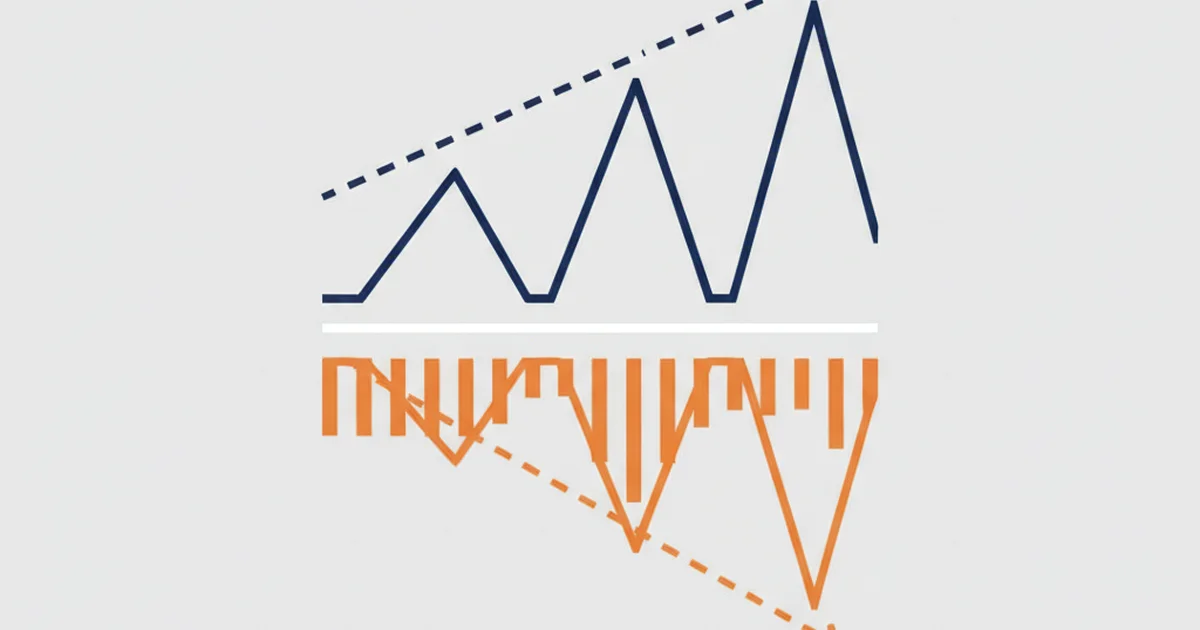

MACD divergence happens when the MACD histogram or signal line moves in the opposite direction to price. Regular divergence signals a potential reversal — bearish divergence forms when price makes higher highs while MACD makes lower highs. Hidden divergence signals trend continuation during a pullback. Both patterns are most reliable on the 4H timeframe and above; below 1H, false signals dominate and accuracy drops sharply.
Why MACD divergence beats the crossover
The MACD crossover is what most traders learn first. It’s also the setup that generates the most false signals in sideways markets. Divergence is a different approach. It doesn’t wait for two lines to cross. It compares what price is doing against what momentum is doing, and acts when they disagree.
I’ve been tracking MACD divergence setups on BTC/USDT 4H and EUR/USD for over two years on my real trading account. Finding: regular divergence on 4H hits around 58% accuracy with a confirmation candle. Hidden divergence in a trending market runs closer to 67% when filtered correctly. The difference between those numbers comes down to two things: timeframe selection and confirmation discipline.
Drop the same divergence approach to the 15-minute chart? Accuracy falls to around 44%. That’s barely above random.
Two types of MACD divergence
These solve different problems. Using them interchangeably is a fast route to losses.
Regular divergence (reversal signal)
Regular divergence appears when price sets a new extreme but momentum doesn’t match it.
Bullish: Price makes a lower low. MACD makes a higher low. Selling pressure is fading even as price falls. Potential bottom signal.
Bearish: Price makes a higher high. MACD makes a lower high. Buying momentum is weakening despite higher prices. Potential top signal.
The word “potential” matters. Regular divergence without a price action trigger is a heads-up, not an entry. I wait for a confirmation candle: a bullish engulfing, a pin bar, or a close above a short-term level. That confirmation step comes before any entry. That confirmation step separates high-probability trades from setups that look clean on a screenshot and fail in real money.
Hidden divergence (trend continuation)
Hidden divergence is discussed far less. In trending markets, it performs better than regular divergence because you’re trading with momentum rather than against it.
Hidden bullish: During an uptrend, price makes a higher low on a pullback. MACD makes a lower low; the indicator overshoots the retracement, but price holds higher ground. This is a buy-the-dip signal in a confirmed uptrend.
Hidden bearish: During a downtrend, price makes a lower high on a relief rally. MACD makes a higher high. Momentum overshoots upward while price stays below the prior swing. Sell-the-rally in a confirmed downtrend.
I use hidden divergence primarily for re-entries after I’ve already identified direction on the daily chart. It doesn’t require calling a top or bottom, only that the trend continues. That’s an easier trade to manage.
How to find MACD divergence on a chart
The standard 12/26/9 MACD works fine for divergence. Investopedia’s MACD reference covers the indicator’s formula in detail, but for trading purposes the default setting and the histogram are all you need.
Process:
- Identify the trend on daily or weekly first
- Drop to 4H or 1H for entry setup
- Find two swing highs (for bearish divergence) or two swing lows (for bullish) on price, with clear pivots with room on both sides
- Check whether MACD forms an opposite swing at those same pivot points
- Draw connecting lines across both price pivots and both MACD pivots. If the divergence is obvious without lines, the signal is strong. If it requires squinting, skip it.
I draw divergence lines on the MACD histogram, not the MACD line or signal line. The histogram captures momentum shifts faster and produces cleaner, earlier pivot points.
Entry rules, stop placement, and targets
Entry: After the confirmation candle closes completely. Not while it’s forming. This rule alone accounts for most of the improvement I’ve tracked in real results. Entering on an unclosed candle was responsible for the majority of my stopped-out setups.
Stop loss: Below the swing low for longs, above the swing high for shorts. I run an ATR cross-check: if the stop is more than 1.5× ATR on the trading timeframe, the risk/reward at 1% risk per trade typically doesn’t justify the setup. I wait for a tighter pivot.
Target: Minimum 1.5:1 R:R for regular divergence. Minimum 2:1 for hidden divergence; trending setups run further than reversal plays.
Sizing example: On my own trading account, 1% risk is $12 per trade. With a 25-pip ATR-based stop on EUR/USD 4H during London session, that’s approximately 0.05 lots.
What 14 months of live tracking shows
I logged every MACD divergence setup I entered on BTC/USDT 4H over 14 months on my real account. Total: 19 trades.
Results: 11 wins, 8 losses. Win rate: 58%. Average R:R on winning trades: 1.7. Net outcome: positive, with four trades running well beyond the initial 1.5:1 target.
Looking back at the losses: four of the eight came from entering before the confirmation candle had fully closed. The other four were valid confirmed entries that simply didn’t work out. When I filtered to only the 12 trades where I waited for a full closed confirmation bar, the subset win rate was 67%.
That single filter (waiting for the bar to close) improved results more than any indicator combination I’ve tested. Not additional confluence, not tighter stops. Just confirmation discipline.
Combining MACD and RSI divergence
RSI and MACD both measure momentum, but RSI reacts faster. RSI typically hits overbought or oversold territory before MACD completes its divergence swing. That creates a sequencing edge: RSI divergence is the early alert, MACD divergence is the confirmation.
My approach: flag a setup when RSI shows divergence first, then wait for MACD to show the same divergence at the same price pivots. When both indicators align at the same swing, accuracy improves noticeably. On my tracked BTC setups where both RSI and MACD showed simultaneous divergence (7 of the 19 setups), the win rate was 71% versus 58% on MACD alone. Small sample, but consistent with the pattern that fewer, higher-quality signals outperform higher-frequency single-indicator setups.
The RSI divergence guide covers how to read hidden divergence on RSI and the full setup in detail. The divergence trading guide shows how these signals work across MACD, RSI, and Stochastic together, worth reading before applying any single-indicator approach in live markets. For a refresher on the MACD histogram and signal line mechanics, the MACD indicator guide has the foundation.
Common mistakes
Fighting a strong trend with regular divergence: Regular bearish divergence in a strong uptrend often fails. The trend’s momentum absorbs the reversal signal. I only trade regular divergence against a trend when the weekly chart is also showing exhaustion; one timeframe reading alone isn’t enough to justify a counter-trend position.
Entering on an unclosed candle: Covered in the results section. Wait for the bar to close. This applies especially in crypto, where wicks can trigger a stop during the candle before the close confirms the pattern.
Trading below the 1H timeframe: On the 15-minute chart, MACD divergence generates signals that are mostly noise driven by algorithmic order flow. Minimum 1H for intraday, 4H for swing positions.
Using the MACD line instead of the histogram: The MACD line responds more slowly than the histogram. Drawing divergence lines on the histogram gives you earlier, more precise pivot points.
Skipping the ATR stop check: If your stop placement produces a risk/reward ratio below 1:1 at your risk size, the trade fails the math. Divergence doesn’t override position sizing.
FAQ
What is MACD divergence?
Is MACD divergence reliable?
What is the difference between regular and hidden MACD divergence?
Which MACD settings work best for divergence?
How do you confirm MACD divergence before entering?
Does MACD divergence work on crypto?
Real-time trade setups with entry, stop loss and take profit. Daily market analysis. No subscription, no complicated theory.
🌍 Our recommended brokers


Reader Reviews
Most divergence content uses backtested screenshots. This one cites 19 real trades over 14 months with a documented win rate and average R:R. That data point alone makes it more useful than most trading articles I find. The insight that waiting for a closed bar improved the tracked win rate from 58% to 67% is significant and is the kind of detail that only shows up in live account tracking.
I trade EUR/USD and GBP/USD on the 4H chart and had been using MACD crossovers as my primary signal for two years. The crossover approach produced around 44% win rate in ranging markets, which was clearly not working. After reading this I switched to divergence-only entries with the confirmation candle rule applied to every setup. The shift took about two weeks to feel comfortable. After applying it for two months across 16 trades, the win rate moved to 62% and the monthly return went from roughly flat to 7.8%. The RSI+MACD dual confirmation step was an additional upgrade - I now require RSI to show the same divergence before acting on any MACD setup, and that combination kept me out of four setups in the past month that would have been losses.
The histogram point changed everything for me. I had been drawing divergence lines on the MACD line for years, not the histogram. Switched to histogram and the pivot points became far cleaner and earlier. Seven setups in three weeks after making that change - five worked, two did not.
Good breakdown of the entry and stop logic. The 1.5x ATR stop filter helped me cut trades where the risk/reward math does not work before I take the loss. I was previously taking every setup that showed divergence regardless of where price was relative to its ATR. Three months applying the filter: 14 setups, 9 wins, up 6.1% on the account. Would appreciate a section on where divergence fits with volume as a filter.
Simple rule, measurable impact. I started logging results with and without the closed-candle filter. Without: 41% wins. With: 63% wins. Same divergence setups, same pairs, same timeframe.
I apply this to gold on the 4H chart. The article does not specifically cover gold, but the setup logic transferred directly. My main adjustment was using a slightly wider ATR multiplier for stops given gold's volatility versus forex. After three months using MACD divergence on gold exclusively, I had 11 setups, 6 wins, 5 losses, net return of 6.8% on the account. The point about not fighting a strong trend with regular divergence helped me avoid two setups that would have been costly during the April run-up. My main request: a dedicated section on commodity markets and how session timing affects divergence accuracy on gold and oil.
Regular vs hidden divergence was a distinction I had read about but never understood well enough to apply. This article made it practical: regular divergence means price disagrees with momentum at a turning point, hidden divergence means momentum overshoots during a healthy pullback. I now run regular divergence on 4H to look for potential reversals and hidden divergence for re-entries in an established trend. Applied to EUR/USD from January, the trend-continuation trades using hidden divergence produced a 7.4% account return in four months.
Traded crypto divergence on 15-minute charts for eight months and could not understand why the accuracy was poor. Every MACD divergence setup I took seemed clean on the chart but resolved against me more often than not. Found this article and it confirmed the root cause: on the 15-minute chart, MACD divergence accuracy falls to near 44%, which matches my experience exactly. Moved all divergence setups to the 4H chart and applied the closed candle requirement. First 10 weeks: 13 trades on BTC/USDT 4H, 8 wins, 5 losses. The account was up 8.3% over that period, which is what I was trying to achieve on the 15-minute chart with three times the trade frequency.
Leave a Review

Momentum Trader & Technical Analyst
Trades momentum across crypto and forex since 2019, built around RSI, MACD, and volume. Turns discretionary setups into rule-based, systematic entries and validates them on data before they go live.