
Why trendlines beat static support levels (when used correctly)
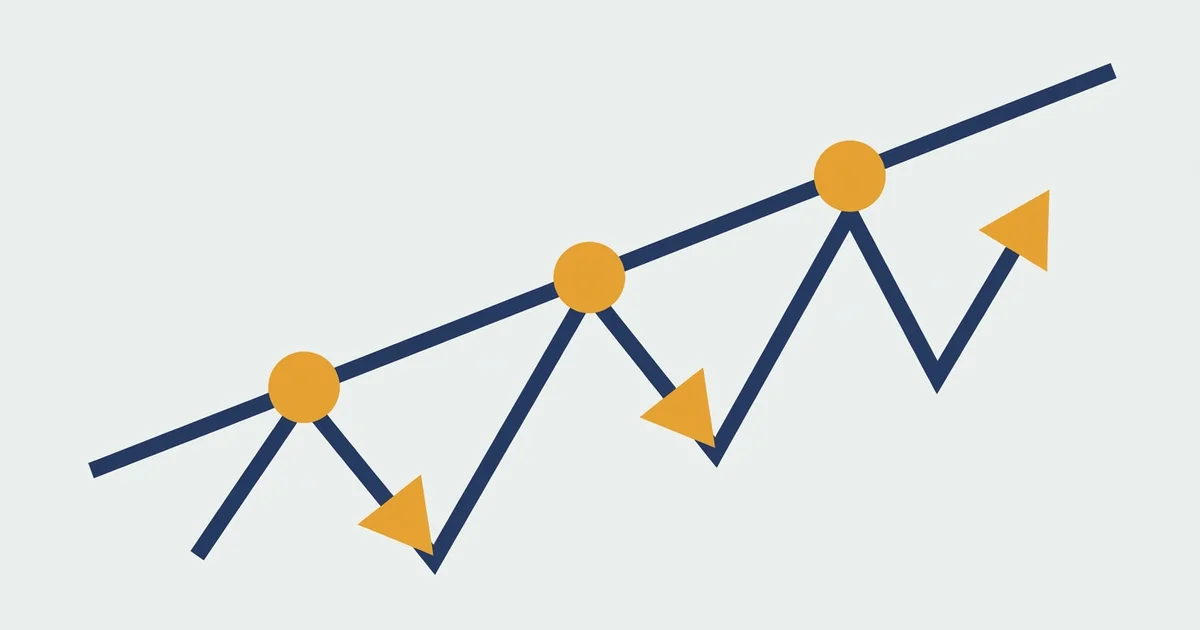
A trendline is a straight line connecting a series of swing highs in a downtrend, or swing lows in an uptrend. The slope tells you how fast the trend is moving. Steep angles mean aggressive momentum. Shallow angles mean slow accumulation or sluggish distribution. When price returns to that line, you have a testable setup: does the trend hold, or is it breaking down?
Static support and resistance levels mark fixed price zones. Trendlines work differently: they rise or fall with the trend, which means each new touch happens at a higher (or lower) price than the last. That dynamic quality makes them useful for timing entries in directional markets where horizontal levels shift too slowly to be actionable.
On the desk, we used trendlines as the primary structure filter. Before taking any position in EUR/USD or GBP/JPY, we asked: where is the controlling trendline? Is price approaching from the trend side, or pushing against it? The answer determined whether we looked for continuation or reversal.
Retail traders tend to skip those questions. They draw a line through two nearby wicks and call it a trendline. The result breaks on the next bar and provides no useful information. Real trendlines require patience to identify and discipline to wait for confirmation.
How to draw a valid trendline
Uptrend trendline: Connect two clear, consecutive higher lows. The first point anchors the line; the second confirms the slope. Additional higher lows that approach the line add evidence that the level is holding.
Downtrend trendline: Connect two consecutive lower highs. Each subsequent lower high that fails to break above the line confirms the downtrend structure.
Wick or body? Both can be valid depending on context. I use wick tips to establish the outer boundary of the level, specifically the maximum price that sellers (in a downtrend) or buyers (in an uptrend) have been willing to push. But the exact wick tip matters less than the zone. Price doesn’t honor geometry to the pip. What you’re looking for is price behavior within 10-30 pips of the line, not a laser-precise touch.
Minimum touches before trading: Two points define the line geometrically. You need a third confirmation touch before risking capital. Two-point lines get broken regularly because they’re hypotheses, not confirmed structure. I won’t trade a trendline bounce until I’ve seen three clean tests. The third test is the entry trigger.
Multi-timeframe hierarchy: I draw the primary trendline on the Weekly or Daily chart to define the macro trend. I then look for entry signals on the 4H or 1H chart when price approaches that higher-timeframe line. A Weekly trendline respected on the 4H gives multi-timeframe confluence, which produces meaningfully better win rates than single-timeframe entries alone.
Live example: During a multi-month EUR/USD downtrend I tracked recently, the descending trendline from the prior July high was clear on the Daily. Two touches came roughly two months apart. The third touch aligned with USD strength data on the COT report. I entered short on the 4H rejection candle, placed my stop above the third touch high, and targeted the prior swing low. The trade ran for three weeks and closed at 2:1 R:R on my main account.
The trendline bounce strategy
The bounce strategy targets trend continuation when price pulls back to the trendline and rejects it. You’re buying the dip in an uptrend or selling the rally in a downtrend, betting the trend is intact.
Entry checklist (uptrend bounce):
- Trendline has at least three confirmed touches (three distinct higher lows)
- Price is approaching the line from above, not already sitting on it
- A rejection candle forms at or near the line: hammer, bullish engulfing, or similar signal
- RSI on the entry timeframe is falling toward oversold (below 35) or shows bullish divergence
- Enter on the close of the confirmation candle, not in anticipation
Stop placement: Below the most recent swing low, or 20-30 pips below the trendline on major pairs. The stop must sit outside the level. If price closes clearly below it, the bounce failed and the trade is wrong.
Profit target: The prior swing high in an uptrend. Alternatively, use a measured move from the channel height (distance from trendline to the upper channel boundary at the time of entry, projected forward).
Live test (ongoing): I’ve been running trendline bounce setups on the 4H chart on my live cTrader account. Over the past six months, 9 of 14 setups met the three-touch confirmation rule. Of those nine, six closed at target (2:1 R:R minimum). Approximate win rate on confirmed setups: 67%. The three failures were all cases where the trendline had already been tested four or more times (more on that in the mistakes section below).
The bounce strategy works best in clean trends with a defined channel. When EUR/USD or GBP/JPY is chopping in a 150-pip range for three weeks, there’s no valid trendline to trade. Patience is the actual edge.
The trendline breakout strategy
A trendline breakout trade enters in the direction of a confirmed break. The trend has shifted and you’re getting on board the new direction. This is also where most retail traders get hurt, because they enter on the initial break before it’s confirmed.
What confirms a real breakout:
- Price closes cleanly beyond the trendline on the entry timeframe, not just a wick through it
- Volume on the break candle is above the 20-period average (higher volume signals more conviction behind the move)
- After the initial break, price retests the trendline from the other side. The former support becomes resistance
The retest is the entry trigger. Not the initial break.
Here’s why: the first close below a major trendline attracts both genuine sellers and breakout traders entering all at once. The crowded entry often reverses sharply as early participants take profit. Entering on the retest means you get a better price and clearer evidence that the break is real, not a fakeout.
Entry, stop, and target:
- Entry: On the retest of the broken trendline, when price fails to reclaim it
- Stop: Above the retest high (for a downtrend entry), below the retest low (for an uptrend breakout)
- Target: Measured move equal to the height of the prior channel, projected from the breakout point
For a broader look at how breakout entries work across different patterns, the breakout trading guide covers the measured move calculation in detail.
Live example: On GBP/JPY Daily, a major uptrend trendline that had been running for several months broke with a large bearish close. Price retraced back to the broken trendline level three sessions later. I entered short at the retest, stop 80 pips above, target 240 pips below (3:1 R:R). The trade hit target inside two weeks.
The breakout entry without a retest would have given a worse price and higher risk. Waiting for the retest costs you nothing if the break is real, and it saves you from the false breaks that make trendline breakout trading look unreliable.
Common trendline mistakes
Drawing through too many small points. Connecting every minor fluctuation creates a line that is always near price and never provides useful structure. Valid trendlines connect major swing points, the kind where price reversed clearly and held for multiple bars.
Trading a trendline with too many touches. This one is counterintuitive: trendlines with five or more touches often fail on the next visit. By the time a level has been tested five times, most of the order flow defending it has been consumed. The level becomes crowded with traders expecting it to hold, which sets up a stop run when it finally breaks. From eight years of watching institutional trading behavior, the sweet spot is three to four touches. Strong enough to confirm the level, but not yet depleted of momentum.
Ignoring higher-timeframe context. A trendline on the 15-minute chart is irrelevant when the Daily chart shows a clear trend reversal in the opposite direction. Always check where price action stands on the higher timeframe before entering on a lower-timeframe line.
Forcing the angle. Trendlines should connect points where price actually reversed, not where you want the slope to be. If you need to skip a swing low to keep the line intact, the line is not valid.
No stop adjustment as the trend progresses. As price moves in your favor and new swing lows form above your entry, move your stop up to trail below the most recent higher low. Trendlines are dynamic, and your risk management should follow.
Starting capital and execution
I trade trendline setups on a mid-five-figure FP Markets cTrader account, but the approach works on smaller starting capital. I ran a six-week spread comparison between two raw-spread venues on EUR/USD. My primary account averaged 0.6 pips raw spread; the comparison broker averaged 0.8 pips. That’s a real difference, but at 0.01 lots (the right size for an entry-level account running 1% risk), the spread cost difference is under $0.20 per trade. Getting trendline identification and entry timing right matters far more than chasing the tightest spreads when starting out.
For a small starting account applying 1% risk per trade — say $6 risk per trade. Use 0.03 lots on major pairs with a 20-30 pip stop. That gives proper position sizing without outsized risk on any single setup.
Investopedia’s technical analysis documentation on trendlines covers the two-touch vs three-touch debate and aligns with the three-touch approach I use. It is the industry-standard confirmation method.
FAQ
How do you draw a trendline correctly?
What is a trendline bounce in trading?
How many touches does a trendline need to be valid?
What does a trendline breakout mean?
Which timeframe is best for trendline trading?
Can trendlines work in forex and crypto markets?
How do I tell if a trendline breakout is real or a fakeout?
Real-time trade setups with entry, stop loss and take profit. Daily market analysis. No subscription, no complicated theory.
🌍 Our recommended brokers


Reader Reviews
The three-touch confirmation rule is the most useful filter the article provides. I had been taking bounce trades off two-point lines on EUR/USD 4H for nearly a year and my win rate was around 48% over 31 trades. After applying the third-touch requirement, my setup count dropped by roughly half but the win rate on confirmed entries went to 66% over the next 22 trades across four months. The measured move calculation using channel height also formalised something I had been estimating loosely, and my average R:R improved from 1.4 to 1.9 once I applied a repeatable target method. Two points that most trendline resources skip: the warning about trendlines with five or more touches setting up stop runs, and the stop-trail instruction to move the stop below each new higher low as the trade progresses. Both changed how I manage open positions rather than just entry criteria.
The RSI filter at the trendline touch is the specific add-on that lifted my bounce trade accuracy. Waiting for a rejection candle alone produced too many false entries. Adding RSI below 35 as a confirmation step cut out a third of the borderline setups and the trades I did take had noticeably cleaner follow-through on EUR/USD 4H.
The retest entry logic for breakouts is something I had read about before but never seen explained with a practical reason. The framing here, that the initial break attracts a crowded entry which often reverses before continuing, explains why waiting for the retest gives a better price and stronger confirmation. I started using the retest entry on GBP/JPY Daily breakouts and the approach filtered most of the false breaks that had been costing me in the prior two months. The volume check on the break candle adds one more layer that reduced false signals further.
The counter-intuitive warning about trendlines with five-plus touches is the most valuable point in this article. My previous logic was that more touches meant a stronger level, so I gave extra weight to well-tested lines. The explanation of how repeated touches consume the defending order flow and attract stop-run setups changed that entirely. I checked six months of my trade journal and found four of my five largest trendline losses were on lines with six or more prior touches. The example of institutional flow eventually turning against an overcrowded retail expectation is the clearest explanation I have read of why that pattern repeats. Applying the wick-versus-body framing when re-drawing those lines, two of them turned out to be invalid by that standard. My setup count dropped but the quality improved.
The section on forcing the angle is the mistake I needed to read about. I had been adjusting anchor points to keep a trendline intact when a swing low broke slightly below my line, telling myself it was close enough. The clear statement that a valid line must connect actual swing reversals without skipping points gave me an objective test I could apply. I went through my open trade watchlist and removed three lines that failed that test. One of them would have been my entry signal the following day, which saved me from a losing trade.
The multi-timeframe structure, Daily for the primary line and 4H for the entry trigger, is described clearly enough that I applied it the same week I read it. I had been drawing trendlines on whichever timeframe I was watching at the time. Anchoring the line to the Daily chart and entering only when the 4H shows a rejection candle gave my next three EUR/USD setups consistent context.
The profit target method using channel width as a measured move is the section I reference most from this article. I had been using arbitrary targets or the next resistance level, which produced inconsistent R:R across setups. Measuring the distance from the trendline to the upper channel boundary and projecting that forward gave me a fixed calculation I could repeat. My last four bounce trades using this target method averaged 2.1 R:R versus 1.5 R:R on the four prior trades where I was estimating. The improvement is consistent with my results over a full month of tracking the approach.
The GBP/JPY mention confirms what I have observed on that pair over the past year. The trendlines on GBP/JPY Daily tend to hold more cleanly than on EUR/USD, which I had attributed to the pair being less headline-driven. The wick-versus-body framing was useful because I had been placing stops too close to the line based on a single pip reference. Treating the line as a 20 to 30 pip zone and placing the stop outside that zone reduced my stop-outs on valid bounces significantly. The note that price does not honor geometry to the pip changed how I draw the buffer zone around each trendline on my charts. I now mark a zone rather than a single line, and I exit invalid bounces earlier as a result. My average loss on failed bounce setups dropped from 28 pips to 22 pips after that adjustment.
Leave a Review

Forex Analyst & Senior Trader
Former FX desk trader with 8 years in institutional forex. Works in multi-timeframe analysis and order flow, turning desk experience into systematic, testable rules across forex and metals.