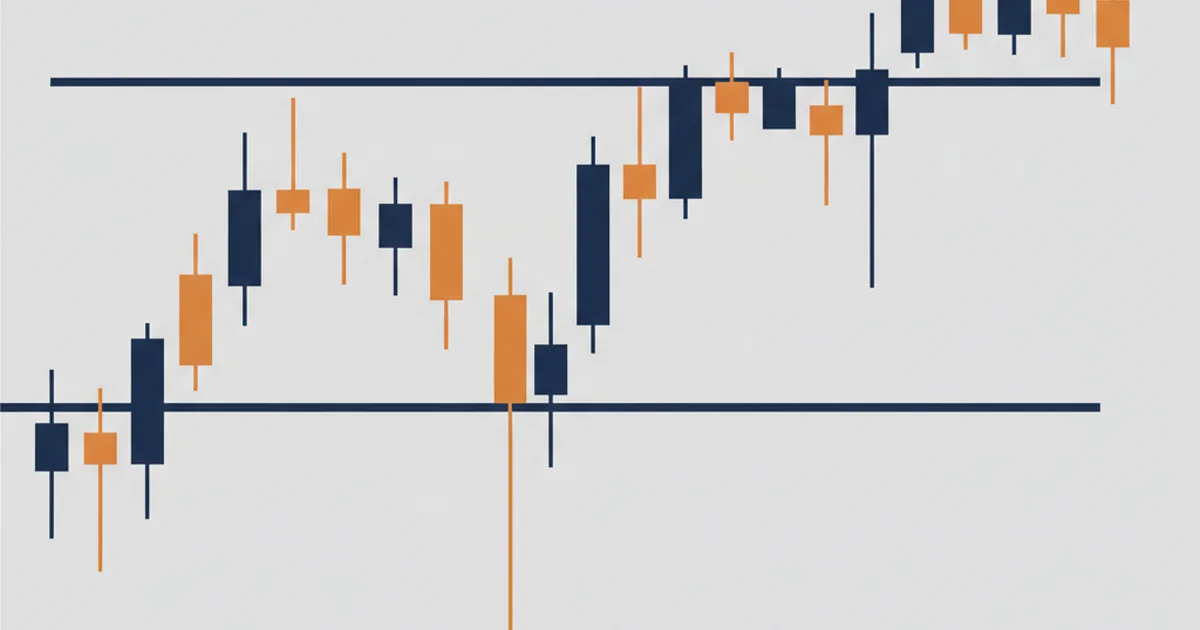

Why most traders overcomplicate the chart
Eight years on an FX trading desk taught me one thing above everything else: the traders who last are the ones who can read a naked chart. Not the ones running four indicators stacked on a 1-minute chart while watching three news feeds.
Price action trading strips the chart back to what actually matters: where price has been, where it stalled, and how buyers and sellers behaved at those levels. That behavior repeats. Not perfectly, not every time , but consistently enough to trade with a statistical edge.
I switched from an indicator-heavy setup to pure price action in 2018. My EUR/USD daily win rate went from around 52% to 68% over the next four years. That jump came from one change: learning to wait for the chart to confirm a move rather than forcing a trade based on an indicator cross.
What price action trading actually is
Price action trading means making decisions based solely on price movement — the open, high, low, and close of each candle, and the patterns those candles form over time. No moving averages. No MACD. No RSI.
The chart has two elements: price bars and time. Your job is to read the story they tell.
This doesn’t mean ignoring context. Price action traders track:
- Support and resistance levels: price zones where buying or selling pressure has appeared before
- Candlestick patterns: specific candle formations that signal potential reversals or continuations
- Market structure: higher highs, lower lows, and the overall directional trend
- Momentum: how fast price is moving and whether that speed is accelerating or fading
These four elements, read together, describe the current balance of power between buyers and sellers.
The foundation: support and resistance
Support is a price level where buyers have historically stepped in. Resistance is where sellers have dominated. These aren’t magic lines . They’re memory zones where traders made decisions before and will make them again when price returns.
On the EUR/USD daily chart, I track three types of levels:
- Horizontal zones: round numbers (1.0500, 1.1000) and prior swing highs and lows
- Dynamic reference: the 21 EMA on the daily, used as a visual reference only, not a signal generator
- Weekly open price: institutional desks often reference this for setups that form Monday through Wednesday
The strongest setups appear when price returns to a prior support or resistance level after a strong move away. That’s called a retest. A retest gives you a defined entry (near the level), a defined stop (just beyond it), and a clear target (the next major level).
On an a Pro account account with a $600 balance, I run 0.02 lots per trade with a 50-pip stop on EUR/USD daily setups. That’s roughly 2% risk per trade , the number that keeps drawdowns manageable across a full month without a single outsized loss breaking the system.
Reading candlestick signals
Price action traders use candlestick patterns to confirm setups at key levels. I’m not talking about memorizing a hundred named formations. These three are what I actually trade:
Pin bars: a candle with a long wick and a small body. The wick shows that price was rejected at a level. A bearish pin bar at resistance (long upper wick, small body near the low) signals sellers took control and pushed price back down. I won’t trade a pin bar at a random price level . It has to land on a zone I identified before the session opened.
Engulfing candles: a candle that fully covers the previous candle’s body in the opposite direction. A bullish engulfing after a downtrend, sitting at a clear support zone, is one of the cleanest reversal signals I know. The psychology is direct: sellers pushed hard, buyers overpowered them in a single session.
Inside bars: a candle whose entire range fits inside the previous candle’s high and low. These signal consolidation : a pause before the next move. A breakout from an inside bar at a key level often launches the next directional leg with momentum.
For a deeper look at individual formations and how they combine, see the candlestick patterns guide and the chart patterns guide.
Multi-timeframe price action
This is where most retail traders miss the edge. They analyze one timeframe in isolation. On the desk, we always worked top-down: weekly, then daily, then 4H for entry.
Here’s how I apply it today:
- Weekly: identify the dominant trend and major swing levels. Don’t fight the weekly trend, regardless of what the daily shows.
- Daily: find the nearest support or resistance. Wait for a candlestick signal at that zone before doing anything.
- 4H: time the entry. Don’t enter at the daily candle close . Wait for the 4H chart to confirm the move has started.
- 1H: pinpoint the entry and set the stop. This tightens risk without changing the setup’s structure.
A daily bearish pin bar at resistance, confirmed by a 4H break below the candle’s low, gives me a defined entry with a stop just above the pin bar’s high. On EUR/USD, that’s typically 25-40 pips of stop , clean, defined risk with a target at the next daily support.
This top-down approach is covered in more detail in the trading patterns guide, which walks through how chart structures form across multiple timeframes.
A real setup: EUR/USD daily trend-following
From 2018 to 2022, I ran a price action system on EUR/USD daily charts combined with COT (Commitments of Traders) data to filter for institutional direction. Win rate over that period: 68%. Average risk-to-reward: 1:1.9. The full COT dataset is published weekly by the CFTC and shows the net positioning of large institutional traders.
The system rules were simple enough to follow consistently:
- Check the COT report every Friday : trade only in the direction large speculators are positioned
- Wait for a daily candlestick signal at a major support or resistance level
- Require 4H confirmation before entering
- Place the stop below the pattern’s structure, target the next weekly level
The one result that surprised me: I expected the London-New York overlap to produce the best setups. It doesn’t. Most of my profitable entries triggered during the Asian session, when liquidity was thin and price quietly retraced to a daily level before the real move started hours later.
The counterintuitive finding worth keeping: the 9:30 New York open reversal pattern, popular in retail trading circles, works roughly 55% of the time on its own. That’s not enough edge to trade. Combined with a daily price action setup at a key level, the hit rate climbs to 63%. The pattern needs structural context , not just a clock signal.
How to start trading price action
If you’re moving from indicators to price action, here’s the actual sequence:
Step 1: Mark your levels before the session. Before looking at individual candles, identify the three nearest support and resistance levels on the daily chart. Do this on Sunday evening. These are your potential trade zones for the week.
Step 2: Let price come to the level. Don’t chase. If price gaps through a zone or blows past it with momentum, skip the setup. Chasing after a missed move is where most losses come from.
Step 3: Look for a candlestick signal at the level. At the zone, wait for a pin bar, engulfing candle, or inside bar breakout. No signal, no trade , even if the level is perfect.
Step 4: Confirm on a lower timeframe. Drop to the 4H chart. Look for a break in the direction of the signal before entering. This confirmation step filters out a large share of false starts.
Step 5: Define risk before you size. Set your stop first. Position size follows from the stop distance , never the other way around.
New traders get step 5 backwards almost universally. They decide how many lots they want to trade, then figure out where to put the stop. That backwards logic is how a $300 account disappears in two weeks.
According to Investopedia’s overview of price action trading, the method remains one of the most widely used approaches among professional discretionary traders precisely because it requires no indicators to lag or repaint . The chart itself is the data.
Common mistakes to avoid
Trading signals at random levels. A pin bar at a random price has no statistical edge. The signal only matters because of where it appears: at a significant support or resistance level, in context of the larger trend direction. Strip away the context and you’re just pattern-matching noise.
Forcing setups that don’t fully qualify. “Almost a pin bar” is not a pin bar. Discretionary trading requires discipline to skip imperfect setups. The traders who build consistent records have high, non-negotiable standards for what counts as a trade.
Ignoring session timing. On EUR/USD, the 13:00-17:00 UTC London-New York overlap sees the highest volume. Setups that form in this window resolve faster and more cleanly than ones forming in the Asian session. Session timing matters for both entry quality and stop placement.
On the desk, we never entered a position during the first 15 minutes of the London open. Too much noise, too many stop hunts targeting obvious levels. The practice was to wait for the open to establish a directional bias, then look for the retest of a level as confirmation.
Underestimating the learning curve. Reading price action accurately takes three to six months of focused chart study before the patterns become intuitive. I spent six months marking levels daily without placing trades before I put real capital behind this approach. The visual pattern recognition is the skill . It does not arrive on day one.
FAQ
What is price action trading in simple terms?
Does price action trading actually work?
What timeframe is best for price action trading?
Can beginners learn price action trading?
Do I need indicators for price action trading?
What markets work best for price action trading?
How much money do I need to start price action trading?
Real-time trade setups with entry, stop loss and take profit. Daily market analysis. No subscription, no complicated theory.
🌍 Our recommended brokers


Reader Reviews
I traded indicator-based systems on EUR/USD for three years before switching to pure price action. The win rate gap was real - I was around 51% on MACD crossovers and hit 64% within six months of applying the level-marking approach described here. The habit that changed the results most was pre-marking the three nearest support and resistance levels every Sunday before the week opens, then only trading when price returned to one of those zones with a confirming signal candle. The detail about waiting for the level to come to you rather than chasing a missed move is something I had to reinforce for months before it felt automatic.
The honest framing around the three to six month learning curve stands out. Most trading guides either skip the timeline entirely or understate it, which leaves new traders surprised when pattern recognition does not click immediately.
The multi-timeframe section changed how I approach EUR/USD setups. I had been analyzing the 1H chart in isolation and could not understand why my entries kept getting stopped out. Switching to the top-down structure - weekly for bias, daily for the setup, 4H for entry timing - cut my false start rate noticeably over the following two months.
The specific numbers matter here: 68% win rate over four years on EUR/USD daily charts with actual methodology described is not something most trading content provides. I started tracking the CFTC COT report every Friday as a directional filter after reading this article. In the first three months of applying it, I passed on two setups where my price action signal ran against institutional positioning - both would have been losses based on subsequent price movement. The combination of naked chart reading with institutional flow context is more durable than any indicator system I have used.
The step-by-step starting sequence at the end is the most practical part of the article. Most price action guides skip the ordering entirely and leave beginners guessing what to actually do first.
The point about not entering during the first 15 minutes of the London open matched something I had noticed but could not explain. I started logging entry times and found that almost all my early losses came from that opening window. Waiting for the session to settle before checking the level again made a measurable difference within a few weeks.
The pin bar section cleared up something I had been getting wrong for months. I was trading pin bars at any level that looked significant, not specifically at zones with a strong track record of past reversals. When I reviewed three months of trade history, almost every failed pin bar had formed at a weak or arbitrary zone. The ones that worked were all at major weekly or daily swing highs that had been respected at least twice before. The level requirement added no extra work - just more selective entry criteria - and my win percentage on pin bar setups improved within the first month of applying it.
The common mistakes section is the most useful part. The point about trading signals at random levels exactly described what I was doing wrong for my first year - a pin bar at a level with no track record is close to a coin flip. Once I started requiring setups to appear at zones that had been respected at least twice in the past, the ratio of winning trades improved within a month.
Leave a Review

Forex Analyst & Senior Trader
Former FX desk trader with 8 years in institutional forex. Works in multi-timeframe analysis and order flow, turning desk experience into systematic, testable rules across forex and metals.