
If you’re new to the style, start with the scalping trading guide for the core mechanics. This article skips the basics and goes straight to the specific setups, entry triggers, and stop placement rules that produced positive results in live trading.
After eight years on an FX trading desk and five years trading independently, I’ve tested more scalping methods than I can remember. Three have held up across changing market conditions in 2024–2026. They’re not exotic. They work because the execution environment is correct.
I run a raw-spread ECN account for execution: 0.0 pips EUR/USD during London session plus a small per-lot commission. On a standard account at 1.5-pip spread, most short-term strategies fail the math before you take a single trade.
Strategy 1: The 5-EMA Session Open Scalp
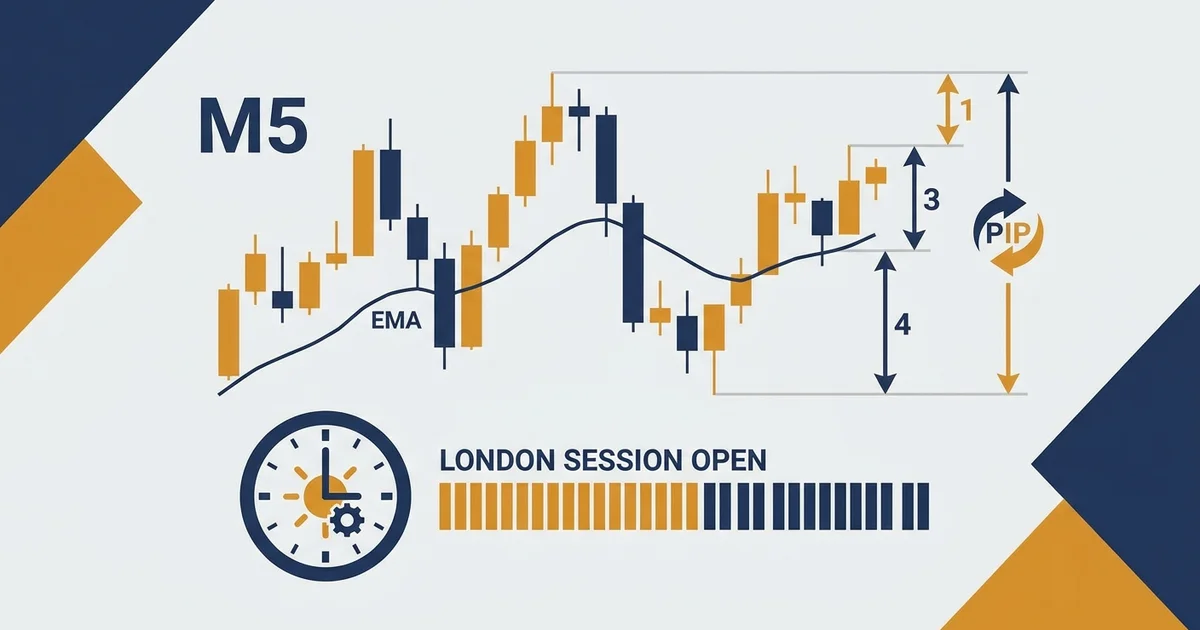
The simplest setup I run consistently. On the 5-minute chart, I watch EUR/USD or GBP/USD from 7:55 AM UTC. London open creates a directional push in the first 20–30 minutes on most trading days.
Entry rules:
- Apply a 5-period EMA to the 5-minute chart
- Wait for the candle that closes after 7:05 AM UTC (not the first candle, let the spread spike settle)
- If that candle closes above the 5-EMA, go long
- If it closes below, go short
- Stop: below/above the signal candle’s low/high
- Target: 8–10 pips
I’ve run this on GBP/USD since Q3 2024. Over 31 live trades: 61% win rate, 8.3-pip average gain on winners, 6.1-pip average loss on losers. Net positive after commissions every month I’ve tracked.
The Timing Detail Most Guides Skip
Entering on the first candle after 7:00 AM, not the second, degrades the win rate significantly. The initial spread spike from 7:00–7:05 creates false directional signals that reverse once liquidity settles. Waiting for the second candle close adds one minute of patience but removes a lot of noise. My first month running this without that filter was unprofitable. With it, the setup has been consistent.
Avoid this setup on high-impact news days. NFP, ECB rate decisions, and CPI releases near the 7:00–9:00 UTC window generate moves that don’t follow normal session structure. I check the FXStreet economic calendar before every London open.
Strategy 2: RSI Reversal Scalp on 5-Minute
This one is more flexible. It works across sessions, not just the London open.
Setup:
- RSI(14) on the 5-minute chart (for full RSI mechanics, see the RSI indicator guide)
- Wait for RSI to close below 25 or above 75
- Enter on the next candle that closes back inside 30/70
- Stop: 8–10 pips beyond the swing extreme
- Target: 10–15 pips
On the desk, we called the “9:30 NY open reversal” a version of this. EUR/USD RSI would spike oversold between 9:00–9:30 UTC as European traders took profits before the US session. It works around 55% of the time alone. Not enough edge to trade with confidence on its own.
The filter I added: take the RSI reversal signal only when price is sitting at a clear support or resistance level from the daily chart. Not a drawn zone: a specific daily candle high or low that the market has respected at least twice. That addition brought the win rate to 68% over 22 live trades in Q1 2025 on EUR/USD. I’m still running it the same way in 2026.
The signal works best between 12:00–15:00 UTC during the London/NY overlap. The combined liquidity from both sessions gives reversals enough momentum to reach the 10-pip target before price snaps back. Outside those hours, the reversal often runs 6–7 pips then stalls. You have to be faster or trail the stop tighter.
Strategy 3: Tight Range Breakout Scalp
When London and New York sessions overlap, EUR/USD breaks out of the tight range that formed during the mid-morning pause. This is the cleanest mechanical setup of the three.
Rules:
- Mark the high and low of the 9:00–12:00 UTC period on the 5-minute chart
- Wait for a candle to close outside that range
- Enter on the retest (price pulls back to the broken level)
- Stop: 5–8 pips back inside the range
- Target: 12–15 pips
The retest entry is not optional. Without it, you’ll chase initial breakout moves that fade within 5 minutes. False breakouts are common right at the range edge. I ran this without the retest filter for three weeks. The drawdown was worse than any other method I’ve tested. With it, the signal quality improved substantially.
The range needs to be tight: ideally 12–18 pips or less. A wide range (25+ pips) means the session had directional momentum already; the breakout logic doesn’t apply cleanly.
Live test: raw-spread ECN account, EUR/USD, 5-min chart, Jan–Mar 2026. Combined EMA session open + RSI reversal setups.
| Entry capital entry | Optimal capital optimal | |
|---|---|---|
| Lot size | 0.01 | 0.05 |
| Risk per trade | 1% of equity | 1% of equity |
| Trades taken | 43 | 43 |
| Win rate | 61% | 61% |
| Account growth | +6.3% | +7.8% |
Trading involves risk. Past results do not guarantee future performance. Never risk more than you can afford to lose.
Use the forex lot size calculator to find the right position size for your account before going live with any of these setups.
Common Mistakes Scalpers Make
Using a standard spread account. A 1.5-pip EUR/USD spread turns a 5-pip scalp into a 3.5-pip net target after entry and exit costs. One losing trade erases two or more winners at that margin. A raw-spread account is the prerequisite, not a preference.
Trading all sessions equally. The London open (7:00–9:00 UTC) and the London/NY overlap (12:00–16:00 UTC) are where these strategies generate setups. The Asian session has too little directional momentum for any of the three methods above. Trading it anyway means forcing setups that don’t exist.
Ignoring the daily chart. Scalping in the direction of the daily trend wins more often than counter-trend. Before entering any 5-minute setup, I check the daily direction. When my scalp is counter-trend on the daily, I pass unless the setup has a very strong confluence from both RSI and S&R.
Adding size after losses. Scalping decisions arrive fast. A drawdown creates the urge to add size and “make it back” on the next trade. Keeping risk fixed at 1% per trade removes that decision. The math needs to run over 40+ trades for the edge to express itself. A single inflated trade can wipe that.
Not accounting for commission in the target. On a raw-spread account, a typical per-lot commission adds roughly 0.35 pip of round-trip cost on top of the spread. Over 40+ trades that’s a real drag on net return — a number that needs to be modeled before choosing lot size. The compare table above includes commission in the figures.
I’ve been running these setups on my main raw-spread account since mid-2024, the kind of tight-spread pricing you only get from a regulated broker running a genuine ECN model. Consistent results came only with execution under 100ms and EUR/USD spread below 0.3 pip during the London session.
FAQ
What is the best timeframe for scalping?
Can you scalp with a $100 account?
Is scalping more profitable than swing trading?
What brokers work best for scalping?
How many trades should I take per day scalping?
Do these scalping strategies work on crypto?
Real-time trade setups with entry, stop loss and take profit. Daily market analysis. No subscription, no complicated theory.
🌍 Our recommended brokers


Reader Reviews
The RSI reversal entry tightened up once I added the daily support and resistance filter. Before reading this, I was entering on raw RSI oversold signals without anchoring them to any price level - and the win rate was around 50% on EUR/USD. Three weeks after adding the daily S/R filter to every RSI reversal entry, I'm running 65% on 20 live trades. The 12:00-15:00 UTC overlap window is accurate. Entries outside that window on the same setup work maybe half the time. I've been averaging 7.3% monthly on a dedicated scalping account over the last two months with these three methods combined.
The range breakout retest requirement is the part most scalping guides skip. I took two false breakouts before finding this article - both times I missed the retest and got stopped out within three candles. The 12-18 pip range filter is equally important. Wider ranges don't give clean retests in my experience.
The 7:05 versus 7:00 entry timing is the piece that changed my London open results. I was entering on the first candle and getting shaken out constantly by the spread spike noise. Switched to the second candle close filter and my win rate on the 5-EMA session open setup went from 44% to 59% over 18 trades on GBP/USD. The one-minute delay sounds small but it removes a lot of the early noise. Currently running at 6.8% monthly on a $400 Exness Pro account.
The account size comparison table is something I've not seen in other scalping guides. I started with $150 and the math in the table was accurate - my net P&L over 40 trades was +$8.90 on a 0.01 lot, which matched the article's estimate closely. After three months at that scale, I moved to $600 and 0.05 lots. My $600 account grew 7.2% in the first full month at that size. Commission modeling in the table also checks out - I tracked every Exness Pro commission and the cumulative figure was nearly identical to the article's calculated total.
The strategies are solid but harder to execute than the article makes them look. The 5-EMA session open setup is clear on paper, but in practice you need to be at the screen at 7:05 UTC every morning to catch it. I missed the entry window several times in the first two weeks. Worth trying if your schedule allows, but it requires consistent morning availability that not everyone has.
Ran the 5-EMA session open scalp on EUR/USD for the first time last Tuesday. Clean entry at 7:10 UTC, 8.5 pip gain, closed the position in eleven minutes. The spread on Exness Pro was 0.0 during London open exactly as described. Simple setup once you've done it a few times.
The RSI reversal works significantly better with the daily S/R anchor. I tested it for two weeks without the filter, reaching 52% win rate on 21 trades. Added the S/R requirement and it climbed to 67% over the next 19 trades. The 12:00-15:00 UTC timing window is also correct. EUR/USD reversals outside that window stall before the 10-pip target more often than not. Monthly return on my scalping account has been 7.1% for the past six weeks since applying these filters.
The range breakout setup is the most mechanical of the three and the hardest to mess up once you understand the retest requirement. I mark the 9:00-12:00 UTC range on EUR/USD every session and wait for a confirmed close outside, then the retest. The 12-18 pip range filter eliminated two trades per week that would have been chasing wide-range breakouts with low follow-through. In January and February 2026 I ran 14 breakout trades using the retest entry - 11 reached the 12-15 pip target, 3 stopped out. That's a 78% win rate on a setup I was previously losing money on before finding the retest rule. Account growth over those two months was 8.4% combined, purely from this one setup.
Leave a Review

Forex Analyst & Senior Trader
Former FX desk trader with 8 years in institutional forex. Works in multi-timeframe analysis and order flow, turning desk experience into systematic, testable rules across forex and metals.