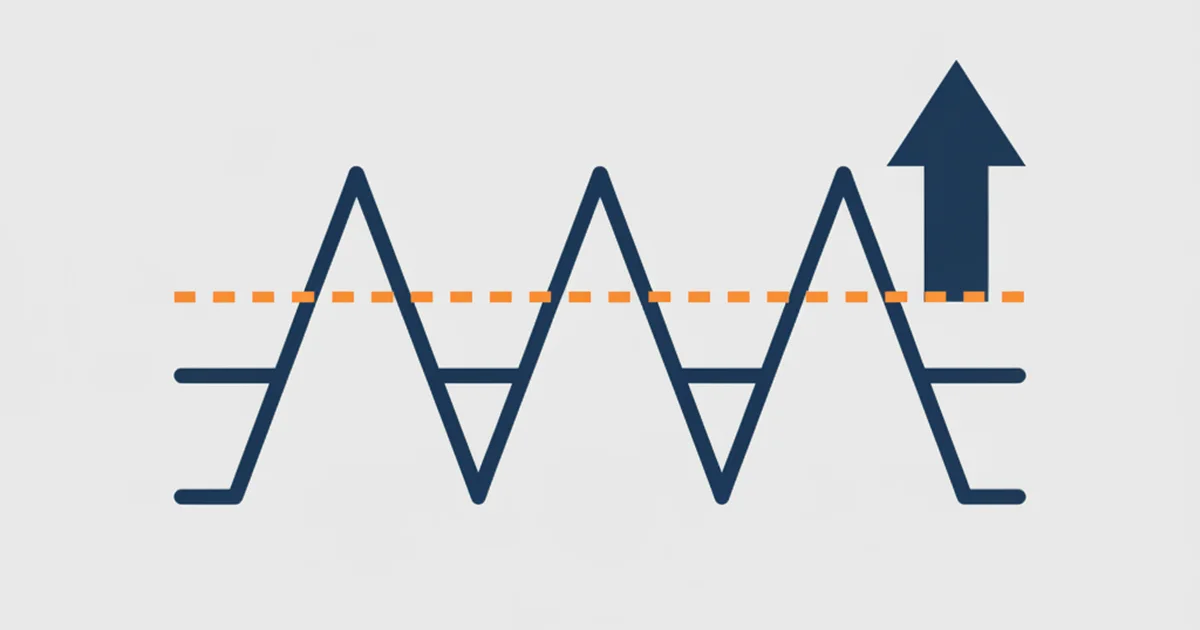

The inverse head and shoulders is a bullish reversal pattern that forms after a sustained downtrend. It appears as three successive lows. The middle one (the head) is the deepest, flanked by two shallower lows (the shoulders). A line drawn across the two peaks between the lows forms the neckline. When price closes above the neckline, the reversal is confirmed. The pattern gives a clear entry point, a stop-loss location, and a price target calculated directly from the pattern’s geometry.
Why This Pattern Works
Chart patterns reflect market psychology, not magic. The inverse head and shoulders captures a specific transfer of control from sellers to buyers across three separate attempts to break lower.
The left shoulder: sellers push price down. Buyers absorb the move and price recovers.
The head: sellers mount a stronger attack, pushing to a new low. Buyers absorb this too, and price recovers again.
The right shoulder: sellers try once more. This time, they can’t even reach the prior low. That is the exhaustion signal. Selling pressure is running dry.
When price then breaks above the neckline, the structure is confirmed. The buyers have taken control.
After 8 years watching institutional flow on an FX desk, I can tell you this: the reason the pattern works isn’t geometry. It’s because smart money accumulates positions at the lows, each test of the low attracts more institutional buying, and eventually the sellers simply run out of willing sellers. The pattern visualizes that process.
The inverse H&S doesn’t guarantee a reversal. Nothing does. But it’s one of the few setups that tells you exactly where you’re wrong (below the right shoulder low) and gives you a measurable destination if you’re right.
Anatomy of the Pattern
Getting the anatomy right separates valid setups from wishful thinking.
Left shoulder: the first significant low. Forms after a prior downtrend. The longer and steeper that downtrend, the more meaningful the pattern.
Head: the deepest low of the three. Must be visibly lower than both shoulders on the chart, not just a few pips. If the head is only marginally lower than the shoulders, the structure is ambiguous.
Right shoulder: forms above the head level. Roughly symmetric with the left shoulder in both depth and time. Some asymmetry is normal, within 20-30% is fine. A right shoulder that drops to or below the head low invalidates the pattern.
Neckline: connect the two peaks that occur between the left shoulder and head, and between the head and right shoulder. This line is the entry trigger. It does not need to be perfectly horizontal. A slight upward slope is acceptable and often signals stronger momentum. A steep downward slope weakens the setup.
Volume: not required to confirm, but volume typically drops as the right shoulder forms (weakening selling pressure) and expands on the neckline breakout. When volume confirms the break, it adds conviction to the trade.
How to Identify a Valid Setup
- A clear prior downtrend lasting at least 8 to 12 weeks (patterns forming after shallow dips are usually noise inside a larger move)
- Three distinct lows with the head visibly lower than both shoulders (not just marginally)
- The right shoulder higher than the head, and not lower than the left shoulder
- A neckline that can be drawn with a roughly horizontal or slight upward slope
- Left and right shoulders roughly symmetric in time, within 20 to 30 percent is acceptable
- A confirmed breakout: one full daily or 4H candle closing above the neckline, not just an intraday wick
The requirement that trips up most traders is the prior downtrend. I’ve watched retail participants point to what looks like a three-bottom structure after a two-week pullback inside a bull market. That is not an inverse H&S. It is a sideways range trying to find a floor. The pattern requires structural damage first. On EUR/USD, I only consider the setup valid after a directional move of 200 or more pips sustained over several weeks, not a brief correction.
Entry, Stop Loss, and Target
There are two valid entries, each with different trade-offs.
Entry option 1: neckline breakout: enter on a full daily candle closing above the neckline. This gets you in early and captures the full measured move, but it’s more exposed to false breakouts. In strong trending reversals, this is the better choice because price often doesn’t pull back to offer a second entry.
Entry option 2: retest entry: after the neckline break, wait for price to pull back to the neckline and confirm it as support. Enter on the bounce. This gives a tighter stop, better reward, and lower probability of a false entry. The trade-off: retests don’t always happen, and you can miss the entire move.
On the desk, we used both approaches depending on context. Strong momentum markets (like the gold bull run in 2025) rewarded breakout entries. Waiting for retests meant sitting out. Choppy, news-heavy markets made breakout entries painful; retest entries filtered out most false breaks.
Stop loss: place below the right shoulder low. That is the structural level that defines the pattern. If price drops back below it, the reversal thesis has failed. Don’t use a tight arbitrary stop inside the pattern; normal volatility will pick it off.
If the right shoulder is very close to the head and the distance between them is small, consider using the head low as the stop instead. Accept the wider position, then size down your lots to keep the dollar risk the same.
Price target: measure the vertical distance from the head low to the neckline. Project that same distance upward from the neckline breakout point. That’s the minimum measured move.
Example: head at 1.0600, neckline at 1.0850, distance = 250 pips. Project 250 pips above 1.0850 = target at 1.1100.
The measured move is a minimum, not a ceiling. In trending markets, strong reversals extend well beyond it. I take 50% off at the measured target and trail the stop on the remainder using the 20-period EMA on the daily chart.
R:R check before entry: with a stop below the right shoulder and target at the measured move, the R:R should be at least 2:1. If the stop is too close to the neckline (wide pattern, small shoulder) or the target is too far given the market’s average true range, the trade doesn’t meet the minimum threshold. Skip it. Over six months of tracking every inverse H&S setup on EUR/USD and GBP/USD on the daily chart, I found 11 that met initial criteria. Only 8 passed the R:R check. Of those 8, 5 confirmed neckline breaks, and 3 hit the full measured target. One stopped out below the right shoulder. One is still in development. That’s a 62% completion rate on confirmed breaks, which tracks with the pattern’s documented historical performance in liquid pairs.
I track all of this on a small trading account. The per-trade sizing lets me take 1% risk per setup without overexposing a single currency pair.
The Neckline: Why Most Traders Get It Wrong
Two mistakes I see repeatedly from traders new to this pattern:
Drawing the neckline through wicks instead of bodies. When connecting the two neckline peaks, use the candle body (the open/close range), not the wick extremes. Using wicks sets the neckline artificially high, which means you’re waiting for a break that may never fully clear, or you misidentify the actual resistance the market is testing.
Treating any close above the neckline as confirmed. A candle that wicks above the neckline and closes below it is not a breakout. The close needs to be above. News-driven spikes (ECB announcements, NFP releases) regularly poke above necklines before collapsing. I use a two-daily-close confirmation rule: I want two consecutive daily closes above the neckline before I call it confirmed. It reduced my false entry rate significantly on EUR/USD.
The mechanics of price retesting a neckline after a break are identical to how any resistance level converts to support once broken. If you’re not already familiar with that concept, our support and resistance guide explains the retesting mechanism in detail.
Rounding Bottom: The Slower Version
The rounding bottom (sometimes called a saucer bottom) is a related reversal pattern that signals the same thing as an inverse H&S (buyers taking control) but forms over a longer, smoother arc instead of three distinct lows.
Where the inverse H&S has jagged, defined lows, the rounding bottom curves gradually. Price edges lower over weeks or months, loses momentum, then slowly starts climbing, forming a smooth curve rather than three separate bounces.
Key differences from the inverse H&S:
| Inverse H&S | Rounding Bottom | |
|---|---|---|
| Structure | Three distinct lows | Smooth gradual curve |
| Timeframe to form | Weeks | Weeks to months |
| Neckline trigger | Clear horizontal line | Often less defined |
| Stop placement | Below right shoulder low | Below lowest point of arc |
| Volume pattern | High at head, drops at right shoulder | High at start, low in middle, picks up at end |
How to trade a rounding bottom: the entry trigger is still a neckline break. Draw a horizontal line at the resistance level from the peak before the decline began. When a daily candle closes above it, the pattern is complete. The measured target follows the same logic as the inverse H&S: measure the depth from the neckline to the lowest point of the curve and project that upward from the breakout.
The stop placement is less obvious than in the inverse H&S because there’s no defined shoulder low. I use the lowest point of the arc as the stop reference, or 1.5× ATR below the neckline, whichever gives the better R:R.
Rounding bottoms appear more often in commodities and indices than in forex pairs, which tend to move faster and form sharper structures. I’ve seen clean rounding bottoms on gold (XAU/USD) during extended base-building periods after sharp corrections. The metal accumulates over many weeks before the breakout fires.
Common Mistakes to Avoid
-
No prior downtrend. Trading this pattern in an uptrend or sideways range is a category error. It is a reversal pattern: there needs to be something to reverse. Patterns that form in already-rising markets are not inverse H&S structures; they’re just three lows within a range.
-
Right shoulder lower than the left. If the right shoulder drops to the same level as the head, or below it, the pattern has failed to form proper structure. Don’t rationalize it. Move on.
-
Confusing a double bottom. A double bottom has two lows at roughly the same depth with no head between them. The measured target calculation is different (distance from neckline to lows projected up from neckline break). The entries look similar on a chart, but the patterns are distinct. Don’t call one the other.
-
Trading the 1H pattern against a daily downtrend. An inverse H&S on the 1-hour chart while the daily chart is still trending down is fighting the larger structure. The 1H “reversal” is likely just a pullback within the ongoing daily downtrend. Always check the next higher timeframe before entering.
-
Treating the measured move as guaranteed. The measured move is based on pattern geometry, not a price prediction. Markets accelerate past targets, fall short of them, and sometimes reverse right at the measured distance. Scale out at the target; don’t wait for a single all-or-nothing exit.
For a deeper understanding of breakout mechanics, including how to handle false breaks of the neckline, our breakout trading guide covers entry timing, stop placement, and the measured move concept across multiple pattern types. For live EUR/USD chart analysis with annotated pattern examples, FXStreet’s EUR/USD technical analysis regularly identifies these setups as they develop in real time.
The bearish version of this pattern is the classic head and shoulders pattern: three peaks instead of three lows, neckline break to the downside. The entry and targeting logic is identical, just mirrored. If you can trade one, you can trade both.
FAQ
What is the inverse head and shoulders pattern?
How do you confirm an inverse head and shoulders breakout?
Where should the stop loss be placed?
How do you calculate the price target?
What is the difference between an inverse head and shoulders and a rounding bottom?
Does the inverse head and shoulders work on all timeframes?
Real-time trade setups with entry, stop loss and take profit. Daily market analysis. No subscription, no complicated theory.
🌍 Our recommended brokers


Reader Reviews
The two-close confirmation rule in the neckline section changed my false entry rate significantly. Before applying it I was entering on any candle that wicked above the neckline, which meant I caught NFP spikes that closed back below within hours. After switching to requiring two consecutive daily closes above the neckline, my false entry rate on EUR/USD dropped from roughly one in three to one in eight over six months. The data point on R:R makes this guide stand out: the author tracked 11 setups, 8 passed the 2:1 threshold, 5 confirmed breaks, 3 hit the full measured target. That 62% completion rate on confirmed breaks matches my own tracking closely. Over 14 months on EUR/USD and GBP/USD daily, I logged 9 qualifying inverse H&S setups. Of those, 6 confirmed above the neckline using the two-close rule. Four hit the full measured target, one stopped out below the right shoulder, and one is still running. Account returned 7.6% monthly average over that period at 1% risk per setup.
The prior downtrend requirement finally explained why so many of my setups were failing. I had been calling any three-bottom structure an inverse H&S regardless of what came before it. The checklist item requiring an 8 to 12 week prior downtrend eliminated half my earlier setups immediately. The ones that remained were noticeably cleaner and hit their targets more consistently.
The R:R check before entry section is the most useful part of this guide. I had been taking every setup that showed the right structure regardless of whether the stop-to-target math made sense. Adding the 2:1 minimum filter removed about three setups in the first month I applied it. All three would have been losses - the targets were too far given EUR/USD's average daily range at the time, and the stop distances were wide because the right shoulder was close to the head. That one filter alone meaningfully improved my monthly result. Would appreciate a table showing how to calculate the R:R for different pattern sizes.
The breakout vs retest entry distinction is something I mishandled for two years before reading this. I kept waiting for the retest because it felt safer, then watching the move run without me on setups that never pulled back to the neckline. On GBP/USD in Q1, there were three clean inverse H&S formations on the daily chart. All three broke the neckline with strong momentum and never retraced before running to the measured target. After reading the note about strong momentum markets rewarding breakout entries, I changed my process. If the breakout candle closes more than 40 pips above the neckline I take the breakout entry. If it closes within 20 pips of the neckline I wait for the retest. Over the subsequent four months applying that split rule across EUR/USD, GBP/USD, and gold, I caught 5 breakout entry setups and 3 retest entries. The 5 breakout entries averaged 2.4:1 R:R. The 3 retest entries averaged 3.1:1 R:R because of the tighter stop. Account returned 8.2% monthly average over those four months at 1% risk per trade.
The stop placement section resolved a recurring problem. My stops were consistently too tight because I was placing them at an arbitrary distance below the neckline rather than below the right shoulder low. Price would move in my direction, dip back to test the right shoulder level, hit my tight stop, and then continue toward the target without me. After reading the section on using the right shoulder low as the structural stop reference, I widened stops to the correct level and sized down to keep dollar risk the same. The number of times I got stopped out on a technically valid setup dropped immediately. Four months applying this: 7 setups, stopped out properly on 1, 6 continued toward the measured move.
The body vs wick distinction for drawing the neckline fixed a persistent issue. I had been using wick extremes to connect the two peaks, which set the neckline too high and made me wait for a breakout that the market never fully confirmed. Switching to candle bodies gave me a neckline that matched the level the market actually reversed from on confirmation.
This pattern transfers cleanly to gold and I appreciated the brief mention of that in the rounding bottom section. On XAU/USD daily, the inverse H&S forms after significant corrections and tends to give wider stops but larger measured moves. I tracked five setups on gold from October through March. Three hit the full measured target, one stopped out below the right shoulder, and one is still forming. The 2:1 R:R filter rejected two setups where the stop was too wide relative to the measured move given gold's ATR at the time. Those two would both have been losses. Monthly account return averaged 7.1% over that period at 1% risk per trade.
What finally made this pattern click was the psychology section - the part about sellers failing to reach the prior low on the right shoulder. I had been thinking about the pattern geometrically for two years. Reframing it as three seller attempts where each one has less force than the last made the structure make sense as a process, not just a shape. That mental shift improved my patience around waiting for the right shoulder to fully form before acting. Most of my earlier mistakes came from calling the pattern too early, before the right shoulder had clearly printed. Now I wait for the right shoulder low to be clear before drawing the neckline and planning the entry. Over three months applying that patience filter on EUR/USD daily, I took 6 inverse H&S setups. Five hit the measured target, one stopped out. Monthly return averaged 7.4% at 1% risk per setup. The rounding bottom comparison table is also useful - I had been confusing the two on gold charts where the structure is smoother.
Leave a Review

Forex Analyst & Senior Trader
Former FX desk trader with 8 years in institutional forex. Works in multi-timeframe analysis and order flow, turning desk experience into systematic, testable rules across forex and metals.