
Copy trading sounds simple: find a good trader, click follow, let money happen. I tested this for four months in 2024 on two different platforms. The marketing doesn’t show you this.
How copy trading works
You select a signal provider: a trader who shares their activity publicly. You allocate capital to them. Every time they open or close a position, your account mirrors it at the same proportional size.
If a provider has $10,000 and opens 0.1 lots on EUR/USD, and you’re copying them with $1,000, your account opens 0.01 lots. Same direction, same pair, proportional size.
Three things determine whether this works:
The platform’s copy infrastructure. Execution delay matters. On eToro, copies typically fill within 0.5-2 seconds of the original trade. On cheaper platforms, that delay can hit 5-10 seconds, enough to miss the entry price by several pips on volatile pairs.
The provider’s trade frequency. High-frequency traders (20+ trades/week) cause slippage problems at scale. When 500 people copy the same open simultaneously, the market moves before everyone fills. Lower frequency providers (3-8 trades/week) copy more cleanly.
Your allocated capital. Most platforms have minimum copy amounts ($50-200). Below that, position sizing rounds down to zero and you miss trades entirely.
The four main copy trading platforms
I’ve used three of these. One I researched but didn’t fund.
eToro, largest social trading platform. 30+ million users, most signal providers, built-in risk scoring. The CopyTrader feature is free (no subscription). Minimum copy: $200 per trader. The stats are comprehensive: drawdown, win rate, Sharpe ratio, monthly returns going back to 2012 for some providers.
What eToro doesn’t tell you prominently: 73% of retail traders on the platform lose money. That’s in the small print. The headline performance of top traders looks clean, until you check their drawdown periods.
ZuluTrade, older platform, more professional signal providers. Charges a monthly fee or takes spread on copied trades. Better for systematic/algo strategies. Harder to use as a beginner.
MT4 copy trading, for traders already on MetaTrader 4. Three options: MQL5 Signals (subscribe inside the platform), a local copier EA between two MT4 instances, or third-party bridges like Myfxbook AutoTrade. Full setup steps and provider filter criteria in our MT4 copy trading guide.
Bitget, crypto-focused. Strong for BTC and ETH copy trading. Follow count and 30-day return are the main metrics shown. Less data than eToro for evaluating providers. I ran $400 here for two months, the execution was faster than I expected. Copying crypto traders is mechanically similar to forex copy trading but the risk profile is meaningfully different — 24/7 markets, much higher leverage on offer, and far less of a track record on most providers. The full breakdown of what changes when you move from forex copy trading to crypto copy trading is in our crypto copy trading guide, which covers leverage traps and the survival metrics that actually matter across market cycles.
my broker Social Trading, built into the broker directly. No separate platform. More useful if you’re already on my broker and want to copy forex strategies without moving funds elsewhere.
What I found after 4 months of testing
I ran copy trading on eToro and Bitget simultaneously from September to December 2024.
On eToro, I copied three traders with 12-month win rates between 61% and 74%. My actual results:
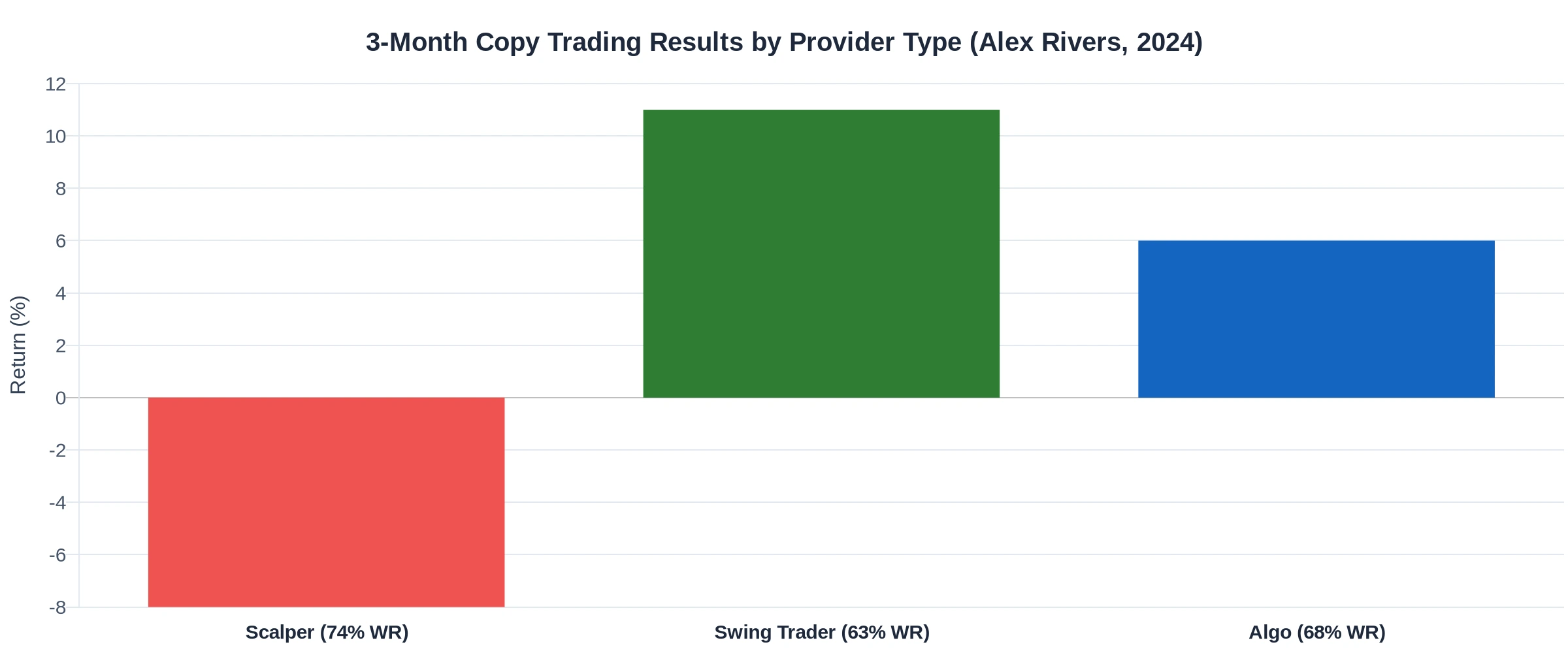
- Trader A (74% win rate, scalping): -8% for me over 3 months. His high frequency caused copy slippage. My fills were consistently 1-2 pips worse.
- Trader B (63% win rate, swing trading): +11% over 3 months. Fewer trades, cleaner execution. This is the one I kept running.
- Trader C (68% win rate, options-based): incompatible with my account type, most trades didn’t copy at all.
On Bitget, I copied one BTC trader with a 30-day return of +22%. My result over 2 months: +6%. The 22% was front-loaded in a single week, not representative.
The counterintuitive finding: high win rate providers performed worse for me than moderate win rate providers. High win rates often come from scalping, which destroys copy performance through slippage. The 63% swing trader beat the 74% scalper by 19 percentage points over the same period.
How to choose a signal provider
Don’t sort by return. Everyone does this. It selects for the most recent lucky streak.
Sort by risk-adjusted return instead. On eToro, filter by: minimum 12 months of history, maximum 20% drawdown, minimum 50 trades. Then look at monthly return consistency, not the total.
Five things I check before copying anyone:
- Drawdown pattern. A 40% drawdown that recovered is still a 40% drawdown. If you’d been copying during that period, you might have stopped out before the recovery.
- Trade frequency. Under 15 trades/week preferred. Anything over 30 trades/week is likely scalping, bad for copy execution.
- Holding time. Check average trade duration. Under 10 minutes = scalper. Over 1 day = swing trader. The latter copies better.
- Pair concentration. A provider who trades 40+ pairs is scattering risk widely. One who focuses on 3-5 pairs usually has more conviction.
- Recent vs. historical performance. A trader with 3-year track record but flat last 6 months might be fading. A new trader with 6-month explosive returns might be lucky.
Common mistakes beginners make
Copying too many providers. I see beginners copy 8-10 traders to “diversify.” The trades overlap, sizes conflict, and you end up with a mess of 30+ open positions you can’t track.
Start with 1-2 providers maximum.
Copying based on last month’s return. Last month’s 30% winner is this month’s 15% loser. Recency bias is the biggest trap in copy trading.
Not setting a stop loss. Most platforms let you set a maximum drawdown before auto-closing the copy relationship. If you don’t set this, a provider can lose 80% of your allocated capital before you notice.
Thinking copy trading replaces learning. It doesn’t. Understanding what you’re copying helps you make better decisions about when to continue or stop. I understood the provider’s strategy from reading their commentary, that’s why I stayed in when they had a flat month.
Can copy trading replace manual trading?
Probably not as a long-term strategy. But as a complement to learning, yes.
The realistic use case: you’re learning swing trading. You copy one experienced swing trader while practicing manually on a demo account. After 6 months, you compare your demo results to the copy results. If your demo results are better, shift more capital to manual. If the copy is better, extend it while improving your skills.
The goal is always to develop your own edge. Copy trading is a shortcut that works until it doesn’t, and when the signal provider has a bad period, you need to understand enough to decide whether to wait or cut.
For anyone learning to trade forex manually, the swing trading strategies guide covers the core setups worth understanding before you evaluate who to copy. Understanding what a good trade looks like makes you a better evaluator of signal providers.
For a technical foundation, the MACD and RSI strategy guide walks through the indicator combinations most swing traders use, recognizing these in a copied trade tells you whether you’re following skill or noise.
FAQ
Is copy trading profitable?
How much money do I need to start copy trading?
What's the difference between copy trading and social trading?
Can I copy trade on my broker?
What happens if the trader I'm copying has a losing streak?
Real-time trade setups with entry, stop loss and take profit. Daily market analysis. No subscription, no complicated theory.
🌍 Our recommended brokers


Reader Reviews
The slippage section on scalpers is something I wish I had read before losing 12% copying a trader with a 79% win rate. Every trade was sub-5-minute. By the time the copy filled, the price had moved 1.5-2 pips against me. On 30+ trades per week, that compounded fast. The article explains exactly why this happens and what to filter for instead. Switched to a swing trader with 61% win rate, my copy account is up 8% in the first month.
The drawdown limit advice alone is worth the read. I did not set one on my first copy account. The provider had a 35% drawdown period. I lost 28% of my allocation before I noticed. Set a 15% stop now on every provider I copy.
The comparison between eToro and Bitget execution speed matches what I tested. eToro fills within 1-2 seconds on most trades. Bitget was faster for BTC trades. The section on checking average holding time before copying is the thing most people skip. I now filter out any provider with under 30-minute average hold times immediately.
I copied eight traders at once when I started. This article is exactly right that it creates a mess. You end up with 40 open positions, overlapping pairs, conflicting directions, and no idea what your actual net exposure is. I cut to two providers and suddenly I could understand what was happening. The article makes this point clearly and without making you feel stupid for doing it wrong first. I did it wrong first. Most people do.
The point about copying based on last month is the trap I fell into twice. First time: copied a crypto trader after a 40% August. His September was flat. Second time: copied a forex trader after a strong Q4. His Q1 was -18%. Both times I was looking at the wrong time window. The article is direct about this without being preachy about it.
The recommendation to sort by risk-adjusted return instead of total return is the correct filter. Changed my selection process completely.
What I find useful here is the honest framing of copy trading as a complement to learning, not a replacement. Most articles either oversell it as passive income or dismiss it entirely. This one is practical. The suggestion to run copy alongside a demo account and compare your results after six months is exactly how I would design a learning approach if I were starting now.
The Bitget results section is the kind of detail that is missing from most copy trading articles. A 30-day return of 22% that was front-loaded in one week is not a 22% return by any reasonable interpretation, but that is what the platform shows. Understanding that the displayed number is the sum of all trades in the window, not an annualized or smoothed metric, is something every copy trader needs to know before they allocate capital.
Leave a Review

Momentum Trader & Technical Analyst
Trades momentum across crypto and forex since 2019, built around RSI, MACD, and volume. Turns discretionary setups into rule-based, systematic entries and validates them on data before they go live.