
What Bitget Copy Trading Actually Is
Bitget is a crypto derivatives exchange with over 20 million registered users and consistently ranks among the top platforms by open interest, according to CoinGecko’s exchange rankings. Copy trading has been available on the platform since 2020 and has grown into one of the largest copy trading ecosystems in crypto, with over 100,000 verified Elite Traders listed.
The mechanic is straightforward. You find a trader whose strategy matches your risk tolerance, allocate capital to copy them, and the system automatically mirrors every position they open, scaled proportionally to your investment. When they close a trade at a profit, you get your share. When they lose, you lose proportionally too.
This article focuses on Bitget copy trading for USDT-M futures, the perpetual contracts market. Bitget also offers spot copy trading, but futures is where 95% of the volume and the interesting trader selection are.
If you’re new to copy trading entirely, read what is copy trading first. This review assumes you understand the basics.
How It Works: The Mechanics
When you allocate funds to copy a trader, Bitget ring-fences that capital in a separate copy trading sub-account. You set three things:
- Copy amount: how much capital to allocate (minimum varies by trader, usually $100-300)
- Copy mode: fixed amount per trade (safer for beginners) or proportional (mirrors the trader’s exact position sizing)
- Account stop-loss: closes all copied positions if your balance drops to a threshold you define
In proportional mode, if the trader risks 3% of their account on a BTC long, Bitget risks 3% of your allocated copy amount on the same position. Fixed mode is simpler: you set a dollar amount per trade regardless of what the trader is doing.
One thing that caught me off guard testing this platform: copy trading on Bitget uses leverage. Most elite traders run 5x-20x leverage on their futures positions. If they’re running 10x leverage and BTC drops 10%, your entire position is liquidated. Check the average leverage displayed in every trader’s stats panel before you copy anyone.
Finding the Right Trader to Follow
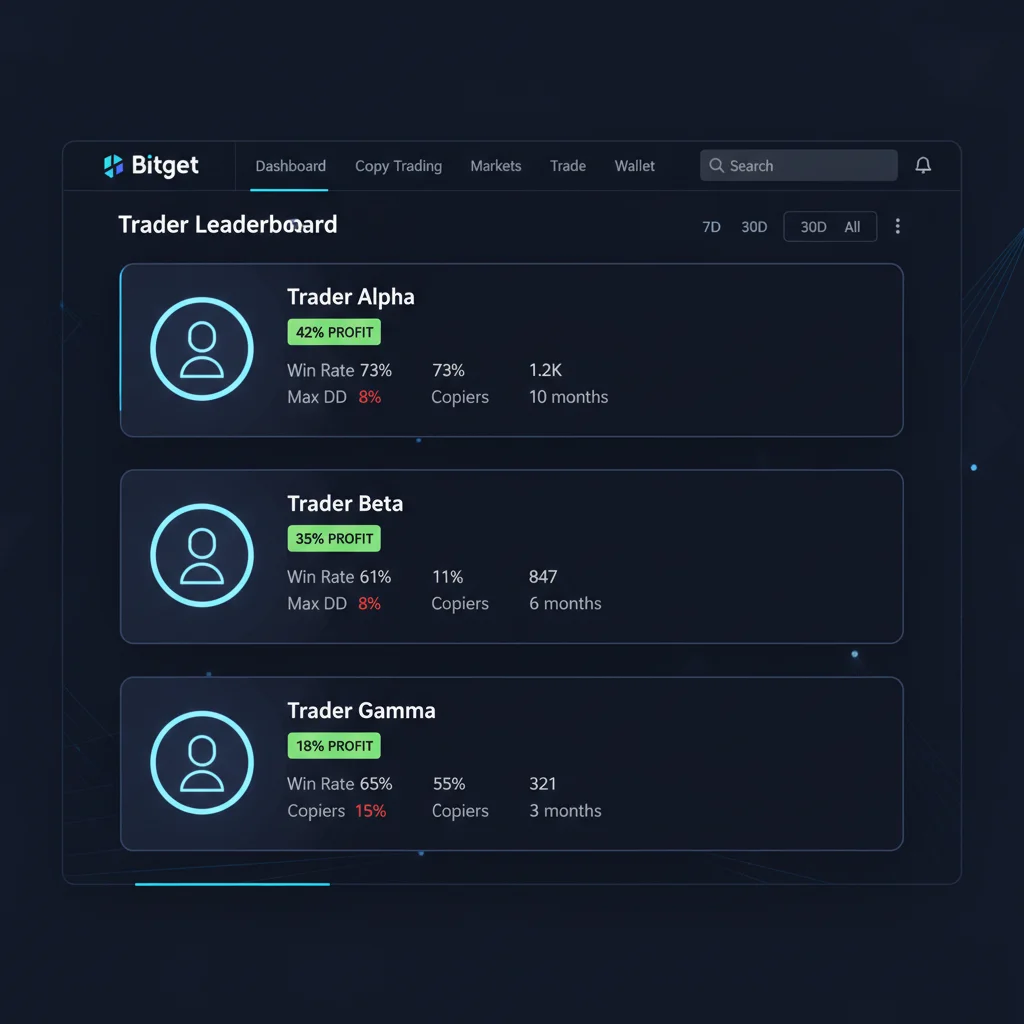
This is where most people go wrong. The default leaderboard sorts by 30-day profit percentage, which means the top of the list is always filled with traders who either got lucky last month or are running dangerous leverage.
I went through the metrics for dozens of trader profiles in early 2026 before committing any capital. Here’s the filter that worked:
Win Rate: target 55-65% over 90+ days. Below 55% means they’re relying on big winners to cover frequent losses. Above 70% usually means they’re cutting winners too early. Both extremes create unstable copy performance.
Max Drawdown: under 20%. This is the number most beginners ignore entirely. A trader showing 300% returns this month might also have a 58% max drawdown, meaning at some point their followers lost more than half their copied funds before the recovery. That’s not a strategy, that’s a lottery ticket.
Copier count and history: 500+ copiers, 6+ months of data. Traders with an established following and a long track record have real reputation at stake. Two months of data is too thin to evaluate anything meaningfully.
The counterintuitive finding: the traders with the best risk-adjusted performance on Bitget are almost never the ones on page one of the default leaderboard. My best-performing copy slot was a trader showing 18% monthly return with 11% max drawdown, ranked somewhere around page four of results. The page-one traders were showing 200%+ monthly returns with drawdowns that would make your hands shake.
Bitget Copy Trading Fees
Bitget doesn’t charge a platform fee for copy trading. The full cost structure:
- Profit share: 8-10% of profits go to the trader you’re copying (they set this, it’s shown in their profile)
- Futures trading fees: 0.02% maker / 0.06% taker per trade, same as regular Bitget trading
- Funding rates: if positions are held overnight, funding rates apply (standard for all perpetual futures)
Practical example: your copied trader generates $100 in profit on your allocation. You keep $90-92. The trader keeps $8-10. That’s a reasonable split given they’re doing all the analysis.
Where fees become significant: if you copy an active scalper opening 10-15 trades per day, the taker fees accumulate fast. I filter for traders with fewer than 5 trades per day average to keep transaction costs in check.
What I Actually Tested
I put $300 into Bitget copy trading across two traders in early 2026, running the test for six weeks.
Trader A: 22% monthly return, 13% max drawdown, 61% win rate, 4 trades/day average. Performed close to the advertised stats, up about 9% over six weeks, which aligns with the monthly rate. Calm periods alternated with a few sharp wins on BTC longs during trend days.
Trader B: 89% monthly return, 47% max drawdown, 52% win rate. Week one looked great, up 15%. Then a BTC position went wrong and the drawdown hit 38% of my allocated funds before partially recovering. I closed this copy position after week three, breaking roughly even.
The math on Trader B is the lesson: a 47% max drawdown requires an 89% gain from that trough just to return to breakeven. You’re not trading anymore. You’re hoping. After six months of testing copy trading across platforms, I’ve learned that max drawdown under 20% is a hard line, not a preference.
Bitget vs eToro vs Bybit: How They Compare
If you’re choosing between platforms, here’s how Bitget stacks up against the two most popular alternatives.
Bitget vs eToro
eToro’s copy trading is built for stock and forex CFD investors, heavily regulated (FCA, ASIC, CySEC), designed for a global retail audience. Bitget is built for crypto derivatives traders. For copying crypto futures traders specifically, Bitget has a far larger and more specialized pool. For copying a forex or stock portfolio in a regulated environment, eToro wins by default.
Read the full eToro copy trading review for a direct comparison.
Bitget vs Bybit
Bybit also has copy trading and is a direct Bitget competitor in the crypto space. Both use similar profit-share models. Bybit’s interface tends to be cleaner, but Bitget’s copy trading ecosystem is larger, with more traders, longer track records, better filtering options. For copy trading functionality specifically, Bitget has the edge on selection depth. If you’re deciding between any of the crypto-native copy platforms, our crypto copy trading guide covers the metrics that actually predict survival across market cycles — drawdown patterns, leverage discipline, and how to filter out scalpers whose stats only look good during a single bull run.
For a full platform comparison, the best copy trading platforms article covers all major options with fee breakdowns.
Who Bitget Copy Trading Is Best For
It makes sense if:
- You have some crypto experience but don’t have time to watch charts daily
- You want futures exposure without building a strategy from scratch
- Your starting capital is $300 or more, which gives you room to spread across two or three traders
- You understand that copy trading profits depend entirely on the trader you pick, not the platform
It doesn’t make sense if:
- You’re completely new to crypto. Futures leverage can wipe your allocation faster than you can react
- You have under $200: minimums and fee structure make small accounts inefficient
- You need a regulated, insured environment. Bitget is registered in Seychelles, not under FCA or ASIC jurisdiction
Common Mistakes to Avoid
Sorting by recent returns only. A trader showing 300% this month may have been flat for the previous four. Always check 90-day and all-time stats, not just the top-line monthly number.
Ignoring average leverage. Bitget displays this in every trader profile. Traders running average 20x leverage turn a 5% adverse move into a liquidation event. I stay under 10x average as a hard filter.
Skipping the account stop-loss. Without it, a bad trader can run your entire copy allocation to zero. Set a stop at 25-35% drawdown from starting balance on every copy slot.
Copying too many traders with too little capital. Splitting $300 across 10 traders at $30 each is usually below most traders’ minimums. Two traders at $150 each (one tested, one experimental) is a cleaner setup.
Expecting passive income. The best copy traders have bad months. Plan to review performance weekly and rotate out underperformers every three months. It’s active monitoring, just less frequent than trading yourself.
FAQ
Is Bitget copy trading safe?
What is the minimum amount to start Bitget copy trading?
How much does Bitget copy trading cost?
Can you lose more than you invest on Bitget copy trading?
How do I stop and withdraw from Bitget copy trading?
Is Bitget copy trading better than eToro?
Real-time trade setups with entry, stop loss and take profit. Daily market analysis. No subscription, no complicated theory.
🌍 Our recommended brokers


Reader Reviews
The four-filter framework cut through a problem I had been stuck on for months. I was sorting by the default 30-day leaderboard and kept picking traders who had a single good month or were running 20x leverage I had not thought to check. Applying the criteria in this article - 55 to 65% win rate, under 20% max drawdown, 500 or more copiers, 6 or more months of history - narrowed the Bitget pool from several hundred to fourteen options. I ran $150 each on two of those fourteen. At eight weeks the first is up 9.2% against a stated 22% monthly rate and the second is up 7.8% against a stated 18% rate. Both are within 3% of advertised performance. The article is right that page-four results outperform page-one results when the filter is risk rather than raw return.
Account stop-loss at 25 to 35% is the setting the article calls out before anything else. I skipped it my first month on Bitget and watched one trader run a 31% drawdown before I closed the position manually. The stop-loss would have exited at 25% automatically. Set it first, before you copy anyone.
The average leverage display in the Bitget trader profile is the stat I had been scrolling past for three months. The article made me go back and check every active copy slot. Two of my three traders were running 15x and 18x average leverage, which meant a 6 to 7% adverse move on a position could wipe the allocation entirely. I replaced both with traders under 8x average leverage and the drawdown volatility on my copy account dropped noticeably in the first four weeks. That one filter changed the risk profile of the whole setup.
The 47% max drawdown section changed how I evaluate every trader profile on Bitget. I had been looking at a trader showing 95% monthly return with a 43% drawdown I had mentally filed as acceptable. The article runs the math: a 47% drawdown requires an 89% gain just to return to starting balance, meaning every recovery eats most of the next run. I closed that slot immediately and moved to a trader with 18% monthly return and 14% drawdown. Seven weeks in, the account is up 11.3% with no drawdown event above 8%. The unpredictable variance from the high-return slot was eating more in recovery periods than the extra percentage points were worth.
Fixed copy mode versus proportional mode is the decision that tripped me up for two months. The explanation here is the only version I found that made the leverage implication of proportional mode concrete. Fixed amount is the right default until you understand how the trader you are following manages position size.
The Bitget versus Bybit comparison confirmed what I had been testing for two months. Bybit has a cleaner interface but the filtering tools are weaker. Finding a trader with a verified 6-month history and under 20% max drawdown on Bybit required clicking into individual profiles one by one. On Bitget the same filters are available directly in the search panel. For copy trading the filtering interface is what matters most, and on that comparison Bitget wins clearly.
I ran the same structure described in the article with $300 on Bitget, $200 on a conservative trader and $100 on a higher-return one. The conservative account at 20% monthly return and 13% drawdown tracked closely to its stated rate over six weeks. The second trader showed 78% monthly return with 44% max drawdown, and week three played out almost exactly as the article predicts. A BTC long went against the position during a volatile session and my allocation dropped 33% before a partial recovery. I closed the slot at minus 14% by week five. The math on a 44% drawdown requiring over 78% gain just to break even is not abstract once you have lived through the drawdown half of that equation. The conservative trader alone made the allocation worth it.
The fee section cleared up a gap I had been seeing on my copy account for weeks. I knew there was no platform fee but my actual returns were consistently 9 to 11% below the trader's stated performance. The article laid out exactly where it goes: 8 to 10% profit share to the trader plus 0.06% taker fee per executed trade. My trader was opening 11 trades per day on average, which meant taker fees alone were taking roughly 7% of monthly gross return. Switching to a trader with 4 trades per day brought the gap between stated and actual performance down to under 2%.
Leave a Review

Momentum Trader & Technical Analyst
Trades momentum across crypto and forex since 2019, built around RSI, MACD, and volume. Turns discretionary setups into rule-based, systematic entries and validates them on data before they go live.