
Why Most Beginners Skip the Course Stage
After 8 years on an FX desk, I watched the same pattern play out: traders who spent their first three months on structured educational resources entered the live market with realistic expectations. Traders who jumped straight in with a funded account lost most of their deposit within 60 days.
The problem is not intelligence. It is vocabulary and sequence. Trading has a specific set of concepts: support and resistance, position sizing, and risk-to-reward ratios. You need to understand these in the right order. A structured trading course for beginners gives you that sequence. Building it from YouTube clips and Reddit threads costs you both time and money.
One thing most course sellers do not mention: even after completing a strong curriculum, you need paper trading practice before risking real capital. The course gives you theory. The simulator is where you develop actual pattern recognition. Most traders reverse this, and the market charges them tuition anyway.
What to Look For in a Trading Course
Not all trading courses are equal. Here is what separates useful ones from expensive noise:
- Risk management content: any course that spends less than 20% of its material on risk management is teaching entry signals, not trading. The entry is the easy part.
- Real trade examples: screen recordings of actual trades, including losing ones. These beat diagrams and theory every time. You want to see stops placed, not described.
- Niche specificity: a forex course and a crypto course are different products. A course that covers stocks, forex, options, and crypto in six hours covers none of them at depth. Pick a course matched to your target market.
- No guaranteed return figures: if the sales page quotes specific monthly profit percentages, that is marketing, not education.
- Community or Q&A access: forums and Discord groups extend the course value significantly. One detailed answer from an experienced trader is worth three video lessons.
What you can skip: live webinars that are 70% pitch, “proprietary indicators” that repackage standard RSI settings, and any curriculum that locks risk management behind a separate paid module.
Best Free Trading Courses
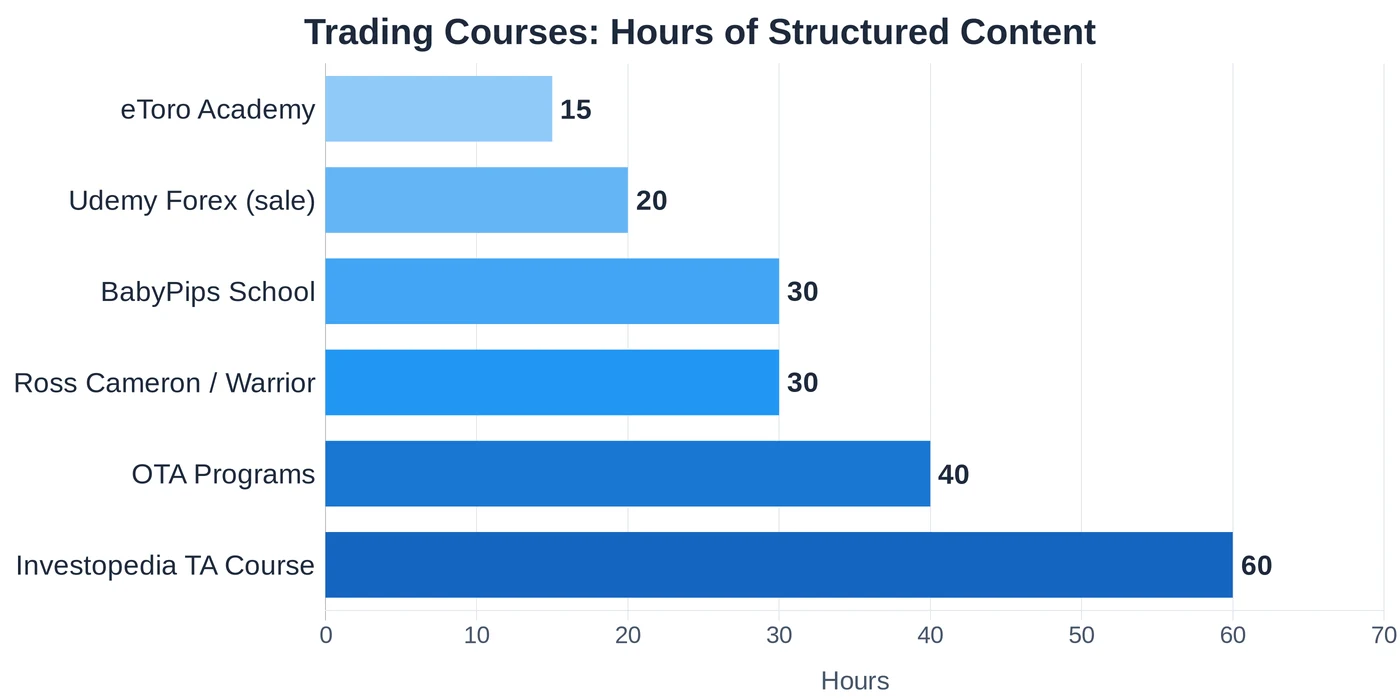
BabyPips School of Pipsology The standard reference for forex beginners. Twenty-eight structured lessons cover pips, lot sizes, leverage, major and minor currency pairs, chart reading, and a solid introduction to technical analysis. Written in plain language, sequenced logically, and free without any paywall or upsell.
The honest limitation: BabyPips stops short of advanced strategy. You will finish knowing the vocabulary and core mechanics, not how to build a systematic edge. That is exactly the right scope for a free course. Use it as your foundation before spending money on anything else. Visit babypips.com to start.
eToro Academy eToro’s free educational platform covers stocks, crypto, and forex basics. Content quality varies by module, but the risk management and portfolio fundamentals sections are genuinely useful. Works well alongside BabyPips if you want crypto covered alongside forex basics.
Investopedia’s Free Articles and Tutorials Investopedia’s free content covers nearly every trading concept in detail. The limitation is that it is a reference library, not a structured course. Use it to look up specific concepts once you have a framework from BabyPips or a paid course. For technical analysis definitions specifically, Investopedia’s technical analysis section is thorough.
TradingView Education Center TradingView offers short educational content integrated directly into the charting platform. The Pine Script basics and indicator explanations are the strongest sections. Best suited to traders who already have core fundamentals and want platform-specific skills.
Best Paid Trading Courses
Investopedia Academy: Technical Analysis ($149) The most structured paid option for beginners. Covers chart patterns, indicators including RSI, MACD, and Bollinger Bands, volume analysis, and risk management across roughly 60 hours of content. Lifetime access and regular updates make the price reasonable for the depth provided.
The chart patterns section is solid, the risk management module covers position sizing correctly, and examples use real market data rather than idealised theoretical charts. It stops short of advanced systematic strategy, which is appropriate for the price point. Good first paid course for traders moving past BabyPips fundamentals.
Udemy: Day Trading by Ross Cameron ($15-30 on sale) Ross Cameron of Warrior Trading runs one of the more honest day trading courses available. He shows losing days alongside winning ones, which is rare in this category. The discipline principles (risk per trade, daily loss limits, trade journaling) transfer directly to forex and crypto regardless of his equity-market focus.
The caveat: the specific setups taught (low-float momentum, gap-and-go) are equity market strategies that do not translate directly to forex or crypto. Take the risk management framework. Adapt the strategy layer yourself for your target market.
Udemy: Complete Forex Courses (various instructors, $15-30 on sale) Udemy regularly discounts trading courses to $15-30. Quality varies significantly by instructor. Filter for: 1,000+ ratings, 4.4 stars minimum, updated within the last 12 months. At this price, the key question is whether the instructor shows real trades or only theoretical chart examples.
Online Trading Academy: multi-day structured programs ($500-2,000+) OTA runs comprehensive multi-day courses online and at physical locations. The curriculum is thorough and the live instruction format provides accountability that video courses cannot. The higher price is the main barrier.
The core supply and demand framework OTA teaches is consistent with how institutional traders actually read markets. From 8 years watching order flow on a trading desk, I can confirm: that part of their teaching is legitimate. The course is worth the cost if you commit to the full program. It is not worth it if you treat it as background video content.
| Course | Cost | Best For | Market Focus |
|---|---|---|---|
| BabyPips School | Free | Forex vocabulary + fundamentals | Forex |
| eToro Academy | Free | Crypto + copy trading basics | Multi |
| TradingView Education | Free | Platform skills + indicator basics | Multi |
| Investopedia Technical Analysis | $149 | Chart patterns + indicators | Multi |
| Udemy Forex Courses (sale) | $15-30 | Forex strategy depth | Forex |
| Ross Cameron / Warrior Trading | $15-30 | Risk management discipline | Equity/Crypto |
| Online Trading Academy | $500-2,000+ | Live instruction + accountability | Forex + Multi |
Putting the Course Into Practice
A course gives you a framework. The actual learning happens on a demo trading account with no real capital at risk. The sequence that works better in practice:
- Complete a structured course. BabyPips for free, Investopedia Technical Analysis if you want to spend $149
- Open a free forex demo account and paper trade for 30 days minimum
- Review your demo results: win rate, average R:R ratio, single biggest mistake pattern
- Deposit real capital only after that review. Start at $150 to experience live execution without catastrophic downside
Where you deposit that first $150 matters as much as the course did. Minimum deposits, spread costs and the quality of the beginner material differ sharply between brokers. Skipping step 2 is how most beginners lose their first deposit in under 60 days. On the desk, we called it “paying tuition twice”: once on the course, once on the market. The simulator prevents the second bill.
For forex beginners, BabyPips followed by 30 days on a demo is the minimum viable preparation. If day trading is your target, add structured paid content focused on discipline and risk management before touching a live account. The market is still there after you prepare properly.
Common Mistakes When Choosing a Trading Course
Assuming price equals quality: this is the single biggest misallocation in trading education. The $15 Udemy course on forex fundamentals often covers identical ground to the $500 branded academy package. Evaluate the curriculum and instructor track record, not the price tag.
Skipping BabyPips because it is free: I have recommended BabyPips to former desk colleagues who needed a structured forex refresher. It is genuinely that good for foundational content. Traders who dismiss it because it costs nothing miss one of the best-sequenced beginner curricula available.
Buying a course before choosing a niche: a day trading course and a swing trading course teach different skills for different timeframes. Know whether you are trading intraday or holding positions overnight before choosing. Risk management principles transfer across niches. The specific setups do not.
Treating a course as an ongoing signal service: a course teaches you to identify setups yourself. It does not tell you what to trade this week. Traders who expect live alerts from an educational product are looking for the wrong thing, and sellers who promise it are selling the wrong thing.
FAQ
What is the best free trading course for beginners?
How long does a trading course take to complete?
Are expensive trading courses worth it?
Can I learn to trade without taking a course?
What should I do after completing a trading course?
How do I know if a trading course covers risk management properly?
Real-time trade setups with entry, stop loss and take profit. Daily market analysis. No subscription, no complicated theory.
🌍 Our recommended brokers


Reader Reviews
Started with BabyPips after wasting six months on YouTube channels with no structure. The difference was immediate: having concepts presented in the right sequence meant I stopped confusing myself with conflicting information. Finished all 28 modules in three weeks, then ran a demo account for 45 days on EUR/USD and GBP/USD. My win rate in demo was 54% with an average R:R of 1.4. Moved to a live account with $200 and have been averaging +7.8% monthly for the past four months. The article is right that the demo stage is where the real learning happens, not the course itself.
Took Investopedia's Technical Analysis course after the BabyPips recommendation in this article. The chart patterns section specifically changed how I read markets. I was pattern-matching without understanding the volume context before. The module on volume confirmation made my entries significantly more selective. Down to about 3-4 trades a week from 12+, but win rate went from 48% to 61% over three months. Running at +8.2% average on GBP/JPY.
The section on what to look for in courses saved me from buying a $400 package that turned out to be mostly entry signals with almost no risk management content. Checked the curriculum sample and found exactly two videos on position sizing out of 40 total. Bought a $22 Udemy course instead with 1,200 ratings at 4.5 stars and got substantially more useful content.
Completed Online Trading Academy's forex program last year. The supply and demand framework they teach is consistent with how I now see large institutional order flow move markets. Worth the premium if you commit fully. I attended every session. My trading shifted from chasing momentum to waiting for defined zones. Three months live, averaging +6.9% monthly on USD/JPY and gold. The article's note about treating it as background video making it not worth the cost is exactly right. You get out what you put in.
Used eToro Academy alongside BabyPips as suggested. The crypto sections added a useful perspective on market cycles I was missing from the forex-only curriculum. One honest limitation: eToro's examples obviously favor their own platform. Still good foundational content, just filter with that in mind.
The 20% risk management benchmark is a genuinely useful filter. Applied it to four courses I was evaluating. Three had one short module on stops, one had six modules covering sizing, daily loss limits, and R:R in detail. Bought the one with six modules. The difference in how I manage drawdowns now versus six months ago is significant. Currently running at +7.3% monthly on BTC and ETH pairs after three months live.
Ross Cameron's course for the risk management framework, BabyPips for forex vocabulary. That combination cost me $22 total and gave me a better foundation than a colleague who spent $800 on a bundled course with weak risk management content. The specific equity strategies from Cameron don't transfer directly but the discipline section does. The article makes this point clearly, take the framework, adapt the setups.
Good overview that covers the honest limitations of each option. The note about TradingView Education being best for traders who already have fundamentals matches my experience. I tried starting there and got lost. Went back to BabyPips, finished that, and then TradingView Pine Script material made immediate sense. Sequence matters more than most course sellers acknowledge.
Leave a Review

Forex Analyst & Senior Trader
Former FX desk trader with 8 years in institutional forex. Works in multi-timeframe analysis and order flow, turning desk experience into systematic, testable rules across forex and metals.