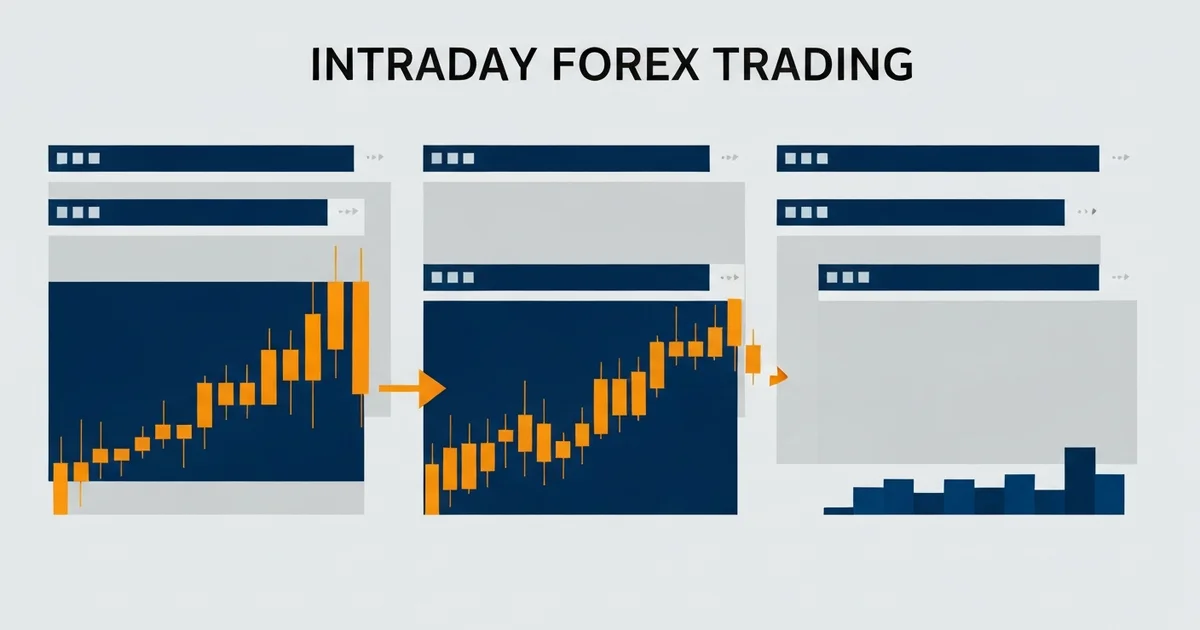

The phrase “intraday trading” is common in India, Vietnam, and Eastern Europe. In the US and UK, traders call the same style day trading. Different label, same mechanics.
I spent 8 years on an FX trading desk before going independent in 2021. Intraday was the default. We opened at the London session and were flat by 5pm every day. Over those years I found which setups hold up under live conditions and which ones only look good in a backtest.
This guide covers how intraday trading works, three strategies with real performance data, and a risk management framework you can apply from day one.
What is intraday trading
The rule is straightforward: every position you open must be closed before the day ends. No overnight holds, no swap fees, no gap risk from news events while you sleep.
In forex, “the day ends” means before the broker’s daily rollover, typically 5pm New York time. Positions held past that point incur a swap charge, and more importantly, price can open significantly higher or lower than where it closed. Intraday traders deliberately cut that exposure.
The tradeoff is time pressure. You can’t wait three days for a setup to develop. The move needs to happen within hours.
Most intraday forex traders focus on one of three session windows:
- London session — 8am to 5pm London time. Highest liquidity for EUR/USD, GBP/USD, EUR/GBP.
- New York session — 8am to 5pm Eastern time. Overlaps with London from 1pm to 5pm London time, the most volatile and most traded window.
- Tokyo session — 12am to 9am London time. Quieter, better suited to JPY pairs like USD/JPY and EUR/JPY.
Each session has its own character. London tends to initiate the day’s directional move. New York either extends it or reverses it. Tokyo is range-bound most days, with occasional sharp spikes on JPY data.
Intraday trading vs day trading
These are the same thing. The terminology differs by region. “Day trading” is standard in the US and UK. “Intraday trading” is the dominant term in India and much of Southeast Asia. The strategies, risk rules, and execution mechanics are identical.
There is one context where “intraday” means something different: financial reporting. When analysts write “the stock reached an intraday high of $150,” they’re describing a price level reached during that session, not a trading style. In forex and CFD markets, that usage doesn’t come up much.
If you’ve already read our day trading guide, everything in it applies directly. This article focuses specifically on the forex application, the session-based approach most forex intraday traders actually use.
How intraday trading works in forex
Forex is open 24 hours on weekdays, but liquidity concentrates in specific windows. The tightest spreads and most reliable setups appear when major sessions overlap. The most active window is the London-New York overlap: 1pm to 5pm London time.
Here’s how a typical intraday day works in practice.
Before the session: Check the daily chart for trend direction and the key level closest to current price. Then check the economic calendar for high-impact releases. On NFP days, ECB decisions, or CPI releases, I either trade with wider stops or stay out. EUR/USD spreads on a tight-spread account run 0.9 to 1.3 pips during the London session. On NFP, they spike to 3 to 5 pips. That spread expansion alone can eat 25% of your risk on a standard 20-pip stop. It has to be factored in before you enter.
Session open: Wait. The first 15 minutes of the London open are almost always noise. Price spikes, reverses, then spikes again as large institutional orders get filled. On the desk, we had a hard rule: no positions in the first 15 minutes. You miss the initial move sometimes. But you avoid far more bad entries than you miss good ones.
Entry: Look for a setup on the 15M or 1H chart that agrees with your daily chart analysis. Enter with a defined stop loss and a target at 1.5x to 2x your risk.
Position sizing: On a small account, I use 0.02 lots per trade on major pairs. That puts about 2% of capital at risk on a 60-pip stop. On an even smaller account, use 0.01 lots. Calculate lot size before entry. Not after.
Exit: Take profit at your target or trail the stop to catch a momentum extension. Close everything before the session ends regardless of trade status. Overnight holds change the entire risk profile.
Three intraday strategies with real results
These are the three setups I’ve traded with real capital. Each has weaknesses I’ll name directly.
London breakout
Price typically consolidates in a 20 to 30 pip range during the late Asian session (5am to 8am London time). At London open, institutional orders push price out of that range. You trade the direction of the breakout.
This strategy was consistently profitable from 2015 to 2022. Then it degraded. Algorithmic systems started front-running the obvious consolidation zones. By 2023, the false breakout rate had roughly doubled compared to earlier years. The setup still triggers, but a wick through the breakout level is no longer sufficient confirmation. You need a candle close outside the range.
With the close-confirmation filter, I’ve measured approximately 52 to 55% win rate on EUR/USD in recent testing. Marginal edge, but it’s real. Without the filter, the strategy is barely better than a coin flip.
New York session momentum continuation
London establishes a directional move by the time New York opens at 1pm London time. The momentum continuation approach joins that direction rather than fading it.
The well-known “9:30am NY reversal” pattern, where London runs stops and NY reverses, gets a lot of attention online. I’ve tested it across multiple months of EUR/USD data. Win rate around 55%, which is not enough edge on its own to trade it with confidence.
The continuation version performs better: trading with London’s established direction into the NY session, when London has moved 40 or more pips by 1pm London time and no major data releases are scheduled for the NY session. In my testing that setup produced approximately 58% win rate. The narrower conditions reduce trade frequency significantly, but the quality improves.
Support and resistance range trading
When there’s no strong directional bias. With mixed data and no dominant session move, price tends to oscillate between clear support and resistance levels. You trade bounces from each level, targeting the opposite side of the range.
The detail that matters: use only levels that have held at least twice on the 4H chart. These represent actual institutional activity, not arbitrary horizontal lines drawn on a chart. For more on identifying valid levels, see our support and resistance guide.
Win rate in my testing: approximately 60 to 62%. The highest of the three setups. The condition that kills it is a range break. A 4H candle close outside the boundaries. When that happens, you exit immediately. Averaging into a broken range is how range-trading accounts get wiped.
Risk management for intraday traders
Intraday risk management starts before you open a single position: set your daily loss limit.
On the desk, we capped daily drawdown at 2% of the book. Hit that number and trading stops for the day. Not because the opportunity is gone. Bad days compound. One loss creates frustration. Frustration creates overtrading. Overtrading creates a much larger loss than the first trade. The daily limit breaks that cycle.
For independent traders, here is the framework I use:
- Risk per trade: 1 to 2% of account capital. On a small account that works out to just a few dollars per trade.
- Daily max loss: 3 to 4% of account. Three consecutive losses and you stop for the day.
- GBP pairs: GBP/USD and GBP/JPY spreads can spike to 8 to 15 pips during volatile sessions. If your planned stop is 15 pips, a spread spike alone can trigger your exit without price actually moving against your thesis. Use wider stops on GBP pairs or reduce position size to compensate.
- Pre-event sessions: EUR/USD behaves differently in the 12 to 24 hours before an ECB decision. Tighter ranges, more false moves. I use smaller position sizes those days or skip entirely.
The practical case for a slightly larger starting account is this: with very small starting capital, your lot sizes are so small (a dollar or two per trade at 1% risk) that even a solid winning streak barely registers in your account balance. With a bit more capital behind you, you’re trading 0.02 to 0.03 lots, meaningful enough to build real feedback on your strategy’s performance. That’s the honest reason for the threshold.
Common intraday trading mistakes
Trading every session regardless of conditions. Monday mornings and Friday afternoons are typically thin with choppy, indecisive price action. Two high-quality setups per week beat ten forced ones.
Ignoring the economic calendar. A technically clean setup run into an NFP release becomes a spread-spike problem, not a trading opportunity. Check FXStreet’s economic calendar before every session.
Moving stops to avoid being hit. When price reaches your stop level, the setup has been invalidated. Moving the stop doesn’t save the trade. It converts a defined small loss into an undefined larger one.
Using timeframes below 15M. I ran 5-minute chart setups on EUR/USD for three months. The signal quality did not justify the complexity and stress. Below 15M, noise dominates signal for most forex pairs. Beginners especially should stay on 15M and 1H until they can read those charts consistently.
Overloading charts with indicators. Three indicators do not produce three times the signal. One clean setup plus one supporting indicator is enough. Every profitable intraday trader I worked alongside over 8 years ran simple systems applied with discipline.
The mental discipline intraday trading demands is often harder than the technical side. Our trading psychology guide covers the specific patterns that cause most traders to self-sabotage once they’ve mastered the mechanics.
FAQ
What is intraday trading in simple terms?
Is intraday trading the same as day trading?
How much money do I need to start intraday forex trading?
What are the best forex pairs for intraday trading?
Which timeframe is best for intraday trading?
Can I do intraday trading part-time?
Is intraday trading profitable for beginners?
Real-time trade setups with entry, stop loss and take profit. Daily market analysis. No subscription, no complicated theory.
🌍 Our recommended brokers


Reader Reviews
The close-confirmation filter for the London breakout was the one detail I had been missing for two years of trading that setup. My previous approach was to trade any wick through the consolidation range, and the false breakout rate was running close to 50%. Switching to a candle close outside the range dropped that to around 30% over a three-month test on EUR/USD. The explanation of algo front-running causing the strategy to degrade since 2023 also made sense of what I had been seeing - entries that worked cleanly in 2021 started producing far more noise, and now I understand the structural reason.
The two-touch rule for support and resistance on the 4H chart is what separates range trading from drawing random lines. I had been using levels that looked significant on the 1H but had no history on the 4H, and the false bounce rate reflected that. Adding the requirement that a level must hold twice on the 4H before I trade it cleaned up most of the bad entries - and the warning about range breaks being immediate exits is the rule I wish I had followed three months ago.
The daily loss limit framing landed differently than I expected. The sequence described - one loss, frustration, overtrading, a much larger loss - is the exact pattern that had been destroying my good weeks. Setting a 3% daily cap and stopping when I hit it once saved what would have been a bad Friday afternoon.
The rule about waiting out the first 15 minutes of the London open was something I dismissed as too conservative, then came back to after two bad Monday entries that happened exactly in that window. The pattern described - price spikes, reverses, spikes again as large institutional orders fill - is precisely what I had been trying to trade as a directional move. Applying the no-position-in-first-15-minutes rule has cut out roughly two to three bad entries per week since I started following it. The session character breakdown also changed how I read the same chart at different times - EUR/USD during the London-NY overlap behaves in a noticeably different way than the same pair during the Tokyo session.
The specific conditions for the New York momentum continuation are what made this article useful. I had been trading every London-to-NY handoff regardless of how much London had already moved, which I now understand dilutes the edge significantly. The 40-pip threshold combined with the no-major-data filter narrows setup frequency, but the quality improvement is real - my win rate over the past three weeks tracks closer to the 58% described than anything I had previously tested.
The position size examples at $150 and $600 made the 1-2% risk rule concrete in a way that most guides skip over. On $150 a 1% risk trade is $1.50, which only works with micro lots - and seeing that number helps explain why $600 is the honest minimum for building real feedback. The practical reasoning behind the account size threshold is the kind of detail that is usually left out.
Most intraday guides give you the theory and leave the mechanics vague. The specific numbers in this article - win rates with the conditions attached, lot sizes by account size, and spread expectations during NFP versus normal sessions - made it applicable immediately without a second research pass. The GBP pairs section covering spread spikes up to 15 pips is broker mechanics detail that does not appear in most strategy write-ups, and it is exactly the kind of thing that quietly erodes small accounts when traders do not account for it in their stop sizing.
I work a nine-to-five and was skeptical intraday trading was even possible around a full schedule. The section on the first 90 minutes of the London session consistently producing the clearest setups for EUR/USD changed that view. I set price alerts the evening before, check in at London open, trade for 90 minutes if a setup is there, and close before 9:30am regardless of trade status. In the three months since adopting this routine I cut trade frequency by more than half and average session P/L improved, mainly because forced trades in the afternoon went away entirely.
Leave a Review

Forex Analyst & Senior Trader
Former FX desk trader with 8 years in institutional forex. Works in multi-timeframe analysis and order flow, turning desk experience into systematic, testable rules across forex and metals.