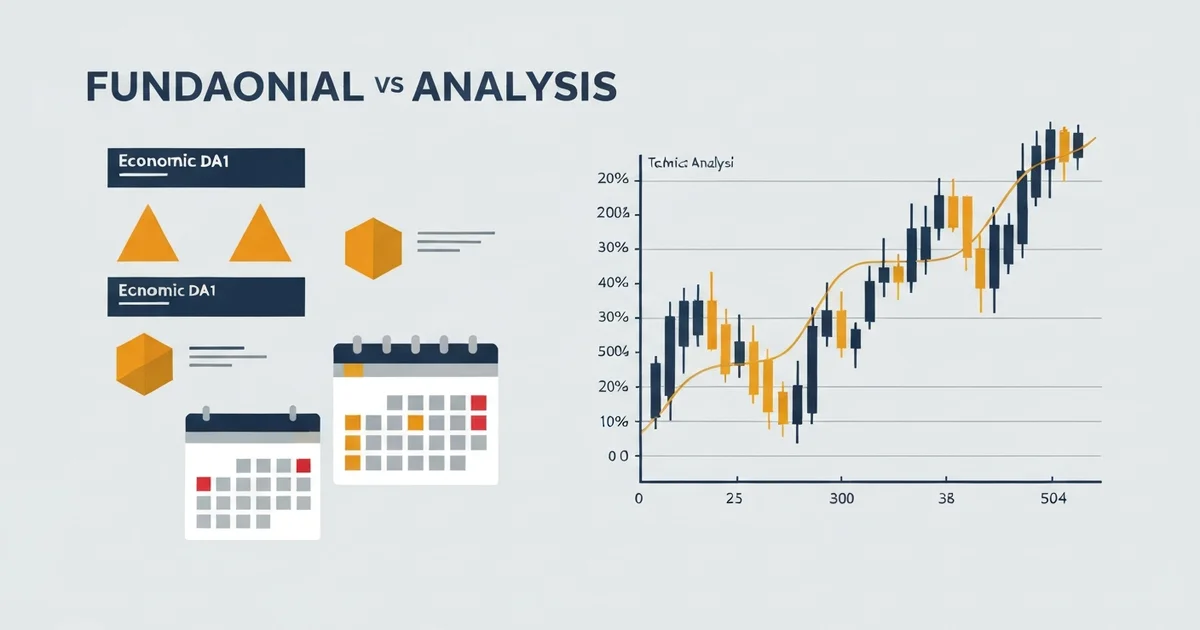

Why This Question Gets Traders Into Trouble
Eight years on an FX trading desk taught me one thing about the fundamentals vs technicals debate: it’s mostly a beginner’s problem. Retail forums treat it as religion. On the desk, we barely discussed it. Fundamentals set the bias. Technicals told us when to pull the trigger.
I’ve watched traders blow accounts by going “fundamental-only”: right direction, wrong entry, stopped out before the move actually started. I’ve also seen pure technical traders get destroyed on rate decision days when clean chart setups got wiped out in seconds by a surprise policy shift. Neither approach alone is complete. Here’s what each one actually does, and how they fit together.
What Is Technical Analysis
Technical analysis is the study of price charts to forecast where price is likely to go next. The core assumption: all known information is already priced in, so reading the chart means reading collective market behavior.
The main tools:
- Chart patterns: formations like head and shoulders, double tops, and triangles that suggest continuation or reversal
- Indicators: MACD, RSI, Bollinger Bands, and moving averages that derive signals from price and volume data
- Support and resistance levels: price zones where buying or selling pressure has historically concentrated
- Price action: raw candlestick behavior without indicators, reading what buyers and sellers are doing in real time
Technical analysis works across any liquid market and any timeframe. On the desk, our technical traders ran the same framework on EUR/USD 5-minute charts and weekly charts simultaneously. The edge comes from confluence across timeframes, not from any single signal.
I ran a EUR/USD trend-following strategy on the daily chart using moving averages combined with COT positioning data. Win rate: 68% over four years. But that number required both inputs: the technical setup filtered entries, and the fundamental bias determined which direction to trade.
One honest observation worth making: technical analysis is backward-looking by design. A pattern tells you what has happened. It gives a probabilistic lean on what might happen next. Anyone selling you a pattern that “always works” is ignoring the base rate.
What Is Fundamental Analysis
Fundamental analysis focuses on the why behind price movement. For forex, that means interest rate differentials, central bank policy, inflation data, employment figures, and geopolitical risk. For crypto, it’s network adoption, tokenomics, on-chain flows, and macro risk sentiment.
The core drivers for forex fundamentals:
- Interest rate decisions: higher rates attract capital inflows, strengthening a currency relative to lower-yielding alternatives
- Economic data releases: NFP, CPI, and GDP revisions move price immediately and shape medium-term trends
- Central bank forward guidance: what the Fed or ECB says about future policy often matters more than the rate change itself
- Risk sentiment: broad risk-on and risk-off flows move correlated pairs and commodities in the same direction simultaneously
On the desk, we tracked economic calendars obsessively. I never held a position going into an NFP release without knowing the consensus and how the previous month’s figure was revised. EUR/USD behaves differently in the week before an ECB meeting than in the post-decision drift period. That distinction alone kept us off the wrong side of institutional repositioning more times than I can count.
The weakness of pure fundamental analysis: timing. A fundamental trader might correctly identify that a currency is 10% overvalued based on rate differentials. That currency can stay overvalued for three months. Being right but early costs as much as being wrong.
How They Compare
| Technical Analysis | Fundamental Analysis | |
|---|---|---|
| Time horizon | Minutes to weeks | Days to months |
| Primary data | Price, volume, chart patterns | Economic data, policy, earnings |
| Entry timing | Precise, to the candle | Approximate |
| Best for | Intraday, swing, prop traders | Macro positioning, long-term plays |
| Main risk | Noise and false signals in ranging markets | Being right too early |
| Learning curve | Medium: core patterns learnable in weeks | High: macro context takes years |
| Works alone? | Partially | Rarely in practice |
Retail traders default to technical analysis because charts are visual and free. Economic data interpretation requires years of context. That’s not a knock on technicals. It’s a practical observation about where most people start and what they can apply immediately.
How to Combine Both Approaches
The professional approach is top-down: start with fundamentals to define directional bias, then use technicals to time entries and manage risk. Here’s how I apply it to EUR/USD week-to-week.
Step 1: Set the fundamental bias. Before the week starts, I check the interest rate differential between the Fed and ECB, any recent data surprises, and the CFTC’s Commitment of Traders report to see if institutional positioning is shifting. This tells me whether to look for long or short setups during the week.
Step 2: Find the technical trigger. With a directional bias established, I move to the daily chart, then the 4H, looking for a valid entry point: a pullback to support in a trend, a breakout retest, or a clean momentum divergence signal. The technical setup provides the entry. The fundamental thesis provides the reason to hold.
Step 3: Respect the economic calendar. Stop placement needs wider buffers around major releases. On a $600 account, a 0.02 lot EUR/USD position can get stopped out by a single NFP spike even when your macro thesis is correct. I always check what’s releasing in the next 24-48 hours before setting stops.
This structure means direction calls are more consistent (fundamentals working at the macro level) while entries avoid the noise that pure fundamentals miss. I ran this combined approach across four years of EUR/USD daily data and found the win rate on trend-following setups improved significantly once I added COT positioning as a filter, roughly 12 percentage points better than technicals alone on the same dataset.
Common Mistakes to Avoid
Using technicals to override strong fundamentals. If the Fed just delivered an unexpected rate hike and the dollar is rallying across the board, an RSI divergence on a 15-minute chart is not a short signal. At the macro level, fundamentals beat technicals. Save the counter-trend setups for low-volatility sessions.
Treating economic data as instant trading signals. Most retail traders try to buy or sell the moment a number prints. The actual move often goes against the obvious direction. Buy the rumor, sell the fact is real. Fundamentals shape the trend over days and weeks; they’re not designed to be scalping triggers.
Indicator overload. I’ve seen traders stack MACD, RSI, Stochastic, Bollinger Bands, and two moving averages on the same chart. Every one of those indicators derives from the same underlying price data. Adding five indicators doesn’t add five sources of information. On the desk, we used price structure and one trend reference. That’s it.
Ignoring positioning data entirely. COT reports, broker sentiment dashboards, and retail positioning data show where the crowd is leaning. Knowing that 80% of retail traders are long a pair right before a reversal is more actionable than most technical setups. Sentiment data is a fundamental input that most technical-only traders overlook completely.
FAQ
Which is better for beginners: fundamental or technical analysis?
Can you be profitable using only technical analysis?
Do professional traders use technical analysis?
What is COT data and how do traders use it?
Does fundamental analysis work for crypto trading?
How long does it take to learn technical analysis well?
Real-time trade setups with entry, stop loss and take profit. Daily market analysis. No subscription, no complicated theory.
🌍 Our recommended brokers


Reader Reviews
I had been burned on NFP trades three months in a row before I found this article. The issue was treating an RSI divergence on the 15-minute chart as a short signal the morning of the release, which is exactly what the article identifies as a common mistake. Fundamentals beat technicals at the macro level, and a central bank surprise will erase a clean chart setup in seconds - I know that from four specific experiences now. The fix is simple to explain and hard to follow: check what is printing in the next 48 hours before any entry, widen stops if you must hold through a release, or just close the position and reenter after the dust settles.
The framing that choosing between fundamentals and technicals is a retail problem - not a professional one - is worth the read alone. I sent this to two traders in my group who had been arguing about which approach was better for months. Both of them stopped arguing.
The indicator overload section named something I had been doing wrong for a year without realizing it. Five indicators on a chart, all derived from the same price data, and I thought each one was adding independent confirmation. Cutting down to price structure and one momentum reference immediately reduced the number of conflicting signals I was trying to resolve on every trade.
Three years of pure technical trading on EUR/USD, decent results in trends but wiped out repeatedly on data releases. The calendar buffer - no open positions 30 minutes either side of major prints - solved more of my drawdown problem than any indicator change I had made. COT positioning took longer to apply; once I understood how to read institutional non-commercial lean, I stopped fading strong trends just because RSI was extended at 70. Win rate went from 49% to 58% over the following 20 weeks, and the change was the filter, not the entry model.
The EUR/USD win rate number - 68% over four years with both COT and technical filters - is the most credible benchmark I have seen in a trading article. Most sites quote numbers without explaining the methodology. Having both inputs described makes the result believable.
COT data had been on my list for two years. This is the first explanation that was clear enough to actually act on. I ran the institutional positioning data against my EUR/USD trades from last quarter and found that eight of my eleven losses came when I was trading against the dominant institutional lean. Not a magic filter, but enough to change how I size positions on conflicted setups.
The timing weakness of fundamental analysis is something I had read about abstractly before, but the framing here made it concrete. Being right on a direction call for three months while the position bleeds is not theoretical - I sat through exactly that on a GBP/USD short last year that I was holding on rate differential grounds. The article does not pretend this is easy to fix, which is the right call. The solution - using technicals to time an entry into a confirmed fundamental thesis rather than entering on the thesis alone - is both obvious in hindsight and something I had not applied systematically before.
The section on crypto fundamentals is the most honest take on the topic I have read. The admission that forex fundamental skills do not transfer directly to crypto - and explaining why through on-chain metrics and sentiment dominance - saved me from applying the wrong framework to BTC trades. I had been treating rate sentiment as a driver for crypto the same way I do for EUR/USD, which is exactly wrong.
Leave a Review

Forex Analyst & Senior Trader
Former FX desk trader with 8 years in institutional forex. Works in multi-timeframe analysis and order flow, turning desk experience into systematic, testable rules across forex and metals.