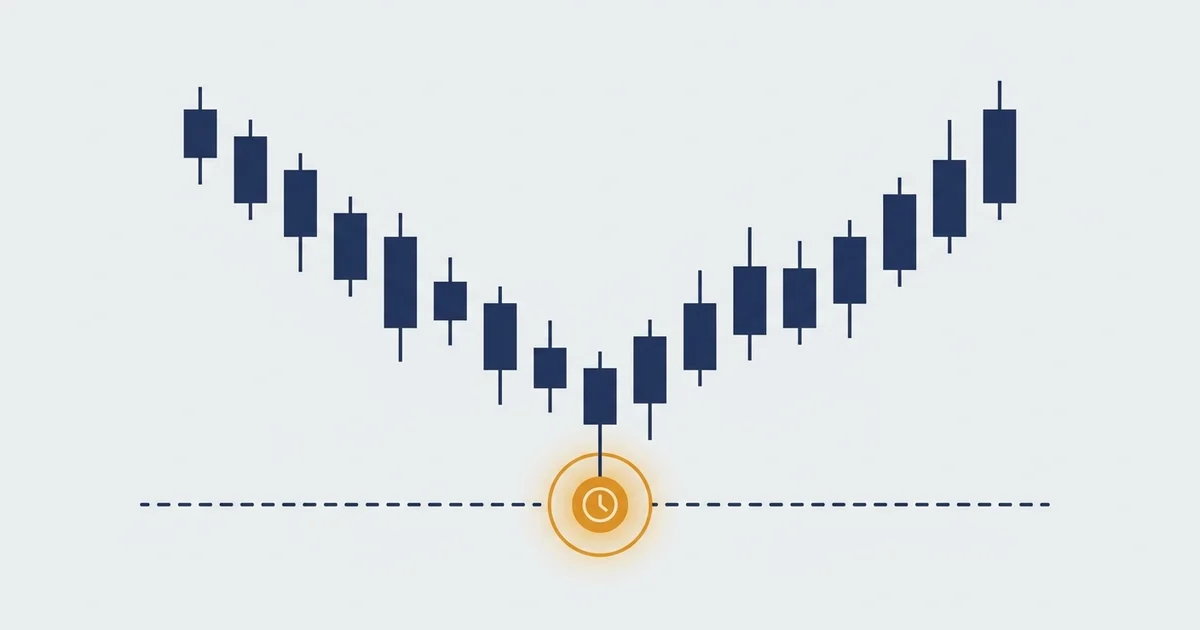

What is a limit order?
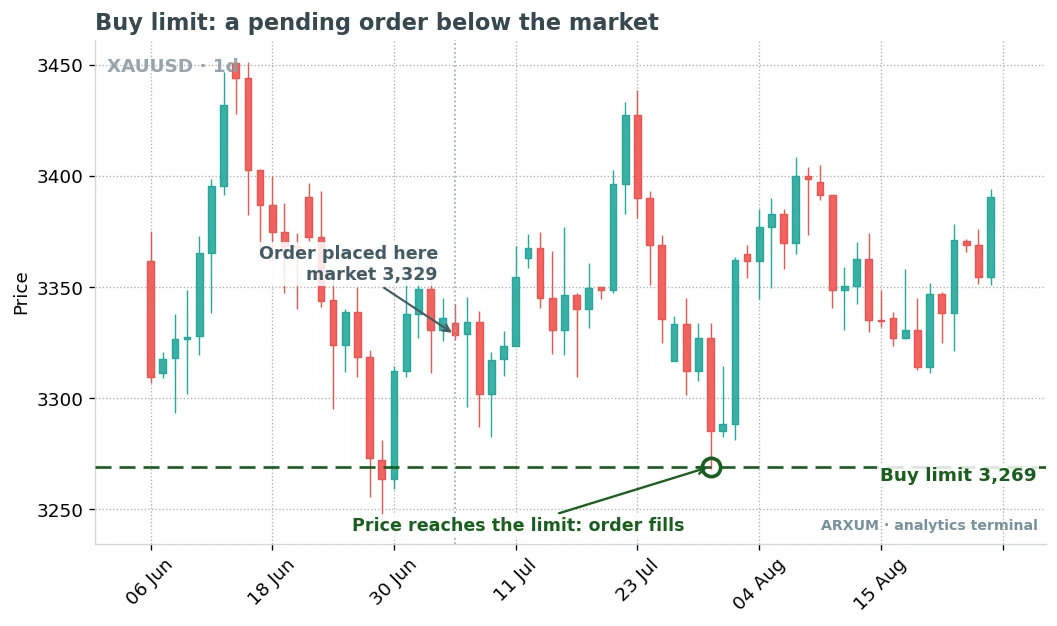
It names your price and parks there until the market reaches it. Here is a buy limit on a daily gold chart, from the moment it was placed to the moment it filled.
Read the chart left to right:
- The market price. Gold trades around 3,329 when the order goes in (the grey “Order placed here” tag).
- The limit price. The green dashed line at 3,269 is the price the trader is willing to pay, about $60 below the market.
- The wait. For weeks, price swings around but never reaches the line. The order just sits there, unfilled and costing nothing.
- The fill. The green circle marks the candle whose low finally reaches 3,269. That is where the buy executes.
- What happened next. Gold bounces back toward 3,400. That is one illustrative case, picked to show the mechanics, not a promise.
The one-line rule: a buy limit sits below the market, a sell limit sits above it. You always ask for a better price than the one on screen right now.
| Order | Sits | Fills when | Typical use |
|---|---|---|---|
| Buy limit | Below market | Price falls to it | Buy a dip |
| Sell limit | Above market | Price rises to it | Sell a rally |
How a limit order works, step by step
Under the hood, it is a pending order. Your broker or the exchange holds it and only executes it once the price condition is met.
- You pick a direction (buy or sell) and a price.
- The platform checks the price is on the correct side. A buy limit above the current price is either rejected (MT4/MT5) or fills at once (most exchanges).
- The order waits in the book or on the broker’s server. You can move it or cancel it for free while it waits.
- Price reaches your level. The order fills at your price, or at a better one if price jumps past it.
- The pending order becomes an open position, with whatever stop-loss and take-profit you attached.
The two guarantees, side by side:
| Promised | Not promised |
|---|---|
| Your price or better | That it fills at all |
| No negative slippage | A full fill on big size |
| Free to cancel while waiting | That price keeps going your way |
Rule of thumb: a market order trades price for certainty, and a limit order trades certainty for price.
The bid/ask detail that catches beginners
Every market has two prices: the bid (what you sell at) and the ask (what you buy at). The gap between them is the spread, and MT4/MT5 charts plot the bid by default.
- A sell limit fills on the bid. If the chart’s candle touches your line, the order fills.
- A buy limit fills on the ask. The bid candle has to fall a spread below your line before the ask reaches it.
- The result. A buy limit can show a “touched” candle and still sit unfilled, by a pip or two.
- The same applies to a short’s take-profit, which is also a buy order.
On a tight pair like EUR/USD the gap is tiny. On gold, during news or overnight, it can be wide enough to matter.
Limit order vs market order
This is the comparison most people search for, and the answer is a trade-off, not a winner.
| Feature | Market order | Limit order |
|---|---|---|
| Fill | Instant, near certain | Only at your price |
| Price | Whatever is on offer | Yours or better |
| Slippage | Possible | None against you |
| Spread | You pay it | Still in the price |
| Crypto fees | Taker rate | Often lower maker rate |
| Main risk | Bad fill in fast markets | Missing the move |
When each one makes sense:
- Use a market order when getting in matters more than the exact price. A breakout already running, or an urgent exit.
- Use a limit when you have a level and the patience to wait for it. A pullback, a range edge, a profit target.
- Use a limit in thin markets. Overnight crypto or a minor pair can fill a market order well away from the quote, which is slippage in action.
- Skip the limit when a missed trade would hurt more than a slightly worse price.
Rule of thumb: if you would be annoyed to miss it, use a market order. If you would be annoyed to overpay, use a limit.
Limit order vs stop order: which side of the market
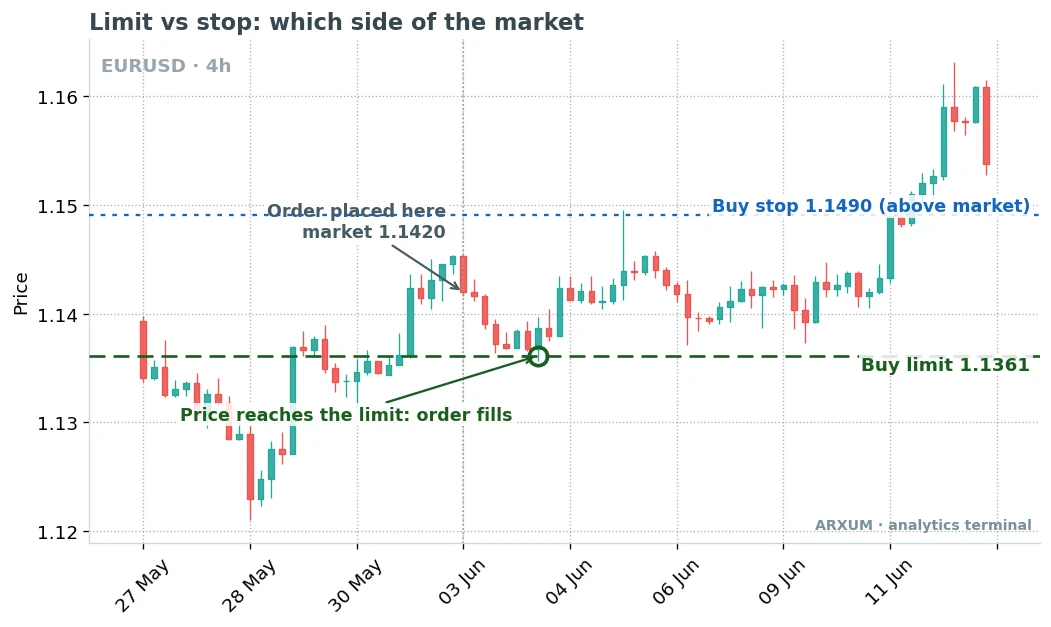
The two pending orders sit on opposite sides of price and do opposite jobs. This 4-hour EUR/USD chart shows both from the same starting point.
What the two lines are telling you:
- The buy limit (green) says “I’ll buy, but only cheaper.” It filled on the dip toward 1.1361.
- The buy stop (blue) says “I’ll buy, but only once price proves strength.” It sits above the market for a breakout.
- A single long upper wick pokes up to roughly the blue line days before the real breakout. A stop order would have triggered on that wick, then sat in a loss while price fell back.
- The real breakout comes later, when candles push through 1.15 and keep going.
| Order | Sits | Logic |
|---|---|---|
| Buy limit | Below price | Buy cheaper |
| Sell limit | Above price | Sell higher |
| Buy stop | Above price | Buy strength |
| Sell stop | Below price | Sell weakness |
| Stop-loss | Against your trade | Cap the loss |
A stop-limit order combines the two: a stop price that wakes the order up, and a limit price that caps what you pay. It is covered in full in the guide to market, limit and stop-limit orders, along with OCO brackets.
Method 1: the pullback limit (buy dips, sell rallies)
This is the read the gold chart at the top of the page shows. You mark a level where buyers stepped in before, and you leave a buy limit there instead of chasing price.
Where to put the limit:
- A prior swing low or high. The cleanest choice, visible on any timeframe.
- A support or resistance zone that has held at least twice.
- A round number. 1.1300 on EUR/USD, a whole fifty or hundred on gold.
- A retracement level. The 50% or 61.8% pullback of the last leg; the Fibonacci guide shows how to draw them.
- A moving average the trend respects, such as the 50-period EMA (an average that weights recent candles more).
| Role | How you use it | Best read |
|---|---|---|
| Entry trigger | Buy limit at support | D1 gold, H4 EUR/USD |
| Trend read | Only buy dips in an uptrend | D1, W1 |
| Price filter | No fill, no trade | All markets |
| Stop anchor | Stop under the level | Any timeframe |
| Short side | Sell limit at resistance | Downtrends only |
The trade-offs to accept up front:
- Missed trades. Price often turns a few pips before your line. That is the cost of insisting on your price.
- Falling knives. A buy limit fills exactly when price is falling hardest. If the level breaks, you are long into a drop, so the stop goes in with the order.
- Trend dependence. Buying dips works when the bigger trend is up. In a downtrend, the same limit just catches the next leg lower.
Rule of thumb: place the limit at the level, and the stop just past the level. If the level breaks, you wanted out anyway.
Method 2: the range-edge limit (fade the edges)
In a sideways market, price bounces between a floor and a ceiling. A sell limit at the ceiling and a buy limit at the floor let you trade both edges without staring at the screen.
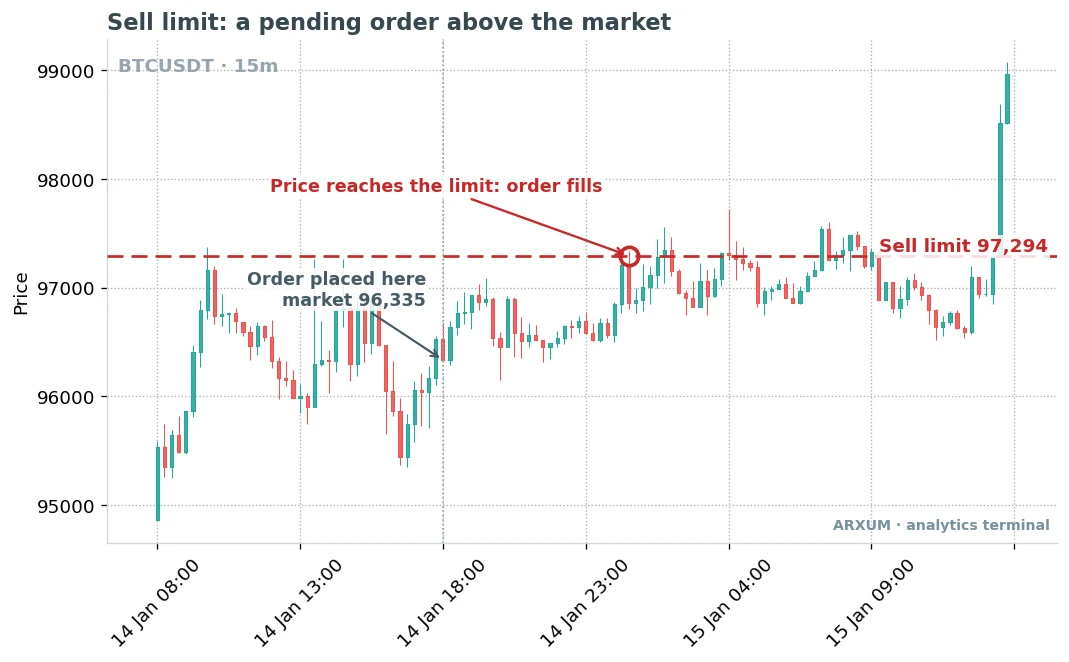
Here is a sell limit on a 15-minute Bitcoin chart, waiting above the market near the top of the recent range.
What the chart shows:
- The order goes in during a dip, near 96,335 (the grey tag and dotted line).
- The rally lifts price back to the area of the earlier high, and the sell limit fills there (red circle).
- For a while price stalls right around the line, which is what a range-edge seller wants.
- Then, at the right edge, Bitcoin rips through 98,000 toward 99,000. A range trade without a stop above the ceiling would be in real trouble.
That last point is the whole lesson of fading edges. Ranges end, usually without warning, so the stop above the ceiling is part of the order.
| Instrument | Best timeframe | Edge to use |
|---|---|---|
| EUR/USD | H1, H4 | Asian-session range |
| GBP/USD | H4 | Prior day high/low |
| Gold (XAU/USD) | H1, H4 | Round numbers |
| Bitcoin (BTC) | M15, H1 | Round thousands |
| Silver (XAG/USD) | H4 | Prior swing highs |
Why crypto traders like this method in particular:
- Maker fees. On most crypto exchanges a resting limit “makes” liquidity and pays a lower fee than a market order, which “takes” it.
- Post-only. Many exchanges offer a post-only option that cancels the order if it would fill instantly as a taker.
- 24/7 markets. A resting limit trades your level while you sleep.
Rule of thumb: fade edges only while the range is clearly sideways. Two closes outside it, and the range is over.
Method 3: the limit order as your exit
Most traders use limits every day without thinking of it. A take-profit attached to a trade is a limit order: a sell limit above a long, or a buy limit below a short.
| Exit type | How it works | Best read |
|---|---|---|
| Fixed take-profit | Limit at 1:2 reward | Any timeframe |
| Level target | Limit just before resistance | D1, H4 |
| Scale-out | Two or three limits, stepped | H4 gold, BTC |
| Range exit | Limit at opposite edge | H1, H4 |
Practical habits that make limit exits work better:
- Set the target a little before the level, not on it. Price often stalls a few pips short of an obvious round number.
- For a long, remember the take-profit is a sell order, so it fills on the bid you see on the chart.
- For a short, the take-profit is a buy order, so it needs the ask to reach it. Leave a spread of room.
- Scale out in pieces. Two or three limits at rising targets take some profit early and leave the rest to run.
- Pair every limit exit with a stop-loss. The limit caps your profit, and the stop caps your loss.
A reward-to-risk of 1:2 means you aim to make two units for each unit you risk. The risk/reward guide explains how to set it.
Rule of thumb: the entry is a guess, the exit is a plan. A take-profit limit turns the plan into an order.
Which limit method to use when
Each method fits a different market state. Match the order to the market, not the other way around.
| Market state | Use | Timeframe |
|---|---|---|
| Clear uptrend | Method 1 buy limits | D1, H4 |
| Clear downtrend | Method 1 sell limits | D1, H4 |
| Sideways range | Method 2 | H1, M15 |
| Breakout running | Market or stop order | Any |
| In a trade | Method 3 | Any |
| News due soon | Cancel resting limits | All |
Limit orders across markets and timeframes
The mechanics are identical everywhere. What changes is how often price reaches your level and how much a near-miss costs.
| Market | Quirk to know | Watch out for |
|---|---|---|
| EUR/USD | Tight spread | Few-pip misses |
| GBP/USD | Spiky wicks | Fills, then reversal |
| Gold (XAU/USD) | Wider spread | Buy limits a spread short |
| Silver (XAG/USD) | Thinner market | Spread widens off-hours |
| Oil (WTI) | Inventory-day spikes | Limits hit on a wick |
| Bitcoin (BTC) | Trades 24/7 | Weekend gaps in liquidity |
| Timeframe | Fill frequency | Best use |
|---|---|---|
| W1, D1 | Rare, days of waiting | Pullbacks to big levels |
| H4 | Moderate | Swing entries, exits |
| H1 | Frequent | Range edges, intraday |
| M15 and lower | Very frequent | Scalps, crypto ranges |
On the fastest charts, limits are the default tool of many short-term traders because the spread is a big share of each trade. The scalping guide covers that world.
Order duration: how long a limit stays alive
Every pending order carries an expiry setting. Forgetting about it is how old orders fill at the worst possible moment.
| Setting | Order lives until | Where you see it |
|---|---|---|
| GTC | You cancel it | Most platforms |
| Day / Today | End of the session | MT5, stock brokers |
| Specified | A date and time you set | MT4, MT5 |
| IOC | Fills now or cancels the rest | Exchanges, MT5 |
| FOK | Fills in full now, or cancels | Exchanges, MT5 |
GTC stands for good till cancelled, IOC for immediate or cancel, and FOK for fill or kill.
For a swing limit, set a specified expiry, such as the end of the week. A forgotten order then cannot fill a month later in a different market.
How to place a limit order, step by step
If you want to use a limit in your own trading, here is the full sequence. The numbers below are an example to show the arithmetic, not a result.
On MT4/MT5:
- Right-click the chart, choose Trading, then New Order (or press F9).
- Set the type to Pending Order, then Buy Limit or Sell Limit.
- Type the limit price, the stop-loss and the take-profit.
- Set the expiry, then click Place.
On TradingView (with a connected broker):
- Open the order panel and choose the Limit tab.
- Enter the price, the size, and tick the Take Profit and Stop Loss boxes.
- Choose Buy or Sell; the order appears as a line you can drag on the chart.
A worked example, using the buy limit from the EUR/USD 4-hour chart and a $1,000 account. Why 2%: a run of losses at that size leaves most of the account intact.
| Step | Value |
|---|---|
| Buy limit entry | 1.1361 |
| Stop-loss (below the dip) | 1.1331 |
| Stop distance | 30 pips |
| Risk budget (2%) | $20 |
| Take-profit (1:2) | 1.1421 |
The division, one line at a time:
- One micro lot (0.01) on EUR/USD is worth about $0.10 per pip.
- Risk per micro lot: 30 pips × $0.10 = $3.00.
- Lots you can hold: $20 ÷ $3.00 = 6.67, rounded down to 6 micro lots (0.06).
- Real risk at 0.06: 30 × $0.60 = $18, just under the 2% budget.
- The target is 60 pips away (2 × 30), worth about $36 if it fills.
On leverage: 0.06 lots is 6,000 euros, roughly $6,800 of exposure, so about 1:7 on a $1,000 account. Your broker’s 1:100 leverage only sets the deposit (margin) needed to open that size; the 2% stop already caps the risk.
The same idea on gold, with the buy limit from the daily chart at the top:
- Entry 3,269, stop $15 lower at 3,254.
- At most brokers the smallest gold lot (0.01) is one ounce, worth $1 for each $1 gold moves.
- Risk at 0.01 lots: $15 × 1 = $15, inside the $20 budget. A 0.02 lot would risk $30, which is over it.
- A daily gold stop much wider than $20 cannot fit 2% on a $1,000 account at all. In that case, use EUR/USD or a 4-hour gold chart with a tighter stop.
The position sizing guide runs the same calculation for other pairs and metals.
Risk and discipline with limit orders
The order controls your entry price. It does nothing about what price does after the fill, so the discipline sits around the order.
- Attach the stop when you place the limit. A pending order with no stop can fill into a fast drop while you are away.
- Keep risk at 2% per trade. A missed fill costs nothing, but a filled trade that breaks the level costs exactly what you sized it for.
- Pause after 3 to 6 stopped-out limits in a row. A streak like that usually means levels are breaking, so the market may be trending through them. Step back and recheck the trend.
- Don’t chase a missed fill. If price turned two pips early, the trade is gone. Moving the limit up after the fact turns a plan into a market order at a worse price.
- Don’t widen the stop after the fill. The level either holds or it doesn’t.
- Only trade money you can afford to lose. No order type changes that.
The stop-loss guide covers where to put the stop relative to the level.
Common limit order mistakes
- Wrong side of the market. A buy limit above price is rejected in MT4/MT5, and fills instantly on many exchanges.
- Mixing up limit and stop. Buy limit below, buy stop above. Swap them and the order does the opposite job.
- Forgetting the spread. A buy limit or a short’s take-profit needs the ask, not the chart’s bid, to reach it.
- Leaving orders over news. A rate decision can spike straight through your level and keep going.
- No expiry. A forgotten GTC order fills weeks later in a market you no longer follow.
- Limit too tight to price. Most brokers have a minimum distance (the stop level) and reject orders inside it.
- Using a limit for a breakout. A limit waits for a pullback, so a breakout runs away without you. That is a stop order’s job.
- Expecting a full fill on big size. On exchanges, large limits can partially fill and leave the rest resting.
What works: the short version
- Right side, right job. Buy limits below price, sell limits above. Breakouts use stop orders instead.
- Level first. Put the limit at a support, resistance or range edge you can defend, like the gold dip at the top.
- Stop with the order. Every limit goes in with its stop and target attached.
- Limit exits. Use take-profit limits, and scale out in pieces when the move is strong.
- Fixed risk. Size so the stop costs 2%, and use EUR/USD micro lots if gold’s stop is too wide.
Glossary
- Limit order: an order to buy or sell at a set price or better.
- Pending order: any order that waits for a price before executing.
- Bid / ask: the price you can sell at / the price you can buy at.
- Spread: the gap between bid and ask.
- Slippage: a fill at a worse price than you expected.
- Maker / taker: a resting order that adds liquidity / an order that fills instantly against it.
- Stop order: a pending order that triggers once price moves through it.
- Stop-limit order: a stop trigger plus a limit price cap.
- GTC: good till cancelled, an order that stays until you remove it.
- Micro lot: 0.01 of a standard lot; on EUR/USD about $0.10 per pip.
- Risk/reward 1:2: you risk one unit to aim for two.
FAQ
What is a limit order, in plain terms?
A limit order is an instruction to buy or sell only at a price you choose, or better. A buy limit sits below the current price and a sell limit sits above it. The order waits until the market comes to your price and fills there. If price never reaches it, nothing happens and it costs you nothing.
What is the difference between a market order and a limit order?
A market order fills right away at whatever price is on offer, so it almost always executes but can suffer slippage in fast or thin markets. A limit order fills only at your price or better, so you control the price but may miss the trade if the market never gets there. Use a market order when getting in matters most, and a limit when the price matters most.
What is the difference between a stop order and a limit order?
They sit on opposite sides of price. A buy limit waits below the market to buy cheaper, while a buy stop waits above it to buy only once price breaks higher. A sell limit waits above the market and a sell stop waits below it. Limits ask for a better price; stops ask for confirmation that price is moving.
Does a limit order always fill?
No. It fills only if price reaches your level, and a buy limit needs the ask price to get there, which on a bid chart means the candle has to dip about a spread below your line. On exchanges, big orders can also fill only partly.
Can a limit order fill at a better price?
Yes. If price gaps past your level, for example over a weekend, a buy limit can fill below your price and a sell limit above it.
Is a take-profit a limit order?
Yes. On a buy trade the take-profit is a sell limit above the market, and on a sell trade it is a buy limit below it. That is why a short's take-profit sometimes stays unfilled when the chart candle touches it: it needs the ask, which sits a spread above the bid the chart shows.
When should I use a limit order instead of a market order?
Use a limit when you have a clear level and can wait: buying a pullback to support, selling into resistance, fading a range edge, or taking profit at a target. Also use one in thin markets, like crypto overnight, where a market order can fill far from the quote. Skip it for breakouts and urgent exits.
How much money do I need to trade with limit orders?
Any amount your broker accepts, since the order type does not change the minimum. What matters is sizing: on EUR/USD, a $1,000 account can risk 2% with a 30-pip stop at 0.06 lots. On gold the smallest lot is one ounce, so a stop wider than about $20 already breaks 2% on that account.
Do limit orders have lower fees in crypto?
Usually. On most crypto exchanges a resting limit order counts as a maker order and pays a lower fee than a market order, which counts as a taker. A post-only setting makes sure the order never fills instantly as a taker.
What do the terms on the limit order charts mean?
The dashed line is the limit price: green for a buy limit, red for a sell limit. The dotted vertical line and the grey tag mark when the order was placed and the market price at that moment. The circle marks the candle where price reached the line and the order filled. The blue dotted line on the EUR/USD chart is a buy stop, which waits above the market instead of below it.
Real-time trade setups with entry, stop loss and take profit. Daily market analysis. No subscription, no complicated theory.
🌍 Our recommended brokers


Reader Reviews
Be the first to review this — tell other traders what actually helped, or where it fell short.
Leave a Review

Forex Analyst & Senior Trader
Former FX desk trader with 8 years in institutional forex. Works in multi-timeframe analysis and order flow, turning desk experience into systematic, testable rules across forex and metals.